
On 25 August 1835, in New York, the newspaper The Sun began a six-part series saying the astronomer John Herschel had seen forests, animals and winged humans on the Moon. Readers were told it came straight from a new telescope in South Africa.
Herschel had seen none of it. He was at the Cape of Good Hope in South Africa, cataloguing stars of the southern sky, and the articles were fiction published under his name.
The series is usually credited to a Sun journalist, Richard Adams Locke. New York's reaction was loud and mixed, and three weeks later the paper printed an editorial that stopped short of calling the story false.
Six installments in a week
The Sun headed the series "Great Astronomical Discoveries Lately Made by Sir John Herschel, L.L.D., F.R.S., &c., at the Cape of Good Hope" and told its readers the material came from a supplement to the Edinburgh Journal of Science. Six installments ran, on 25, 26, 27, 28, 29 and 31 August 1835, with none on Sunday, 30 August.
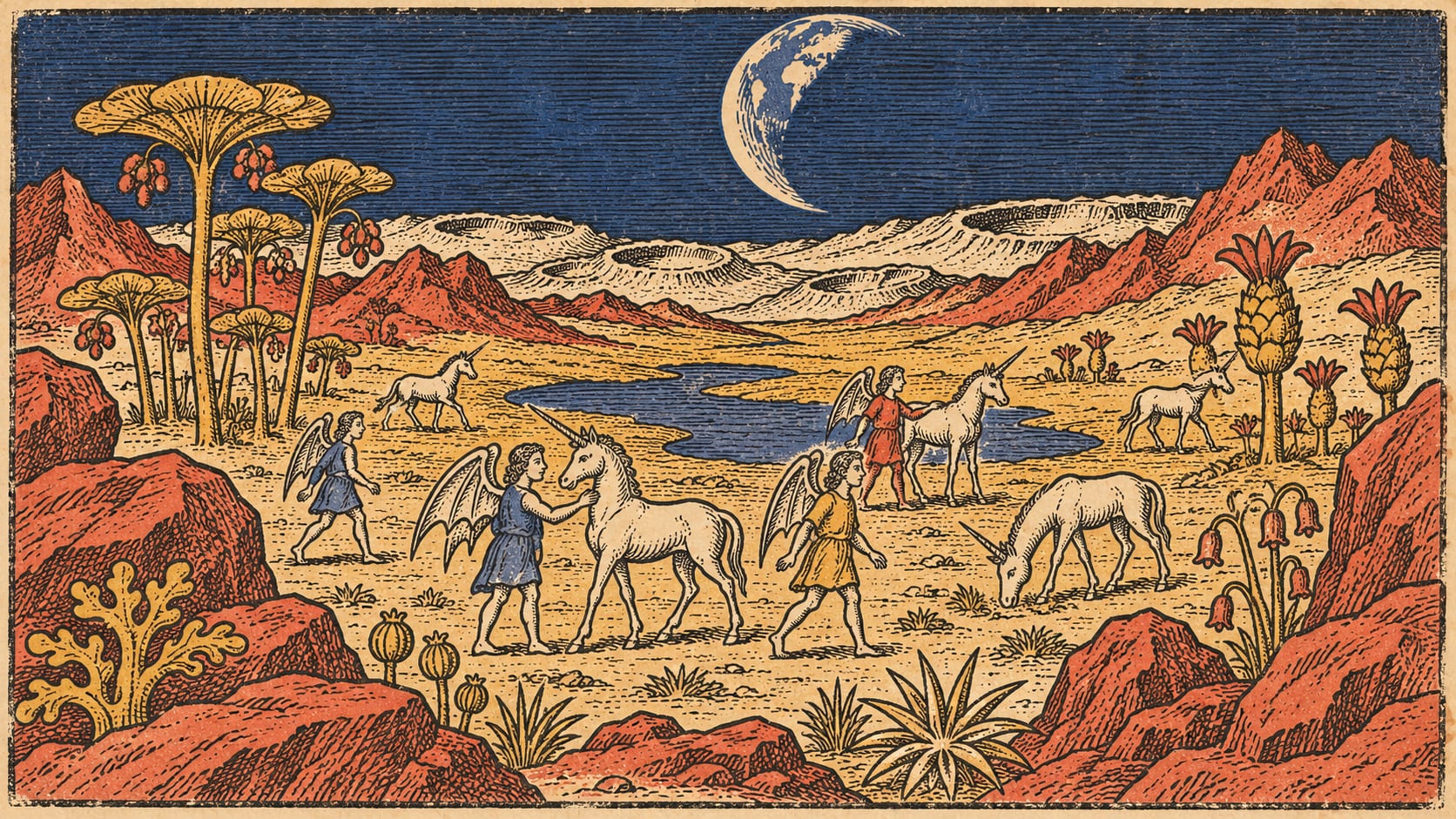
The opening installment described a gigantic new telescope with "hydro-oxygen" lenses and said Herschel had detected an atmosphere, vegetation, animals and lunar geography. The second described landscapes: dark red flowers, forests, valleys, beaches, rivers, islands, extinct volcanoes and a lake near the crater Langrenus.
On 27 August came the animals. There were herds of miniature bison, bluish one-horned goats, gray pelicans and cranes with unusually long legs, a spherical amphibious creature that rolled along the beach, and upright beavers that carried their young, lived in huts and used fire.
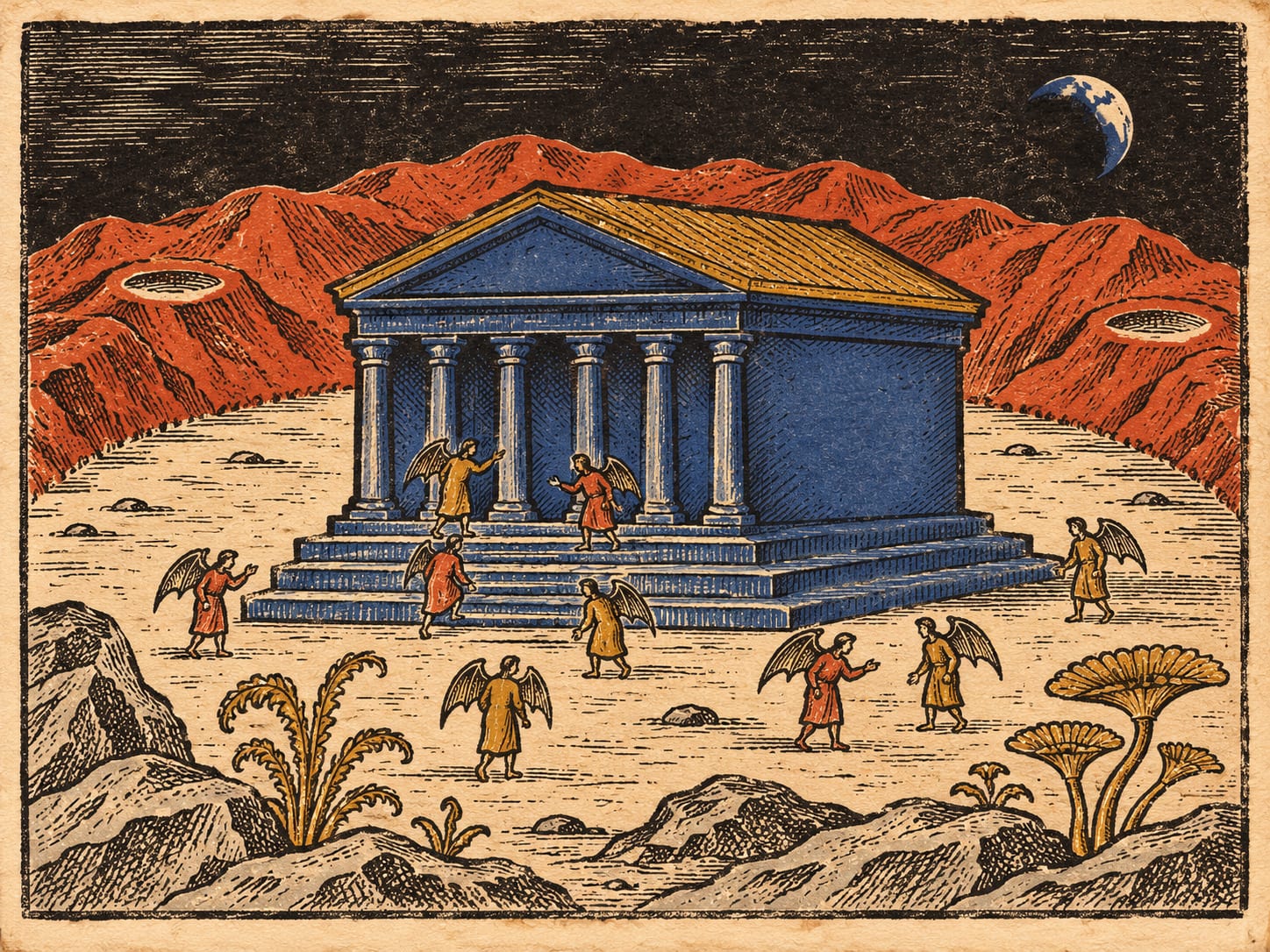
On 28 August The Sun announced winged humanoids with copper-colored hair and yellowish faces, named Vespertilio-homo, or "bat-men," living around a lunar valley of red hills called the Ruby Colosseum. The 29 August installment described their social behavior, communication, temples and religious-looking gatherings. The 31 August installment described a higher class of bat-men and a sapphire temple, and ended the observations when the telescope's lens supposedly started a fire at Herschel's observatory.
The fake supplement and the invented witness
The Edinburgh Journal of Science had been a real publication. The supposed supplement was not, and the journal had stopped appearing under that title before the hoax.
The articles also needed a witness. The Sun gave them Dr. Andrew Grant, described as a colleague or protégé of Herschel. Andrew Grant was not a real witness to anything.
That is how the series worked: a real astronomer's name, a real journal's name and an invented man at the telescope.
Who Richard Adams Locke was
Richard Adams Locke was born on 22 September 1800 in East Brent, Somersetshire, England, into a prosperous farming family. He wrote for a radical paper, The Republican, contributed to literary journals and edited the Bridgwater and Somersetshire Herald. He lost that post over his politics and worked freelance.
He married around 1826 and brought his family to New York on 13 January 1832. There he worked as a legal reporter and stenographer, and in 1834 he became metropolitan reporter for James Watson Webb's Courier and Enquirer.
Locke said he had studied at Cambridge, and James B. Reece repeated that he entered at nineteen. Matthew Goodman concluded that Locke never attended. His scientific reading was real; the Cambridge degree is in dispute.
Benjamin Day hired him for The Sun in 1835. Locke wrote popular articles on the trial of Matthias the Prophet, then the lunar series. He later edited the New Era until October 1839, entered the New York Customs Service in 1842, stayed until 1862 and retired to Staten Island. He died there on 16 February 1871.
Who wrote it
The 1835 articles carried no signed byline, so Locke's name comes from several directions.
- James Gordon Bennett's New York Herald named Locke as the likely writer on 31 August 1835, the day the Herald returned to print.
- A later account by Frank O'Brien says Locke told a Sun reporter named Finn, "Don't print it right away. I wrote it myself."
- Locke acknowledged authorship in a letter on the front page of the New World on 16 May 1840.
- He republished the six installments in 1859 as The Moon Hoax, or, A Discovery that the Moon Has a Vast Population of Human Beings.
- The Sun's obituary of 18 February 1871 called him the author of "the most successful scientific joke ever published."
Locke said he meant the series as satire aimed at extravagant theories about life on other worlds, especially those of Thomas Dick. In the 1840 letter he wrote, "I think it quite laudable in any man to satirize, as I did, that school of crude speculation and cant of which he is so eminent a professor." He added that Dick's own writings had prepared the way for his hoax.
Whether he worked alone is a separate question. Benson J. Lossing put another name forward in his History of New York City in 1884, nearly fifty years later: "Clark was the real inventor of the incidents, the imaginative part, while to Locke was intrusted the ingenious task of unfolding the discoveries." Lewis Gaylord Clark edited The Knickerbocker.
Augustus De Morgan offered a different candidate in 1872. He wrote that the lunar narrative was produced in the United States "by M. Nicollet, an astronomer, once of Paris, and a fugitive of some kind." S. A. Mitchell revived the idea in 1900. Jean-Nicolas Nicollet was in the United States, but he lived in St. Louis, and the articles' English does not read like a native French speaker's. Later writers generally favored Locke.
Satire or money-maker?
The Sun ran it as both. Locke described satire. The paper dressed it as serious news, used Herschel's real name, kept readers coming back with each installment and sold products around it.
Benjamin Day, The Sun's owner and publisher, paid Locke between $500 and $600 for the series, in a later historical account. The paper sold a one-shilling pamphlet of the narrative and commissioned lithographs of the lunar creatures and landscapes. William Gowans claimed in 1859 that 60,000 pamphlets sold in less than a month. That is a later claim, not a sales record from 1835.
Day later told how the secret got out: Locke revealed it while drinking with a newspaper colleague. Day guarded the story's look as news while it paid, and Locke, not Day, is the usual name for its author.
The visitors from New Haven
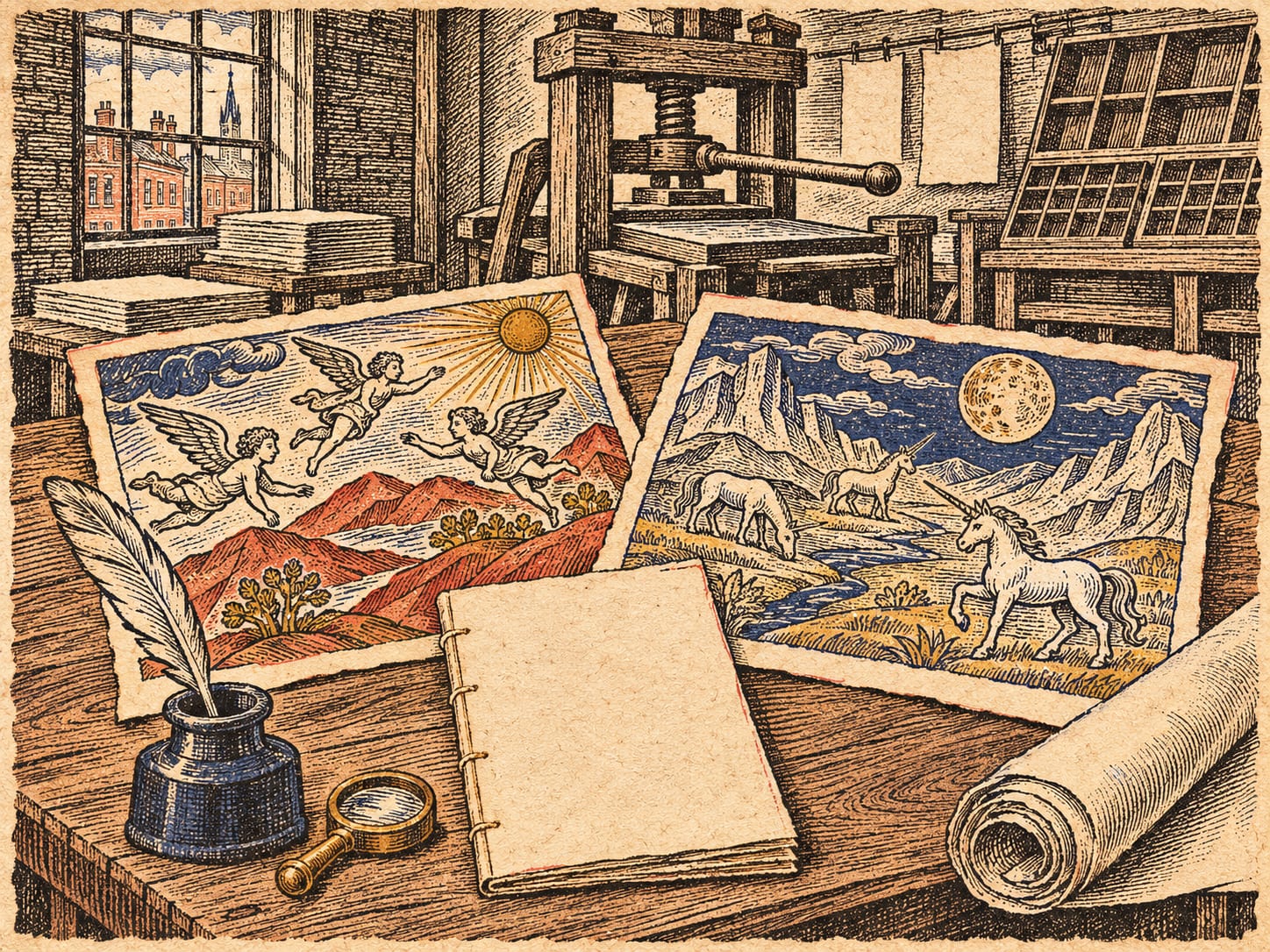
In early September, scientific gentlemen from New Haven came to The Sun's office and asked to see the supposed Edinburgh supplement. The Sun's own report of 22 September says they wanted to reprint parts of it in a scientific publication and check that it was genuine.
The paper wrote that the visitors "were informed that we could not then show them the original, as it was partly divided among a number of compositors, and the remainder of it was in the hands of the lithographic artist." One of them, the paper believed, then went to the Journal of Commerce and advised its editors not to print the article without questioning it.
Frank O'Brien's 1918 history tells the visit with more colour. It names a Yale deputation and has Day say: "Surely, you do not doubt that we have the supplement in our possession? I suppose the magazine is somewhere up-stairs, but I consider it almost an insult that you should ask to see it." O'Brien adds that Locke sent the visitors from printer to printer, each shop saying the supplement had just gone elsewhere.
That version is later than the paper's own. Later retellings name the Yale scientists Denison Olmsted and Elias Loomis; The Sun's report names no one, and both men were watching Halley's Comet around then.
Did everyone in New York believe the bat-men?
The story goes that all of New York believed it. The reaction was mixed.
Asa Greene, editor of the New York Transcript, wrote in his 1837 guide to the city: "The credulity was general. All New York rang with the wonderful discoveries of Sir John Herschell... There were, indeed, a few sceptics; but to venture to express a doubt of the genuineness of the great lunar discoveries, was considered almost as heinous a sin as to question the truth of revelation." Greene had not been a simple believer. His own paper ran satirical "Captain Tarbox" pieces, including imaginary lunar parasites.
Philip Hone, a former mayor of New York, wrote in his diary in late August 1835: "In sober truth, if this account is true, it is most enormously wonderful, and if it is a fable, the manner of its relation, with all its scientific details, names of persons employed, and the beauty of its glowing descriptions, will give this ingenious history a place with 'Gulliver's Travels' and 'Robinson Crusoe.'" The Daily Advertiser praised the supposed discoveries and said they would make Herschel immortal. The Mercantile Advertiser, the New-York Evening Post and other papers reprinted the articles.
Doubters spoke up too. The Journal of Commerce suspected the account had been manufactured in the United States and compared it with Robinson Crusoe and Gulliver's Travels. On 31 August 1835 Bennett's Herald printed "The Astronomical Hoax Explained." "The town has been agape two or three days at the very ingenious astronomical hoax," he began, and he pointed out that the Edinburgh Journal of Science had ceased publication in 1833: "no work of that kind being now published. A few years ago there was such a work, but it merged into another journal published in London."
Locke denied it. On 1 September Bennett answered him: "We still persist in our belief."
Poe and the balloon voyage
Edgar Allan Poe had a stake in it. His "Hans Phaall, A Tale," later known as "The Unparalleled Adventure of One Hans Pfaall," ran in the Southern Literary Messenger in June 1835, about two months before The Sun began. It told of a balloon voyage to the Moon, written, Poe said in an 1846 sketch of Locke, in "a style half plausible, half bantering," with the lunar scenery described "as if surveyed and personally examined by the narrator."
When The Sun's series appeared, Poe wrote, "no sooner had I seen the paper than I understood the jest, which not for a moment could I doubt had been suggested by my own jeu d'esprit." He remembered the gap between the two as three weeks. It was about nine.
On 11 September 1835 he wrote to John P. Kennedy asking whether Locke might have taken the idea from Hans Pfaall. Kennedy answered on 19 September: "More than yourself have remarked the coincidence between Hans Phaal and the Locke Discoveries and I perceive that in New York they are republishing Hans for the sake of comparison." The New York Transcript had indeed run Poe's story anonymously from 2 through 5 September, as "Lunar Discoveries. Extraordinary Aerial Voyage by Baron Hans Phaal, the Celebrated Dutch Astronomer and Aeronaut."
Poe later wrote that Locke denied ever having seen Hans Pfaall, and that he believed him. He left his own story unfinished, saying the Moon story had anticipated "all the main points" of it. His voyager "remains where I left him, and is still, I believe, 'the man in the moon.'"
Poe also paid the Sun series a compliment. He called it "decidedly the greatest hit in the way of sensation" ever made by such a fiction, in America or Europe. Looking back in 1846, he also claimed that "Not one person in ten discredited it."
What the circulation numbers say
On 28 August 1835, the fourth day of the series, The Sun printed a boast of 19,360 copies: 15,440 New York subscribers, 700 Brooklyn subscribers, 2,000 street sales in New York and 1,220 copies sold outside the city.
Retellings often say the hoax lifted The Sun from about 8,000 copies to about 19,000 or 20,000. The paper had already claimed 26,000 copies on 13 August, before the Moon series began, largely during a temporary disruption: the great New York fire had cut rival newspapers' printing capacity. The numbers do not show a sudden tripling caused by the Moon story.
The Sun did profit through the pamphlet and the lithographs, and the pamphlet was advertised for sale on 31 August. Poe's verdict was that "from the epoch of the hoax 'The Sun' shone with unmitigated splendor," and that its success firmly established the penny system across the country.
What The Sun said on 16 September 1835
The paper did not expose the fiction when the series ended. On 16 September it printed an editorial that admitted suspicion without admitting the story was false.
"Some persons of little faith but great good nature, who consider the 'moon story,' as it is vulgarly called, an adroit fiction of our own, are quite of the opinion that this was the amiable moral which the writer had in view," the editors wrote. They confessed that the idea of intended satire had "somewhat shook our own faith" in the extracts, which a gentleman connected with the office had furnished them as coming from a medical gentleman just arrived from Scotland.
Then came the line that mattered: "Certain correspondents have been urging us to come out and confess the whole to be a hoax; but this we can by no means do until we have the testimony of the English or Scotch papers to corroborate such a declaration. In the mean time let every reader of the account examine it and enjoy his own opinion."
The Library of Congress describes the paper as never retracting the story and never naming Locke.
John Herschel's side of it
Herschel took no part in the lunar story. A later account reports that when he learned of it, he asked, "This is a most extraordinary affair! Pray, what does it mean?" That line is reported second-hand.
In a letter drafted in 1836, Herschel objected to the claims going on circulating. He wrote that he did not think anyone with basic optical knowledge or common sense could believe the extravagances, but that he thought it harmful for an absurd story to gain authority through repetition.
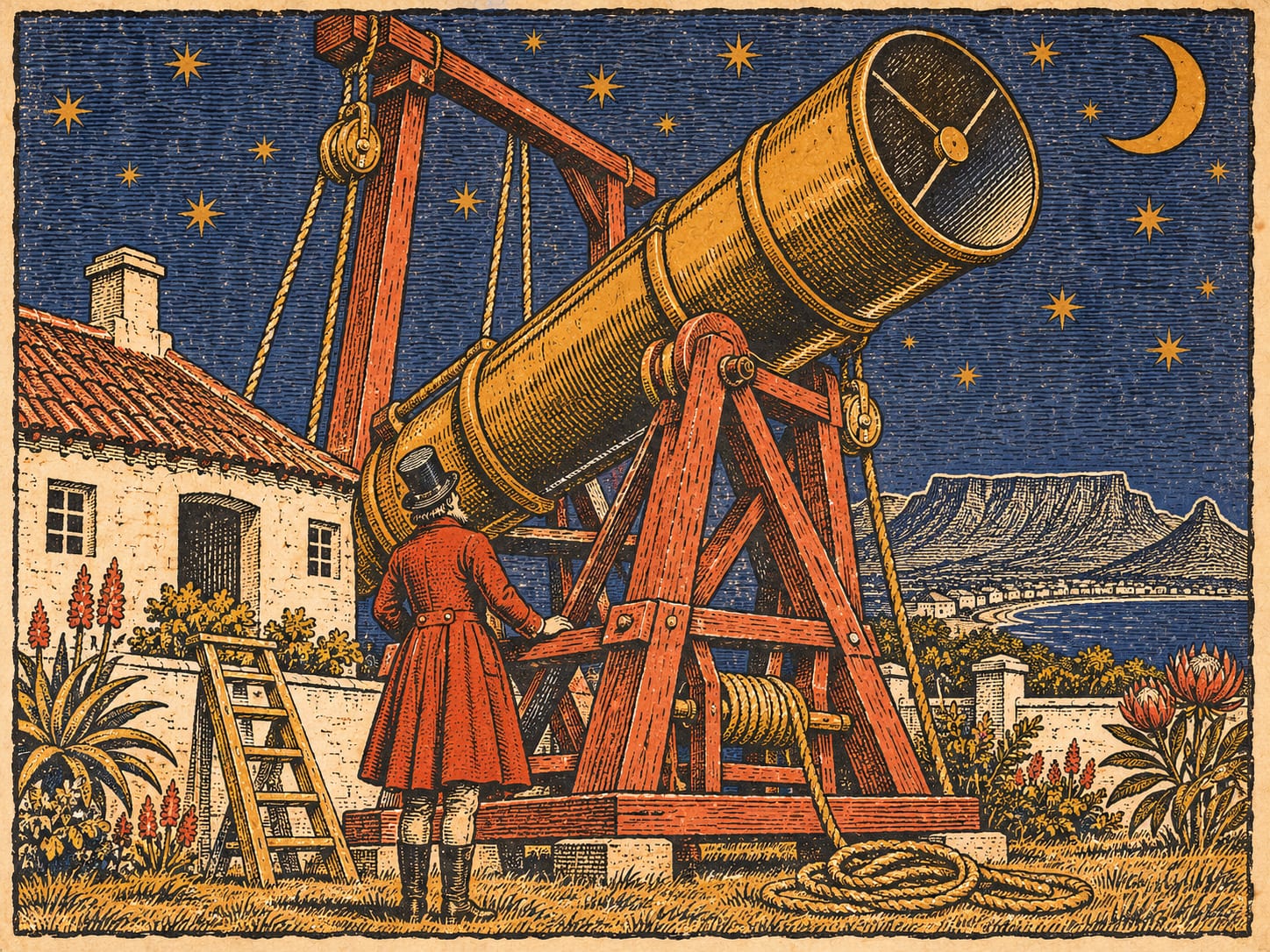
From 1834 to 1838 he ran a major astronomical survey from the Cape of Good Hope. He observed and catalogued stars, double stars, nebulae and other objects in the southern sky, completing the southern part of the survey his father, William Herschel, had begun. He worked from an observatory near Cape Town and returned to England in 1838. His real results appeared as Results of Astronomical Observations Made During the Years 1834, 5, 6, 7, 8, at the Cape of Good Hope.
What became of Day and The Sun
Benjamin Day had founded The Sun on 3 September 1833 with George W. Wisner. In 1838 he sold it to Moses Yale Beach for $40,000. Years later, in 1883, he told Frank O'Brien, "I owned the whole concern till I sold it to Beach. And the silliest thing I ever did in my life was to sell that paper!"
Day stayed in newspapers. He founded the True Sun in 1840 and the illustrated weekly Brother Jonathan in 1842, and ran the weekly for about twenty years. In 1862 a paper shortage forced him to suspend publication, and he retired. He died on 21 December 1889.
The Sun outlived him. Charles A. Dana became part owner and editor in 1868, and the Library of Congress calls his era the paper's "true glory days." Frank Munsey bought it in 1916. In 1950 it merged with the New York World-Telegram, and that title later joined two others to form the World Journal Tribune, which ceased publication in 1967.
What survives of it
The Library of Congress holds an 1835 lithograph titled "Lunar animals and other objects Discovered by Sir John Herschel in his observatory at the Cape of Good Hope and copied from sketches in the Edinburgh Journal of Science." It measures 36.8 by 53.6 centimetres and shows bat-winged humanoids, unicorn-like creatures and other imaginary animals.
Italian printmakers took up the idea. A Naples lithograph by Salvatore Fergola from about 1836 shows a bat-man and a lunar landscape, and another Naples print from between 1835 and 1849 shows people watching bat-men from a balloon. Those are later reinterpretations, not evidence that the creatures existed.
The series itself travelled. It was translated into French, German, Italian and Welsh, adapted for the stage and mocked in satire, and "moon-hoaxy" became a word for suspicious writing. Moon Hoax prints, a snuff box and wallpaper survive. The opening advertisement of the 1859 edition says: "It appears to be as natural for the human mind to be craving after the wonderful, the mysterious, the marvellous, and the new discoveries, as it is for the physical appetite to desire food, drink, and sleep."
Jules Verne's From the Earth to the Moon of 1865 has a character refer to Poe's Hans Pfaall and Locke's Moon Hoax, a Smithsonian Libraries account says. Verne's larger debt is usually traced to Poe.
Herschel kept counting southern stars. The bat-men lived in six issues of The Sun and in a pamphlet that sold at a shilling.
The Great Moon Hoax
- 25 August 1835
The Sun begins the series with the telescope and the lunar landscape
- 27 August 1835
Upright beavers and other lunar animals appear
- 28 August 1835
The bat-men, Vespertilio-homo, are announced, and The Sun boasts of 19,360 copies
- 31 August 1835
The sixth installment ends the series, the pamphlet is advertised for sale and the Herald publishes "The Astronomical Hoax Explained"
- 2 to 5 September 1835
The Transcript runs Poe's "Hans Phaal" anonymously
- 16 September 1835
The Sun prints an editorial that stops short of calling the story false
- 22 September 1835
The Sun reports the visit of scientific gentlemen from New Haven
- 1840
Locke acknowledges authorship in a letter in the New World
- 1859
Locke republishes the six installments as The Moon Hoax
Sources
- "Primary Sources and April Fool's Day: The Great Moon Hoax of 1835," Library of Congress
- "Belief, Legend, and the Great Moon Hoax," Folklife Today, Library of Congress
- Full text of the six installments and "The Great Moon Hoax," Museum of Hoaxes
- "Life on the Moon," The Heavens, University of Michigan Clements Library
- "Rising and Shining: Benjamin Day and His New York Sun Prior to 1836," ERIC
- Frank M. O'Brien, The Story of the Sun, 1918
- "Richard Adams Locke," Edgar Allan Poe and Thomas Ollive Mabbott, and Hans Pfaall notes, Edgar Allan Poe Society of Baltimore
- James B. Reece, "Richard Adams Locke"
- Richard Adams Locke, The Moon Hoax, 1859
- Augustus De Morgan, A Budget of Paradoxes, 1872
- "In Defense of Vespertilio-homo," James Eric Black, Mercer University
- "The great moon hoax," The Washington Post, 2022
- John Herschel, Results of Astronomical Observations Made During the Years 1834, 5, 6, 7, 8, at the Cape of Good Hope
- Library of Congress print records for the 1835 lunar animals lithograph and the Naples lithographs
- Fantastic Worlds exhibition, Smithsonian Libraries
Watch the full story on the Flashback Fables YouTube channel, and send it to someone who would love it.