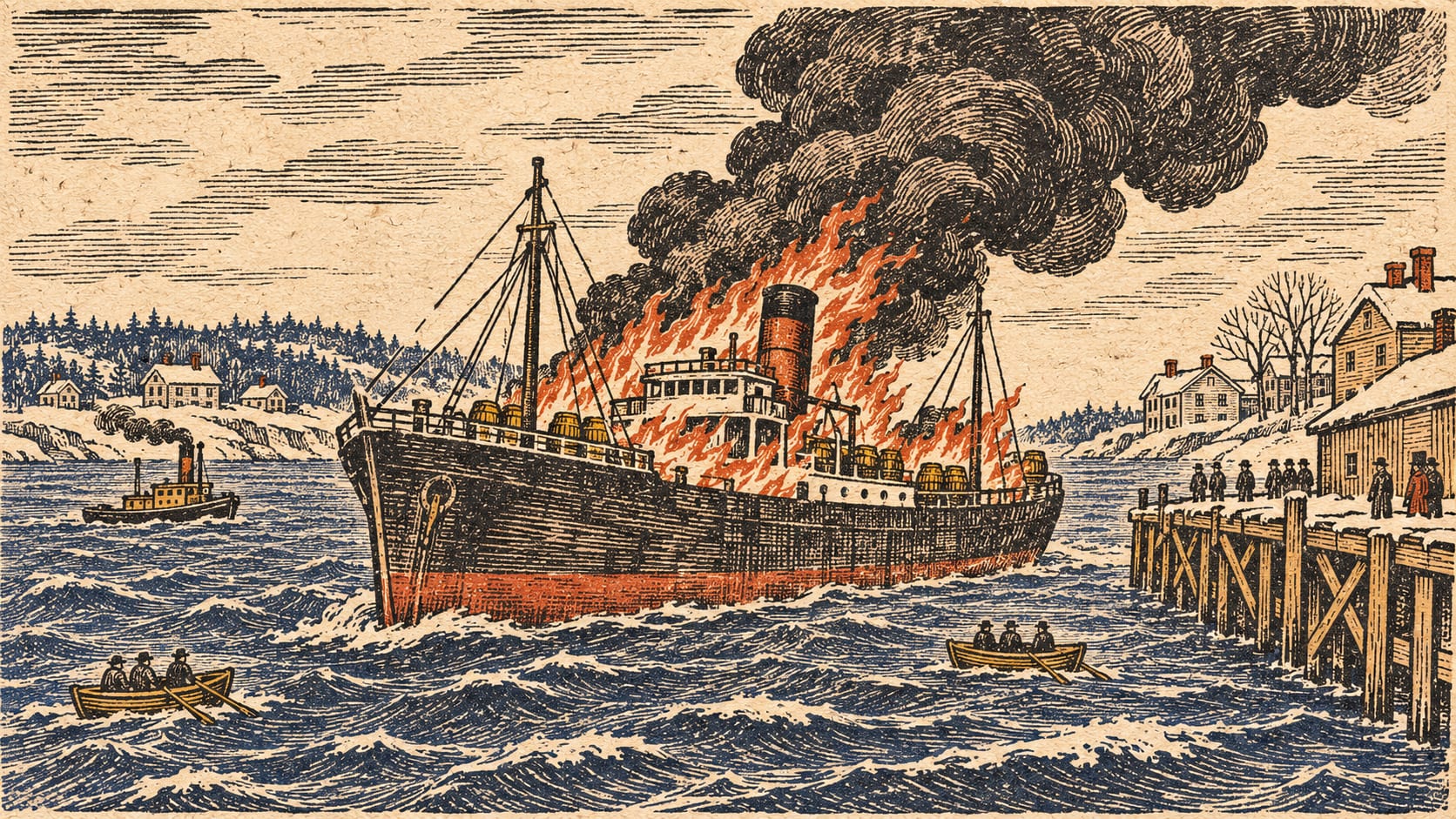
At about 9:04 a.m. on 6 December 1917, a French ship loaded with wartime explosives blew up in Halifax Harbour, Nova Scotia. At least 1,782 people are known to have died from the blast, its aftermath or later injuries and illness, and more than 9,000 were injured.
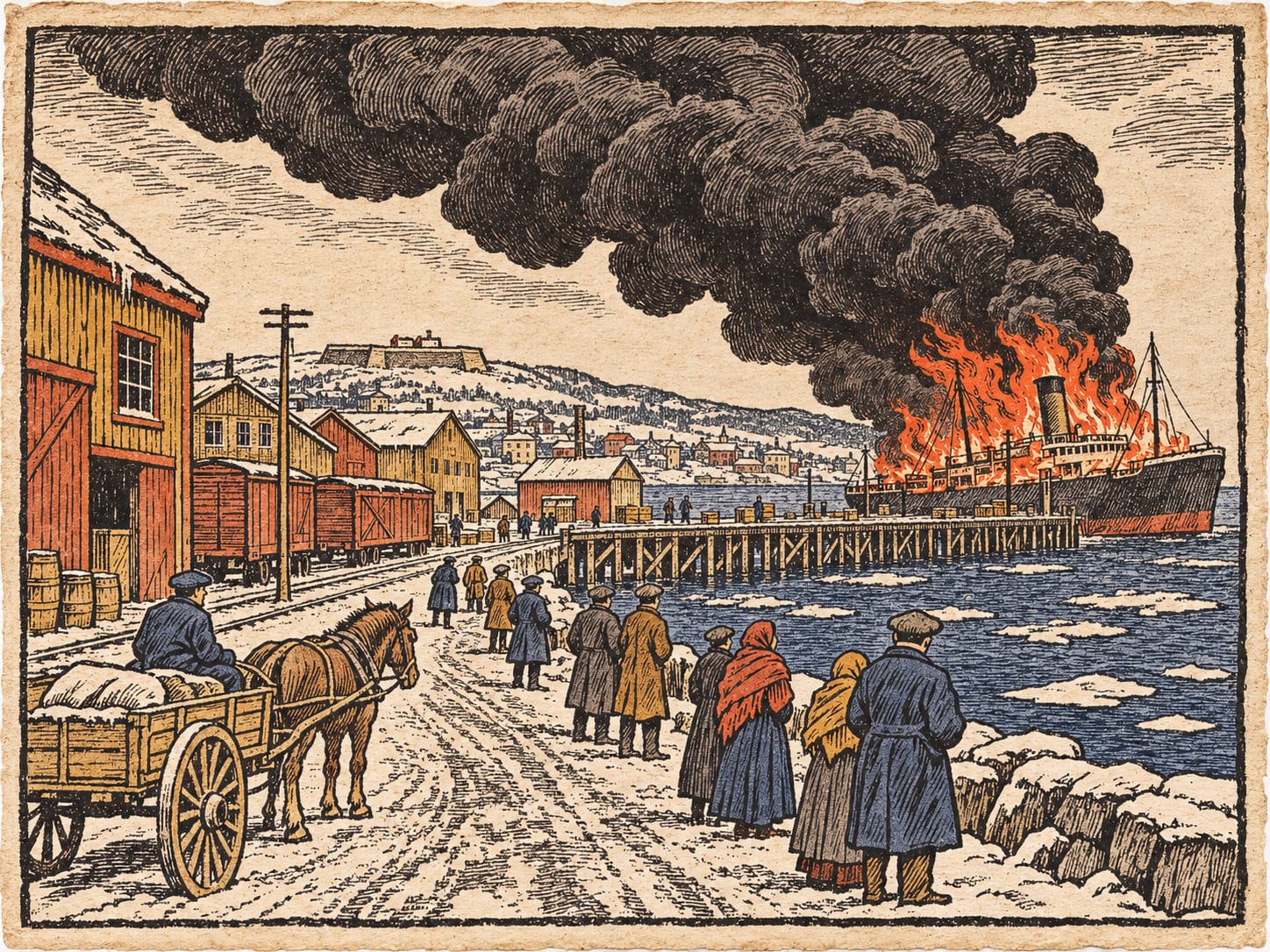
The ship was the SS Mont-Blanc. It had collided with the Norwegian SS Imo in the Narrows, the channel between Halifax and Dartmouth, caught fire, and drifted to Pier 6, where it exploded about twenty minutes later.
The blast destroyed about 1,600 homes and left around 6,000 people homeless. A blizzard struck the next day, and help came by train through the snow.
Two ships in the Narrows
On the morning of 6 December 1917, Mont-Blanc came into Halifax Harbour from the Atlantic, carrying wartime explosives bound for France. Imo, chartered to the Belgian Relief Commission, was heading out of Bedford Basin for New York, where she would load relief supplies for occupied Belgium.
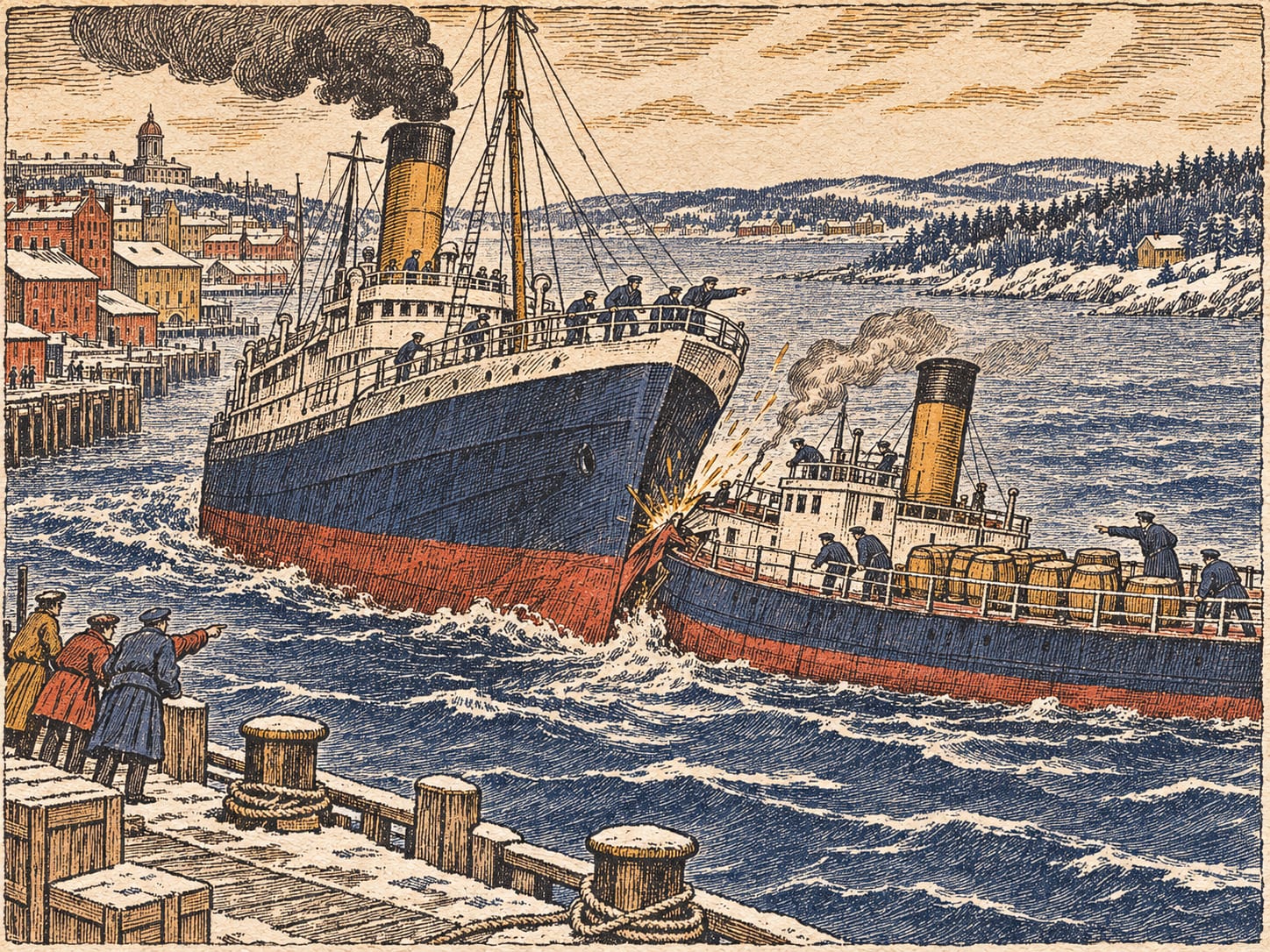
The two ships met in the Narrows. Imo was on the Dartmouth side, the wrong side for a ship going out. Conflicting whistle signals followed. Mont-Blanc first moved toward Dartmouth, then turned toward Halifax to avoid Imo. Imo turned toward Halifax as well and struck Mont-Blanc near the bow.
The collision spilled fuel on Mont-Blanc, and it ignited. Her crew abandoned ship, and the burning vessel drifted to Pier 6.
Mont-Blanc's cargo included about 2,500 tons of high explosives and a deck load of monochlorobenzene. Other accounts break the load down as picric acid, TNT, gun cotton and benzol.
The whistles and the final turns
Several seamen watched the final minutes before the collision. Captain William McLean of the Douglas H. Thomas said Mont-Blanc gave one short blast, then another later, and Imo answered with one short blast. He said Imo then altered toward the Halifax shore. Of the final manoeuvre, McLean said: "The Frenchman has given a cross signal and there is going to be a collision."
Chief Engineer Rourke said the ships were about 300 or 400 yards apart when Mont-Blanc gave two blasts and altered course to port toward the Halifax shore. Until then, he said, the vessels had been on parallel courses.
The court papers lay out the exchange of signals this way. Imo gave one blast, for a turn to starboard, then three blasts and reversed her engines. Mont-Blanc gave another single blast, and Imo answered with one. Mont-Blanc then gave two blasts and turned across Imo's bow. Imo answered with three blasts and reversed again, but the ships struck.
The witnesses did not agree. McLean and Rourke supported the view that Mont-Blanc's final turn across the channel caused the collision. Other testimony held that Imo had entered the wrong side of the channel and created the emergency.
The crews
Aimé Le Médec was captain of Mont-Blanc. He ordered the ship's final turn to port. Francis Mackey, a Halifax harbour pilot, was aboard Mont-Blanc with him. Both survived the explosion in a lifeboat.
On Imo, Captain Haakon From and the Halifax pilot, William Hayes, were killed. So was the ship's first mate. The second mate, Peter B'Jonnas, the third mate, Bjarne Birkland, and the wheelsman, John Johansen, survived and later testified.
When the fire took hold, the Mont-Blanc crew tried to fight it. Once the flames reached the benzol drums and the danger was plain, Le Médec ordered everyone into the lifeboats. The crew rowed hard toward Dartmouth, shouting warnings to nearby vessels and to people on shore. The people watching the burning ship did not understand what they were being told.
9:04 a.m. at Pier 6
The explosion came at approximately 9:04:35 a.m. Atlantic time. It is commonly described as the largest man-made explosion before the atomic bomb, with an estimated yield of about 2.9 kilotons of TNT. The Canadian Red Cross puts it at a comparable figure, nearly 2,700 tonnes of TNT. The Geological Survey of Canada words the ranking more narrowly: one of the world's largest non-natural explosions before atomic bombs.
Those yields are estimates worked out afterwards, not measurements taken at the time.
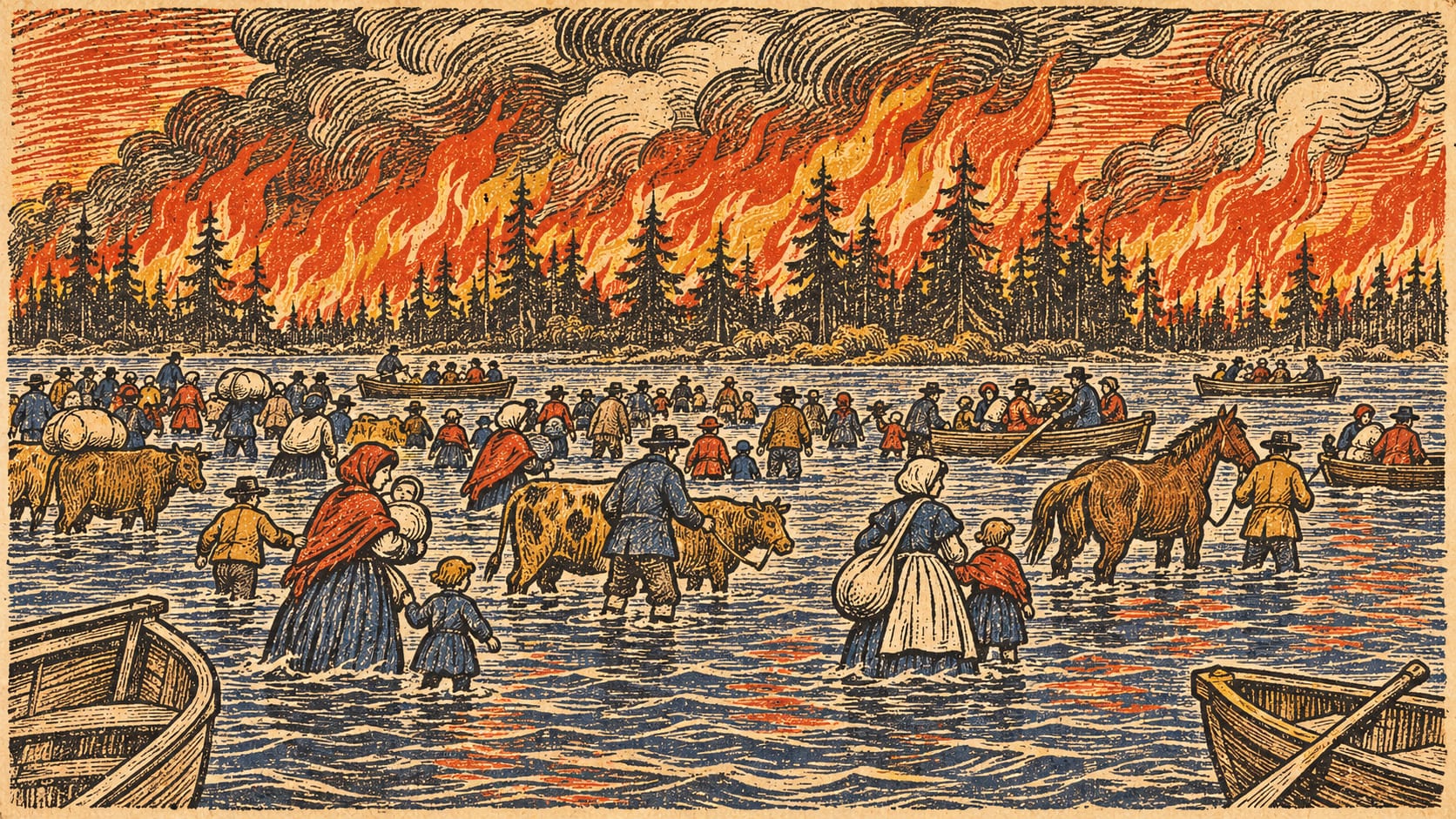
The blast pushed water out of part of the harbour for a moment. The water then rushed back as a tsunami about four metres high, roughly thirteen feet. It dragged ships from their moorings, carried smaller vessels inland, and damaged the shores of Halifax's North End and Dartmouth.
What survivors wrote
Frank Baker, a Royal Navy sailor aboard HMCS Acadia, kept a diary. On 6 December 1917 he wrote: "The first thud shook the ship from stem to stern and the second one seemed to spin us all around." He saw "a veritable mountain of smoke of a yellowish hue" and iron fragments flying around the ship. Acadia's doctor treated wounded men on a tug, patients were carried ashore by motorboat, and the hospital wards stood two feet deep in water after pipes burst. Later he wrote that the city was "literally ablaze," with the dead and dying carried to improvised hospitals.
Walter Hoganson, a 17-year-old employee of the Daily Echo, wrote to Harold Kennedy on 18 December 1917: "The explosion was an awful thing." He described a short rumble and then "a big 'crash,'" and said the newspaper building "rocked like a little cradle." He saw people running with cuts and bruises, houses split in half, fires, and the waterfront "swept as low as a field." He lost his sister, her husband and a nephew.
Others gave accounts to the historian Archibald MacMechan. Dr. Clement Courtenay Ligoure was the only doctor serving the Cotton Factory and Willow Park district and treated the injured from his home clinic. Dr. M. J. Burris of Dartmouth described treating injured people on 6 December and in the days after. Agnes Foran, aged 12, who lived at 12 Merkel Street, gave a narrative of her own. Private Joseph Settle, stationed at the Halifax Armouries, wrote on 21 December 1917 about the explosion and the military relief work that followed.
The people and the homes
The Nova Scotia Archives' database holds 1,782 people known to have died in the explosion, in its immediate aftermath, or later from injuries and disaster-related illness. The official register that was closed in December 1918 held 1,631 entries. Wartime records were incomplete and some victims were never identified, so the full number may never be known. Older rounded estimates put the toll at nearly 2,000.
Injuries are put at more than 9,000. Parks Canada reports 1,630 homes destroyed and 6,000 people left homeless, and the Nova Scotia Archives gives about 1,600 homes. Those figures count destroyed homes and people officially identified as homeless, not everyone who lacked proper shelter.
The numbers moved fast in the first days. The Halifax Herald of 7 December 1917 ran the headline "HALIFAX WRECKED" over a line saying more than a thousand were killed and many thousands injured and homeless. The Victoria Daily Times reported that many residents first thought Halifax was under air attack. A report of 10 December said some estimates of the dead ran as high as 6,000, a figure the report itself called exaggerated.
Snow on the ruins
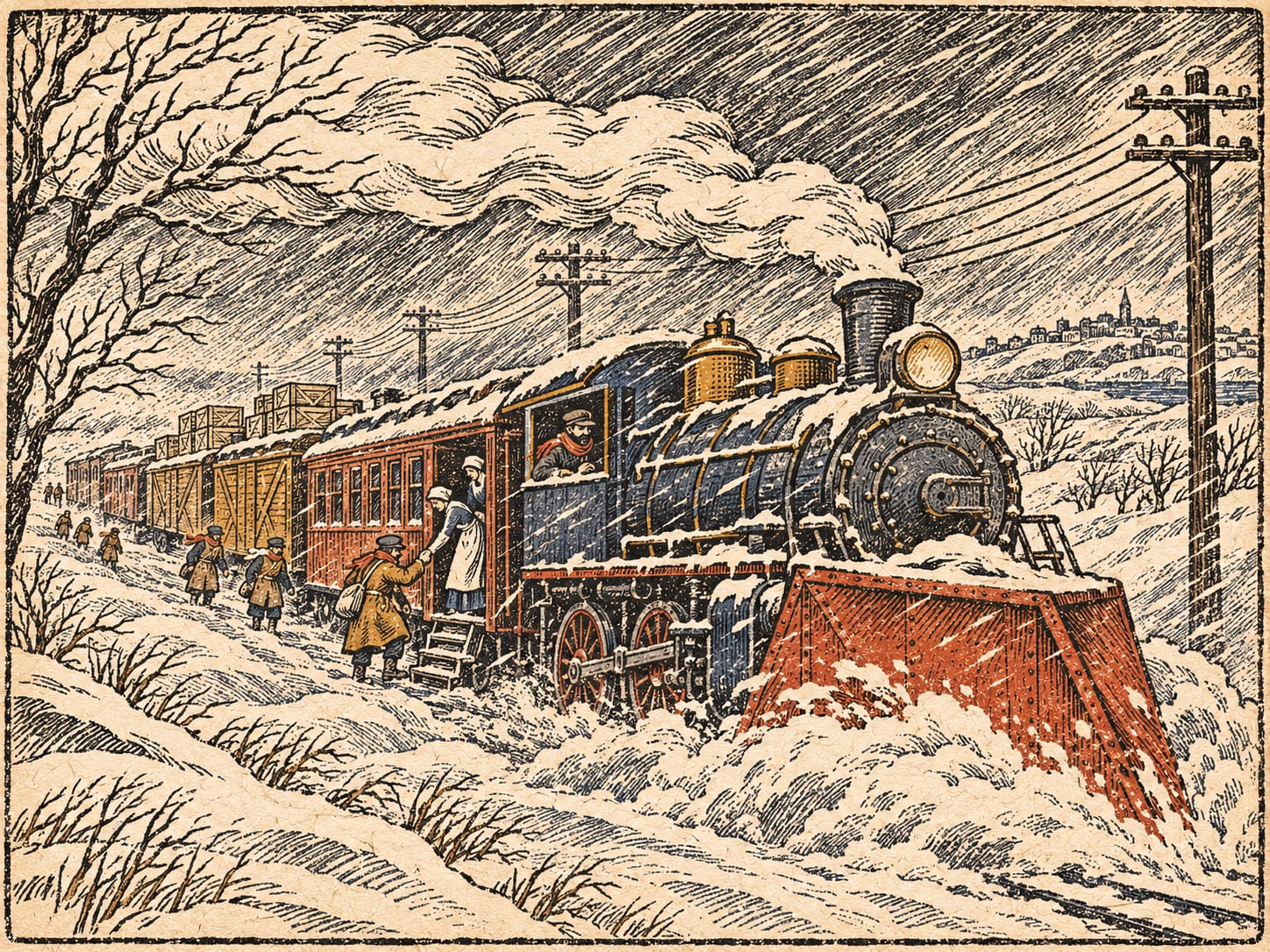
On 7 December 1917, a blizzard struck the damaged city. Up to forty centimetres of snow fell, the temperature was freezing, and strong winds fanned fires that were still burning after the explosion. The storm slowed rescue and relief work, and a December report said many of the injured died in the blizzard because rescuers could not reach them.
A volunteer Halifax Relief Committee had formed within hours to shelter homeless people, identify victims, arrange medical care, put up temporary housing and assess damaged buildings. Help also came from outside the city, by train from Boston.
The hospitals
Lieutenant-Colonel F. McKelvey Bell was responsible for the district's medical arrangements. The Cogswell Street Military Hospital treated 500 wounded on the first day. Camp Hill Hospital, which had only 280 beds, admitted 1,400 patients on 6 December. The American ship Old Colony, converted into a hospital ship under Dr. F. C. Patterson, treated 150 wounded that day. Emergency stations outside the main hospitals needed 3,754 dressings.
Ten hospitals and improvised treatment centres took part, among them Victoria General Hospital, the Halifax Infirmary, the Children's Hospital, the Nova Scotia Hospital, the YMCA, Bellevue House, St. Mary's College and the Waegwoltic Tennis Club. Flying glass blinded many. The medical service counted 41 people who lost both eyes, 87 who lost one, and 61 whose sight was impaired.
Vince Coleman and the telegraph
Vince Coleman was a train dispatcher for the Canadian Government Railways, working at the Richmond railway yard near Pier 6. He learned that the burning ship carried explosives and initially tried to leave. Then he went back to his telegraph office, because trains were approaching Halifax.
The message attributed to him reads: "Hold up the train. Ammunition ship afire in harbour making for Pier 6 and will explode. Guess this will be my last message. Goodbye boys."
Those words are a remembered version, not a surviving original telegram. The detailed story of Train No. 10 comes from interviews Archibald MacMechan gathered in 1917, published in Graham Metson's 1978 book. MacMechan's account has the train already past Rockingham and impossible to stop, saved because it was running late. The Moncton Transcript of 7 December 1917 says it was held fifteen minutes at Rockingham.
What is documented is that Coleman sent warnings along the railway and halted other inbound trains. Whether he personally stopped Train No. 10 is disputed, and the popular version of a man who knowingly gave his life stopping a train of 300 people is not established.
Who was to blame
Justice Arthur Drysdale reported the Wreck Commissioner's Inquiry on 4 February 1918. It held that the collision came from violations of the rules of navigation, and it put the blame wholly on the master of Mont-Blanc, Aimé Le Médec, and the pilot, Francis Mackey. It recommended that Mackey lose his licence and that French authorities cancel Le Médec's. It also criticised the harbour authorities, including Commander Frederick Wyatt as chief examining officer, and asked for specific rules for ships carrying explosives.
Criminal charges followed against Le Médec, Mackey and Wyatt. Supreme Court Justice Benjamin Russell ruled that there was too little evidence to send Le Médec and Mackey to trial. He considered Imo at fault and said Mackey had taken every possible care to prevent the collision. Wyatt was the only one of the three to stand trial, and a jury acquitted him.
In the civil case, the Supreme Court of Canada divided over details but treated both ships as negligent and shared the responsibility equally. It said Imo was on the wrong side of the channel, and it also criticised Mont-Blanc for her final turn across Imo's path. The dispute went on to the Judicial Committee of the Privy Council in London, which also held both ships responsible for navigational errors.
Later tellers blamed German saboteurs. Neither the Wreck Commissioner nor the Supreme Court said so. Both described a collision between two ships, followed by a fire and an explosion.
What became of the men blamed
Mackey lost his pilot's licence even after the criminal charge was dismissed. He later got it back and went on piloting in Halifax Harbour for about twenty years. A Library and Archives Canada interview says he kept meeting public blame, and that he withdrew from the newspapers around each anniversary of the disaster.
Le Médec returned to France. A secondary account says he was given another ship. Wyatt's career suffered after the affair, and one account says he left Halifax for the United States.
The train from Boston
Boston heard of the disaster by telegraph. Abraham C. Ratshesky organised the Massachusetts relief expedition, a train of doctors, nurses, medical supplies, food and clothing, and it left on the night of 6 December. Severe snow and the blizzard delayed it.
The expedition reached Halifax around 3 a.m. on 8 December. Its people began handing out supplies and helping the exhausted local medical staff. More units followed from the United States.
Nova Scotia sent Boston a Christmas tree in 1918 as thanks. The tradition was revived in 1971 and continues every year, with Nova Scotia providing Boston's official Christmas tree for Boston Common.
What changed
The large number of eye injuries from flying glass changed eye surgery and eye-care practice, and the blast contributed to the creation of the Canadian National Institute for the Blind. Treating burns, especially in children, contributed to advances in pediatric surgery, including the handling of fluids and electrolytes.
Wartime traffic rules for the harbour did not deal directly with ships carrying explosives. The Wreck Commissioner recommended specific rules for them for that reason.
The Halifax Relief Commission was established by a federal Order-in-Council on 22 January 1918, incorporated on 26 April 1918 as a federal-provincial body, and later incorporated by Nova Scotia legislation. It looked after the families of the dead, widows and orphans, the disabled and blinded, people needing medical care, and owners and tenants whose homes and belongings were destroyed. It managed relief funds, compensation, repairs and reconstruction.
Its long-term figures cover different things and do not add together. It settled about 16,000 disaster-loss claims, paying about $18.5 million. It helped about 14,000 medical and convalescent cases, paid about $3.5 million in pensions to disabled survivors, widows and orphans, spent about $4 million on temporary hospitals and houses, and repaired about 12,000 damaged houses. By early May 1918, officials had considered 13,193 loss claims, and the Pension Board had dealt with at least 577 pensions.
In Richmond Heights, the commission built temporary housing and then developed the Hydrostone neighbourhood, a planned, safer replacement for much of the destroyed working-class district. By 1 March 1918, 832 modern flats had been built.
The Halifax Explosion, from collision to rebuilding
- 6 December 1917, morning
Mont-Blanc enters the harbour and Imo leaves Bedford Basin
- 6 December 1917, about 9:04 a.m.
Mont-Blanc explodes at Pier 6, about twenty minutes after the collision
- 6 December 1917, night
The Boston relief train leaves
- 7 December 1917
A blizzard strikes the damaged city
- 8 December 1917, around 3 a.m.
The Massachusetts relief expedition reaches Halifax
- 18 December 1917
Walter Hoganson, 17, writes to Harold Kennedy about the explosion
- 22 January 1918
The Halifax Relief Commission is established
- 4 February 1918
The Wreck Commissioner's Inquiry reports
- 1 March 1918
832 flats stand in Richmond Heights
- 1918
Nova Scotia sends Boston a Christmas tree
- 1971
The Christmas tree tradition is revived
What stands in Halifax today
The Maritime Museum of the Atlantic keeps a permanent Halifax Explosion exhibition. Its original "Halifax Wrecked" display opened in 1994, and the updated "Explosion in The Narrows" opened in 2019. It tells of the collision, the blast, the military response and relief work, and of the effects on Mi'kmaw, African Nova Scotian, migrant, military and working-class communities. The museum also holds objects, photographs, documents and ship fragments.
The Hydrostone is a living district, not a preserved ruin. Parks Canada describes it as an English-style garden suburb and a nationally significant example of post-disaster planning. Visitors can walk its streets of hydrostone-clad homes, shops and public spaces.
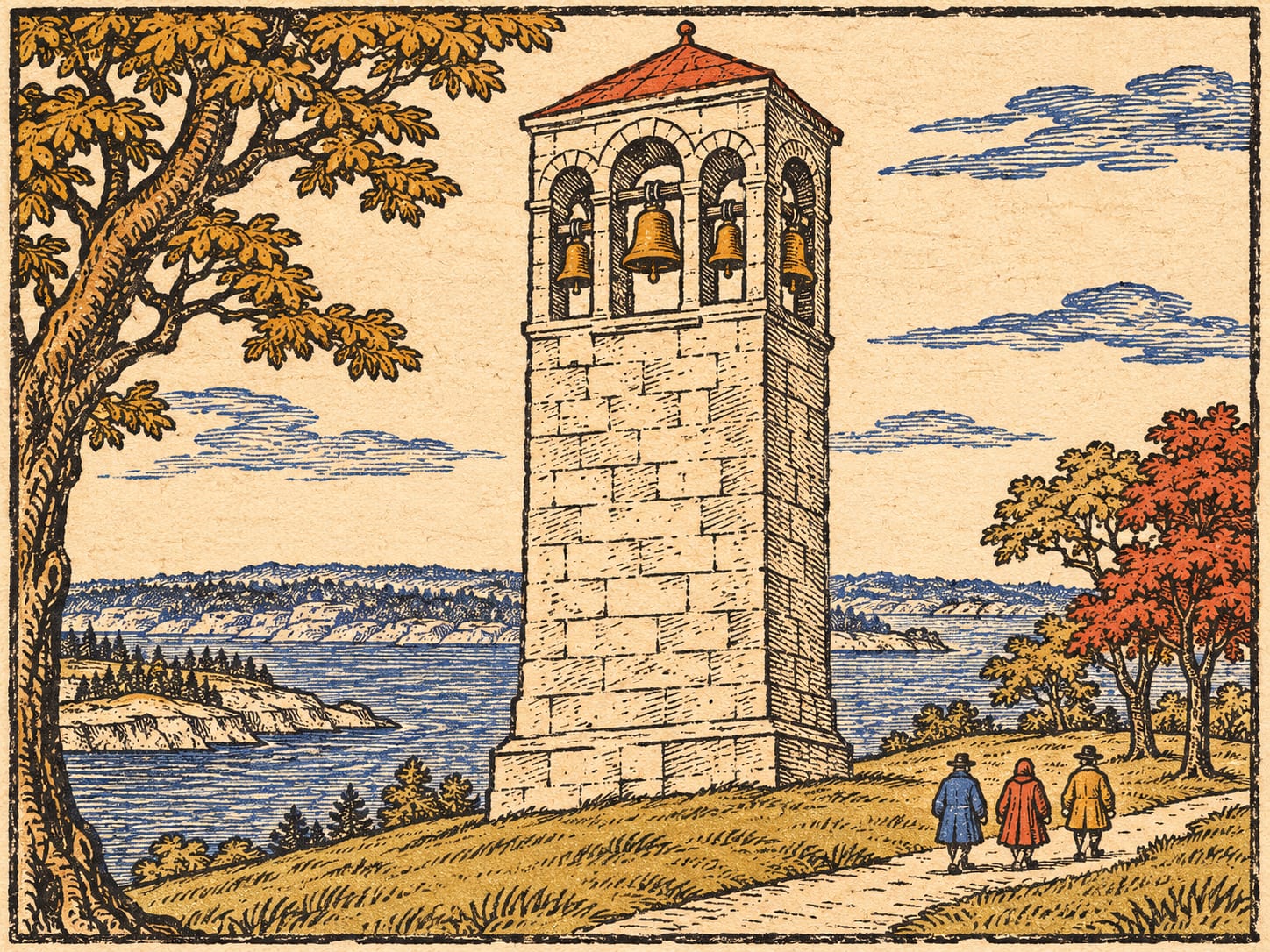
The Halifax Explosion Memorial Bell Tower stands in Fort Needham Memorial Park, overlooking the Narrows. It is about 60 feet high and holds 14 bronze bells, and it is built of hydrostone, the material of the North End rebuilding. The largest bell is inscribed to the memory of Samuel Orr Jr., Annie S. Orr and their children Ian, Mary, Archie, Isabel and James, who died on 6 December 1917. Their daughter Barbara Orr presented the original ten bells. Four more were added in 1990.
At the Mont-Blanc Anchor Site, a monument keeps a 1,140-pound section of the ship's anchor shaft, which the blast threw about 2.35 miles. The inscription names it as a fragment hurled by the explosion of 6 December 1917.
A tree on Boston Common
The explosion killed 1,782 known people. Every Christmas, a tree from Nova Scotia stands on Boston Common, because of a train that came through the snow.
Sources
- Nova Scotia Archives, "Halifax and Its People" and the Remembrance Book
- Nova Scotia Archives, personal narratives of the explosion
- Nova Scotia Museum, "Explosion in The Narrows"
- Parks Canada, Halifax Explosion national historic event
- Wreck Commissioner's Inquiry decision, 1918
- Supreme Court of Canada decision on the collision
- Courts of Nova Scotia, history of Nova Scotia courts
- Canadian Red Cross, "The Halifax Explosion: birth of Canadian Red Cross disaster response"
- Geological Survey of Canada study of the explosion
- Maritime Museum of the Atlantic, "Vincent Coleman and the Halifax Explosion"
- Report of the Halifax Relief Expedition, December 6 to 15, 1917, Massachusetts
- Government of Nova Scotia, Tree for Boston
- Nova Scotia Archives, "A Vision of Regeneration"
- Official History of the Canadian Forces, Medical Services
- Library and Archives Canada, podcast episode on Francis Mackey
- Frank Baker diary, Library and Archives Canada, as reported by Smithsonian Magazine
- Walter Hoganson letter, American Ancestors
- Acadiensis, history of the Halifax Relief Commission
- Veterans Affairs Canada, Halifax Explosion Memorial Bell Tower
Watch the full story on the Flashback Fables YouTube channel, and send it to someone who would love it.