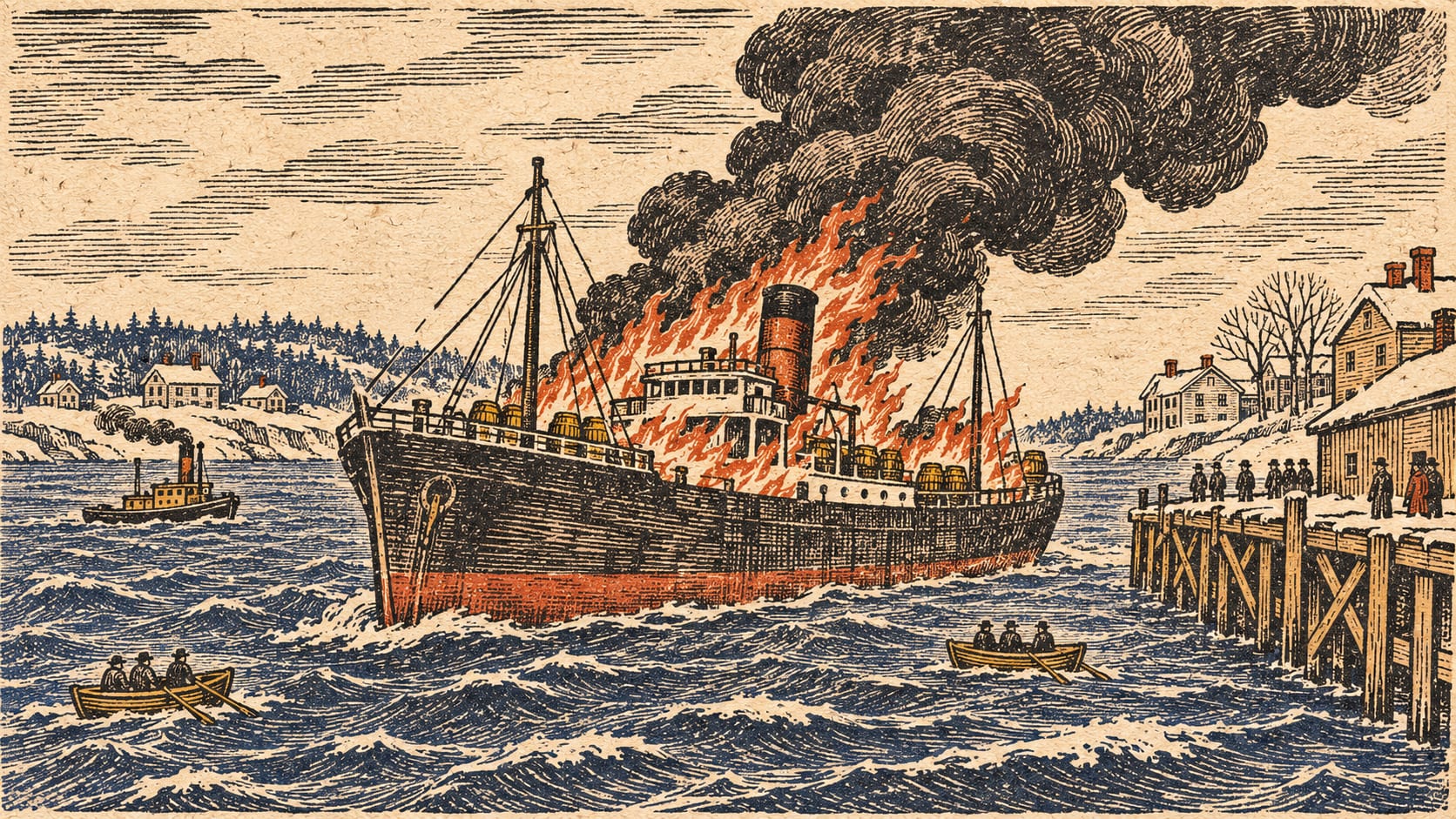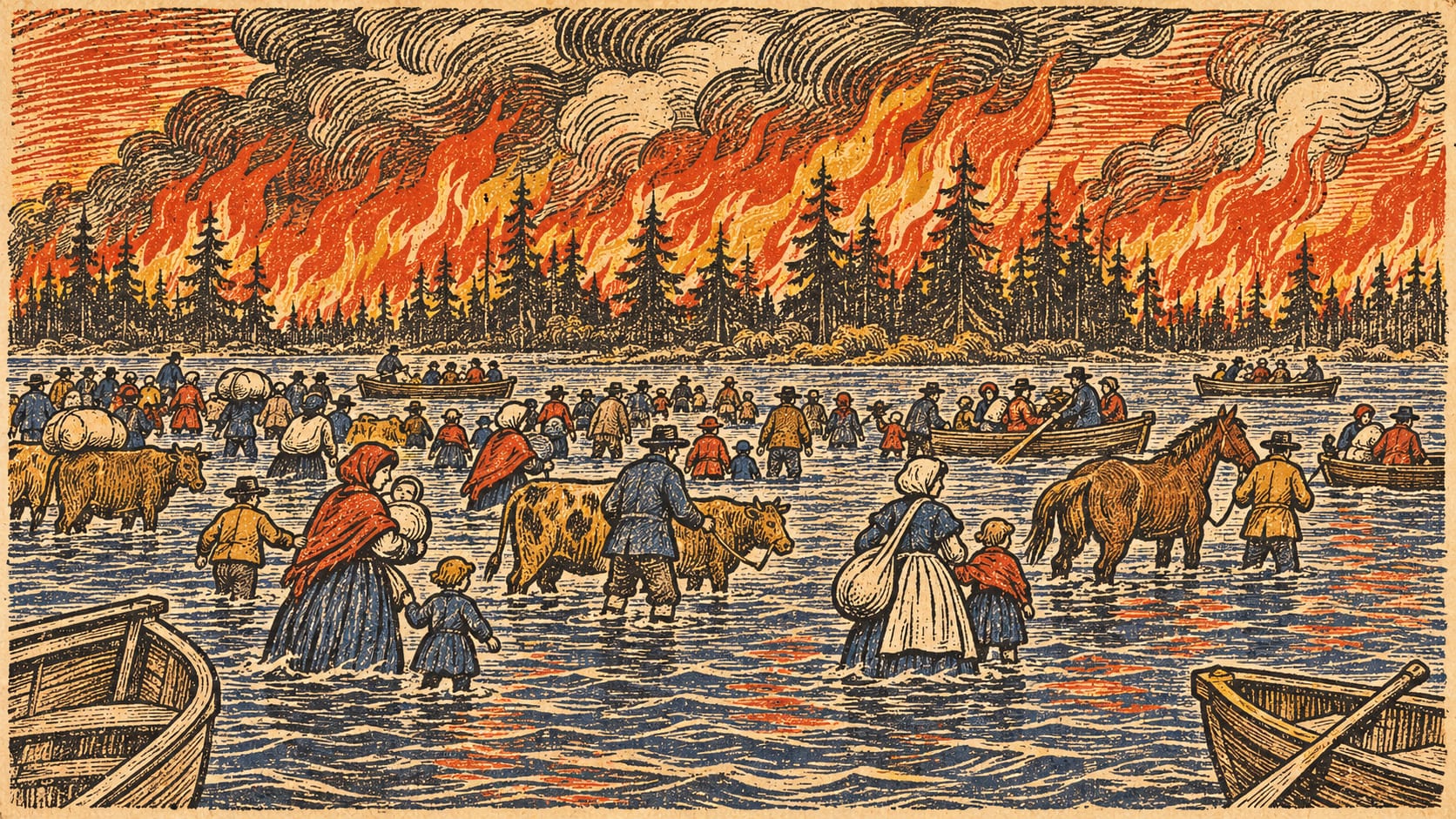
On the night of 8 October 1871, a firestorm largely destroyed the lumber town of Peshtigo, Wisconsin, in roughly two hours. It is usually called the deadliest wildfire in American history, with an estimated 1,200 to 2,400 people killed.
The flames crossed northeastern Wisconsin, reached parts of Michigan's Upper Peninsula and burned communities around Green Bay, across an area put at 1.2 million to 1.5 million acres. Some of the people who lived through it did so in the Peshtigo River, where they stood in the water for hours.
The Great Chicago Fire burned the same night, and Chicago took the headlines. Peshtigo was a separate fire.
A lumber town in a dry year
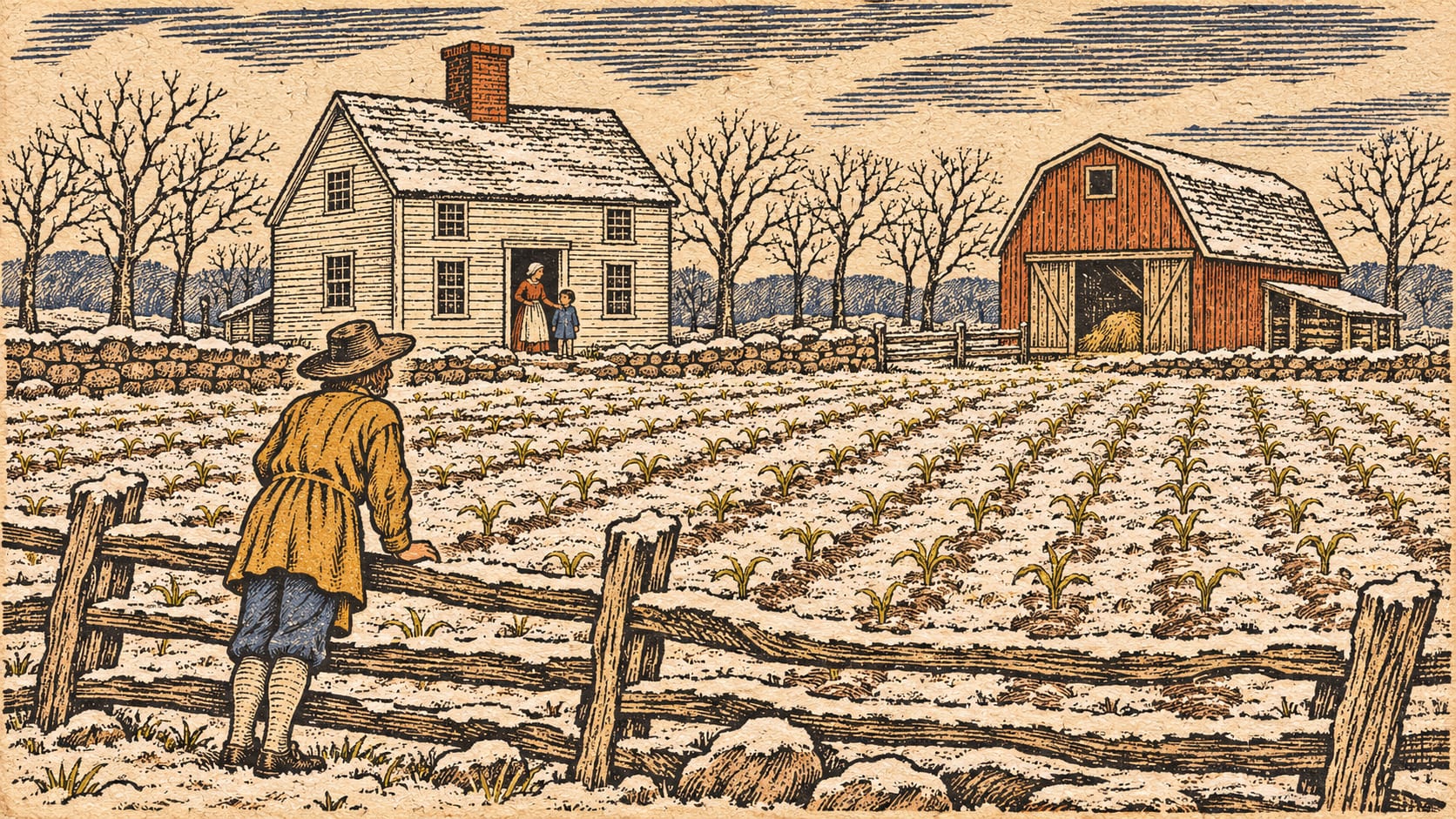
Summer and early autumn of 1871 were unusually dry. High pressure sat over the region from July through September, and rainfall in the preceding months ran at roughly one-fourth of normal. Temperatures were above normal, and smoke from earlier fires hung thick. At Fort Embarrass, about 60 miles southwest of Peshtigo, observers recorded dense smoke and temperatures in the 70s on 8 October. A strong low-pressure system with a high to the southeast drove strong southwest winds across Wisconsin and Michigan.
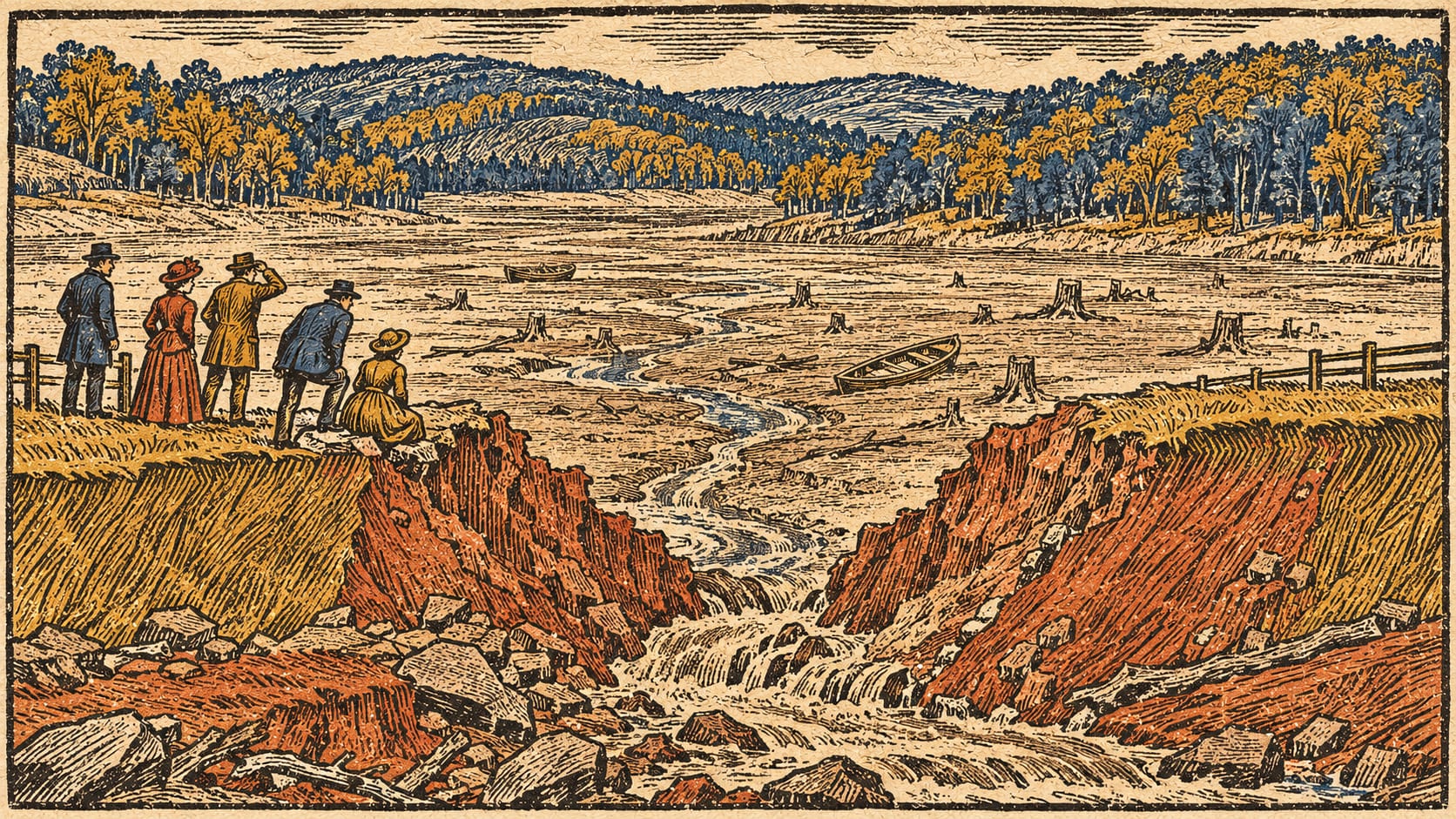
Peshtigo was a lumber town, and logging had left its surroundings full of fuel: slash, sawdust, waste wood and cut timber. Settlers also used fire to clear land for farms and for railroad construction.
Survivors linked the opening brush fire to railroad workers clearing land. The exact place where it started was never established.
The company town
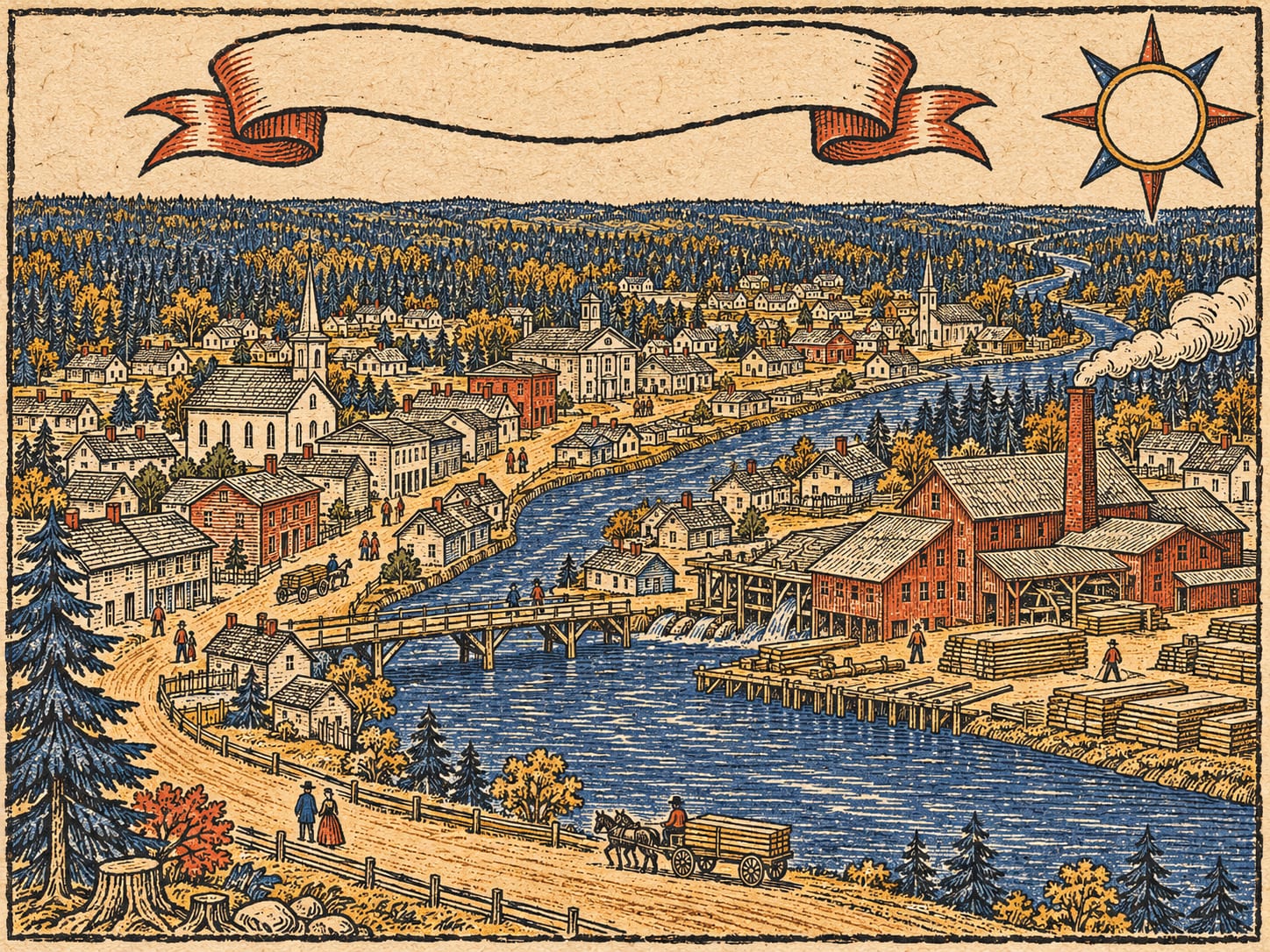
Peshtigo was a company town. William B. Ogden bought the Peshtigo mill in 1856 and founded the Peshtigo Company. In 1867 Isaac Stephenson invested and reorganized it as the Peshtigo Lumber Company, with Thomas A. Bufe as president and Stephenson as vice president and general manager.
The company ran sawmills, a steam mill, a woodenware factory that turned out tubs, buckets and household goods, a dry-goods store, boarding houses, logging camps and barges. Father Peter Pernin wrote that the woodenware factory alone employed "more than three hundred workmen." The Wisconsin marker erected in 1951 calls Peshtigo "a booming town of 1700 people" built around "a woodenware factory, the largest in the country." The company boarding house was among the deadliest places that night, and later accounts commonly put the dead there at about 75.
Two hours on 8 October
The fire reached Peshtigo and largely obliterated the town within roughly two hours. From there it spread across a swath that the Wisconsin Historical Society puts at about 10 miles wide and 40 miles long. The National Weather Service describes about 1.5 million acres burned and at least 17 affected towns.
James Monahan, a laborer in the Peshtigo Company's mill, told a reporter that the wind "was blowing a heavy gale from the southwest, so hard that piles of lumber were upset and boards carried for ten or fifteen rods." He said no rain had fallen for six weeks and that the fire, "carried along by the gale, struck the village about nine o'clock."
Was it a tornado?
Survivors described a cyclone-like firestorm, and the word tornado stuck to the story. Modern explanations read it as a large fire whirl, or fire tornado: intense heat drove rising air, violent circulation, burning embers and fast-shifting winds. Descriptions of the night put the winds above 100 miles per hour. That is an estimate, and no instrument at Peshtigo measured it.
The nearest readings come from elsewhere. A Forest Service reconstruction of the 2 p.m. weather map for 8 October gives 63 degrees Fahrenheit and a 12 mile-per-hour wind at Sturgeon Bay, the station it uses for the fire's location, and winds of 20 to 26 miles per hour in parts of the fire region. Rain came only on 9 October, after the fire, and then just 0.3 to 0.5 inches at Peshtigo.
Standing in the river
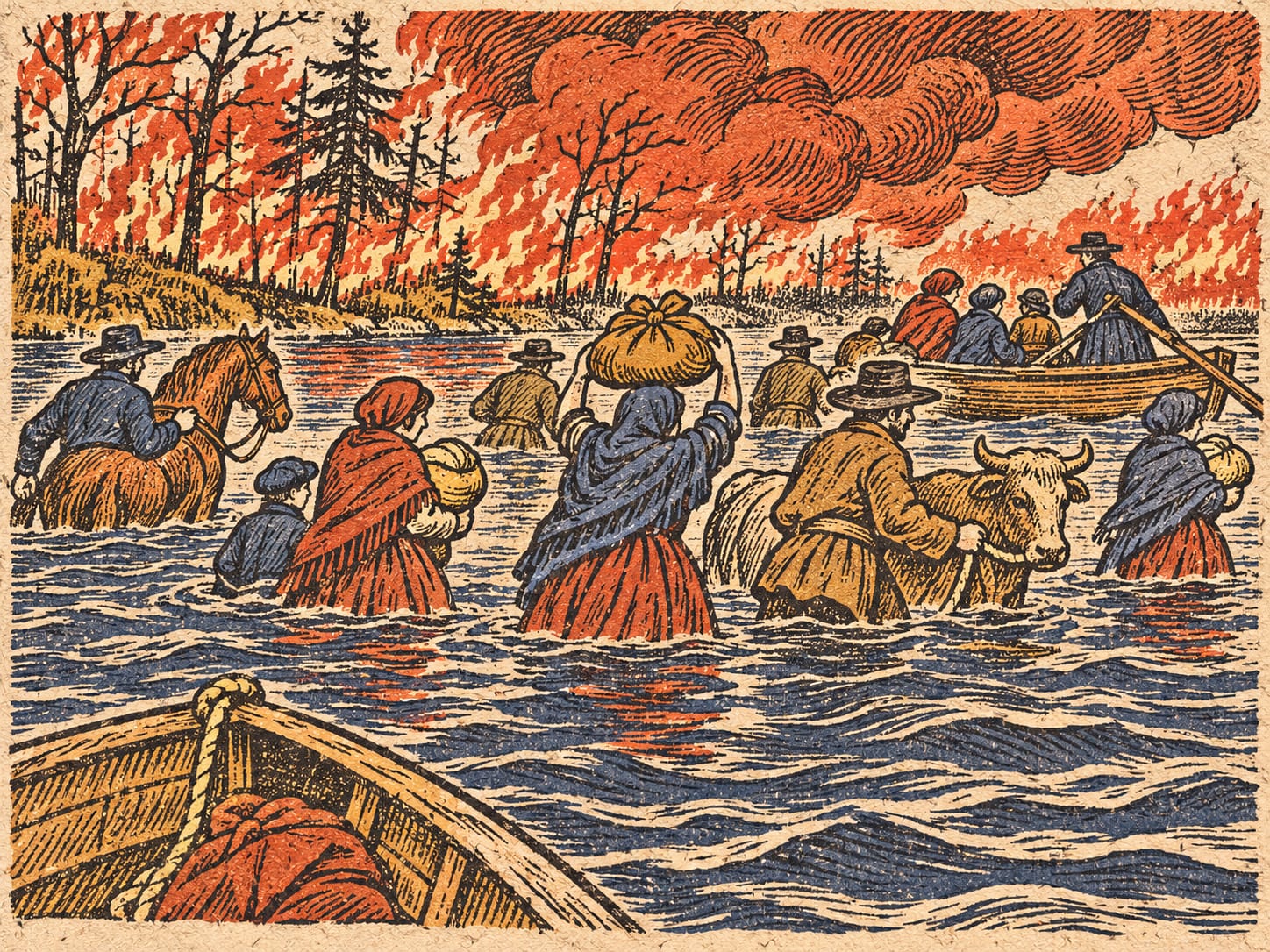
People ran for the Peshtigo River and stayed in the water for hours. Father Peter Pernin, the town's Catholic priest, was among them. His account was published in Montreal in 1874 as The Finger of God Is There! He wrote that by about 7 p.m. on that Sunday he knew he had waited too long: "It would be impossible to describe the trouble I had to keep my feet, to breathe, to retain hold of the buggy which the wind strove to tear from my grasp."
Before he left, he buried his trunks, books, church ornaments and valuables in a trench and covered them with about a foot of sand. He tried to open the tabernacle, dropped the key, and in his words "caught up the tabernacle with its contents" and put it in his wagon. He pushed the wagon as far into the river as he could.
"It was about ten o'clock when we entered into the river," he wrote. He thought that water up to the neck would be safe, and it was not: "the flames darted over the river as they did over land, the air was full of them, or rather the air itself was on fire." People held on to logs, boats, animals and one another. He stayed in the water for about five and a half hours.
When Pernin tried to leave the river, another survivor warned him that his clothing was on fire. After the group left the water, he described temporary blindness, swollen throats, burns, cold and exhaustion. These details are his own testimony.
Voices from the river and the fields
Monahan, the mill laborer, gave his account to a reporter from the Oshkosh Northwestern at Gebauer's Hotel, and the Door County Advocate printed it on 19 October 1871. The paper called it substantially the reporter's version of his statement. Monahan said, "We had to stay in the river from a little before 10 o'clock until daylight next morning." He described the heat: "The heat was so great that we had to keep our faces wet to prevent them from blistering. Our heads took fire and blazed up. Saw logs in the river took fire, and the fire seemed to be all around us."
A family story kept in the cemetery records tells of Terance Kelly, his wife and four children, who lived in the upper Sugar Bush. When the fire came with the wind and smoke, the family became separated. Voices could not be heard above the roar. Kelly and his wife each held a child, and the other two children clung to each other, and each group lost the others. The next day Kelly and a child were found dead nearly a mile from the farm. The mother and another child were safe.
The bell and the tabernacle
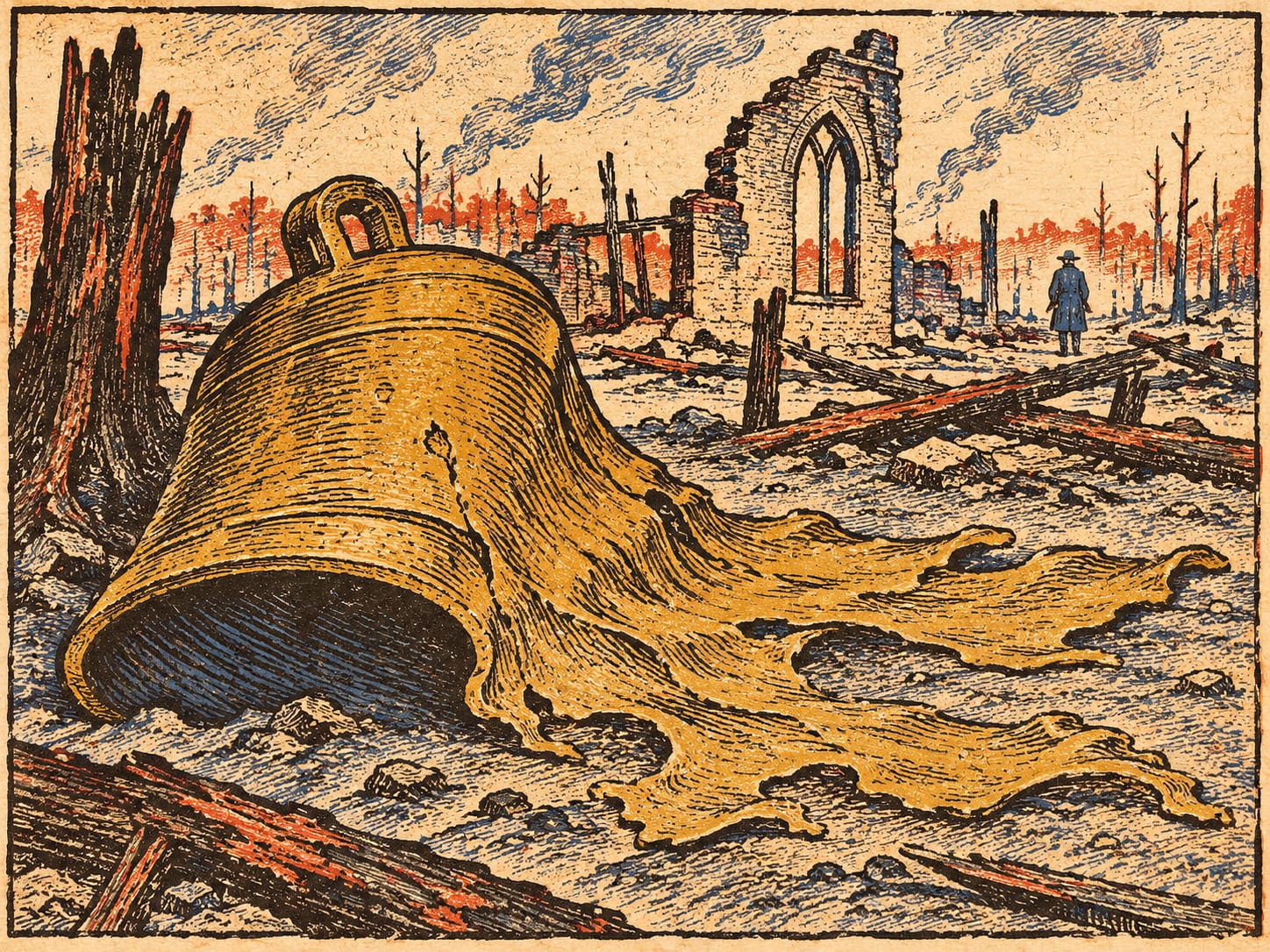
Pernin recorded that his church was ashes, "nothing remaining save the church bell." The bell had been thrown a distance of fifty feet. One half lay intact, and the other half had melted and spread over the sand "in silvery leaves."
The wagon had been blown over on its side, and the tabernacle had been caught up by the wind and thrown onto a floating log. Pernin left it there for two days, then sent it to Marinette. He wrote that the consecrated Host, the monstrance, the ciborium and the inner lining were unharmed. He read that as the work of God.
How the news travelled
The fire destroyed the telegraph lines, so the early reports were fragments. News reached Madison on 10 October. The Milwaukee Sentinel printed a dispatch from Fort Howard, dated 9 October, that passengers on the Escanaba steamer reported "the village of Peshtigo entirely burned, together with some sixty or seventy people." It added, "Those who were saved rushed into the river up to their necks and dashed water over their heads," and "Every house but one were burned."
By 13 October the Sentinel had mail from Green Bay and a far bigger count. It reported that 325 bodies had been found and buried at Peshtigo, with another 100 possibly in the river. The Green Bay Advocate ran an extra page that day with headlines that went on: "Another horror, Burning at Williamsonville: From 50 to 60 Lives Lost," "Another Hamlet Burned, Great Loss of Life!" and "More of the Fires North: Menekaunee and part of Marinette Burned, Loss of life at Birch Creek."
Estimates moved with each steamer and each mail bag. On 19 October the Advocate listed 48 people dead at Williamsonville and described survivors sheltering in a well. It reported about 116 dead between Green Bay and Sturgeon Bay, as a report and not a final count.
Villages beyond Peshtigo
The Peshtigo fire was a group of connected fires across northeastern Wisconsin, the Door Peninsula and adjoining Michigan, not one flame front crossing everything. Among the named communities were Peshtigo Harbor, Williamsonville, Brussels, Sugar Bush, New Franken, Casco, Lincoln, Rosiere, Union, Forestville, Nasewaupee, Sevastopol, Clay Banks, Sturgeon Bay, Birch Creek, Menekaunee, Marinette and Pensaukee.
The reports differed place by place. The Sentinel said Brussels lost about 180 houses and nine people were missing, presumed dead. At Birch Creek an early report gave 10 or 12 deaths and said only three people escaped. Near Sturgeon Bay, four deaths were reported at Williamson's mill, among them Hyppolyte Ligot. The Wisconsin Historical Society gives 128 lives lost in Door County. In Michigan, Menominee was threatened and partly affected, and the wider October fires burned communities in the Upper Peninsula.
How many died
The death toll is an estimate, not a settled count. The figures run from 1,152 known dead plus another 350 believed dead, to 1,200 to 2,400 for the whole burned region, to as many as 2,500 once farms and logging camps are included. About 800 of the dead were people from Peshtigo itself.
The number stays uncertain for plain reasons. Local records burned, many bodies were burned beyond recognition, and some victims lived in temporary lumber camps. Migrant and mobile workers were not reliably listed in town records, and the burned area held many rural settlements. Nobody could take a full census of the dead.
Why Chicago got the headlines
The Great Chicago Fire destroyed a major city, one that mattered for commerce, newspapers, transport and communications. Chicago produced extensive newspaper coverage, illustrations, fundraising and political attention.
The numbers point the other way. Roughly 300 people died in Chicago. Peshtigo's regional toll is generally put at about 1,200 to 2,500, several times as many, from a remote lumber town and the settlements and camps around it.
Peshtigo was a remote lumber town. The fire destroyed the telegraph lines, which delayed word reaching government officials, and it struck scattered rural settlements rather than a famous city. The tragedy was also hard to document, because local records and many bodies were gone. Chicago overshadowed Peshtigo at once, and Peshtigo remains less famous despite its greater toll.
A comet in the story
In 1883 Ignatius Donnelly, a Minnesota politician and amateur catastrophist, put forward a different cause. He proposed that fragments of Biela's Comet had entered the atmosphere or struck the ground and set off the Chicago, Peshtigo and other fires of 8 October 1871.
His reasons were the fires on the same night, reports of flames falling from the sky, odd fire behaviour and melted objects. To him, fires breaking out in several places at once pointed to something from above.
Physical evidence has not established the comet theory. Fire historians and scientists point to drought, dry fuel, logging debris, land clearing and powerful winds. A 2004 aerospace conference paper raised a comet impact again for the Chicago fire, and that idea remains speculative. It is not the accepted explanation for Peshtigo.
Relief and rebuilding
Survivors searched for missing relatives, treated burns and smoke injuries, sheltered in nearby towns and rebuilt homes and businesses. Marinette, about seven miles away, took in injured survivors and opened homes, hotels and other buildings as hospitals.
Governor Lucius Fairchild had set out toward Chicago with supplies. After word of Peshtigo's destruction reached Madison on 10 October, his wife Frances Fairchild redirected a train car carrying food and supplies toward Peshtigo. She organised a blanket drive in Madison and helped coordinate wider appeals, and a carload of food and clothing left Madison on the afternoon of 11 October. Elizabeth Baird and her husband Henry Baird sat on the relief committee that handled what came in. More than $166,000 was sent to Madison for fire relief, a figure for the money sent there and not a national total.
Gifts came from far away. St. Luke's Episcopal Church in Wamego, Kansas, sent $7.50. Sixteen employees at the Kittery Navy Yard in Maine sent $50.50. The mayor of Cambridge, Massachusetts, sent $500. London sent three large bales of new white blankets, reported on 20 January 1872, and Belgian communities raised thousands of dollars, especially for Belgian settlers in Door County. Relief committees in Milwaukee and Green Bay collected cash, clothing, food and other necessities.
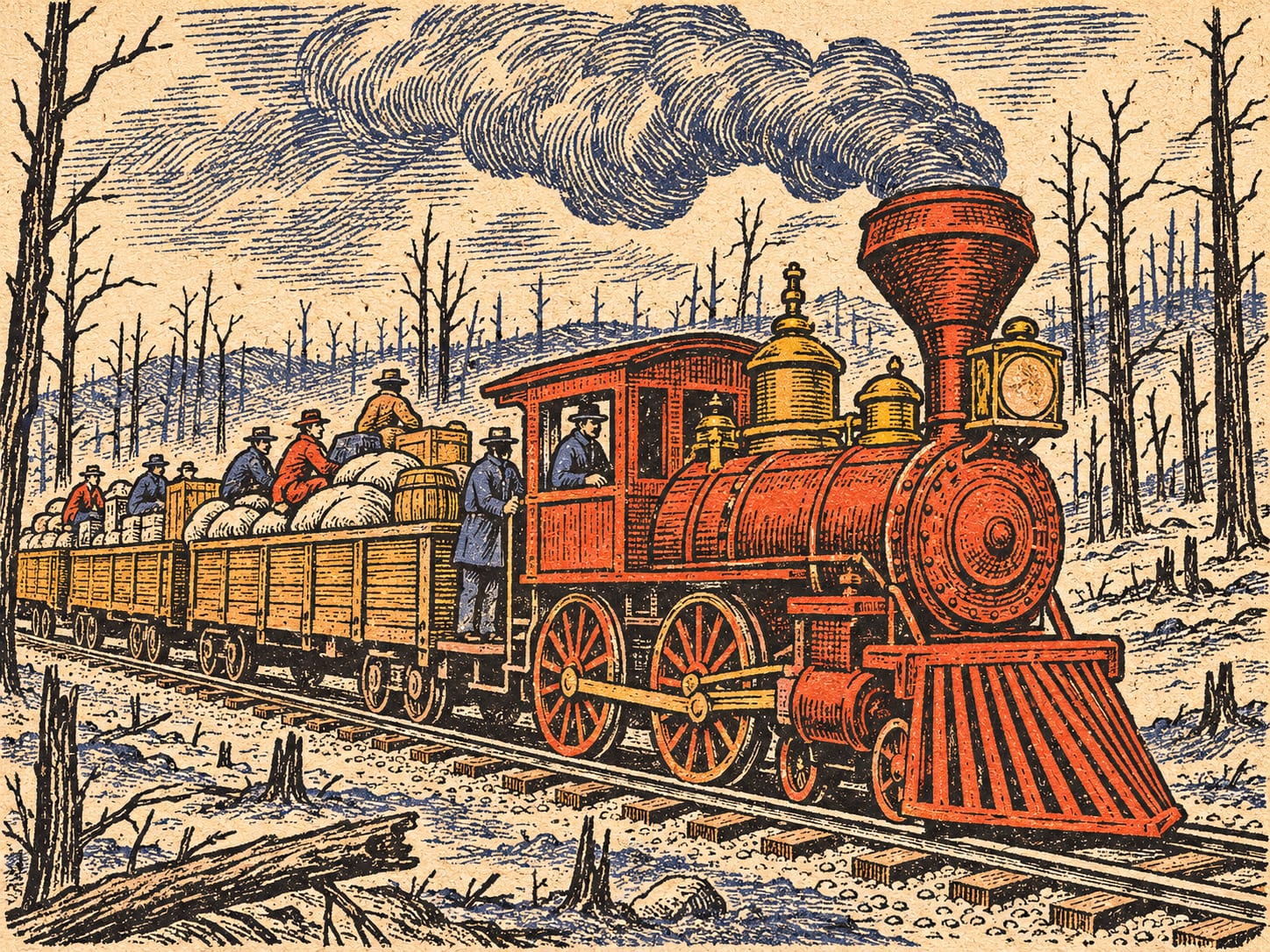
The company rebuilt fast. Isaac Stephenson wrote that the foundry and machine shop resumed work in the second week after the fire, and the railroad extension from Green Bay toward the Menominee was finished on 27 December 1871. The Peshtigo loss was reported at about $400,000 on 10 October. The mills and village were operating again in 1872. Stephenson also wrote that the company withdrew a promised $20,000 toward a $75,000 railroad bonus after the fire, and in 1892 he bought the company and reorganized it as the Peshtigo Lumber Company.
What changed in Wisconsin
The fire helped bring stricter fire-prevention rules. Wisconsin laws passed after it banned burning marshes, fields and woodlots during certain seasons, and a later rule restricted burning timber between August and November.
State forest protection came more slowly. Wisconsin set up town fire wardens in 1905, hired forest rangers in 1911, created fire-protection districts in 1919 and passed a written burning-permit law in 1925.
The Peshtigo fire and what followed
- 8 October 1871
A firestorm destroys Peshtigo and spreads across northeastern Wisconsin
- 10 October 1871
News reaches Madison; the Milwaukee Sentinel prints a major Peshtigo report
- 11 October 1871
A carload of food and clothing leaves Madison
- 13 October 1871
The Sentinel reports 325 bodies found and buried at Peshtigo
- 27 December 1871
The railroad extension from Green Bay toward the Menominee is completed
- 1874
Father Peter Pernin's eyewitness account is published
- 1883
Ignatius Donnelly proposes that fragments of Biela's Comet caused the fires
- 1905
Wisconsin creates town fire wardens
- 1911
Wisconsin hires forest rangers
- 1919
Wisconsin establishes fire-protection districts
- 1925
Wisconsin enacts a written burning-permit law
- 29 March 1951
The cemetery's state historical marker is created
- 1963
The Peshtigo Fire Museum opens
What stands in Peshtigo today
The Peshtigo Fire Museum opened in 1963 in the former Congregational church, a church rebuilt after the fire. It holds period rooms showing life before the fire, household objects, fire artifacts, photographs, maps, survivor stories, paintings of families fleeing, and the tabernacle tied to Father Pernin's account.
Beside it lies the Peshtigo Fire Cemetery, with marked graves and a mass grave for about 350 unidentified victims. Its surname list includes Kelly, Mellen, Merkatoris, Lemke, Drees, Buchholtz, Hoppe, Gilbert and Corbett, and it is not a list of everyone who died.
The marker, created on 29 March 1951, reads in part: "Every building in the community was lost. The tornado of fire claimed at least 800 lives in this area. Many of the victims lie here. The memory of 350 unidentified men, women, and children is preserved in a nearby mass grave." The museum names it Wisconsin's first official state historical marker. Its figure of at least 800 is the 1951 wording for Peshtigo's own dead, and the regional estimates run higher.
Sources
- "The Great Midwest Wildfires of 1871," National Weather Service
- "Peshtigo Fire," Wisconsin Historical Society, and "A Brief History of Peshtigo"
- Peshtigo Fire Museum, museum pages, cemetery page and list of the dead
- "After the Fire," Peshtigo Historical Society
- Peter Pernin, "The Finger of God Is There," Wisconsin Magazine of History, 1919
- Door County Advocate, 19 October 1871; Milwaukee Sentinel, 10 and 13 October 1871; Green Bay Advocate extra of 13 October 1871
- Isaac Stephenson, Recollections of a Long Life, chapter XIV
- Wisconsin Historical Society, relief correspondence and the 1951 historical marker text
- "Fire Weather and the Great Fires of 1871," U.S. Forest Service; Wisconsin State Climatology Office
- Haines and Sando, 1969, U.S. Forest Service
- "The Peshtigo Fire of 1871," University of Illinois Library research guide
- "Saved by the river," Minnesota Public Radio, on Father Peter Pernin's account
- "How the 1871 Peshtigo Fire Became America's Deadliest Wildfire," History
- Peshtigo Fire Centennial Collection, Forest History Society
- Ignatius Donnelly, Ragnarok: The Age of Fire and Gravel, and EARTH Magazine, "The deadliest wildfire in American history"
- Wisconsin Department of Natural Resources fire-history timeline and Wisconsin Historical Foundation conservation timeline
- Peshtigo Fire Cemetery documentation, National Park Service
Watch the full story on the Flashback Fables YouTube channel, and send it to someone who would love it.