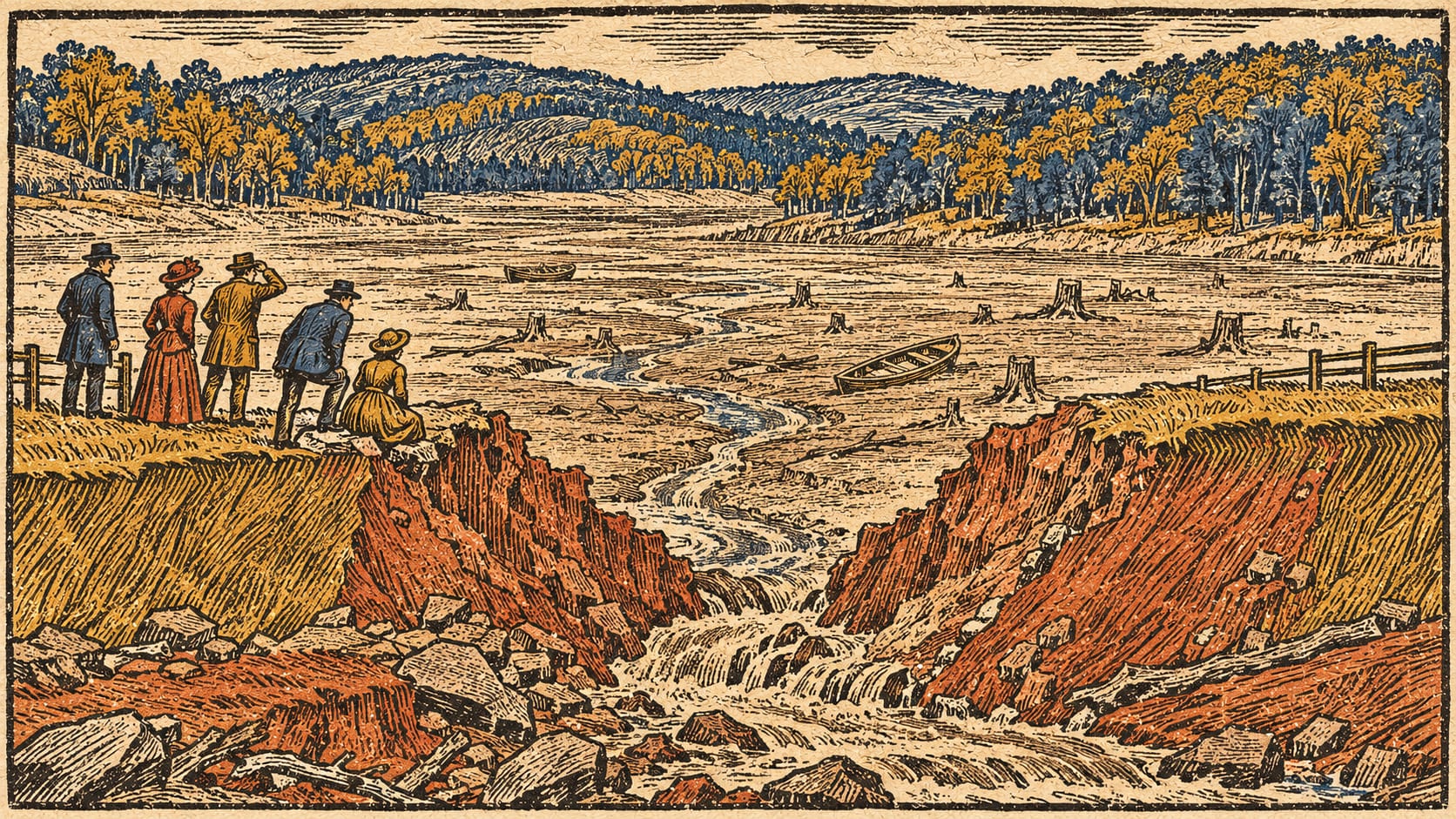
On 31 May 1889, the South Fork Dam in western Pennsylvania broke after heavy rain. The flood that followed killed 2,209 people, the standard published figure, and the National Park Service says the real toll was probably well over 3,000.
The lake behind the dam covered about 450 acres and held about 20 million tons of water. The wave reached Johnstown, about fourteen miles downstream, at roughly 4:07 p.m., less than an hour after the dam failed. Ninety-nine entire families died, and more than 750 victims were never identified.
Warnings went out that day, but they did not reach most of the town in a form people acted on. Engineers and courts argued afterward over who was to blame, and no club member was ever held liable.
The dam above Johnstown
The South Fork Dam was an earthfill dam on South Fork Creek, about fourteen miles upstream from Johnstown. The Commonwealth of Pennsylvania built it between 1838 and 1853 to supply water to the Western Division of the Pennsylvania Main Line Canal.
The reservoir behind it covered about 450 acres. The South Fork Fishing and Hunting Club later called it Lake Conemaugh.
When the Pennsylvania Railroad took over the canal system, the dam changed hands. John Reilly bought it in 1875 and removed five cast-iron discharge pipes from its base. Those pipes had let the reservoir drain. Benjamin Ruff bought the property in 1879 for the South Fork Fishing and Hunting Club, which was set up that year as a nonprofit corporation.
Ruff turned the old canal reservoir into a private recreational lake. He died of cancer on 29 March 1887, more than two years before the flood.
The club repaired the breach from an earlier failure inadequately and did not replace the discharge pipes. It lowered the crest by about two to three feet so carriages could drive across, and it put fish screens across the spillway. During the storm of 31 May 1889, debris clogged the screens.
Warnings before the storm
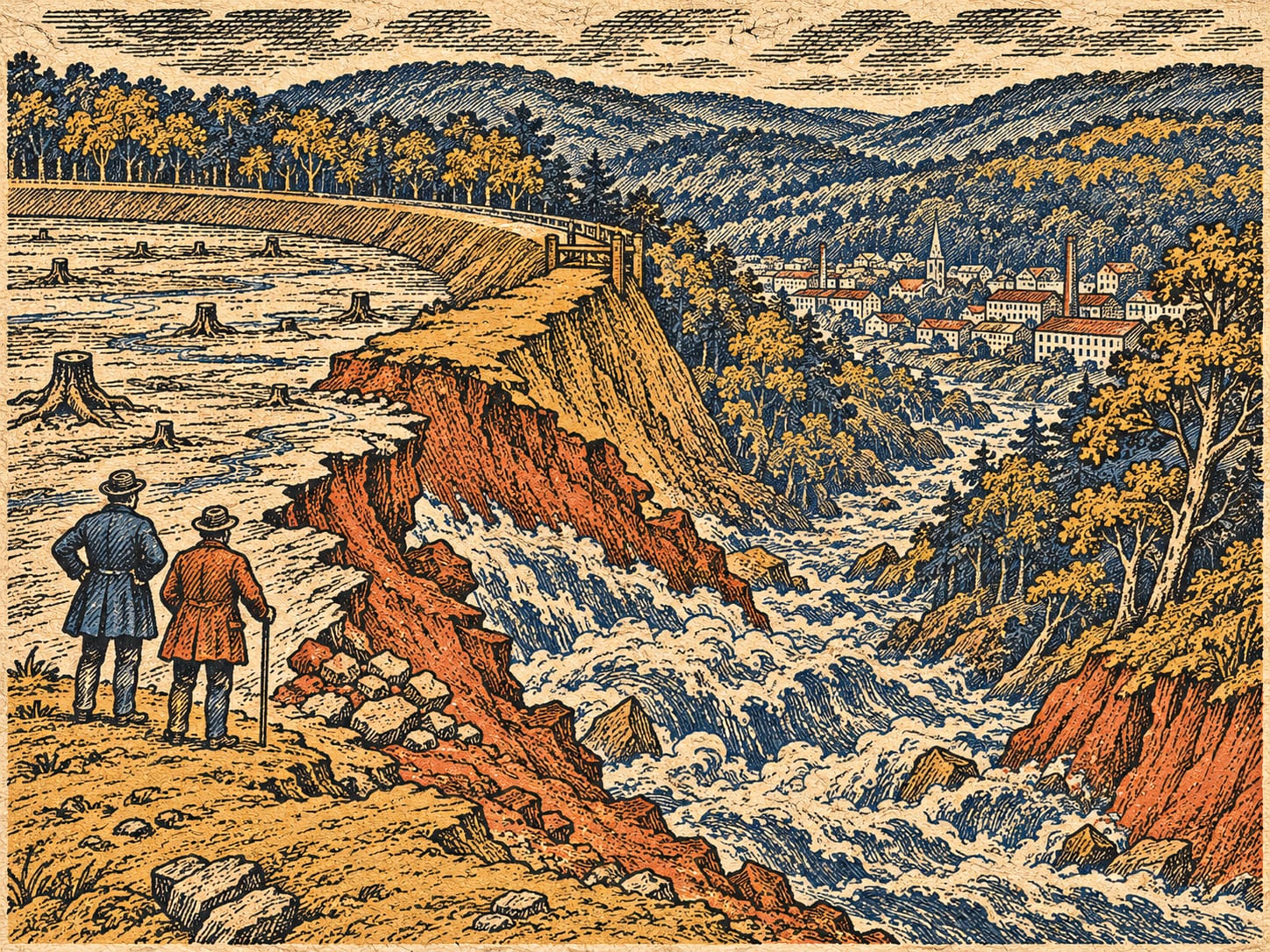
The dam had a long record of trouble. It failed during heavy rains in 1862, though that raised Johnstown's water only two or three feet. After Reilly removed the five pipes in 1875, the lake could no longer be drained safely through the base of the dam.
In late 1880, Daniel Morrell, the head of the Cambria Iron Company, asked John Fulton to look at the rebuilt dam. Fulton was the company's general manager and an engineer. He wrote: "There appear to me two serious elements of danger in this dam. First, the want of a discharge pipe to reduce or take the water out of the dam for needed repairs. Second, the unsubstantial method of repair, leaving a large leak, which appears to be cutting the new embankment."
He added a warning about the leaks: "As the water cannot be lowered, the difficulty arises of reaching the source of the present destructive leaks." And he named the stakes: "Should this break be made during a season of flood, it is evident that considerable damage would ensue along the line of the Conemaugh."
Pennsylvania Railroad engineers inspected the dam too. It leaked often after the club rebuilt it, and talk about its condition went around the Johnstown area. Earlier false alarms and routine flooding had worn down the public's trust in warnings.
Rain, 30 and 31 May 1889
Heavy rain began during the night of 30 May 1889 and carried on through 31 May. Gertrude Quinn Slattery was six years old that morning. In her 1936 book Johnstown and Its Flood, she wrote: "The morning of May thirty-first was dark. There was a mist like the smoke of brushwood fires that changed into a fine drizzle and later into a heavy rain, which came down steadily."
She remembered the streets filling. "Only the ducklings were allowed out in the yard, for the rivers were now over their banks and backing up in the streets so that people living in the lower end were moving all household effects to the upper floors." Her father, James Quinn, feared the reservoir at South Fork would burst.
At the lake, club president Elias Unger saw by early morning that Lake Conemaugh had risen sharply. Unger lived at Lake View Farm, which looked out over the reservoir. He directed workers who tried to clear the fish screens, and they dug an emergency ditch and built an embankment to turn water away from the dam. A later recollection kept by the National Park Service says John Bucannon urged Unger to remove the weir, but it would not budge.
Around 11:00 a.m., a young engineer named John Parke went toward South Fork to spread the warning. Parke worked for the Pittsburgh firm Wilkins and Powell, supervising sewer work at the club. He sent someone to the telegraph station, and messages went out toward Johnstown. At least three warnings left South Fork, and the National Park Service says the latest is believed to have reached Johnstown at about 3:00 p.m.
Between about 11:00 a.m. and noon, water began flowing over the dam's crest, at the lower middle section, then across a far wider stretch of the embankment. The workers kept digging and repairing. Their efforts failed.
The breach came shortly after 3:00 p.m., commonly put at about 3:10 or 3:15 p.m. A later hydraulic analysis places it closer to 2:50 or 2:55 p.m.
The wave
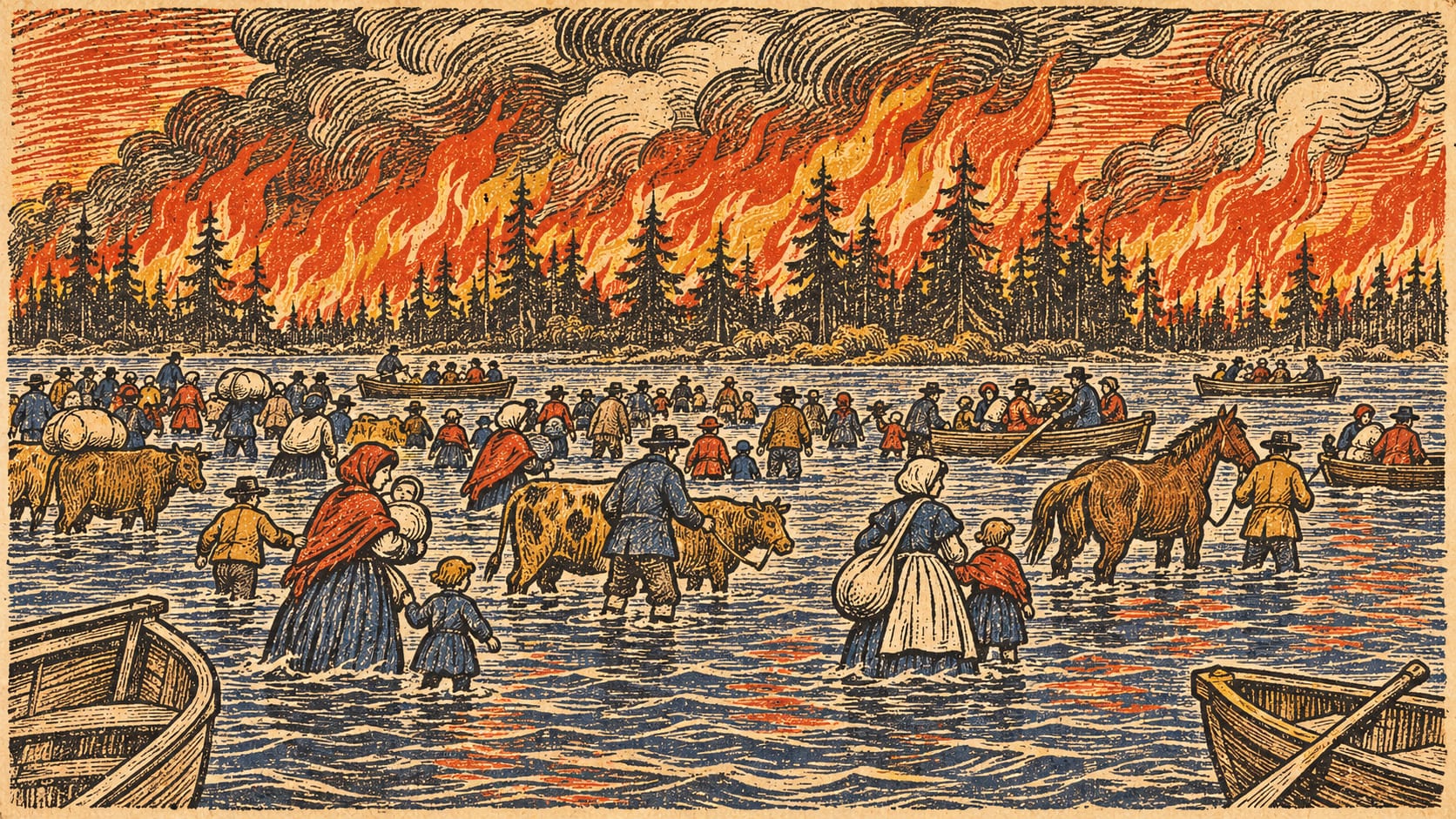
The water swept through South Fork, Mineral Point, East Conemaugh and Woodvale. It carried houses, trees, railroad cars, locomotives and other debris along with it. It reached Johnstown at roughly 4:07 p.m.
Victor Heiser was sixteen. In his later memoir, An American Doctor's Odyssey, he wrote: "I had loosed the horses and was about to leave the shelter of the doorway when my ears were stunned by the most terrifying noise I had ever heard in my sixteen years of life."
He described what came down the street as "a huge wall advancing with incredible rapidity down the diagonal street. It was not recognizable as water, it was a dark mass in which seethed houses, freight cars, trees, and animals." Then he watched his home go: "my boyhood home was crushed like an eggshell before my eyes, and I saw it disappear."
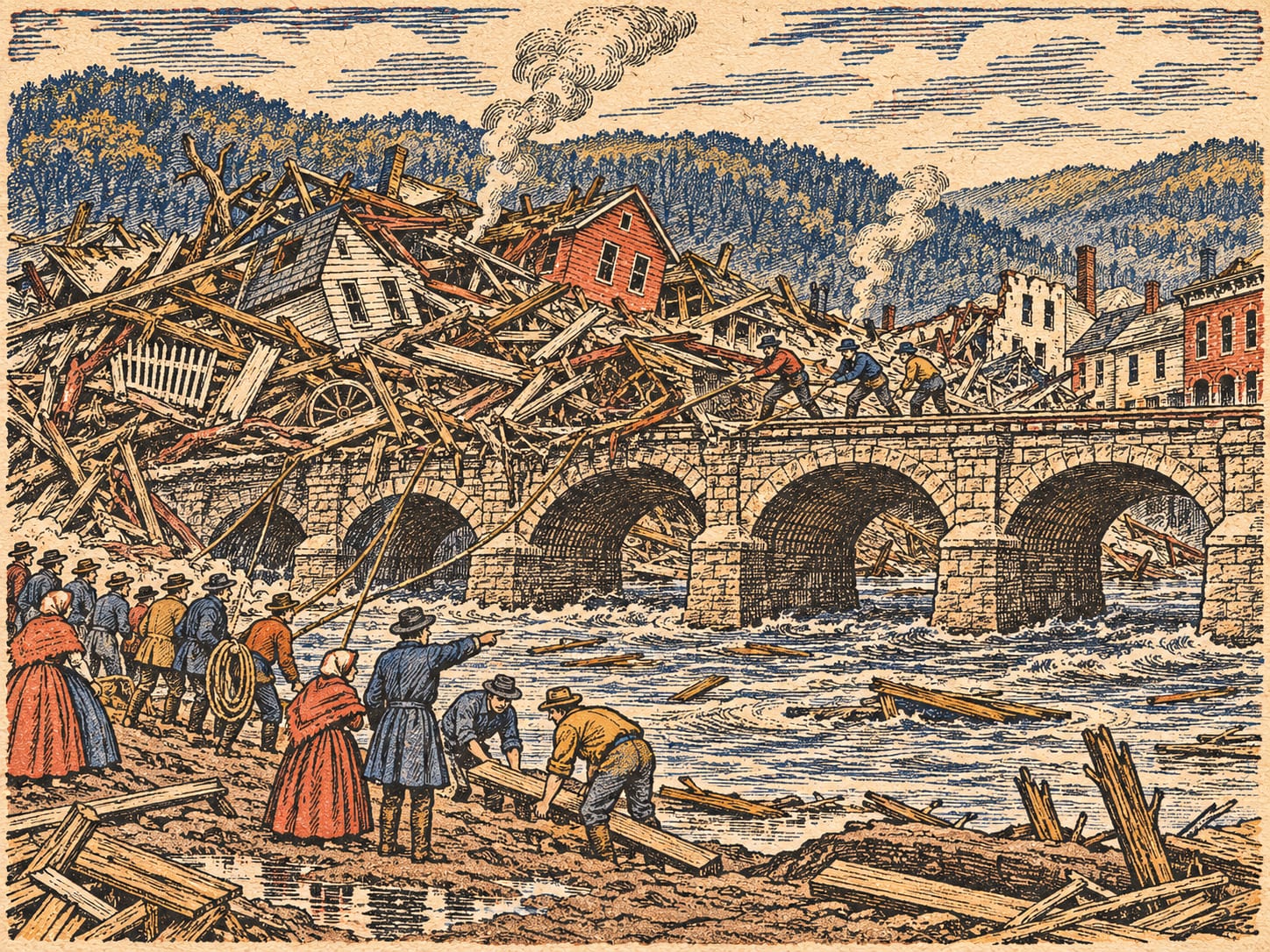
At the Pennsylvania Railroad's Stone Bridge, the debris jam caught fire. The Johnstown Weekly Tribune of 14 June 1889 described the wreckage piling against the Stone Bridge and burning.
The debris pile covered about 30 acres and rose to about 40 feet in places. At least some people trapped in it died in the fire. Heiser remembered the fire this way: "I can still hear the maddened shrieks of the men, women and children, as the flames approached." And: "We could not save them all. It was horrible to watch helplessly while people, many of whom I actually knew, were being devoured in the holocaust."
A commonly repeated estimate puts the deaths in the fire at about 80, but nobody has established how many people died by fire rather than by drowning or crushing.
The people it took
The standard published figure is 2,209 deaths. It is a carefully derived list, not a census of everyone who died, and the National Park Service puts the real toll at probably well over 3,000.
The Johnstown Area Heritage Association records that 99 entire families died, and that 396 children were among the dead.
More than 750 victims were never identified. The commonly cited figure is 777 unidentified people. Their remains were buried in the Plot of the Unknown at Grandview Cemetery.
The morning after
Reverend David J. Beale, a survivor, published Through the Johnstown Flood in 1890. He began the next morning this way: "The dawn of the day after the flood disclosed the wide scene of its terrific disaster. The survivors, after the night of infinite horrors, beheld that which, even in the retrospect, is so overpowering that they are amazed at the retention of their sanity."
The town needed places for the dead. In Beale's words: "In the prosecution of the morgue work, the Fourth Ward school-house, the Presbyterian church, the Millville school-building, the Catholic church in the borough of Cambria, a saloon in Morrellville, and a private residence on the corner of Napolean and South Street, were converted into houses for the dead." Other morgues followed, among them the Pennsylvania Railroad station, the Peelorville schoolhouse, the Grand View Cemetery chapel and Dibert's soap factory.
The Johnstown Weekly Tribune reported that on the night of the flood, "Headquarters for relief had been established, a general morgue opened, and at the most accessible points up and down the valley dead-houses were located." On Sunday, identified victims began to be buried, and "Friends not infrequently had to dig the graves for their lost." By Monday the paper saw the mood turning: "Hope for the old town's future began to mount."
At the citizens' meeting on 1 June 1889, Beale and Reverend H. L. Chapman were put in charge of the burials. Bodies were embalmed, dressed and placed in coffins as supplies arrived. The Pennsylvania Flood Relief Commission's report said: "Opportunity was given for identification, but from the number of morgues, of burial places, and the general confusion, many bodies were never identified."
The Record of Bodies, now digitised by the National Park Service, lists names, descriptions, clothing, keys, watches, money and the relatives who claimed the dead. One entry records Reverend Davin, who ran a Catholic morgue. He said so many bodies came to his church in the opening days of June, and the confusion was so complete, that he "was unable to give descriptions of most that passed through his Morgue; but that he merely counted them."
A contemporary summary counted 2,253 bodies handled by the regular morgues and one temporary site, and called the total approximate. The Cambria City morgue held records for 875 bodies and had descriptions or names for only about two thirds of them. Bodies carried downstream, bodies never recovered and the people lost in the Stone Bridge fire all kept the count from being complete.
Who warned Johnstown
The documented warnings came mainly from people at or near the dam. Elias Unger directed the effort to save it, and he asked John Parke to warn South Fork and Johnstown. Parke reached South Fork around 11:00 a.m. and arranged for a warning to go out by telegraph. W. H. Pickerill's statement, kept by the National Park Service, describes messages sent from South Fork saying the dam was in danger.
Those warnings were sent. They were not widely acted on, because earlier false alarms and routine flooding had weakened public confidence in warnings.
A second story grew up beside the real warnings. Newspapers and early flood books told of a young man on horseback who galloped through the valley shouting, "Run for your lives to the hills!" Tellers called him Daniel Peyton, Daniel Periton or another name.
Nobody has pinned down the rider's identity, route, timing or death. Survivors did not remember such a rider, and Heritage Johnstown reads the story as possibly a blend of several real warnings and rescue efforts. The tale also conflicts with the testimony Reverend David Beale collected from survivors, which says the telegraph operators at Conemaugh received no word that the reservoir had broken and saw the wave itself.
Why the dam failed
In 1891, a committee of the American Society of Civil Engineers took up the question. J. Max Becker was its president, and James B. Francis, William E. Worthen and Alphonse Fteley sat with him. Their report laid out what the club had changed: the missing discharge pipes, the lowered crest, the repaired center section and the fish screens.
The committee wrote that these changes "materially diminished the security of the dam, by exposing the embankment to overflow, and consequent destruction, by floods of less magnitude than could have been borne with safety if the original construction of 1851-1853 had been adhered to." But in its opinion, they "cannot be deemed to be the cause of the late disaster," because the embankment would have been overflowed and the breach formed anyway. The committee also wrote: "It occurred a little earlier in the day on account of the changes, but we think the result would have been equally disastrous, and possibly even more so."
Its technical verdict was plain: "The failure was due to the flow of water over the top of the earthen embankment, caused by the insufficiency of the wasteway."
Later hydraulic studies disagree. In 2016, Neil Coleman, Uldis Kaktins and Stephanie Wojno ran a hydraulic reanalysis and argued that the original dam, with its higher crest, working discharge pipes and auxiliary spillway, had more than twice the discharge capacity of the rebuilt one. They concluded it probably would not have failed the same way.
In their reading, the club's changes most likely turned an overtopping that the dam survived into a destructive breach. The United States Army Corps of Engineers now uses Johnstown as a test case for dam-breach and life-loss modeling.
Either way, the failure itself was an overtopping breach after extreme rainfall.
The lawsuits
Survivors and property owners sued the club, Elias Unger and others tied to it. The club members were not held liable, and no suit won damages against the South Fork Fishing and Hunting Club.
The club's lawyers called the flood an act of God, an extraordinary natural event for which the defendants were not legally responsible. Pennsylvania courts generally required plaintiffs to prove negligence by a particular defendant. That made it hard to hold all the members responsible as a group, especially when the duty for repairs and management was divided.
One named case was brought by Jacob Strayer, a Johnstown lumber dealer, who sued the club for $80,000. It never reached a successful trial judgment. The club became insolvent in 1891, venue changes and other problems slowed the proceedings, and Strayer later went bankrupt.
The Pennsylvania Railroad was treated differently. The National Park Service says the only successful flood-related cases were two property-loss cases against the railroad. In Lang v. Pennsylvania Railroad Company, decided by the Supreme Court of Pennsylvania on 24 April 1893, Lewis Lang sued over whisky shipped on a train that survived the flood. Some of it was stolen, and citizens who had guarded the train broke open the car and destroyed the rest to stop the looting.
The court ruled for Lang. "The flood was therefore not the cause of the loss, but the occasion, the opportunity for its plunder by bad men," it said, and the loss "did not arise from inevitable accident, or the act of God." The railroad's men had been given charge of the freight. The case held the railroad responsible for cargo after the flood had passed, not for the dam.
Andrew Carnegie and Henry Clay Frick were among the club's members. The suits against members failed, and members gave relief donations individually after the flood. The National Park Service's landscape report says victims received no compensation through the courts, and that the disaster fed a later shift, beginning in the 1890s, from fault-based liability toward strict liability for dangerous uses of land.
Clara Barton and the relief
Clara Barton founded the American Red Cross in 1881. Johnstown became its earliest major peacetime disaster-relief operation. Barton arrived on 5 June 1889 with about 50 workers, doctors and nurses among them.
Her organization set up hospitals and handed out food, clothing, furniture and other supplies. It also built six Red Cross hotels for survivors who had lost their homes.
The money figures measure different things. The Red Cross's own cash count in the Pennsylvania Flood Relief Commission's accounting was $39,000. The National Park Service reports that Barton's operation distributed nearly half a million dollars in money and supplies. Heritage Johnstown gives about $211,000 in material relief and about 25,000 people helped, and it puts the wider relief campaign at more than $3.7 million, from the United States and eighteen foreign countries.
Rebuilding
Many survivors left, but most stayed. The Cambria Iron and Steel mill reopened on 6 June 1889, less than a week after the flood. Heritage Johnstown says that by 1910 the city's population had more than doubled from its 1889 level and steel production had quadrupled.
Andrew Carnegie paid to rebuild the Cambria Library, which the flood had badly damaged. The new building went up from 1890 to 1892 and later became the Johnstown Flood Museum. Cambria Iron also planned and financed the Inclined Plane soon after the flood, linking the rebuilt city to homes on higher ground.
The river came back. On 17 March 1936, snowmelt and three days of rain put water about 14 feet deep in places. About two dozen people died, 77 buildings were destroyed, nearly 3,000 were severely damaged, and losses were put at $41 million. President Franklin D. Roosevelt toured the city. After the Flood Control Act of 1936, the Army Corps of Engineers built the Johnstown Local Flood Protection Project, finished in 1943, which channelized about 8.7 miles of waterways.
On 19 and 20 July 1977, thunderstorms dropped as much as a foot of rain in parts of the region, and the water beat the channels' design capacity. Heritage Johnstown counts at least 80 dead, and the National Park Service gives at least 85 for the wider disaster. Corps estimates say downtown water would have stood about 11 feet higher without the channels.
What changed for dams
Pennsylvania did not pass a comprehensive dam-inspection law after 1889. The change came after the Austin Dam in Potter County failed on 30 September 1911 and killed 78 people. On 25 June 1913, the General Assembly passed the Water Obstructions Act, which gave the Water Supply Commission power to regulate dams. The Association of State Dam Safety Officials calls it the nation's first dam-safety law.
The 1977 floods, which broke the Laurel Run and Sandy Run dams and others near Johnstown, led to the Dam Safety and Encroachments Act of 26 November 1978. Pennsylvania's rules today require regular inspections, and annual condition reports signed by a registered professional engineer for high-hazard dams.
Later engineers read Johnstown as a lesson in spillway capacity, altered dam shapes, missing low-level pipes, poor repairs, the lack of qualified inspection and the danger of private dams above crowded valleys. The 2016 reanalysis adds that the 1891 report overlooked the auxiliary spillway and underrated the lowered crest, the missing pipes and the repair fill.
The Johnstown Flood, 1838 to 1913
- 1838 to 1853
Pennsylvania builds the South Fork Dam
- 1862
The dam fails in heavy rain, raising Johnstown's water two or three feet
- 1875
John Reilly removes the five discharge pipes
- 1879
Benjamin Ruff buys the property for the South Fork Fishing and Hunting Club
- 1880
Engineer John Fulton inspects the dam and sees serious danger
- Night of 30 May 1889
Heavy rain begins
- Around 11:00 a.m., 31 May 1889
John Parke carries the warning toward South Fork; telegraph messages go toward Johnstown
- Shortly after 3:00 p.m., 31 May 1889
The dam breaches
- About 4:07 p.m., 31 May 1889
The flood reaches Johnstown
- 1 June 1889
Citizens put Beale and Chapman in charge of burials
- 5 June 1889
Clara Barton arrives with about 50 Red Cross workers
- 6 June 1889
The Cambria Iron and Steel mill reopens
- 1891
The American Society of Civil Engineers committee reports
- 31 May 1892
Grandview Cemetery dedicates the Plot of the Unknown
- 25 June 1913
Pennsylvania passes the Water Obstructions Act
What stands there today
The Johnstown Flood National Memorial protects the surviving ruins of the South Fork Dam, parts of the former Lake Conemaugh bed, the South Abutment, the spillway area and buildings tied to the South Fork Fishing and Hunting Club. Visitors can stand on the remaining abutments and walk through the breach.
The Lake View Visitor Center has views of the empty lakebed, a fiber-optic map of the flood's path, a replica of the morgue book, a list of flood victims and a Victor Heiser exhibit. It also shows the 35-minute film Black Friday. Elias Unger's Lake View House survives, closed to the public, and serves as park offices.
In Johnstown, the Flood Museum fills the old Cambria Library that Carnegie's money rebuilt. High-water marks for 1889, 1936 and 1977 can be read on Johnstown City Hall.
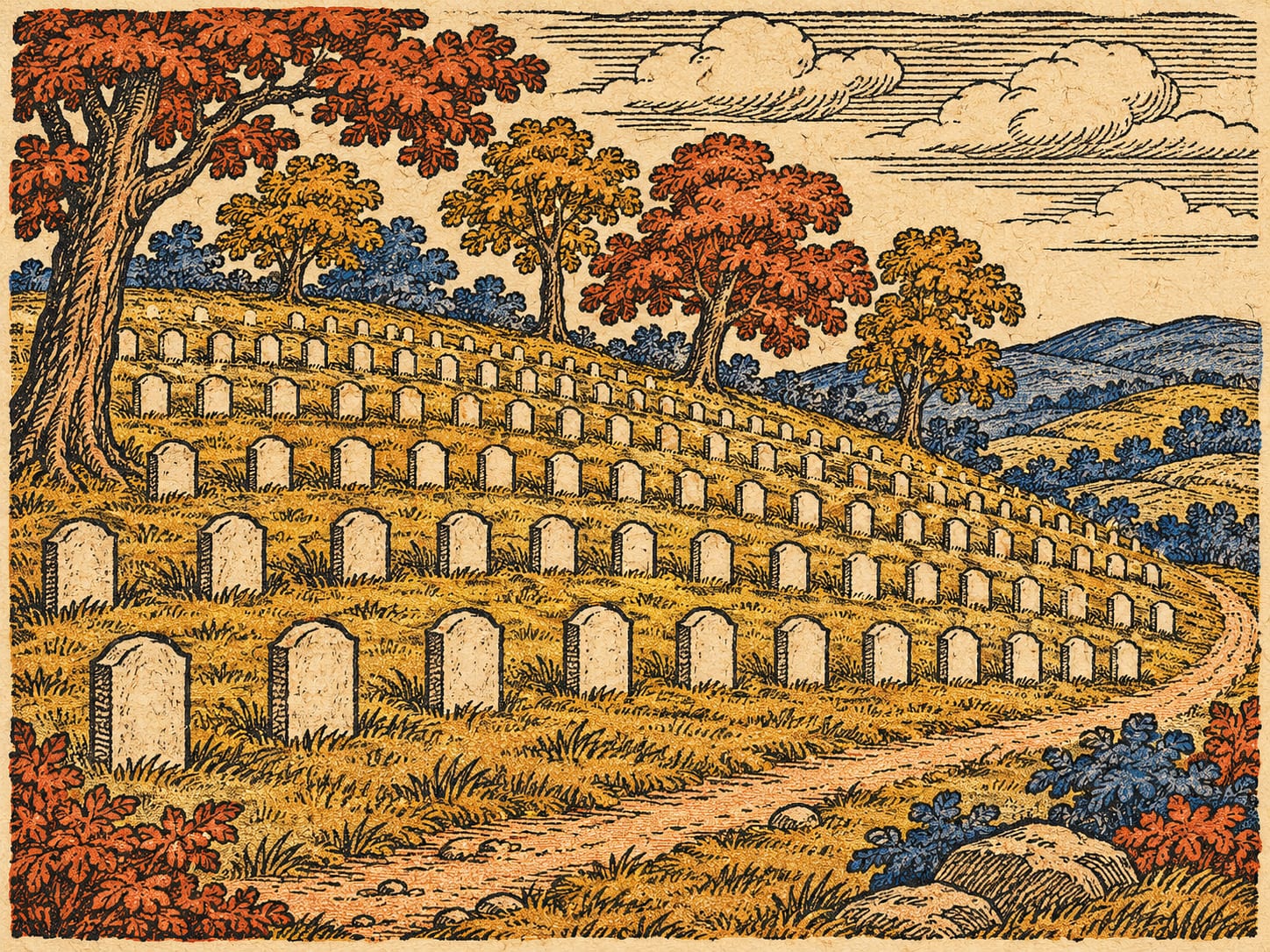
At Grandview Cemetery, the 1889 Flood Memorial marks the Plot of the Unknown, dedicated on 31 May 1892. The cemetery's own site says 777 unidentified victims are buried there, under markers that stand for the group rather than for names. The plot is the main memorial to people whose bodies were found and could not be identified. Some people were never recovered at all.
Sources
- National Park Service, Johnstown Flood National Memorial: "The South Fork Dam," "South Fork Fishing and Hunting Club," "Frequently Asked Questions," "Johnstown Flood Timeline," "Record of Bodies," "Clara Barton," "Colonel Elias J. Unger," "John Fulton," "Gertrude Quinn Slattery," "Visitor Center," and the Statement of W. H. Pickerill
- National Park Service, Cultural Landscape Report, Johnstown Flood National Memorial
- Coleman, Kaktins and Wojno, "Dam-Breach Hydrology of the Johnstown Flood of 1889"
- Heritage Johnstown (Johnstown Area Heritage Association), "Facts about the 1889 Flood," "The Flood and the American Red Cross," "The Peerless Rider," the survivor stories of David Beale and Victor Heiser, "Care of the Dead after the Johnstown Flood of 1889," and "1936 & 1977 Floods"
- Johnstown Weekly Tribune, "Our Calamity," 14 June 1889
- Pennsylvania Flood Relief Commission report
- Report of the Special Committee of the American Society of Civil Engineers on the Cause of the Failure of the South Fork Dam, 1891, and Scientific American, 29 June 1889
- Supreme Court of Pennsylvania, Lang v. Pennsylvania Railroad Company, 24 April 1893
- Association of State Dam Safety Officials, "The Influence of Dam Failures on Dam Safety Laws in Pennsylvania," and Pennsylvania Dam Safety and Encroachments Act
- United States Army Corps of Engineers, Johnstown validation study for LifeSim
- U.S. Geological Survey, "The Floods of July 19-20, 1977"
- Library of Congress, photographs of the debris at the Pennsylvania Railroad stone bridge and the bed of the lake
- Grandview Cemetery, "The 1889 Flood Memorial"
Watch the full story on the Flashback Fables YouTube channel, and send it to someone who would love it.