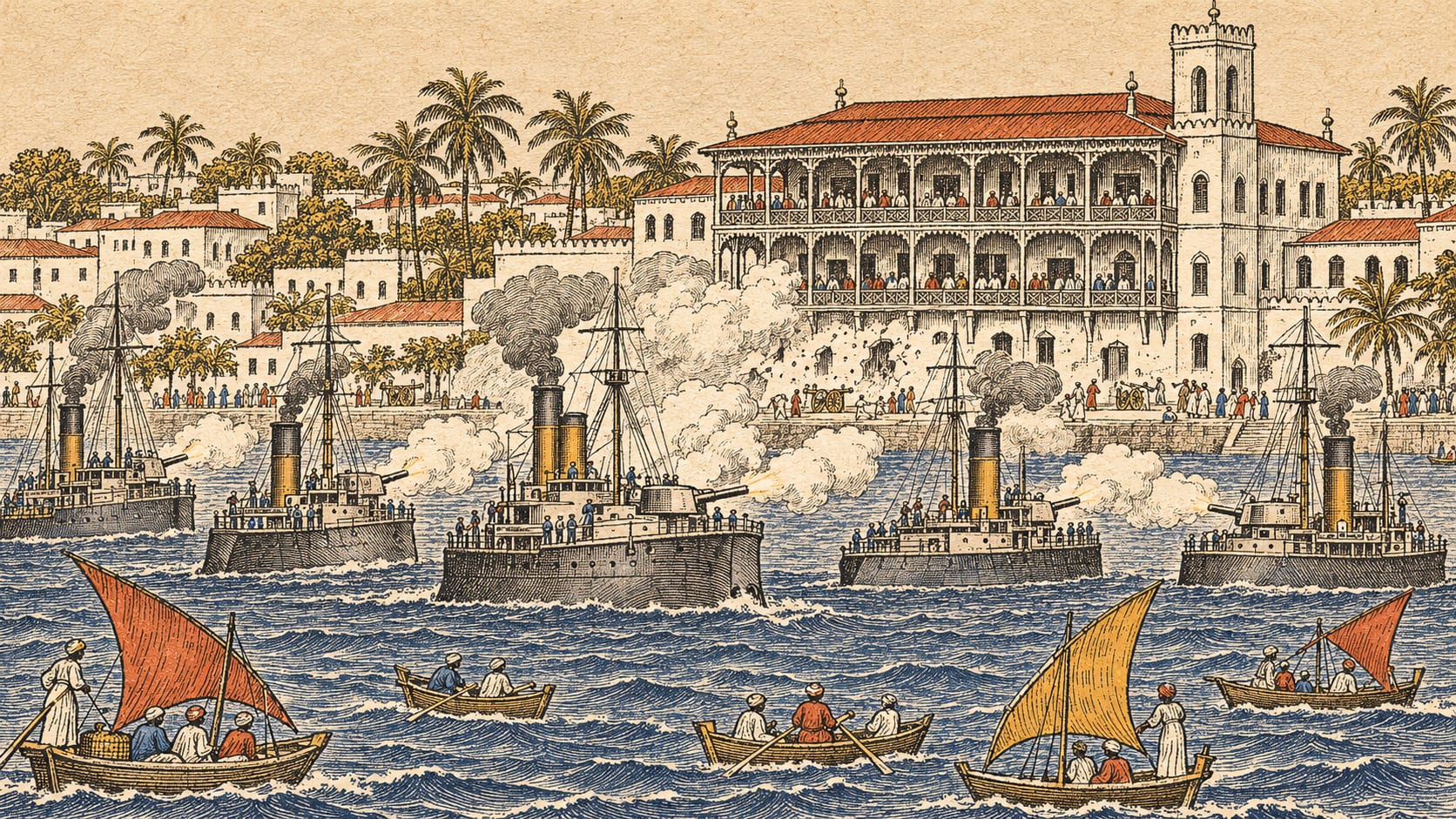
Yes, the Anglo-Zanzibar War was real, and it lasted less than an hour. On 27 August 1896, British warships shelled the sultan's palace in Zanzibar Town, and about 500 Zanzibaris were casualties.
The cause was a succession. Sultan Hamad bin Thuwaini died suddenly on 25 August 1896, and his nephew Khalid bin Barghash took the palace and called himself sultan. Britain wanted a say in who ruled, and it gave Khalid until 9 a.m. on 27 August to leave.
The war is usually put at 38 minutes. Ship accounts end the fighting anywhere from 9:35 to 9:45 a.m., so the span runs from about 38 to 45 minutes.
A sultan dies and a nephew takes the palace
Hamad bin Thuwaini had ruled Zanzibar since 1893. He became seriously ill and died suddenly before noon on 25 August 1896.
Khalid bin Barghash, his nephew, moved into the palace and proclaimed himself sultan. Britain objected. Khalid had not obtained British approval, and the British considered him harder to manage than Hamoud bin Mohammed, the man they preferred. A British consul had written earlier that Hamoud was "easier to lead than Khalid bin Barghash."
The rule was written down. In the Agreement of 14 June 1890, Britain guaranteed the sultan's right to nominate a successor, subject to approval by the British government. Khalid had not obtained that approval. To Britain, his accession was an unauthorised seizure of power and not a succession it would recognise.
Hamoud had long been marked out by the British government as a suitable successor. He was a cousin of the dead sultan, and he stayed at home during the crisis instead of joining Khalid in the palace.
Cave, Rawson and the telegram from London
Basil Cave was the senior British consul in Zanzibar. On 25 August he sent telegrams to London reporting that Khalid had occupied the palace without approval and was gathering armed supporters. Cave asked for authority to use the warships if talks failed, and for more Indian troops from Mombasa.
Lord Salisbury's answer reached him on 26 August: "You are authorised to adopt whatever measures you may consider necessary, and will be supported in your action by Her Majesty's Government. Do not, however, attempt to take any action which you are not certain of being able to accomplish successfully."
Rear-Admiral Harry Rawson, commander of the Cape of Good Hope and West Africa Station, directed the naval side from HMS St George. Captain George Le Clerc Egerton commanded the St George, and Commander Powell Cecil Underwood commanded the Racoon. On land, Brigadier-General Lloyd Mathews, First Minister and commander of Zanzibar's army, directed the loyal forces, with Raikes in command of the Zanzibar government troops.
One account built on Foreign Office files gives the landing force as 230 sailors and 120 marines, with about 700 loyal Zanzibar troops, five Maxim guns and a 17-pounder. Other reports at the time gave different totals.
The ultimatum
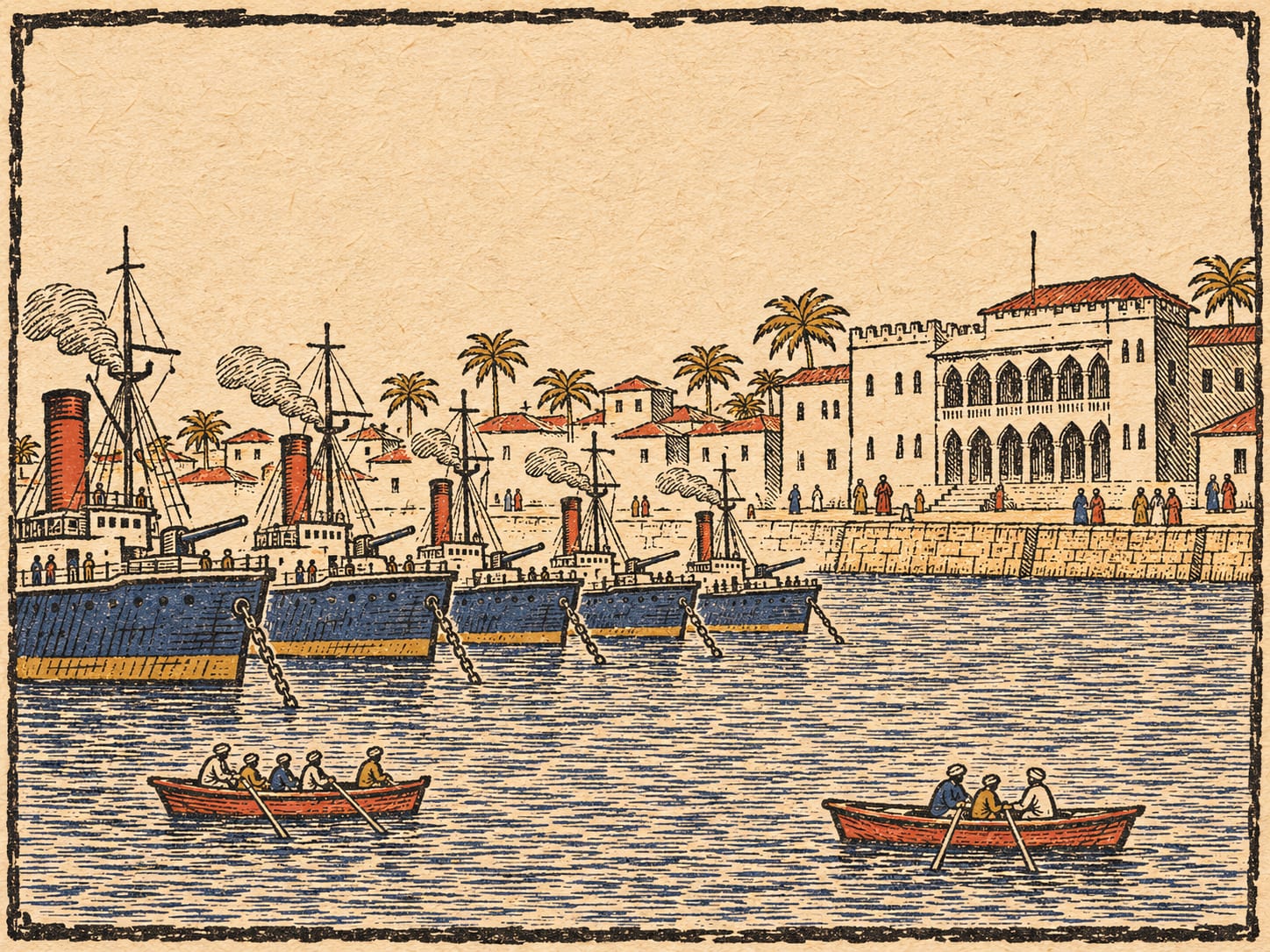
Cave's demand went to Khalid on 26 August: leave the palace and give up the claim. Khalid's representatives met Cave and Rawson that day. Rawson's own report dates his final naval ultimatum to seven o'clock on the morning of 27 August, and the deadline in it was 9 a.m. The British naval force took up positions to open fire the moment that deadline passed.
Rawson's report gives the terms: Khalid was to "haul down the flag, surrender himself to me," and his armed followers were to "pile arms and leave the palace before nine o'clock in the morning to-day, failing which I would open fire on him with the ship's guns." Some accounts add that Khalid was to accept Hamoud bin Mohammed as sultan.
Khalid did not give way. Cave told London that at about 8:00 a.m. a messenger came from Khalid asking for a parley, and that he answered that the only way to avoid shelling was to accept the ultimatum. At about 8:30 another messenger brought the refusal: "We have no intention of hauling down our flag and we do not believe you would open fire on us."
Cave replied: "We do not want to open fire, but unless you do as you are told we shall certainly do so."
An elderly Arab shaykh carried a final exchange. He was told the choice was surrender or bombardment, and his reply was recorded in two words: "Do it."
Who was inside the palace
The men around Khalid are put at very different sizes. One account built on Foreign Office files gives about 2,000 armed men, rising to about 2,500. A later account gives 500 to 600 after the late sultan's private guards joined Khalid. Newspaper reports at the time said 2,500 or 3,000.
The crowd was mixed. Palace guards, Arab supporters, Swahili and Comorian followers, servants, employees and enslaved people were all described among them, so the larger figures count more than soldiers.
Khalid's followers had artillery pieces and guns trained toward the harbour, and one report described guns placed to command the British ships. On the loyal side, three Maxim guns and the 17-pounder stood in the Customs House.
One name stands out among the palace soldiers. Saleh al-Anjizi led them, and he was the man who escaped with Khalid. Cave later called him a wanted participant.
Nine o'clock
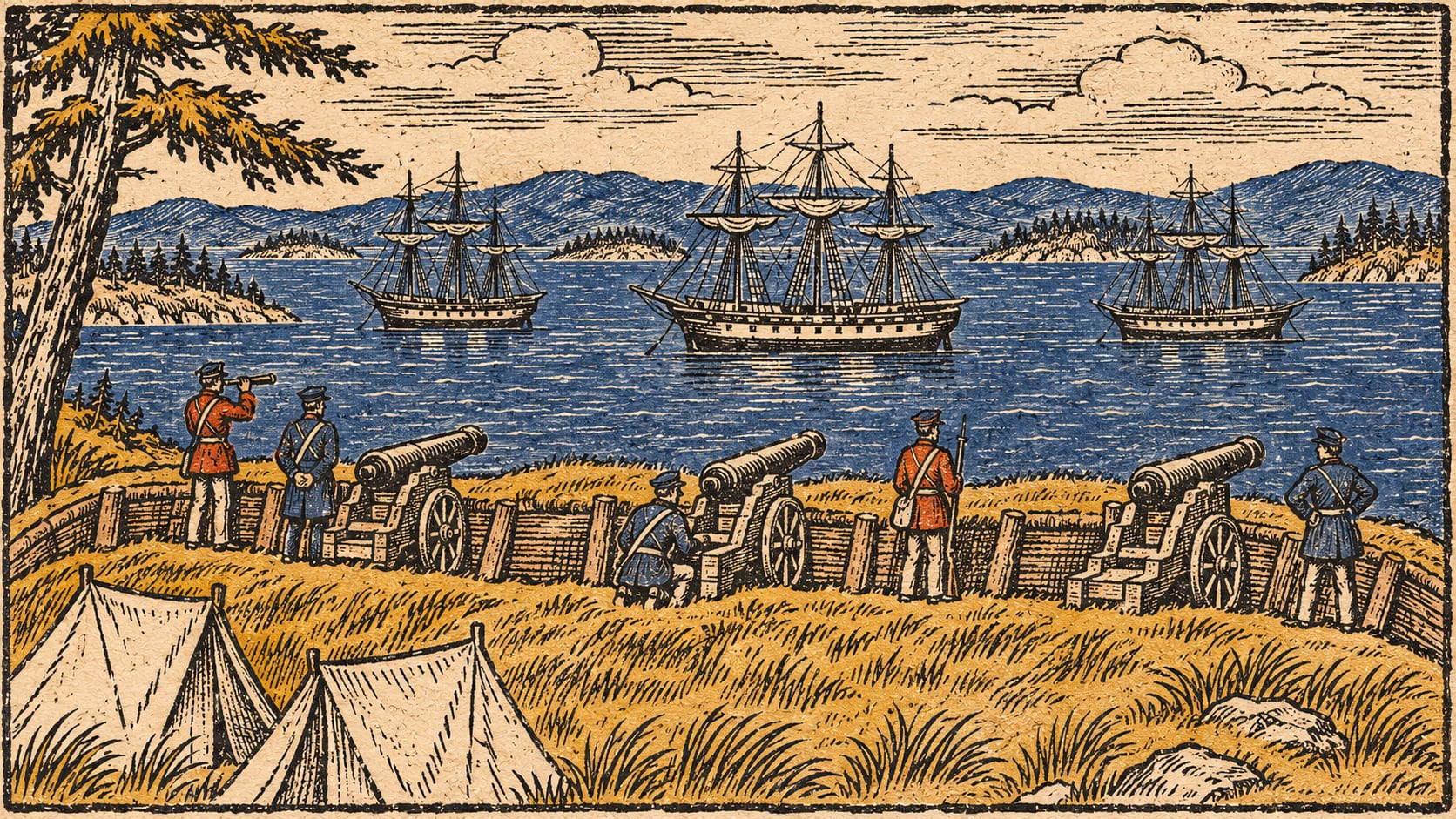
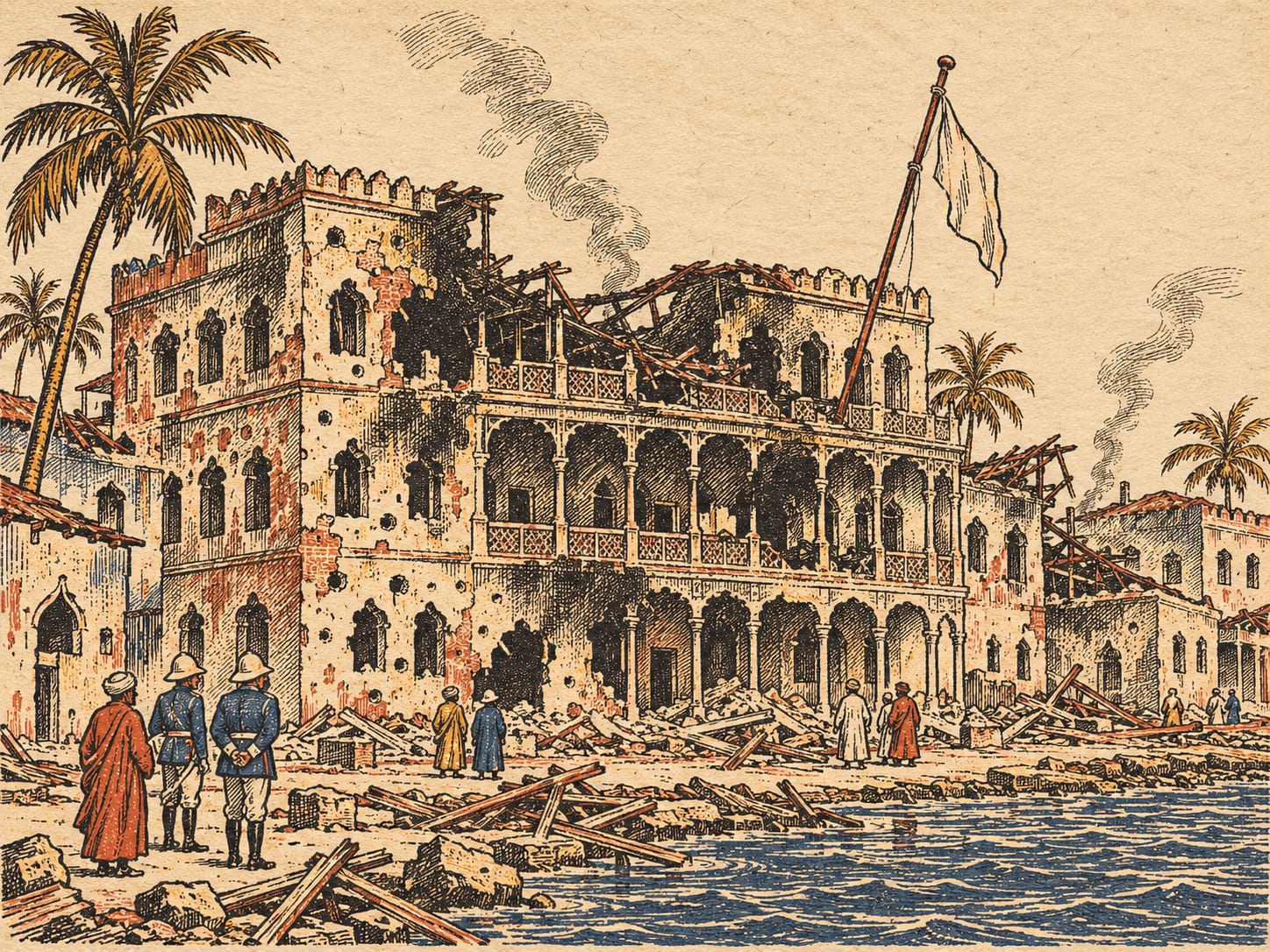
At about 9 a.m. on 27 August 1896, the British ships opened fire on the sultan's palace and harem in Zanzibar Town. The British force was HMS St George, HMS Philomel, HMS Racoon, HMS Sparrow and HMS Thrush. The palace caught fire and was heavily damaged.
Rawson wrote his report to the Admiralty at 2:45 p.m. that day: "At nine I opened fire on the Palace and the corvette, which was promptly returned. At 9.40 I ceased firing. The Corvette was sunk. All the guns were silenced. The Usurper Sultan surrendered to the German Consul."
A midshipman on the St George, T. J. Hardinge, wrote in the ship's journal that "By about 10 o'clock there was only little firing on the enemy's side & the palace was almost in ruins most of it having been knocked down by the bombardment."
Some accounts place the opening shots at two minutes past nine. One reconstruction ends the barrage at about 9:48, when the sultan's flagpole was struck. Other accounts end it earlier, and the ships' own times do not match.
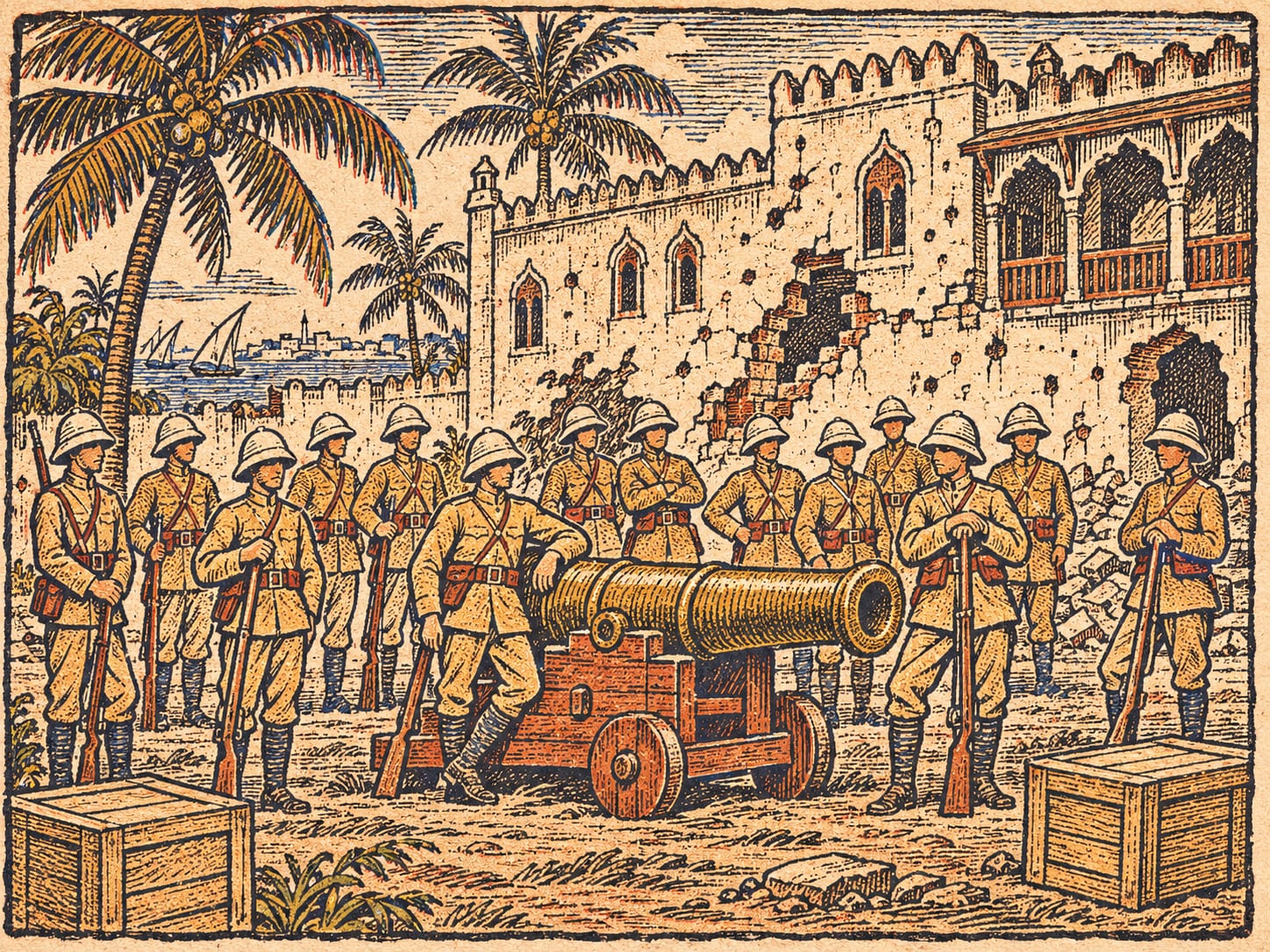
After the palace was taken, British marines were photographed beside a captured Zanzibari gun on 27 August 1896.
How long did it last?
The usual figure is 38 minutes, counted from opening fire at about 9:02 to the surrender at about 9:40. Some accounts count from about 9:00 to about 9:40, which makes it 40 minutes. Others run to the latest reported ceasefire, about 9:45, and get 45. Other reports at the time describe the action as 45 minutes or 50 minutes.
The ships disagree about when the action ended. HMS St George gives 9:35, HMS Thrush 9:40, HMS Racoon 9:41, and HMS Philomel and HMS Sparrow 9:45. The St George's log is reported to tie its 9:35 ceasefire to Khalid going into the German consulate.
Counted by the ships' own times, the fighting lasted about 38 to 45 minutes, and 38 is the figure that stuck.
Is it the shortest war ever fought?
The Anglo-Zanzibar War is widely cited as the shortest war in recorded history. The exact end time blurs the exact length, but even the longest accounts keep the fighting under an hour.
The Glasgow
The Glasgow was an armed steam yacht built in Scotland in 1878 for Sultan Barghash. The story goes that she was a gift from Queen Victoria. What is secure is her construction and her service as the principal vessel of Zanzibar's small navy, with seven 9-pounder rifled muzzle-loading guns and a nine-barrel Gatling gun.
On 27 August she fired on HMS St George. Hardinge wrote that the Glasgow "with startling audacity opened fire on the flagship & was answered by a 6 pdr which went right into her side." The British ships returned fire, and she was hit below the waterline. She hoisted a British flag as a sign of surrender, and HMS Philomel sent help.
Hardinge wrote of her end: "The 'Glasgow' was perceived to be sinking & settled down steadily by the stern till with a sudden plunge she went down, the water spouting in the air as the decks burst."
What happened to the people aboard is told two ways. A Wellington woman who said she watched the bombardment wrote to the New Zealand Times that one woman and half a dozen men who had stayed in their cabins went down with the ship. A Royal Navy history says the crew were rescued.
The wreck stayed in shallow water for years, and early twentieth-century photographs show masts and a funnel above the harbour. A maritime archaeological survey in 2005 and 2006 located the site. What remains is the lower part of the copper-sheathed hull, with more than one metre standing above the seabed on the southern side, brick and probable stone ballast, a drive shaft, scattered ceramics and glass, and no propeller. Salvage divers were removing copper from it while the survey ran.
Khalid, the German consulate and a new sultan
During or just after the bombardment, Khalid bin Barghash left the palace and took refuge in the German consulate, with Saleh al-Anjizi and other supporters. German personnel protected him. The German consul, Albrecht von Rechenberg, refused to hand him over.
Britain installed Hamoud bin Mohammed as sultan, the candidate its administration had wanted from the start. Hamoud ruled from 1896 until his death in 1902.
On 2 October 1896, the German warship SMS Seeadler came into the harbour at high tide. Khalid passed from the consulate grounds straight onto the ship without setting foot on Zanzibar, and she took him to Dar es Salaam.
Who was hurt, and what it cost
The numbers on the Zanzibari side are reasonably close. The Historical Association counts more than 500 defenders killed and one British marine injured. The Bluejackets reconstruction gives 500 Zanzibari dead and two British casualties, a seaman and a petty officer. Other accounts report about 500 Zanzibaris killed or wounded and one British sailor wounded.
Put plainly, the figure is about 500 Zanzibari casualties, and one or two on the British side depending on the account.
One reconstruction also says Zanzibar was charged about 300,000 rupees for the shells and the war damage. That figure comes from a single secondary account.
What changed in Zanzibar
The bombardment strengthened British control. Hamoud bin Mohammed succeeded Khalid, and the protectorate continued: the sultan stayed on as ruler in form, while British officials held the decisive influence.
Slavery's legal status in Zanzibar and Pemba was abolished by decrees in April and June 1897. A Cambridge legal-history study identifies Hamoud bin Mohammed's 1897 Abolition Decree as a major step. The war strengthened British leverage, but the legal end of slavery came through Hamoud's decrees of 1897, and it did not instantly end every form of forced dependency or exploitation.
Zanzibar became independent from Britain on 10 December 1963 as a constitutional monarchy within the Commonwealth. Its 1963 Constitution protected people from slavery and forced labour.
What became of Khalid
Khalid lived in German East Africa for roughly two decades. In the First World War he joined the Germans against Britain, and British forces captured him. One scholar dates the arrest to 1917. Other summaries place it in 1916, when British forces took Dar es Salaam.
As a prisoner of war he was exiled to Saint Helena, and in 1921 he was sent to the Seychelles. By 1925 he had renounced any further claim to the throne, and he was allowed to live in Mombasa.
He died there on 19 March 1927 and was buried in the cemetery of the Sheikh Jundani Mosque, in the burial area of the Salim bin Khalfan Al-Busaidi clan. His wife and elderly mother were reportedly still barred from entering Zanzibar after his death.
What stands on the waterfront
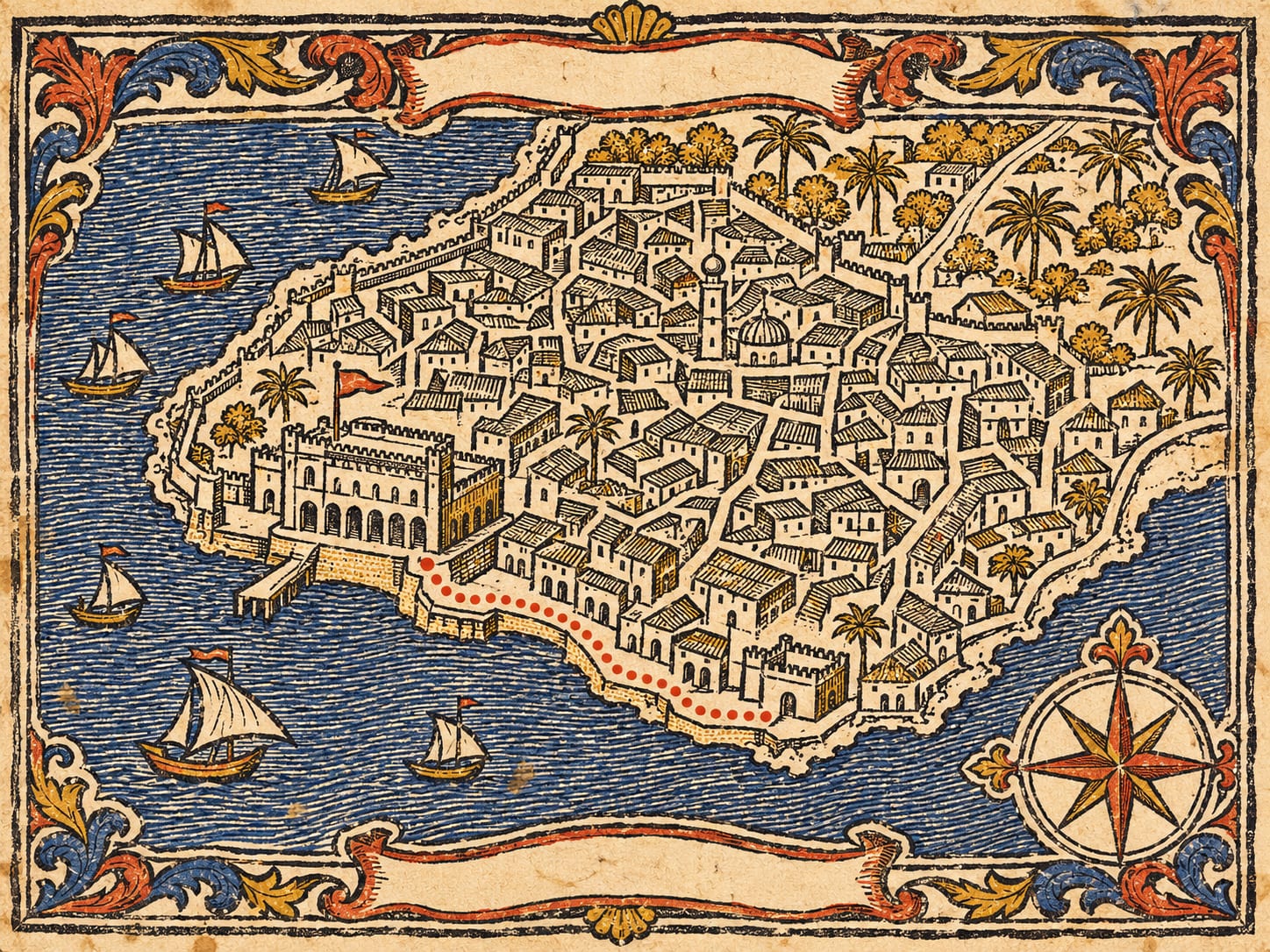
The bombardment destroyed Beit al-Hukum, the government palace, and destroyed or badly damaged much of Beit al-Sahel, the older residential palace. The harem was destroyed or left unsafe, and so was the lighthouse tower in front of the complex. The site of Beit al-Hukum later became a garden.
Beit al-Ajaib, the House of Wonders, came through with less damage. Sultan Barghash had built it in 1883 as a ceremonial palace, and after the bombardment it was the main royal building left on the waterfront. In 1911 it became government offices, and a clock tower went up in front of it in 1987, in place of the old lighthouse structure.
Today Beit al-Ajaib is the most visible surviving building tied to the palace complex. Beside it stand the Old Fort and Forodhani Gardens, and the lower hull of the Glasgow lies under the harbour.
Zanzibar, 1890 to 1963
- 14 June 1890
Britain's agreement guarantees the sultan's right to nominate a successor, subject to British approval
- 25 August 1896
Sultan Hamad bin Thuwaini dies suddenly and Khalid bin Barghash takes the palace
- 26 August 1896
Cave demands that Khalid leave, and Khalid's representatives meet Cave and Rawson
- 27 August 1896, 7 a.m.
Rawson issues his final ultimatum, with a 9 a.m. deadline
- 27 August 1896, about 9 a.m.
British ships open fire on the palace and sink the Glasgow
- 27 August 1896, 9:35 to 9:45 a.m.
The ships' accounts mark the end of the action
- 2 October 1896
Khalid boards SMS Seeadler from the German consulate and is taken to Dar es Salaam
- 1897
Decrees in April and June end the legal status of slavery in Zanzibar and Pemba
- 1902
Hamoud bin Mohammed dies after ruling since 1896
- 19 March 1927
Khalid dies in Mombasa
- 10 December 1963
Zanzibar becomes independent as a constitutional monarchy within the Commonwealth
Sources
- "The shortest war in history: The Anglo-Zanzibar War of 1896," Historical Association
- "The Anglo-Zanzibar War of 1896," South African History Online
- "Anglo-Zanzibar War," The Bluejackets
- Benyan Saud Turki, "Sayyid Khalid Bin Barghash, Britain and the throne of Zanzibar," University Complutense of Madrid
- Zanzibar Treaties collection, including the Agreement of 14 June 1890
- Rawson's Admiralty telegram of 27 August 1896, as printed in the Western Times, 28 August 1896
- "Dictionary of National Biography, Harry Rawson," 1912 supplement
- Ashburton Guardian, 28 August 1896, and New Zealand Times, 3 November 1896, Papers Past
- Log and journal of T. J. Hardinge, HMS St George, extract in a rare-book dealer's catalogue
- "Maritime archaeological survey of Stone Town," International Journal of Nautical Archaeology
- P. J. L. Frankl, "The Exile of Sayyid Khalid bin Barghash Al-BuSa'idi," British Journal of Middle Eastern Studies
- "Beit al-Ajaib" and "Sultan's Palace," Archnet
- "Entre 38 y 45 minutos: Así fue la guerra más corta de la historia," RTVE
- "38 minutos para la Historia: la guerra más corta," La Razón
- "The Sultans of Zanzibar and the Abolition of Slavery in East Africa," Cambridge University Press
- Constitution of the State of Zanzibar, 5 December 1963, Zanzibar Legal Services Centre
- The Illustrated London News, "The Crisis at Zanzibar," 5 September 1896
Watch the full story on the Flashback Fables YouTube channel, and send it to someone who would love it.