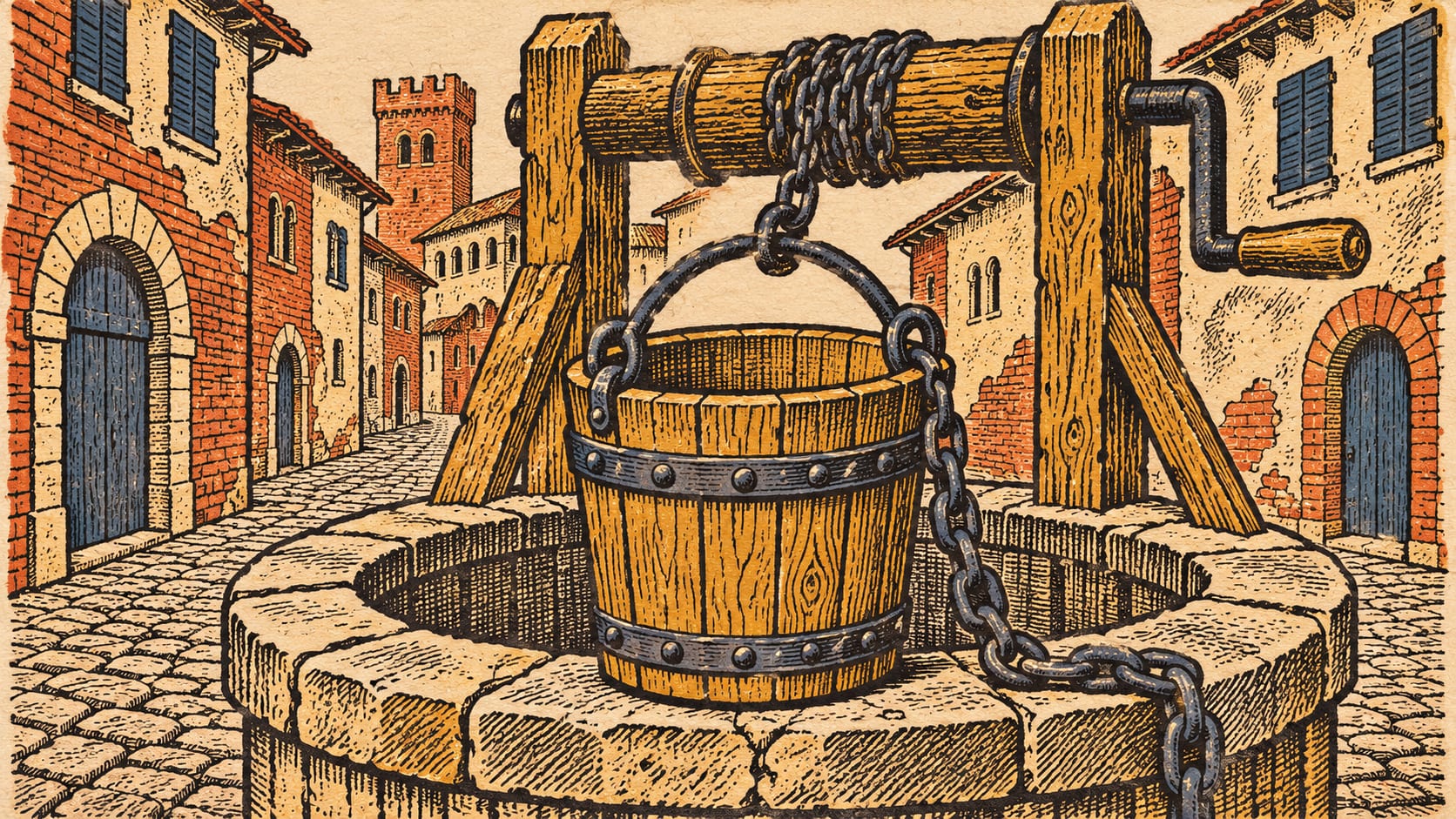
Bologna and Modena did fight a battle in 1325, and a wooden bucket sits at the centre of the story told about it. The bucket did not start the fight.
The Battle of Zappolino was fought on 15 November 1325 on Bolognese ground, near present-day Castello di Serravalle in Emilia-Romagna. Modena and its allies beat the Bolognese army. The two cities were already rivals over land, castles and loyalties.
The bucket arrives afterwards, as a trophy in a tradition that grew up around the victory. Modena still keeps one, and an Italian poet made the whole episode famous.
Two cities on opposite sides
Bologna stood with the Guelf, papal camp. Modena generally belonged to the Ghibelline, pro-imperial camp. Their rivalry ran through border castles, exiles, water routes and rival alliances.
Bologna pushed toward Modena after taking frontier territories such as Bazzano and Savigno. Modena's pro-imperial network tied it to Cremona, Ferrara, Mantua and the Visconti.
That is the documented quarrel: land, power and who answered to whom. The bucket came into the story later, as a symbol hung on a longer struggle.
The Battle of Zappolino, 15 November 1325
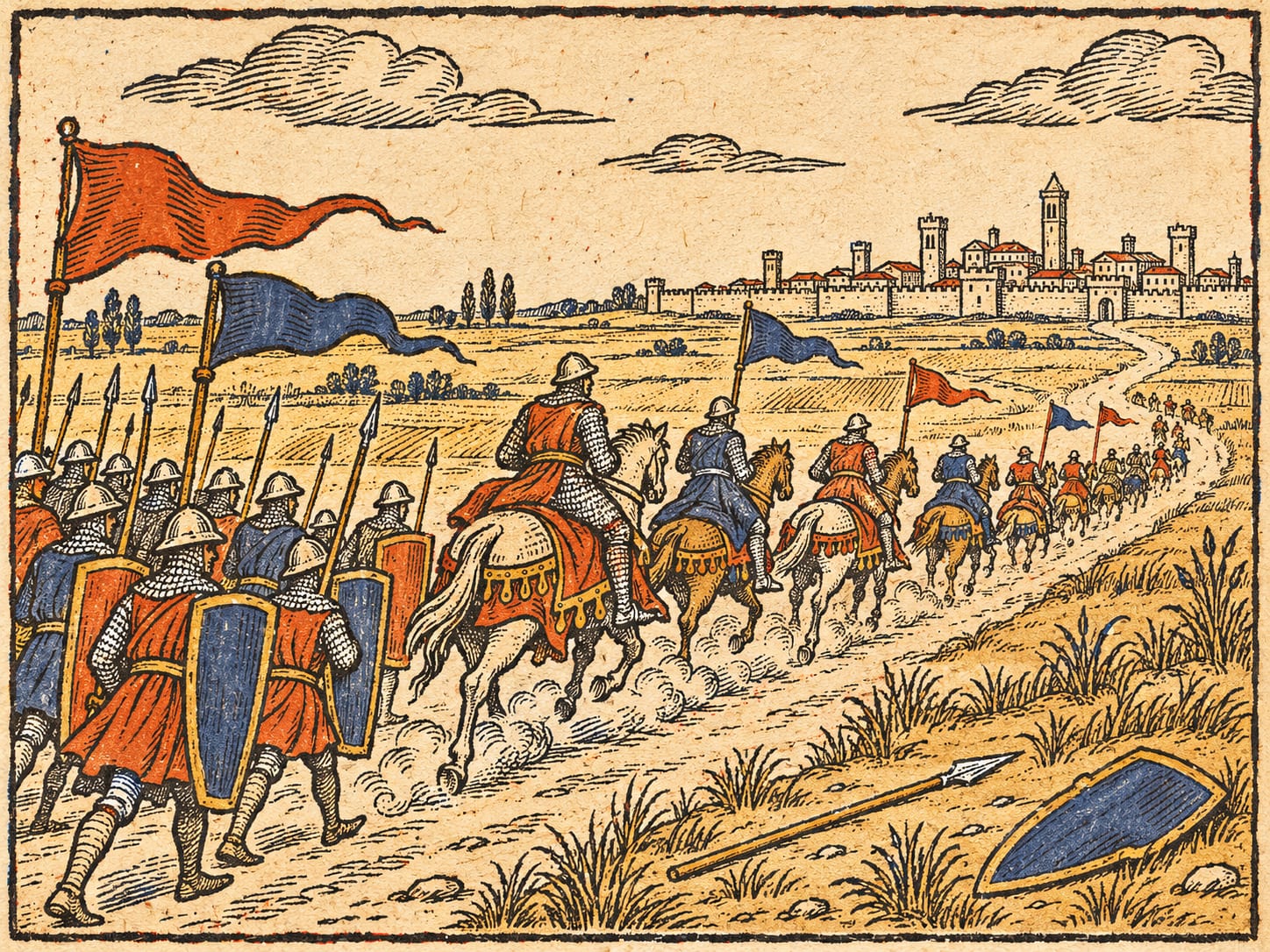
Passerino Bonacolsi, lord of Modena and Mantua, led Modena's forces, and his son Francesco rode with him. Rinaldo II d'Este, marquis of Ferrara, was declared captain general of the army. Azzo Visconti arrived with Milanese cavalry, and the combined force crossed the Panaro, the Muzza and the Samoggia rivers to offer battle at Zappolino. In one account, Gangalando Bertucci di Guiglia led a charge of 200 horse against the Bolognese flank.
Against them stood Bologna's Guelf army under Malatestino Malatesta, its captain general, with Fulcieri da Calboli as captain of the people.
Giovanni da Bazzano's Cronaca di Modena dates the battle to 15 November 1325 and says the Bolognese were beaten by Passerino, his son and the people of Modena, with the help of the marquis of Ferrara and Azzo Visconti. Numbers from the day vary, and every figure is an estimate. Bazzano gives the Bolognese 30,000 infantry and 1,500 cavalry, against 8,000 Modenese infantry and 2,500 cavalry. Another modern reconstruction gives Bologna about 30,000 infantry and 2,000 cavalry against Modena's 5,000 infantry and 2,000 cavalry.
Bazzano reports 600 Bolognese taken prisoner and more than 2,000 killed. Ludovico Antonio Muratori, writing in his Annali d'Italia, also reports more than 2,000 Bolognese dead, and he puts the prisoners above 1,500. He names the captured podestà of Bologna, Angelo da San Lupidio, and Malatestino Malatesta among them. Muratori describes a rout: at the opening assault the Bolognese were overturned, and they used their feet instead of their hands.
Bonifacio Morano's chronicle adds a harsher detail. It says captured Bolognese were sold over the ditches of their own city, like animals, by the men who had taken them. It names Alberto Boschetti, a Guelf from Modena, as killed in the battle, and Sassolo da Sassuolo, Jacopino Rangoni and Gherardo Rangoni as prisoners. Sassolo later died in captivity.
Modena chased the beaten army toward Bologna, took Crespellano, burned settlements near the city, damaged fortifications and waterworks, and strengthened Ghibelline influence in the region.
A victory that did not hold
The peace of 28 January 1326 undid much of the win. Passerino gave Bazzano and Monteveglio back to Bologna, along with the prisoners, except Sassolo da Sassuolo. Bologna returned Nonantola and the tower of Canoli to Modena. The deal was politically poor for Passerino, whatever the field had shown.
The leaders of the winning side did not fare well either. Passerino lost Modena in 1327. On 16 August 1328, an uprising led by Luigi Gonzaga, with his sons and Veronese troops, overthrew and killed him in Mantua. His son Francesco and other relatives were imprisoned and died in captivity.
Azzo Visconti was imprisoned with his father Galeazzo in Monza in 1327, became imperial vicar of Milan in January 1329, and died of gout on 16 August 1339. Rinaldo d'Este fell ill during a siege of Modena in 1335, was taken to Ferrara, and died there on 31 December 1335.
Where the bucket story starts
The story goes that Modenese soldiers took a wooden well bucket from Bologna and carried it home as a trophy. Tradition places the well near Via San Felice, or Porta San Felice.
The earliest written witness cited for the bucket is the Cronica di San Cesario. It describes the 1325 defeat of Bologna and says the Modenese chased the fugitives into Bologna, took a bucket near the San Felice road and carried it back to Modena. The text that survives was written or copied in 1494, and copied and circulated again in 1523.
A 1502 inventory of the sacristy of Modena Cathedral lists "a wooden bucket that has around it three iron bands with an iron chain, which once belonged to the Bolognese."
Why the bucket is a later tradition
Doubts are old. The Modenese chronicle linked to the Tassoni family does not mention the bucket, and many other early chronicles leave the episode out.
Versions of the story disagree on when the bucket was taken. Some place it after the battle of 1325, some during the pursuit toward Bologna, and some tie it to the earlier Battle of Fossalta in 1249.
Muratori noted that older Modenese histories said nothing of the bucket. He asked whether its link to Bologna had been imagined later.
The documented part is the battle and its political causes. The bucket as the cause of the war is legend. A bucket may well have been carried home as a trophy after the fighting, but when and how it was taken remains disputed.
Nor does any treaty paper show Bologna asking for it back. The surviving evidence covers the territorial swap, the prisoners and the return of Nonantola and Canoli, and no clause about a bucket.
The poet
Alessandro Tassoni was born in Modena on 28 September 1565 and died there on 25 April 1635. He studied law at Bologna, Pisa and Ferrara, and he joined the Accademia della Crusca in 1589. From 1599 to 1604 he served Cardinal Ascanio Colonna and followed him to Spain. Later he worked for Cardinal Cesi and the Savoy court, and from 1626 to 1632 for Cardinal Ludovico Ludovisi.
He wrote La secchia rapita, or The Stolen Bucket, around 1614 to 1615. A letter of 26 December 1615 says he had spent ten months on it and had ten cantos done, though he meant to write twelve. The poem passed around in manuscript before it was printed: in a letter of 7 January 1616 he told Albertino Barisoni about the Secchia reaching Modena. On 28 April 1618 he wrote in a hurry to publish, because he had heard that Francesco Bracciolini was preparing a rival mock-heroic poem.
The poem is mock-heroic. It uses the grand language and structure of epic poetry for a comic subject, and it turns the central prize into an ordinary wooden bucket. Tassoni opens by promising to sing of "that memorable anger" that once fired fierce human hearts over "an unhappy and worthless wooden bucket" that the Gemignani took from the Petronians. The Petronians are the Bolognese, named for Saint Petronius, and the Gemignani are the Modenese, named for Saint Geminianus.
That is the reason for the title. Tassoni treated the bucket as an epic prize, in the way classical poems treat the objects heroes fight over.
A scrambled war
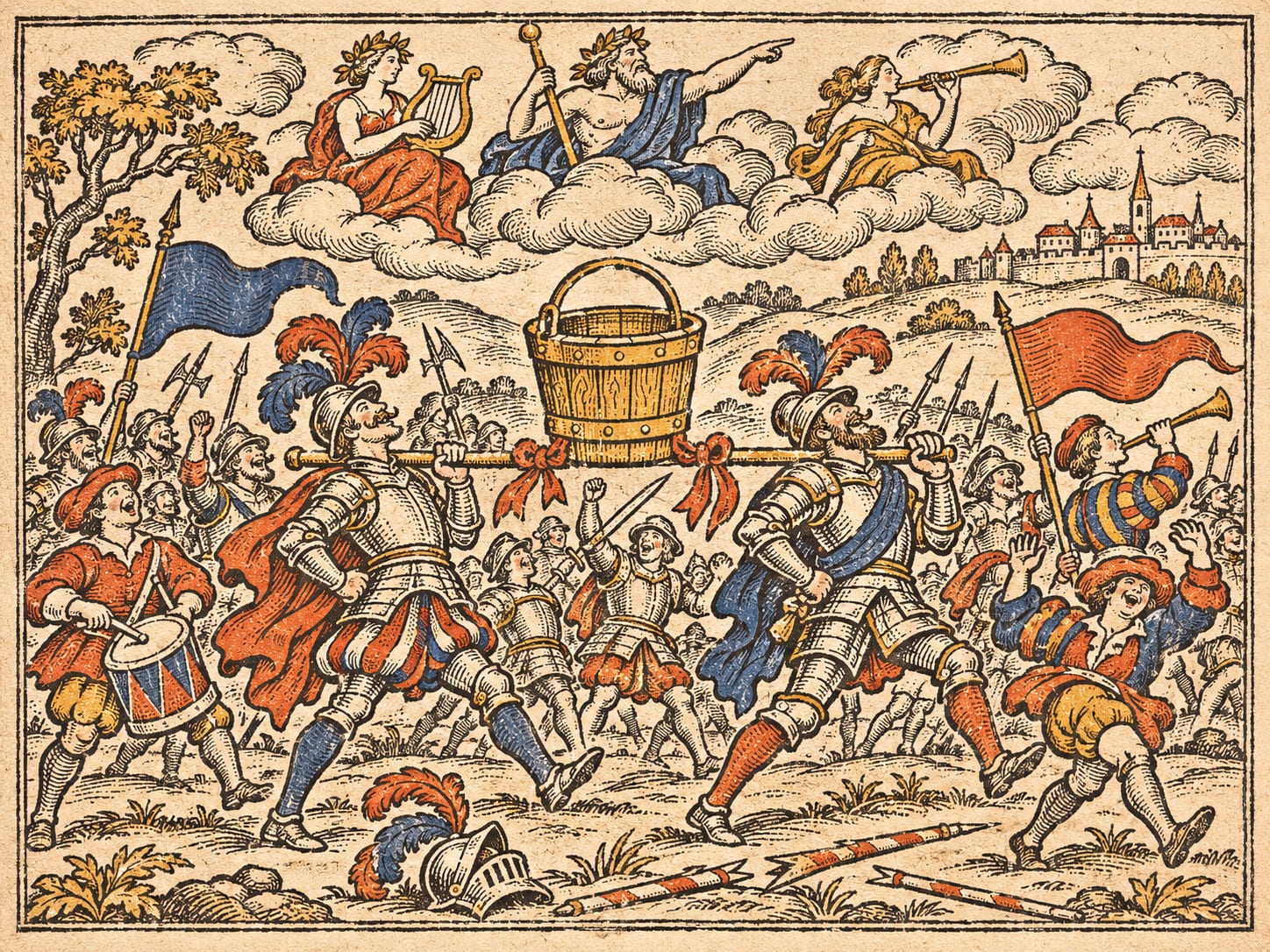
The poem runs to twelve cantos in ottava rima. It has battles, warriors, divine interventions, love plots and quarrels, with serious historical names and political memories mixed into the satire and the deliberately inflated comparisons.
The history is scrambled on purpose. Tassoni pulls King Enzo, the son of Frederick II, out of the 1249 Battle of Fossalta and drops him into the bucket war. The 1249 capture, the 1325 battle and the bucket tradition become one fictional conflict. The poem's comic peace, in which Bologna keeps King Enzo and Modena keeps the bucket, is not the real treaty of January 1326.
His cast includes the Count of Culagna, a boastful and cowardly nobleman who readers take as a caricature of Alessandro Brusantini, Renoppia, an invented woman warrior who leads an army of women, and Titta, a comic Modenese fighter. The Olympian gods step in on both sides. Real people from Tassoni's own day appear in disguise.
A relatively minor bucket tradition became the best-known literary version of the conflict. Because of the poem, many people know the episode as a war over a bucket, even though the real 1325 battle was fought over politics and territory.
Censors and imitators
The poem came out in Paris in 1622 under the pseudonym Aldrovinci Melisone. The Inquisition suspended it on 6 August 1622, partly because of its attacks on Bolognese and papal figures. A corrected Roman edition followed in 1624, printed under the false place name Ronciglione, with only a few changes asked for by Pope Urban VIII.
In 1630, Giacomo Scaglia printed in Venice the last edition Tassoni oversaw. It added the Dichiarazioni credited to Gaspare Salviani and a second preface signed with the name Paulino Castelvecchio. In 1632, after Ludovisi's death, Francesco I d'Este offered Tassoni a pension of 300 scudi and rooms in the Modena castle. Tassoni died there in 1635 and was buried in the church of San Pietro.
Girolamo Tiraboschi later noted that the poem had gone through nearly thirty editions and had been printed in France and England and translated into French and English. Muratori helped build Tassoni's name with a 1744 Modena edition and a biography. Nicolas Boileau's Le Lutrin, begun in 1674 and complete in 1683, borrowed the method and swapped the bucket for a quarrel over a lectern in the Sainte-Chapelle.
From rivalry to bucket to poem
- 15 November 1325
Modena and its allies defeat Bologna's Guelf army at Zappolino
- 28 January 1326
A peace returns most captured territory to Bologna
- 1494
The surviving text of the Cronica di San Cesario is written or copied
- 1502
An inventory lists a wooden bucket with three iron bands and an iron chain once held by the Bolognese
- 1523
The Cronica di San Cesario is copied and circulated
- 1614 to 1615
Alessandro Tassoni writes La secchia rapita
- 1622
The poem is published in Paris, and the Inquisition suspends it
- 1624
A corrected Roman edition appears
- 1630
A revised edition is published in Venice
- 2025
Modena, Bologna and Valsamoggia mark the 700th anniversary with the Zappolino700 programme
Which bucket is in Modena?
Modena holds two buckets, and only one is the old one. The bucket displayed in the Ghirlandina civic tower, in the Sala della Secchia Rapita, is a copy.
The original is kept in Modena's Town Hall, the Palazzo Comunale, in the Camerino dei Confirmati, where it is better protected. The move followed repeated student pranks and thefts involving the bucket on show in the tower. It is a plain wooden bucket reinforced with iron bands, not a richly decorated ceremonial object.
The Comune di Modena says scientific analysis dated the wood to the thirteenth century, and a 2025 municipal notice says new radiocarbon analysis points to a medieval origin in the thirteenth or fourteenth century. That fits a bucket old enough to have been at Zappolino. It does not prove this is the one carried home.
Calling it the bucket taken from Bologna is tradition. That identification is part of Modena's story, but it has not been conclusively demonstrated.
The well in Bologna
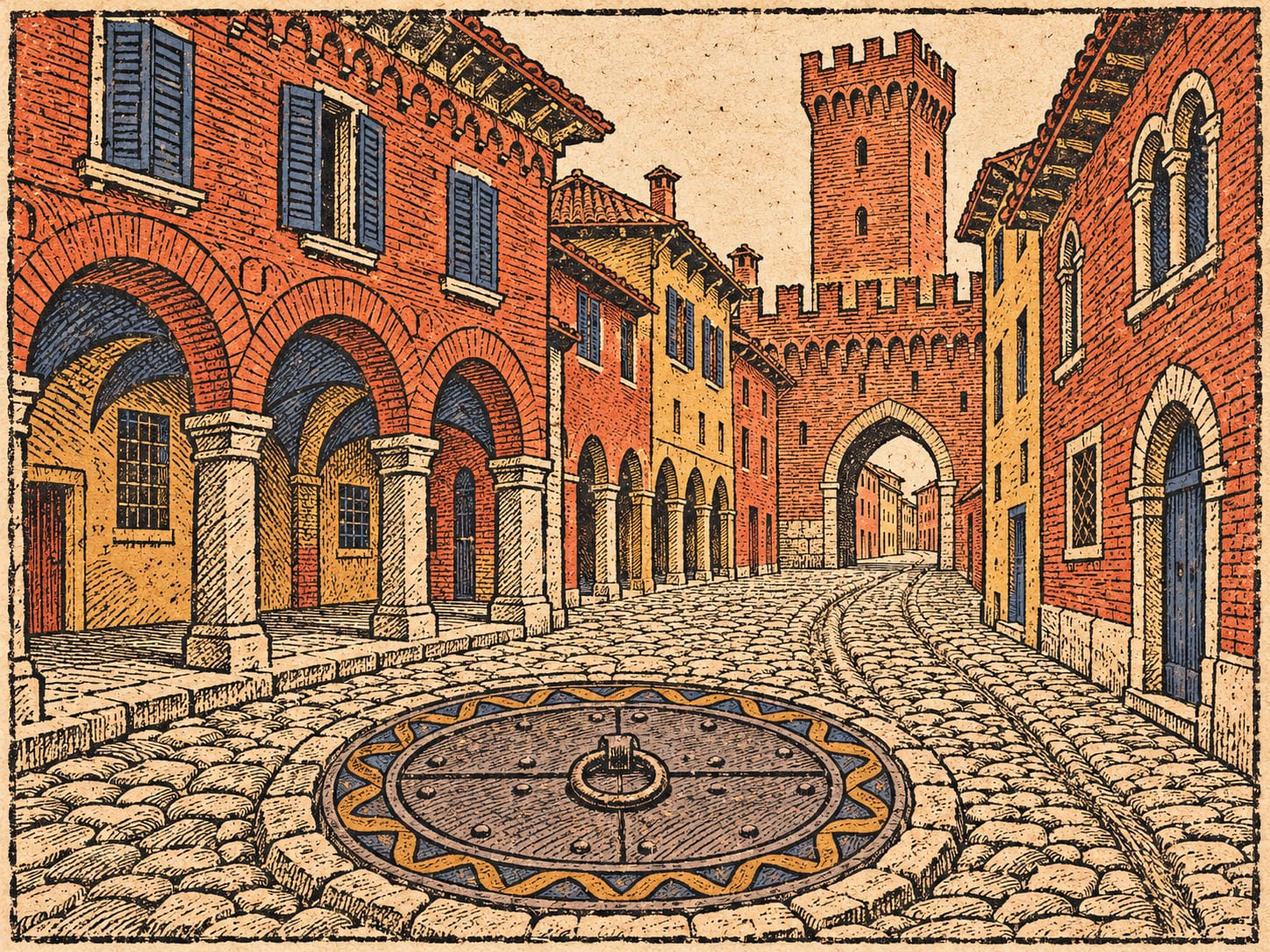
Bologna's end of the story sits just outside Porta San Felice, today also called Porta Saffi. The well is no open medieval well. Local descriptions say it is a covered opening under a large metal cover set in the street on Via Saffi, near number 34, roughly a hundred metres outside the gate. It looks more like a utility hatch than a famous well.
How the two cities remember it
Modena treats the bucket as a civic symbol tied to the Ghirlandina, the Palazzo Comunale, Tassoni and the victory at Zappolino. Bologna remembers the episode through the former well tradition near Porta San Felice, and through the long rivalry with Modena.
In 2025 the 700th anniversary was marked by the Zappolino700 programme, organised across Modena, Bologna and Valsamoggia. It included historical reenactments, walking routes, theatre and music, conferences, exhibitions, school activities and medieval dinners.
The bucket has a football match named for it. Modena and Bologna meet in the "Derby della Secchia," the Bucket Derby, a name that recalls the Battle of Zappolino and Tassoni's poem. A 2014 account counts 31 meetings at Modena's Braglia stadium in Serie A, Serie B and Serie C1, leaving out the Italian Cup: 14 Modena wins, 10 draws and 7 Bologna wins.
Do not mix it up with the "Derby del Secchia," which is Modena against Reggiana and takes its name from the Secchia river, where the two provinces meet. Neither the league nor the clubs name a bucket prize for the winner of either match.
Sources
- Treccani, "Modena" and "Bologna," Federiciana encyclopedia
- Treccani, biographies of Alessandro Tassoni, Azzone Visconti, Rinaldo d'Este and Passerino Bonacolsi, Dizionario Biografico
- Stefani and Trenti, "La Battaglia di Zappolino nelle storie dei Modenesi," on the chronicles of Giovanni da Bazzano and Bonifacio Morano
- Lodovico Antonio Muratori, Annali d'Italia, entries for 1325 and 1326
- 1935 newspaper article reproducing the Cronica di San Cesario and the 1502 inventory, Avvenire d'Italia
- Fondazione di Modena, study of the Cronica di San Cesario
- Modena World Heritage, Ghirlandina civic tower, Hall of the Stolen Bucket
- Modena City Hall, "La Secchia Rapita," Camerino dei Confirmati, and Comune di Modena notice on the bucket and radiocarbon analysis
- Cambridge History of Italian Literature, "Mock-epic poetry and satire"
- Barotti commentary on La secchia rapita, Wikisource, and Cabani, "Le lettere di Tassoni a Barisoni"
- Girolamo Tiraboschi, biography of Alessandro Tassoni
- Bologna Metropolitan City, Zappolino700 programme
- Modena Sportiva, Derby della Secchia coverage
- ANSA, report on Bologna's historic well tradition
Watch the full story on the Flashback Fables YouTube channel, and send it to someone who would love it.