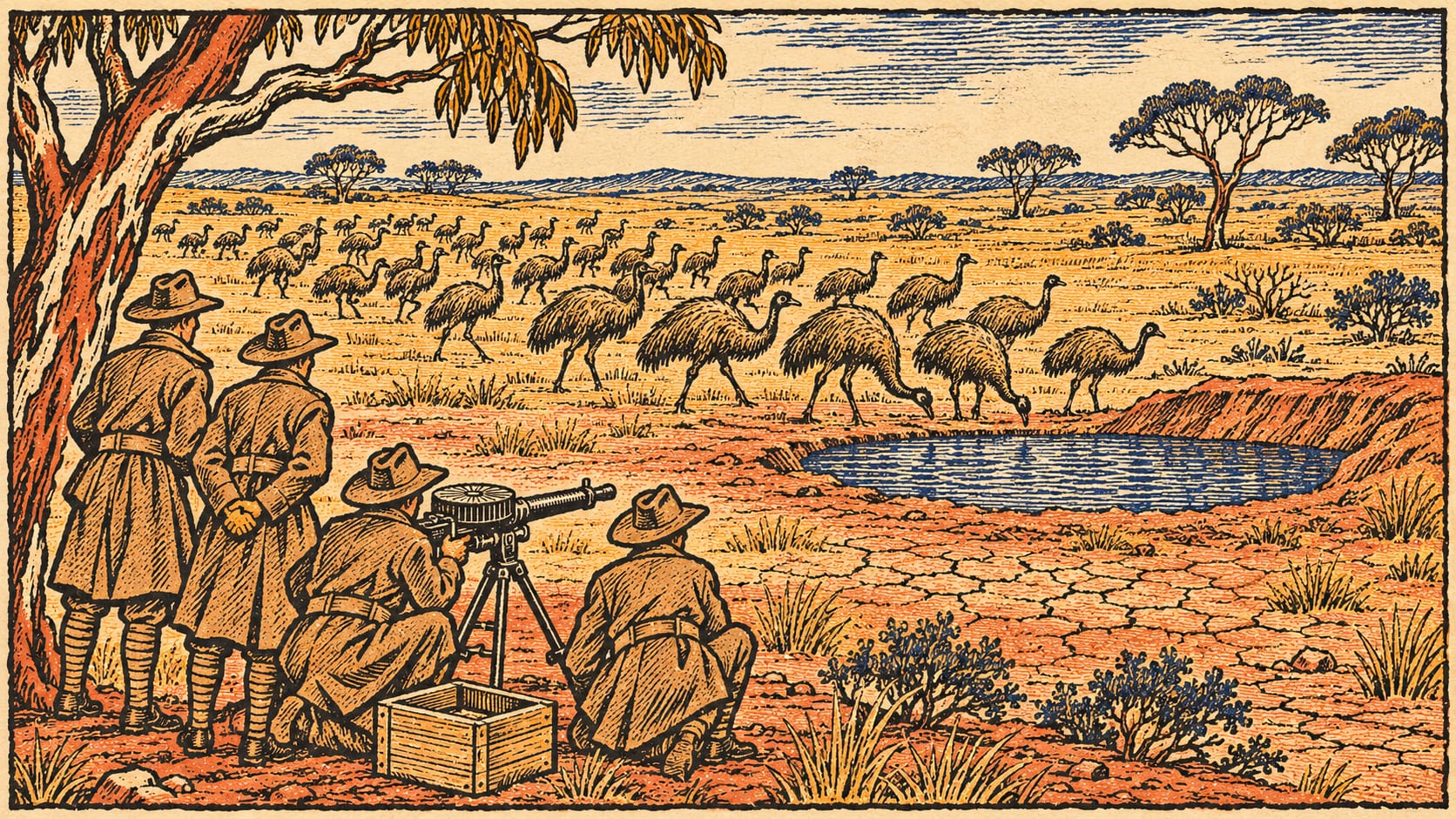
Yes, Australia sent soldiers with machine guns after emus. Major G. P. W. Meredith and two men reached Campion in Western Australia on 2 November 1932 with two Lewis guns and 10,000 rounds, to help wheat farmers whose crops the birds were wrecking.
The operation did not end the problem. The soldiers withdrew, came back, and left for good on 10 December 1932, and the emus were still there.
Nobody declared war and nobody surrendered. "War" was a newspaper's word, printed before the soldiers even arrived.
Why farmers asked for machine guns
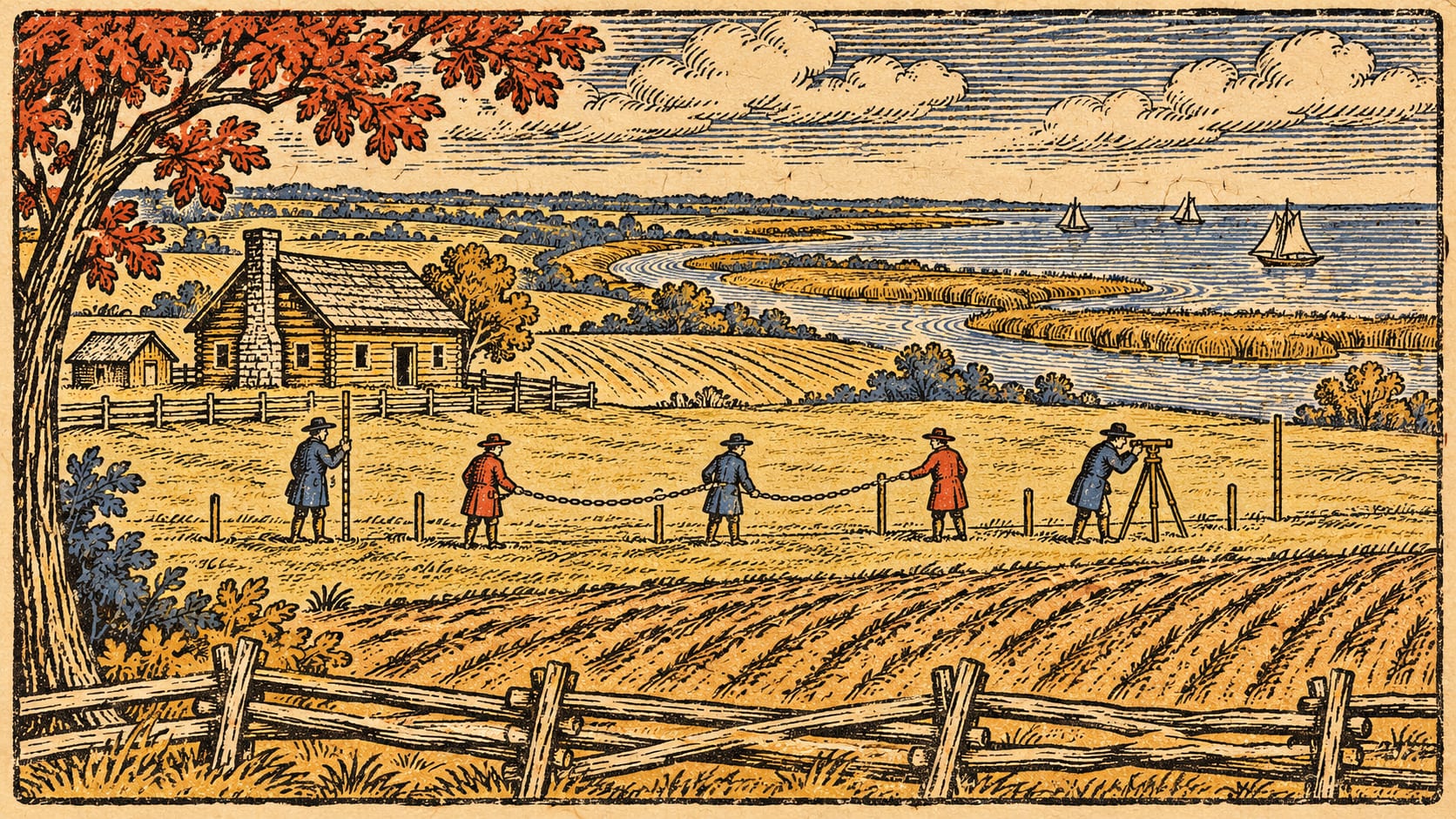
After World War I, returning soldiers received land in Western Australia's Wheatbelt under the soldier-settlement scheme. By the early 1930s, drought, the Great Depression and falling wheat prices had left many of them struggling.
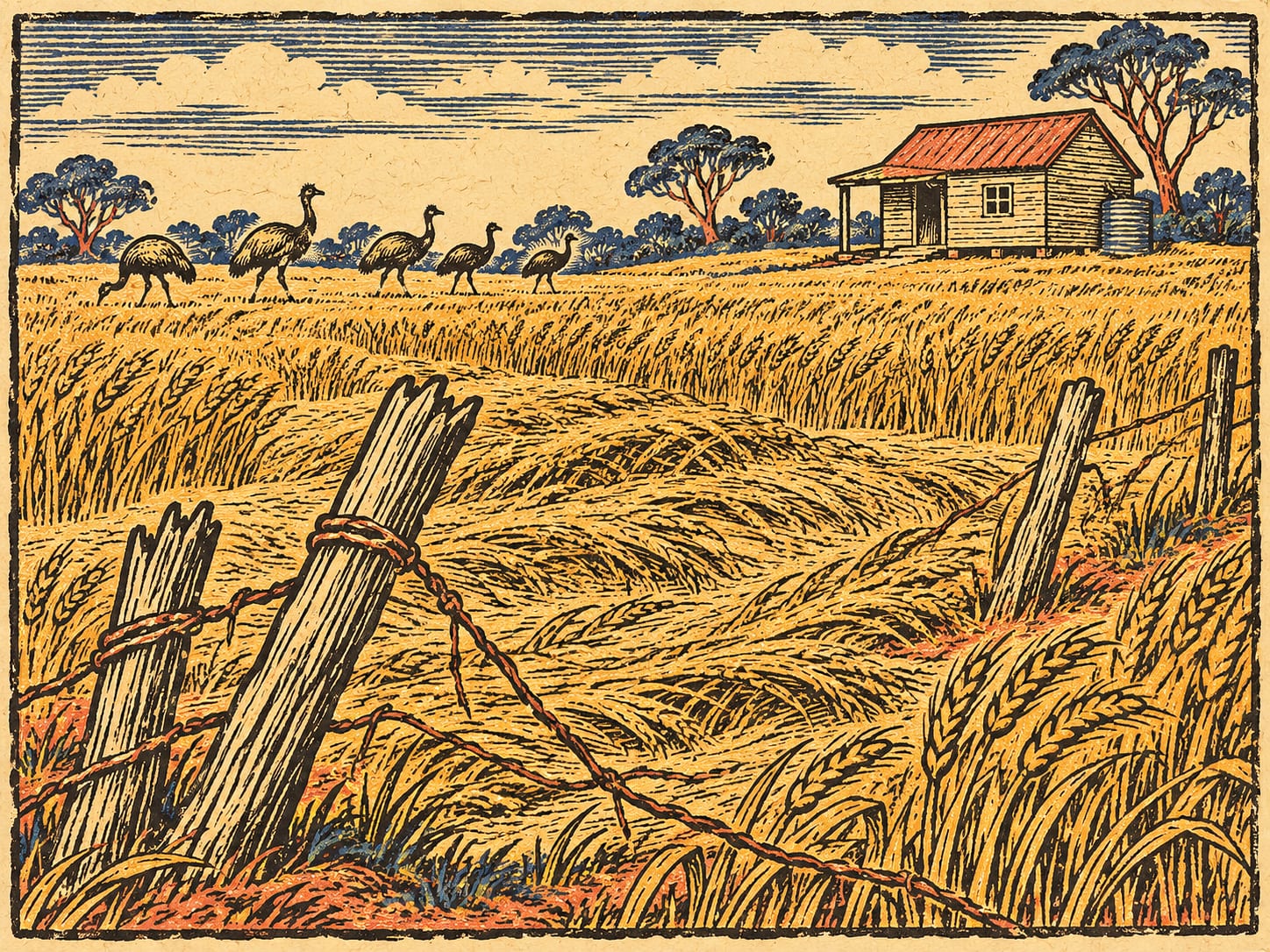
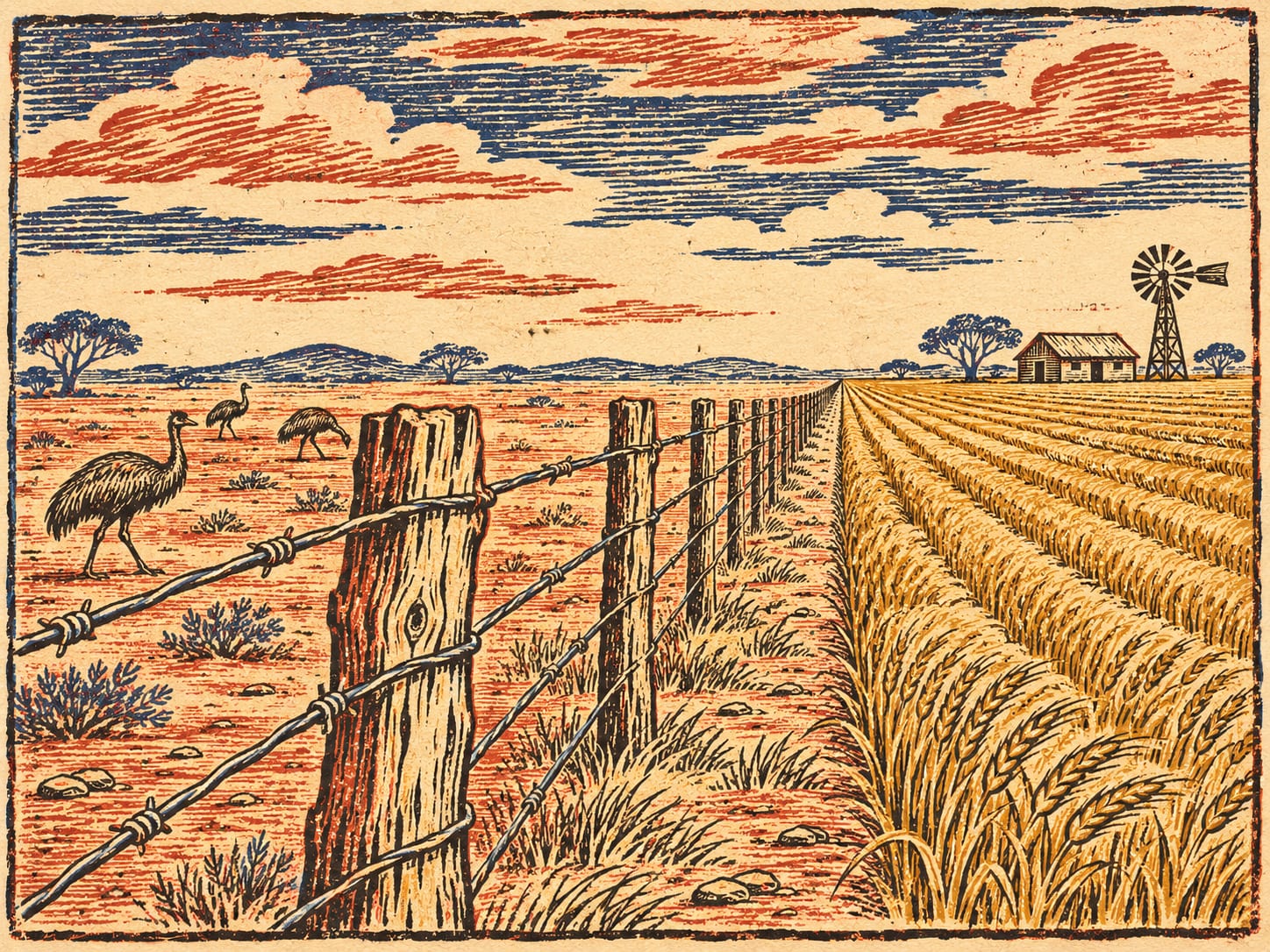
After breeding season, an estimated 20,000 emus moved toward the wheat farms. A Sun report of 6 November 1932 said the dry spell "drove the emus in thousands from their natural haunts, and for six months over 10,000 birds have been plaguing the wheat crops." They ate and trampled crops and broke fences, and the broken fences let rabbits into the fields. Campion and Walgoolan were among the affected districts.
A contemporary report put the request plainly. "Thousands of emus are doing so much damage to wheat crops east of the No. 1 rabbit-proof fence that settlers of the Campion district, in a deputation to the State Ministry, asked for the loan of a machine-gun to rid the district of them."
Defence Minister Sir George Pearce replied that he "would accede to the request if the State Ministry accepted the responsibility for costs, with the proviso that the gun be manned by militiamen." Western Australia's Premier, Sir James Mitchell, backed the request. Pearce approved a limited military operation: three permanent military personnel with two Lewis guns. The Western Australian government and the farmers were expected to cover railway travel and ammunition, so the operation would cost the Commonwealth nothing.
"War on Emus"
The word came before the guns. On 12 October 1932, The Daily News of Perth ran the headline "War on Emus" over a report on the Campion farmers' request for Defence Department machine guns. It ran three weeks before the troops reached Campion.
The press treated the operation as a serious farm matter and as a comic show at once. Reports described machine guns, scattered emus, jammed weapons, low kill figures and birds that outran the vehicles chasing them.
The three men
Major Gwynydd Purves Wynn-Aubrey Meredith was born in Tasmania. He joined the Royal Australian Artillery in 1910, served briefly with the AIF in 1918, studied at the Royal Artillery College at Woolwich and became an armaments specialist. In 1932 he commanded the Royal Australian Artillery in Western Australia.
Sergeant S. McMurray and Gunner J. O'Halloran worked the Lewis guns beside him.
Meredith went on to command artillery and coastal-defence formations and retired from the Australian Army in 1947. He then worked as a United States Army civilian ordnance adviser in Japan and Korea, and died on 5 May 1975. A 1932 newspaper reproduction calls him "D.W.P. Meredith," while later military records use "G.P.W."
Campion, 2 November to 10 December 1932
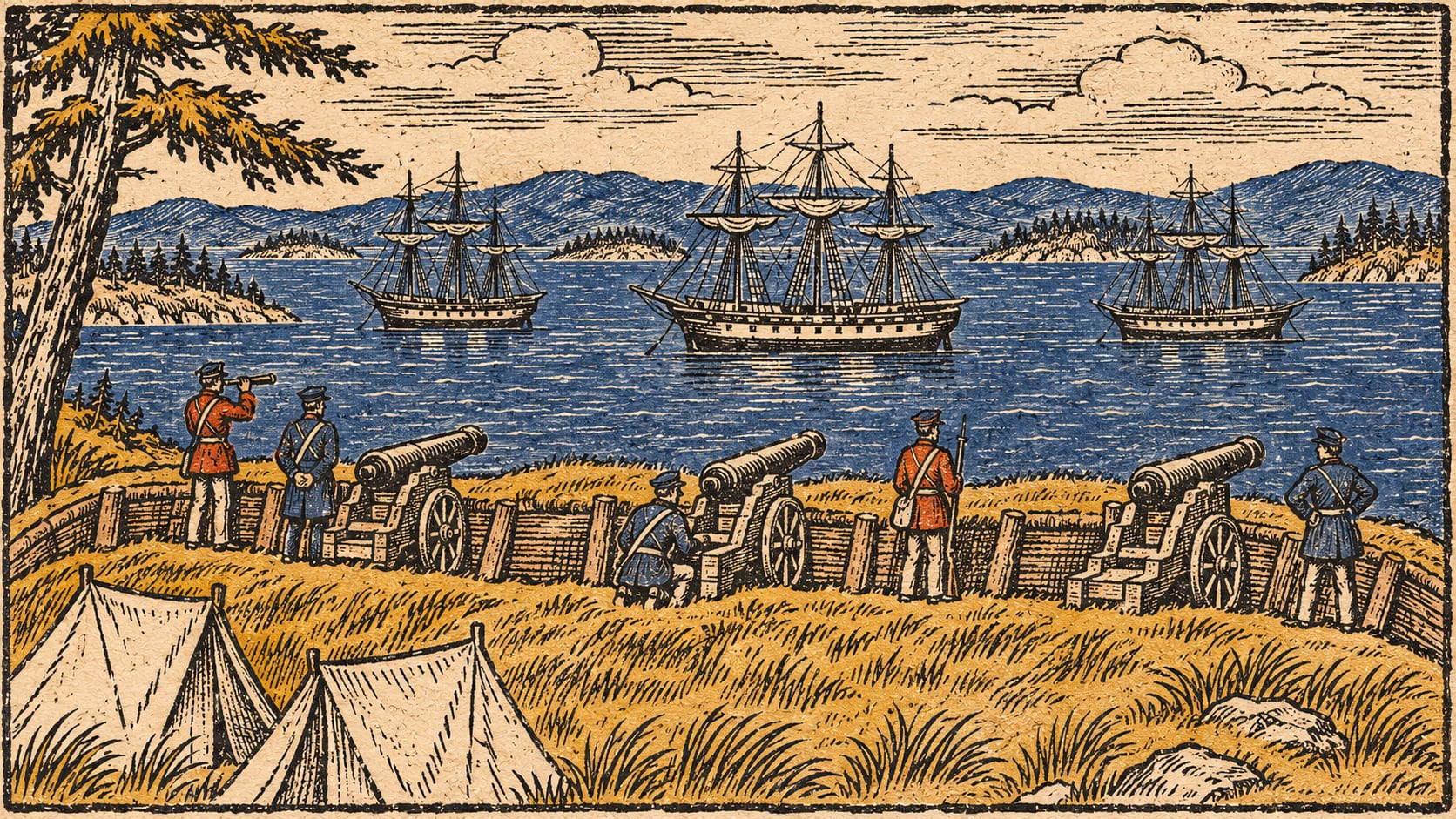
Major Meredith of the Royal Australian Artillery led the detachment, with Sergeant McMurray and Gunner O'Halloran. They reached Campion on 2 November with the two Lewis guns and 10,000 rounds.
The opening days went badly because the emus broke into small groups. On 4 November the soldiers waited near a dam for a large flock. One gun jammed after only a few birds had been hit. The Daily Telegraph reported from Campion on 5 November: "Unfortunately, the emus did not come within 1200 yards, and Sergt. McMurray had to fire at this range, stampeding them to the safety of the bush." It added that more than 1,000 rounds had been fired and "only a dozen birds have been killed."
The Sun was kinder to the gunners. "Few emus have fallen to the gunners, but many have taken to the bush, obviously carrying heavy loads of lead," it wrote, and put the casualties at a conservative 200.
Meredith had a line for the press. In the Telegraph's version, he said: "If I had a division of men who could carry bullets like they do I would take on any army corps in the world."
The troops withdrew on 8 November after using about 2,500 rounds. Reports that week put the kill at about 200, and contemporary estimates ran from about 50 to 200 birds. Later accounts cite 300 to 500. Nobody counted the birds independently.
The operation resumed around 12 or 13 November and continued until the final withdrawal on 10 December 1932. Meredith's own report claimed 986 confirmed kills from 9,860 rounds, plus an estimated 2,500 birds that later died of their wounds. That report is generally described as unpublished.
A newsreel crew in the wheat
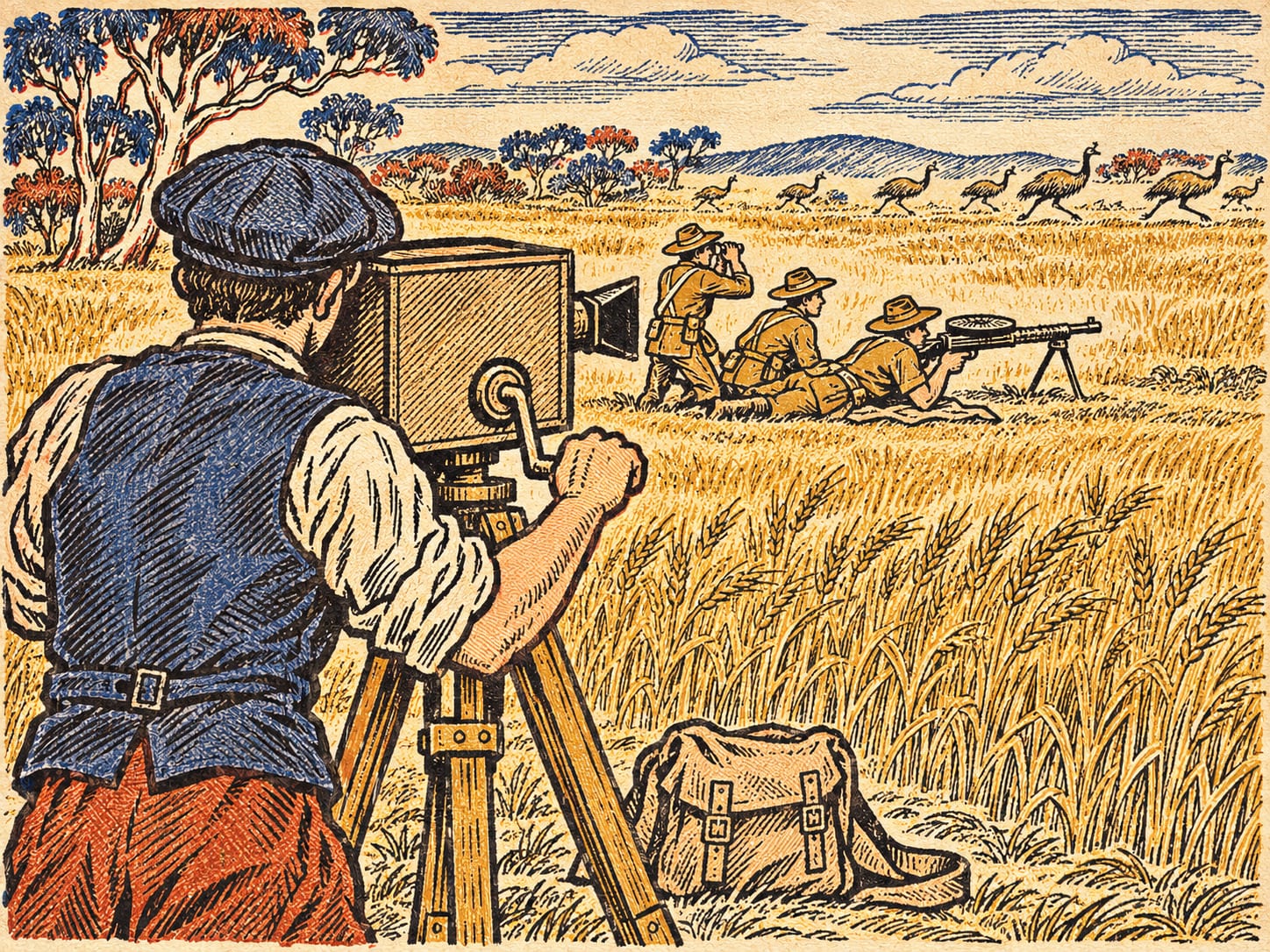
A Fox Movietone cameraman went with the soldiers. The film came out as a Movietone newsreel in January 1933. It shows men handling and firing a Lewis gun in wheat country, emus running through the crops, soldiers stalking birds and wounded birds in the field.
The narration is comic, and the newsreel plays the operation as a spectacle. It is a few minutes of edited film, not a record of every engagement and not a count of the birds. The Movietone archive now sits with the Associated Press archive.
Withdrawn, then sent back
On 18 November 1932 Pearce explained the whole affair to the Senate. He said that the damage was easy to see for anyone who had been in emu country, and that the birds "roll down the crops." He said ordinary fences "offer no obstacle to emus, for the birds take them in their stride, or knock them down, and thus let the rabbits into the crops." Rifles failed because "only one or two birds could be shot before the remainder scattered far and wide."
He told senators he would not let the farmers run the guns themselves: "I could not allow the machine guns to go into the hands of persons not under Commonwealth control or authority." So three members of the permanent military went, on the State Government's promise to pay their railway fares and the ammunition.
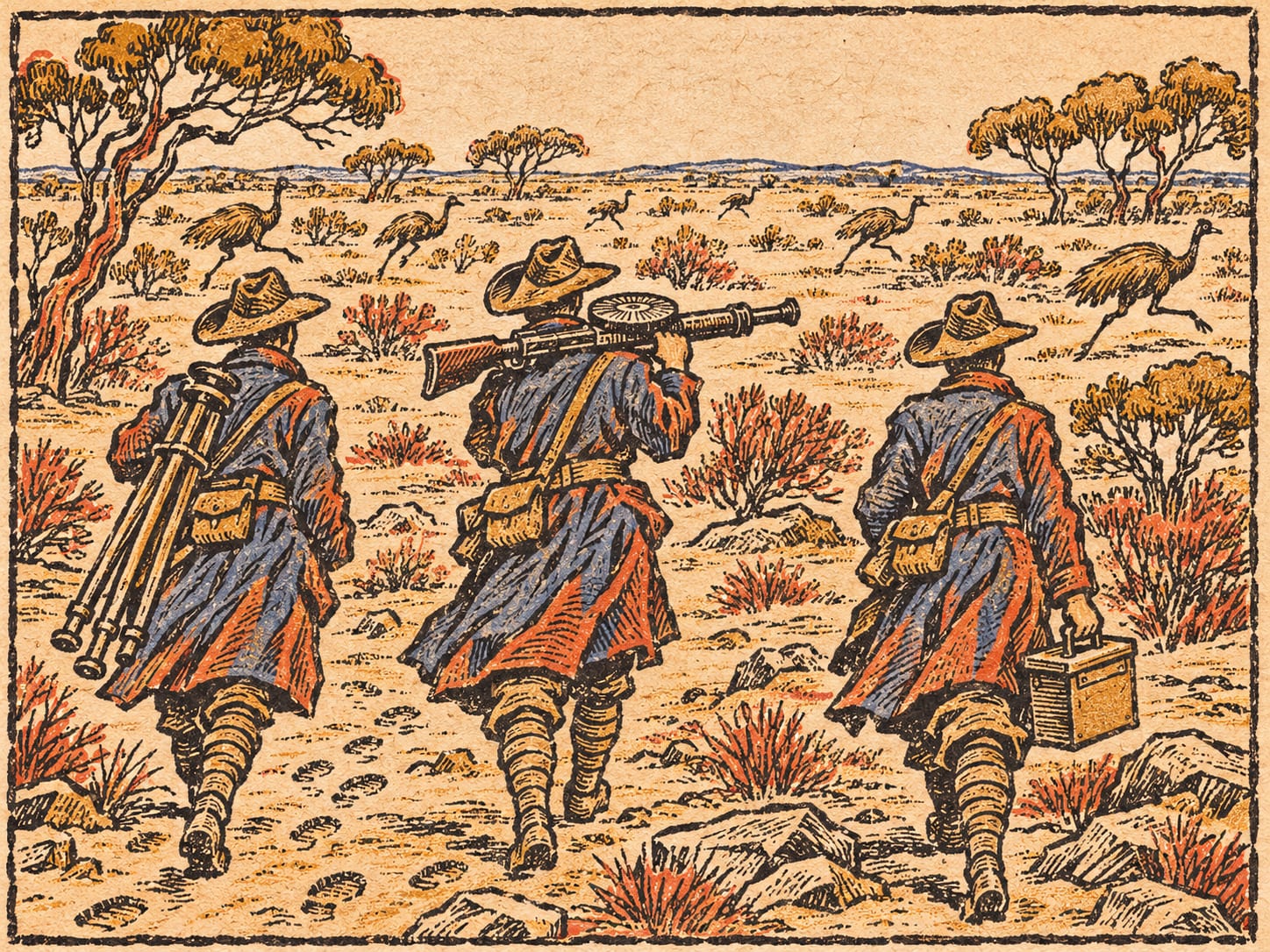
Then the eastern newspapers weighed in. Pearce said "paragraphs appeared in the press of the eastern States to the effect that the machine gun shooting of the birds was not effective, as only a few birds had been shot." He ordered the guns and crew withdrawn.
Western Australia pushed back. Pearce said the withdrawal "caused a storm of protest from the people in these wheat areas, and also from the Premier of that State," who told him that hundreds of birds had been shot and that since the shooting stopped, "the birds had returned in thousands." He agreed that "the guns and crew should be returned to the area."
Critics raised cruelty, and Pearce answered in the Senate: "There is no more cruelty in shooting birds with a machine gun than with a rifle." He said men were sent among the wounded birds to finish them quickly.
So, the operation was withdrawn over poor reported results and public criticism, and renewed after Western Australia argued that its own results were better than the eastern papers said.
Mobile birds made the job harder than it looked. The emus scattered into small groups, ran fast across rough country, and outran the vehicles. At the dam on 4 November, a jammed gun added to the trouble.
Did Australia lose?
Australia did not go to war with emus and did not surrender. The event was a military wildlife-control operation in Western Australia, and "The Great Emu War" and "Australia lost" are later shorthand and press jokes.
The operation did not reach its practical goal of quickly cutting emu damage to farms. The emus stayed widespread, the troops left, and later control relied mainly on bounties and fences. In that limited sense, historians and authoritative summaries call the military effort unsuccessful.
One line keeps turning up in retellings: the medals should go to the emus, who had won every round. It is a joke about the operation and not a military result. The documented version is short. Australia sent a small military detachment against emus, killed some birds, failed to control the wider problem and ended the operation without a surrender or a formal defeat.
What held the emus back
Western Australia kept paying bounties for killing emus. The Government Gazette of 30 January 1931 allowed it through Regulation 90A: a Vermin Board "may grant at the cost of the Board a bonus for every emu destroyed," with the approval of the Chief Inspector and the Minister. No single statewide rate was set. A Gazette of 29 August 1947 lists 1 shilling per emu in both of its vermin districts.
The counts that survive each measure something different.
Barrier fences mattered too. The State Barrier Fence and earlier rabbit-proof and vermin-proof fences were meant to limit the movement of emus, rabbits and other pests into farming districts. Farmer-led shooting added to it. These figures count claims, beaks or recorded kills, not necessarily every bird shot.
Asking again
The farmers did not stop asking for soldiers. Accounts differ on the years: one gives requests in 1934, 1938 and 1943, and others give 1934, 1943 and 1948. In each telling the Federal Government turned them down and kept to bounties, firearms for farmers and barrier fencing.
The 1943 request went furthest on paper. The Mail ran the headline "Request to Use Bombs to Kill Emus" on 3 July 1943.
What the story shows
The episode shows how economic pressure can turn a wildlife problem into a political one. Veteran settlers were expected to make marginal wheat farms pay through drought, depression and falling prices. The emus were going where cultivation had put food and water, and the farms were open to trampling, fence damage and rabbits.
It shows the limits of military tactics against fast-moving wildlife too. Bounties, farmer-led shooting and barrier fences did more over time than a short operation by three soldiers.
Campion and Walgoolan today
Campion is now close to a ghost town. Walgoolan is largely abandoned too, with the former town hall and tennis club standing as ruins. The farmland and the old Rabbit-Proof Fence routes around them are the landscape of 1932. Access to ruins and private farmland should be confirmed locally before a visit.
The Central Wheatbelt Visitor Centre at 45 Barrack Street, Merredin, gives regional history and visitor information. The Merredin Military Museum on Great Eastern Highway shows uniforms, vehicles and equipment from the First World War onward.
The soldiers left Campion on 10 December 1932. The emus stayed, and Western Australia went back to fences and bounties.
The Great Emu War, from request to withdrawal
- Early 1930s
Drought, the Depression and falling wheat prices squeeze soldier-settlers in the Wheatbelt
- 12 October 1932
The Daily News of Perth runs the headline "War on Emus"
- 2 November 1932
Major Meredith's three-man detachment reaches Campion with two Lewis guns and 10,000 rounds
- 4 November 1932
The dam ambush fails when a gun jams
- 8 November 1932
The troops withdraw after about 2,500 rounds
- 12 or 13 November 1932
The operation resumes
- 18 November 1932
Pearce explains the operation to the Senate
- 10 December 1932
The detachment makes its final withdrawal
- January 1933
The Movietone newsreel is issued
- 3 July 1943
The Mail runs "Request to Use Bombs to Kill Emus"
Sources
- Senate Hansard, 18 November 1932, "Destruction of Emus," statement by Sir George Pearce
- "Environmental issues from the not so distant past," National Archives of Australia
- "Australia's Emu War spawns feature film, jokes and memes 90 years on," ABC News, 2022
- Murray Johnson, "Feathered foes," Journal of Australian Studies
- Richard J. Cook and Andrew M. Jovanovic, "The Emu Strikes Back," Romanian Journal of Historical Studies
- The Daily News (Perth), 12 October 1932 and 8 November 1932, Trove
- The Daily Telegraph, 5 November 1932, and The Sun, 6 November 1932, as reproduced by Wyalong Family History
- Western Mail, 10 November 1932, and The Canberra Times, 12 November 1932, Trove
- Maxine Cornish, A Piece of String, reproducing the 1932 deputation report
- Australian Gunner Obituary Resource, Brigadier G. P. W. Meredith
- Fox Movietone newsreel, January 1933, and the Associated Press announcement on the British Movietone archive
- The Mail, 3 July 1943, as reproduced in the University of Wollongong article
- "Australia's emu wars," Australian Geographic
- Western Australian Government Gazette, 30 January 1931 and 29 August 1947
- Final Report on the State Barrier Fence, Parliament of Western Australia
- Riggert, The Management of the Emu in Western Australia
- Central Wheatbelt Visitor Centre and Merredin Military Museum, Wheatbelt tourism pages
Watch the full story on the Flashback Fables YouTube channel, and send it to someone who would love it.