
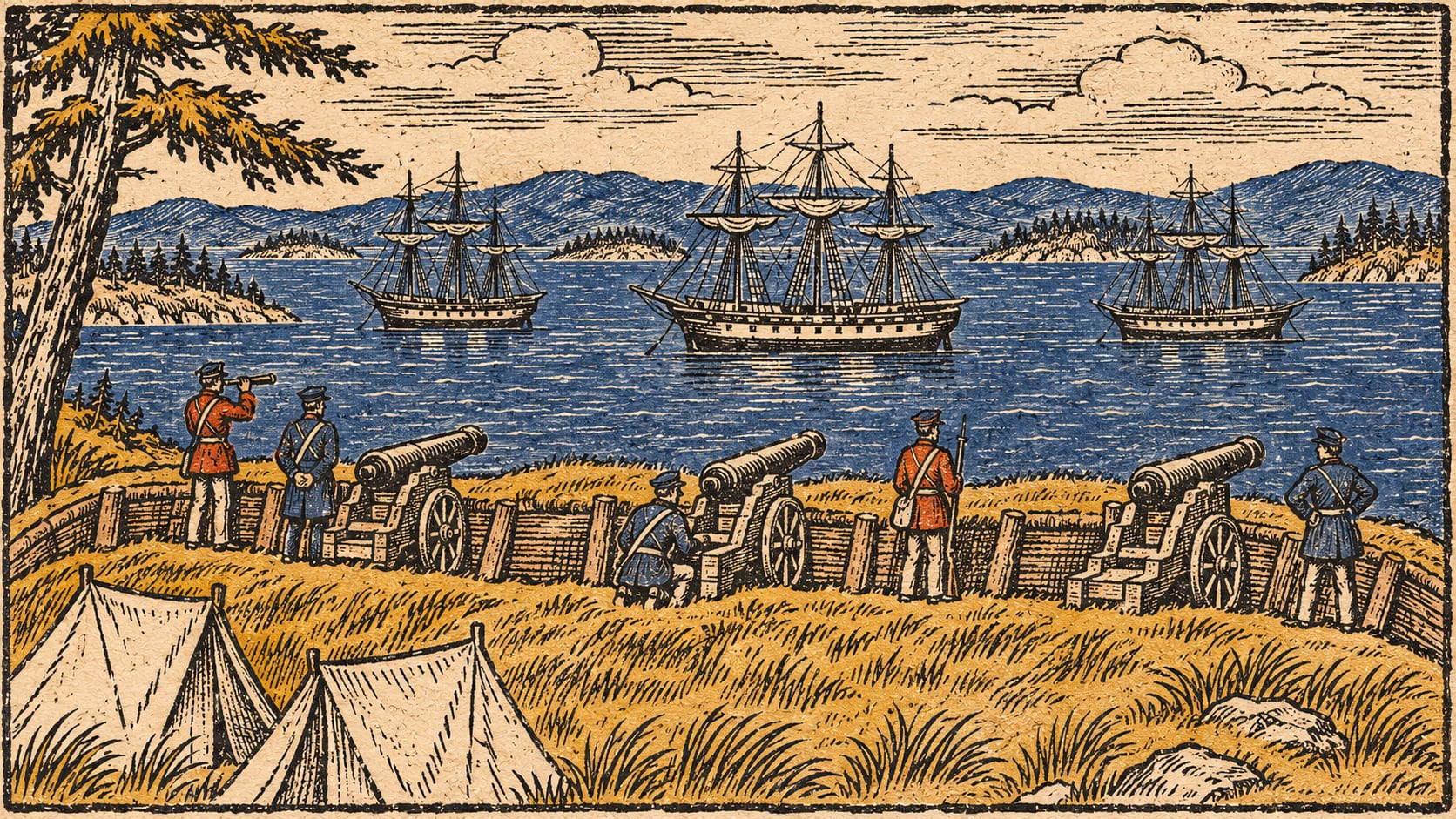
Yes, a shot pig on San Juan Island in June 1859 led the United States and Britain to station troops, cannons and warships against each other, and nobody died in combat.
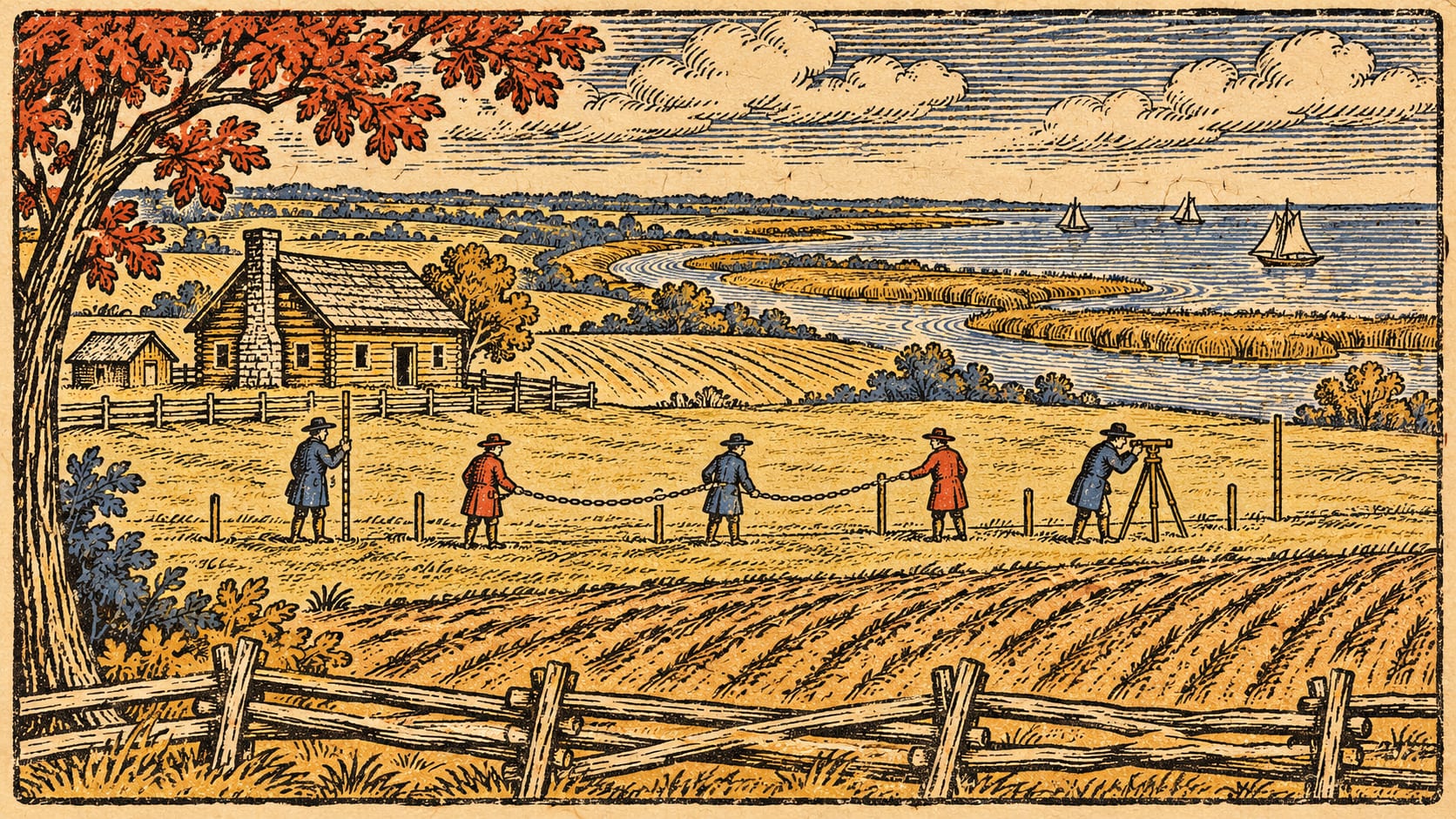
On 15 June 1859, an American settler named Lyman Cutlar found a Hudson's Bay Company pig rooting in his potato patch and shot it. The pig belonged to Charles Griffin, who managed the company's Belle Vue Sheep Farm on the island.
The pig was not the real quarrel. Treaty wording from 1846 had left it unclear which channel carried the border, and the San Juan Islands lay between the two choices. The question stayed open until 1872.
The treaty that did not name a channel
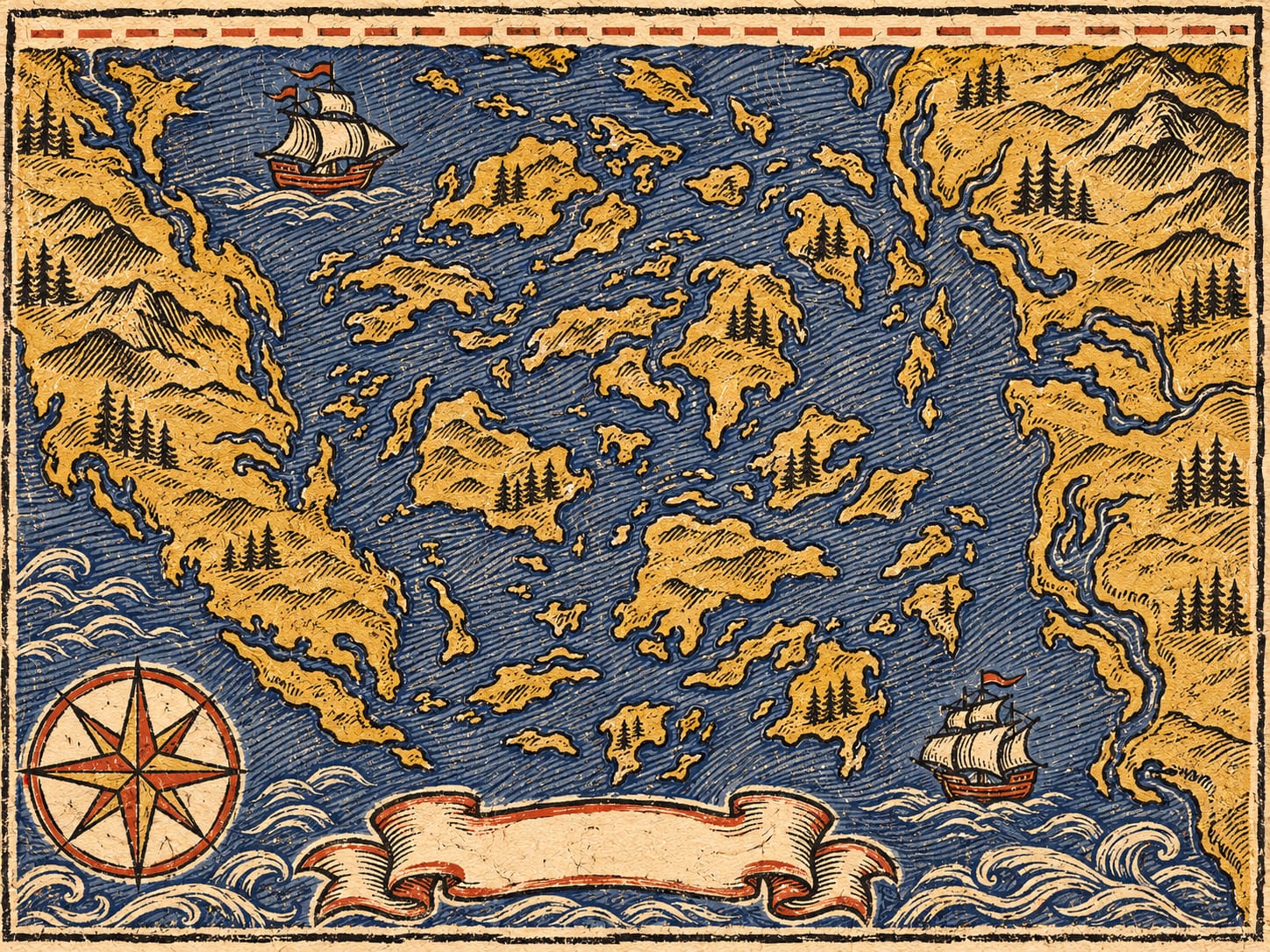
The Oregon Treaty, signed at Washington on 15 June 1846, ran the boundary west along the 49th parallel "to the middle of the channel which separates the continent from Vancouver's Island." From there it turned south through that channel and the Strait of Juan de Fuca to the Pacific Ocean. The words did not say which channel.
Two channels fit. Haro Strait lay to the west and Rosario Strait to the east, with the San Juan Islands between them. The United States claimed Haro Strait, which put the islands on the American side. Britain claimed Rosario Strait, which put them on the British side.
For thirteen years nobody settled it, and the dispute was not closed until arbitration in 1872.
Who lived on the island
San Juan Island was part of the traditional territory of the Central Coast Salish peoples long before any treaty drew a line through the water. The Songhees, Saanich, Lummi and Samish had winter villages in the islands. They fished, hunted and gathered there through the seasons, and kept camas meadows healthy by reseeding and burning. The grass that sheep and settlers later fought over was a tended landscape, not empty wilderness.
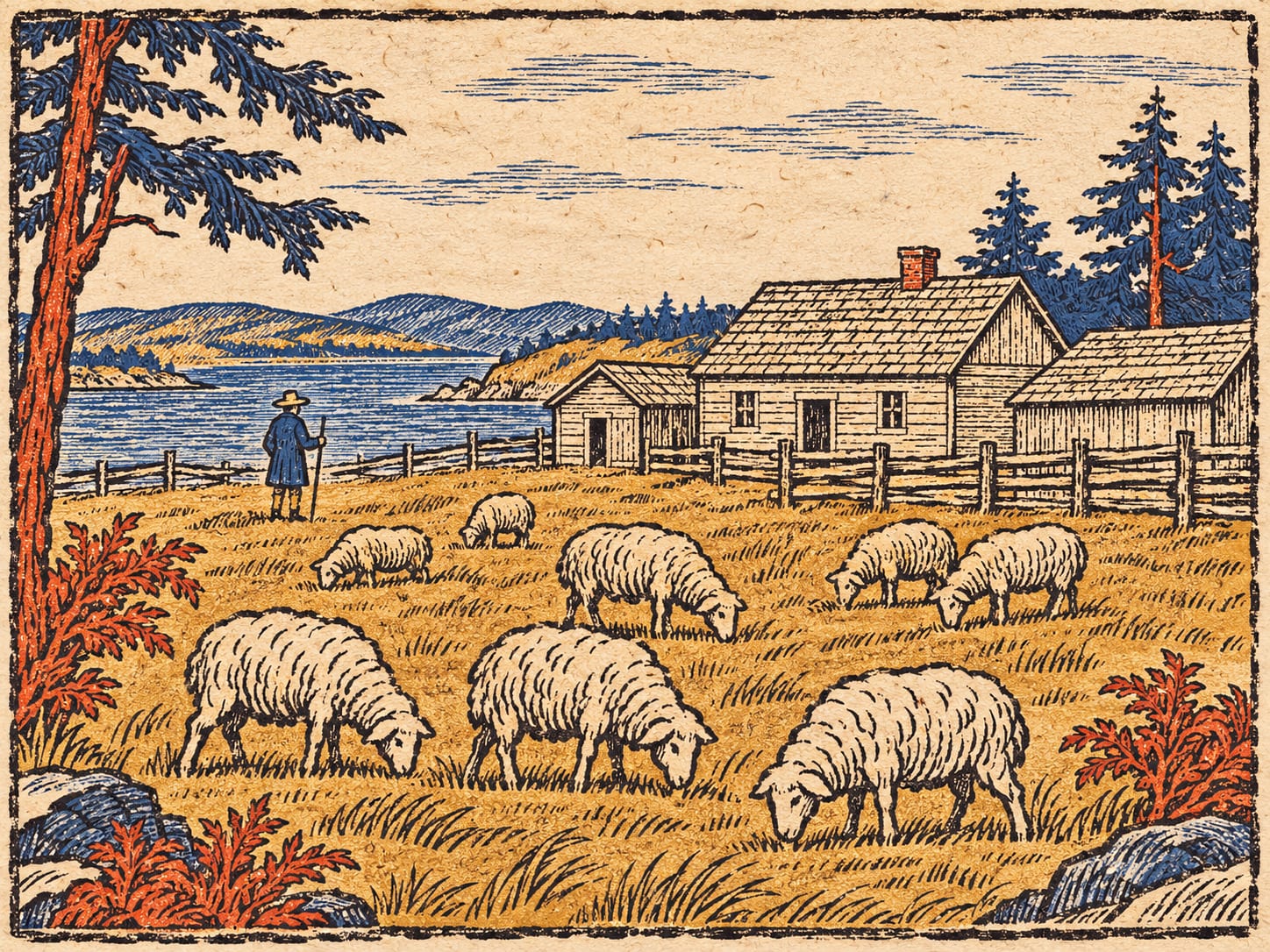
By 1859, the Hudson's Bay Company ran Belle Vue Sheep Farm on the island's southern shore. Charles Griffin, a company chief trader, managed it and served as the island's magistrate. The farm kept large flocks of sheep, along with cattle, horses and pigs. Its workforce was English, Canadian, French, Scottish, Indigenous and Hawaiian. Kanakas was the word of the time for the Hawaiian workers. One of them, Po'alima, also known as Peter Friday, gave Friday Harbor its name.
American settlers had also taken land. By spring 1859, 18 Americans had staked claims on ground the Hudson's Bay Company used for grazing. The British saw them as trespassers. The settlers expected American authorities to recognise their claims.
So, two sets of newcomers shared the same grass, and each side expected the border to back its claim.
15 June 1859
Cutlar had lived on the island since April and had claimed 160 acres. In the affidavit he swore on 7 September 1859 before the notary Henry R. Crosbie, he said he shot the hog after it had repeatedly torn up his garden, "in a moment of irritation." He went straight to Griffin and offered either to replace the animal or to have three men value it and pay the sum.
Cutlar said Griffin demanded $100. Cutlar thought that unreasonable and left. He then said Griffin came back with A. G. Dallas, Dr Solmie and a Mr Fraser. In Cutlar's telling, Dallas asked whether he had killed the hog, called the island British soil, and said he would take Cutlar to Victoria for trial unless he paid $100. Cutlar answered that the animal was not worth ten dollars, and that he would answer to an American court and no English one.
Griffin told it differently. His letter of 15 June to Governor James Douglas said Cutlar had threatened to kill company cattle that strayed onto his claim, and that American squatters were taking the best prairie. To Griffin, the pig was one part of a larger quarrel over unauthorised settlement and company property. Paul K. Hubbs Jr. swore an affidavit for Cutlar the same day, saying Griffin had called the Americans "a pack of intruders."
The famous exchange about potatoes and pigs is a popular retelling. Cutlar's affidavit records Griffin's anger and his demand for $100, but not those words.
The pig has no name in the accounts. Later tellings call it a "black boar" or a "Berkshire boar," and the National Park Service's main account calls it a company pig. British authorities threatened to arrest Cutlar and remove the American settlers from the island.
Soldiers on the beach
The settlers appealed to Brigadier General William S. Harney, who commanded the U.S. Army's Department of Oregon. Harney said the Hudson's Bay Company had threatened "to take an American citizen from our soil, to be tried by British laws," which he called "an insult to our flag and an outrage upon the rights of our people." He ordered Captain George E. Pickett and Company D of the 9th U.S. Infantry to occupy San Juan Island.
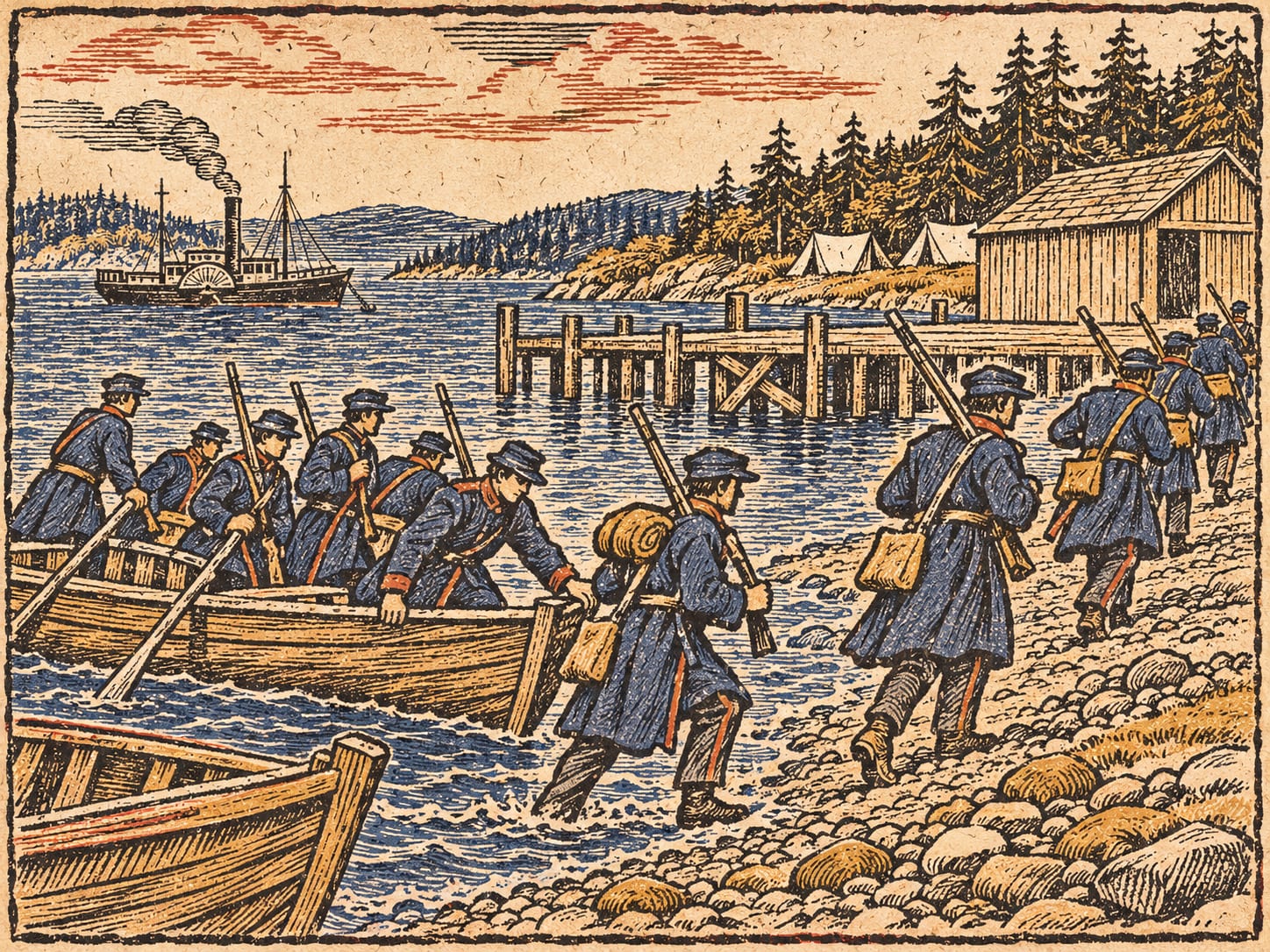
Pickett's company landed on 27 July 1859 near the Hudson's Bay Company wharf at Griffin Bay. The company is put at 64 to 66 men, depending on the account.
Three days later Griffin wrote to Pickett that the island "is the property and in the occupation of the Hudson's Bay Company," and asked him to "immediately cease to occupy the same." Pickett replied that he did "not acknowledge the right of the Hudson's Bay Company to dictate my course of action."
Governor James Douglas of Vancouver Island rejected Harney's reasons outright. He wrote that the alleged grounds for the occupation "do not exist" and called the story told to Harney "a fabrication." He ordered British warships to dislodge Pickett, and told their commander to avoid an armed clash if he could. HMS Tribune, HMS Satellite and HMS Plumper appeared off the island. Pickett refused to withdraw.
Royal Marines later landed at Garrison Bay on 21 March 1860 and set up English Camp.
31 August 1859: the biggest standoff
At the height of the crisis, on 31 August 1859, the American force on the island numbered 461 men, with 14 cannons and an earthwork fortification. The British side had about 2,140 troops, including Royal Marines, artillerymen, sappers and miners, and five warships carrying 167 guns.
Rear Admiral Robert L. Baynes, who commanded the British Pacific Station, refused to begin an attack, saying he would not "involve two great nations in a war over a squabble about a pig." Captain Geoffrey Hornby supported him and declined to land Royal Marines against Pickett's force. Douglas, too, was holding back a fight his own side could have started.
The earthwork was the work of Lieutenant Henry Martyn Robert, who designed and supervised the American redoubt in August 1859. It was meant for eight 32-pounder guns. Robert would later write Robert's Rules of Order.
In Washington, President James Buchanan sent General Winfield Scott to negotiate. Scott reached the island in October 1859 and worked out a joint military occupation with Douglas. Both governments approved it in November. One American company stayed in the south of the island, a British force held the north, and the reinforcements went home. The guns meant for the redoubt were removed.
Twelve years of sharing an island
The joint occupation ran for about twelve years, from 1859 to 1872. One American company held the south of the island, at American Camp, and one British company held the north, at English Camp.
Private William A. Peck Jr. served at American Camp and helped build the redoubt. He kept a journal, published in 1993 as The Pig War and Other Experiences of William Peck, Soldier, 1858-1862. It records British warships facing the camp, the digging, the weather and camp life. Of the whole crisis he wrote: "it seems present difficulties all arose from an unruly hog, of which there are plenty here."
The Royal Marines built at Garrison Bay. They found a large shell midden and an abandoned plank longhouse at a Coast Salish place the park now calls Pe'pi'ow'elh. The National Park Service says the longhouse could hold as many as 600 people. The British took it apart and used its timber for building.
The two camps drew workers away from Belle Vue Farm, and American settlers took more of its prairie. By mid-1860 the farm was losing money, and Griffin left in 1862.
The Treaty of Washington, signed on 8 May 1871, sent the San Juan boundary question to arbitration by Kaiser Wilhelm I of Germany. The United States argued for Haro Strait, and Britain for Rosario Strait.
The Kaiser's written award, issued at Berlin on 21 October 1872, ruled that the American reading was "most in accordance with the true interpretations" of the 1846 treaty and ordered the boundary through Haro Channel. That put the San Juan Islands inside the United States. George Bancroft, the U.S. minister in Berlin, thanked the Kaiser for the United States, and Britain accepted the award too. The Royal Marines left English Camp on 25 November 1872, and American troops had left American Camp by July 1874.
The award settled who owned the islands. It did not settle every personal claim. A later claims commission heard individual claims over arrests, property and removals from San Juan Island.
So, the Pig War ended with a German emperor's written award, not a battle.
The Pig War, from treaty to award
- 15 June 1846
The Oregon Treaty is signed at Washington without naming which channel carries the border
- 15 June 1859
Lyman Cutlar shoots a Hudson's Bay Company pig on San Juan Island
- 27 July 1859
Captain George E. Pickett's company lands at Griffin Bay
- 31 August 1859
461 Americans and about 2,140 British troops face each other
- October 1859
General Winfield Scott arrives and negotiates a joint occupation
- 21 March 1860
Royal Marines land at Garrison Bay and set up English Camp
- 8 May 1871
The Treaty of Washington sends the boundary question to arbitration
- 21 October 1872
Kaiser Wilhelm I's award places the boundary in Haro Strait
- 25 November 1872
The Royal Marines leave English Camp
- July 1874
American troops have left American Camp
Did anyone die?
No one was killed in combat in the 1859 confrontation. The pig was the only casualty of the armed standoff itself.
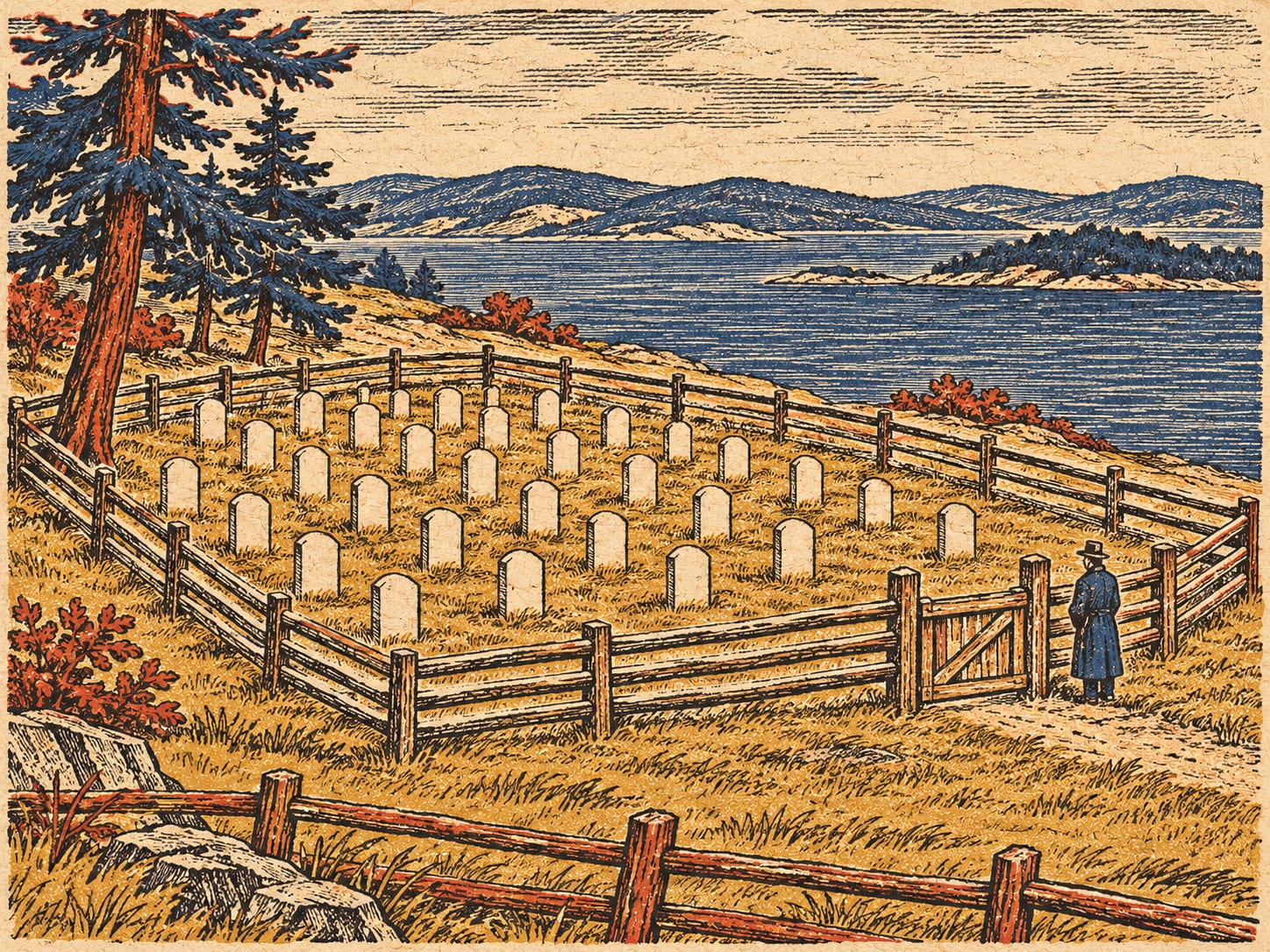
The line "the only casualty was a pig" stops being true if it is stretched across all twelve years of occupation. Seven people lie in the Royal Marines' Cemetery on Young Hill, most of them Royal Marines, and two of them are people whose names have been lost. They died during the occupation, mainly from accidents, drowning, natural causes, or an accidental shooting. None of them died in combat.
Who won?
The United States won the border. Kaiser Wilhelm I's award of 21 October 1872 chose Haro Strait, so the San Juan Islands became American.
Nobody fought for them. The two sides spent twelve years sharing the island under arms, and the quarrel that started over a pig ended with arbitration.
What became of the people
Lyman Cutlar stayed on the island for years. He was a partner in the San Juan Island Lime Company in 1860 and 1861, and American settlers elected him constable in 1864. By 1871 he was living at Blanchard, in Skagit County, and he died in 1874. No photograph of him is known.
Charles Griffin managed Belle Vue Farm from 1853 until 1862. Robert Firth replaced him, leased the farm from the company by 1865, and after the 1872 decision homesteaded on the former farm and turned the home prairie into a private one. Where Griffin went after 1862 is not known.
George Pickett returned to the island in 1860 and commanded for part of the joint occupation. A Virginian, he resigned from the U.S. Army in 1861 and joined the Confederacy. He commanded a division in the assault known as Pickett's Charge at Gettysburg on 3 July 1863, and he died in Richmond on 30 July 1875.
Henry Martyn Robert, who had dug the redoubt beside him, served the Union as an Army engineer. Harney was rebuked after the crisis and reassigned, retired in 1863, and died in Orlando, Florida, on 9 May 1889. Scott retired as commanding general in November 1861 and died at West Point on 29 May 1866.
Douglas stayed governor of Vancouver Island until 1864, was knighted in 1863, and died in Victoria on 2 August 1877. Baynes retired from the Royal Navy in 1860, became an admiral in 1867, and died in 1869.
Why it took twelve years
The dispute ran that long because the boundary in the Oregon Treaty was still unresolved, and the pig was never the real issue. The shooting gave both sides a reason to send soldiers, and it did not change the question of which channel the treaty meant.
What changed in 1859 was that soldiers now stood on the disputed ground. American settlers had asked General Harney for protection, British officials had threatened to remove them, and Douglas and Baynes were holding back a fight their own side could have started. General Scott's joint occupation kept the peace on the island, and the Treaty of Washington in 1871 sent the channel question to the Kaiser.
What the park protects today
San Juan Island National Historical Park preserves places tied to the Pig War and the joint British and American occupation of the 1850s through the 1870s. It also recognises the continuing history of Coast Salish peoples on San Juan Island.
At American Camp, visitors can see the parade ground, original officers' quarters, laundress quarters and the Redoubt, which the National Park Service calls one of the best-preserved American fortifications of the years before the Civil War west of the Mississippi. It is an earthwork left over from the crisis, not a fully armed fort.
At English Camp on Garrison Bay, the parade ground, barracks, blockhouse, commissary and formal garden are among the sites. The blockhouse was a defensive structure, but the marines used it mainly to confine civilians and soldiers who broke laws or rules. The Royal Marines' Cemetery sits a fairly strenuous hike up Young Hill, with views toward Canada.
The park's grounds and outdoor exhibits stay open around the clock all year. The visitor centres are seasonal, and the park advises checking the schedule before travelling.
The park also protects trails, beaches, intertidal areas, Garry oak savanna, Pacific Northwest coastal prairie, and the site of Belle Vue Sheep Farm.
The pig and the border
The pig has no name in the accounts. The border runs through Haro Strait, and the San Juan Islands are American.
Sources
- National Park Service, "The Pig War," San Juan Island National Historical Park, and its Pig War bibliography
- National Park Service, "Belle Vue Sheep Farm," "Lyman Cutlar Homestead," English Camp, American Camp and "Royal Marines' Cemetery"
- National Park Service, Outpost of Empire and the park's administrative history
- National Park Service, American Camp National Register nomination
- Oregon Treaty text, Library of Congress
- "Bungled Borders in the Pacific Northwest, Part 2," Library of Congress
- Affairs in Oregon, U.S. congressional publication, 1860, with the Cutlar and Hubbs affidavits and the Harney, Griffin and Pickett letters
- Affidavit of Lyman A. Cutlar regarding the pig shooting, September 1859, National Archives
- "Award of His Majesty the Emperor of Germany on the San Juan boundary question," and claims commission records, U.S. Office of the Historian
- William A. Peck Jr., The Pig War and Other Experiences of William Peck, Soldier, 1858-1862, edited by C. Brewster Coulter and Bert Webber, 1993
- HistoryLink essays on San Juan Island
- Salish Current, "The Pig War: They were committed to keeping the peace"
Watch the full story on the Flashback Fables YouTube channel, and send it to someone who would love it.