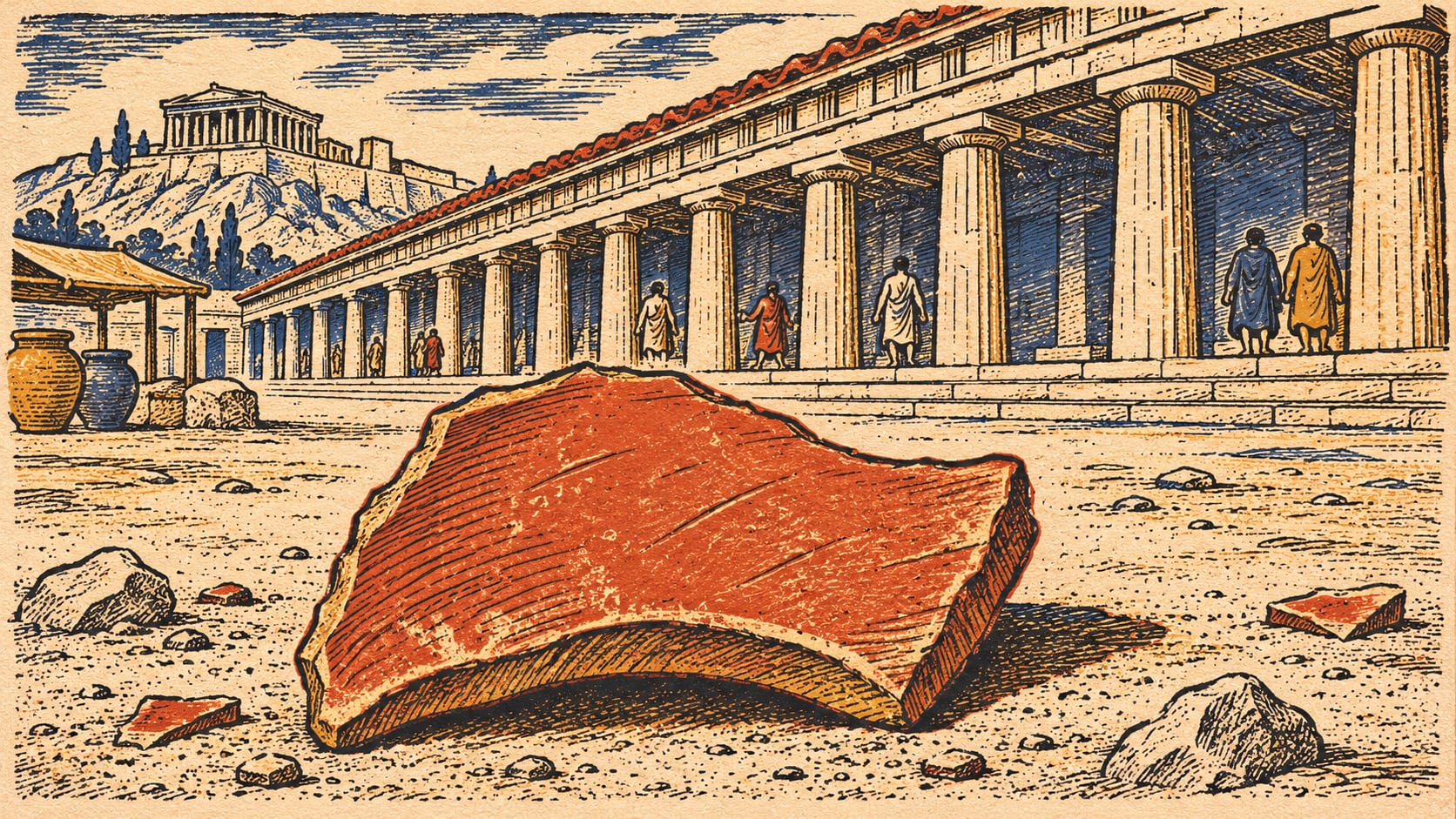
In Athens, citizens could vote a man out of the city for ten years by scratching his name on a broken piece of pottery. The practice was called ostracism, and Aristotle credits Cleisthenes with the law.
Cleisthenes reorganised Athens in 508 to 507 BC. The earliest known ostracism came around 487 BC, about twenty years later. The man sent away was not tried for a crime, and he kept his property.
Thousands of those pottery ballots survive, and one of them is aimed at Aristides, a man later called "the Just."
An exiled family and a rival
Cleisthenes belonged to the Alcmaeonids, a wealthy Athenian family driven into exile by the Peisistratid tyrants. Herodotus says the exiles tried to return by force under Hippias, fortified a place called Leipsydrion above Paionia, and lost badly. Afterward the family took the contract to finish the temple at Delphi. They had agreed to build it in ordinary limestone and used Parian marble for the front instead. Herodotus adds that Cleisthenes was reputed to have persuaded the Pythian priestess to turn Sparta against the tyrants.
When the tyrants were gone, two men dominated Athens: Cleisthenes the Alcmaeonid and Isagoras, son of Tisandrus. Cleisthenes lost the early struggle. Herodotus says he then "took the commonalty into partnership" and reorganised Athens into ten tribes instead of four, named for heroes. Herodotus gives him a model in his maternal grandfather, Cleisthenes of Sicyon, who had changed tribal names in his own city.
Why he did it is still argued. Family hatred of the tyrants, rivalry with Isagoras and an appeal to the wider body of citizens all fit the accounts of Herodotus and Aristotle. None of it shows he acted from democratic principle alone, and none of it shows the reforms were only a grab for power.
The man who rebuilt Athens
Cleisthenes carried out his reforms in 508 to 507 BC, during the archonship of Isagoras. He was an aristocrat, the son of Megacles.
He replaced Athens's four traditional tribes with ten new ones. Aristotle says the Pythian priestess chose the ten tribe names from a list of 100 heroes. Cleisthenes divided Attica into demes, which were local political communities, and grouped them into thirty trittyes: ten in the city, ten on the coast and ten inland. Each tribe held three trittyes, so every tribe had members from different parts of Attica. Citizens began to name themselves by their deme instead of by their father's name, and officials called demarchs ran the demes.
He also created the Council of 500 in place of the older Council of 400. Aristotle puts it plainly: "Next he made the Council to consist of five hundred members instead of four hundred, each tribe now contributing fifty." Generals were elected by tribe, one from each, while the polemarch stayed in command of the whole army. The changes widened who could take part and weakened the old structure built on family and regional networks.
Two days on the Acropolis
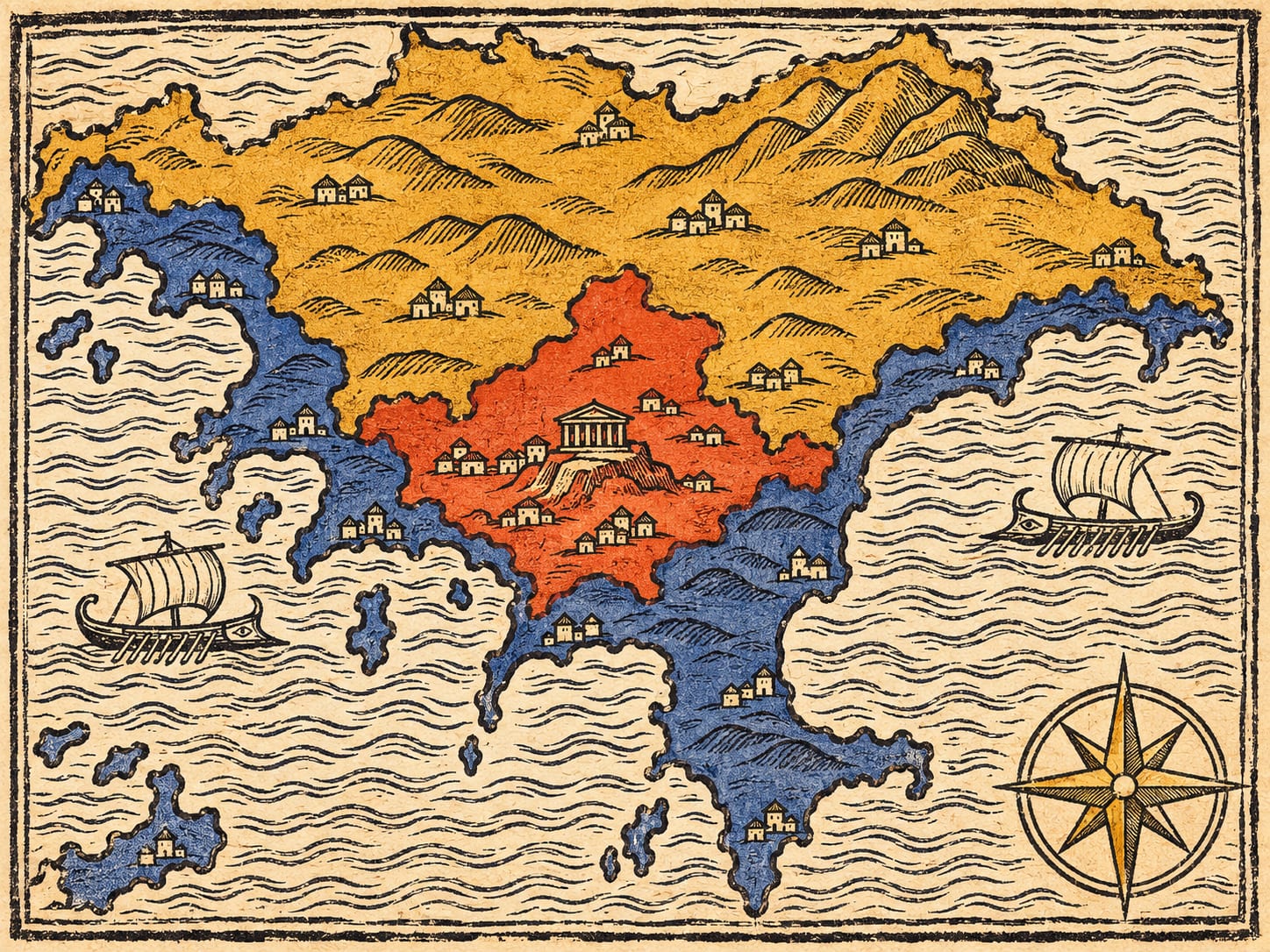
Isagoras turned to Cleomenes I, king of Sparta. Cleomenes demanded that Athens expel Cleisthenes and other Alcmaeonids as "the Accursed," a reference to the old killing of Cylon's suppliants. Cleisthenes slipped away in secret. Cleomenes entered Attica with a small force and expelled 700 Athenian households whose names Isagoras supplied. Then he tried to dissolve the Council and hand power to Isagoras's faction.
The Council would not agree. Herodotus puts it this way: "But the Council resisted him and would not consent; whereupon Cleomenes and Isagoras and his partisans seized the acropolis. The rest of the Athenians united and besieged them for two days."
On the third day the Spartans and their allies surrendered under an agreement that let them leave. The Athenians who had sided with Isagoras were imprisoned and executed. The Athenians recalled Cleisthenes and the 700 households. Aristotle tells the same outline and says the people besieged the Spartan force on the Acropolis for two days.
Athens against its neighbours
After the siege, Cleomenes raised an army from the Peloponnese to punish Athens and restore Isagoras, and marched as far as Eleusis. At the same moment the Boeotians seized Oenoe and Hysiae on the Attic border, and the Chalcidians raided Attic land. The Corinthians withdrew. The Spartan king Demaratus withdrew too, after a quarrel with Cleomenes, and the Peloponnesian army broke up.
The Athenians then attacked the Boeotians, beat them and took 700 prisoners. On the same day they crossed to Euboea, defeated Chalcis and settled 4,000 Athenian tenant farmers on the lands of the Chalcidian elite. The prisoners were released for ransom. Herodotus says the Athenians dedicated a tenth of the ransom and displayed the prisoners' fetters on the Acropolis.
Herodotus judged that Athens fought no better than its neighbours under tyrants, and far better once free of them. That is his reading of events, not a count of soldiers.
A council with a house
The new Council of 500 needed somewhere to sit. The Old Bouleuterion, a late sixth or early fifth century BC building beside the Tholos in the Agora, was probably built for it. An inscription found near the building names it as a bouleuterion, and the remains point to an inner room with wooden benches laid out in a Pi shape. Only foundations and floor levels survive, so reconstructions of the upper building are partly guesswork. In the late fifth century BC a New Bouleuterion replaced it. After about 410 BC the old building held state archives and the worship of the Mother of the Gods.
The nearby Tholos, built around 465 BC, was the headquarters of the 50 prytaneis, the councillors of one tribe who served as the executive committee for a tenth of the year. They convened the Council and the Assembly, guarded state equipment and archives, dined at public expense and kept someone on duty overnight for emergencies.
What Aristotle says about the law
In Constitution of the Athenians, section 22, Aristotle says Cleisthenes established the law of ostracism as part of reforms meant to make the constitution more democratic. The law existed, he says, because Athenians feared the concentration of power that had let Peisistratus become tyrant.
Aristotle says the Athenians put it to use after their victory at Marathon, two years after the battle. The earliest man he names is Hipparchus, son of Charmus, of the deme Collytus, a relative and supporter of the Peisistratid tyrants. Cleisthenes, Aristotle says, particularly wanted him gone.
For three years the procedure aimed at friends of the tyrants. In the fourth year it was used against other citizens who seemed too powerful, beginning with Xanthippus, son of Ariphron.
Aristotle credits Cleisthenes with the law, and modern scholars debate when it began. The gap of about twenty years between the reforms and Hipparchus's ostracism has led some to ask whether the law was fully working when Cleisthenes brought it in. The date of Hipparchus's ostracism is written as 487 BC or 488/487 BC, because an Athenian archon year crossed parts of two modern calendar years.
How the vote worked
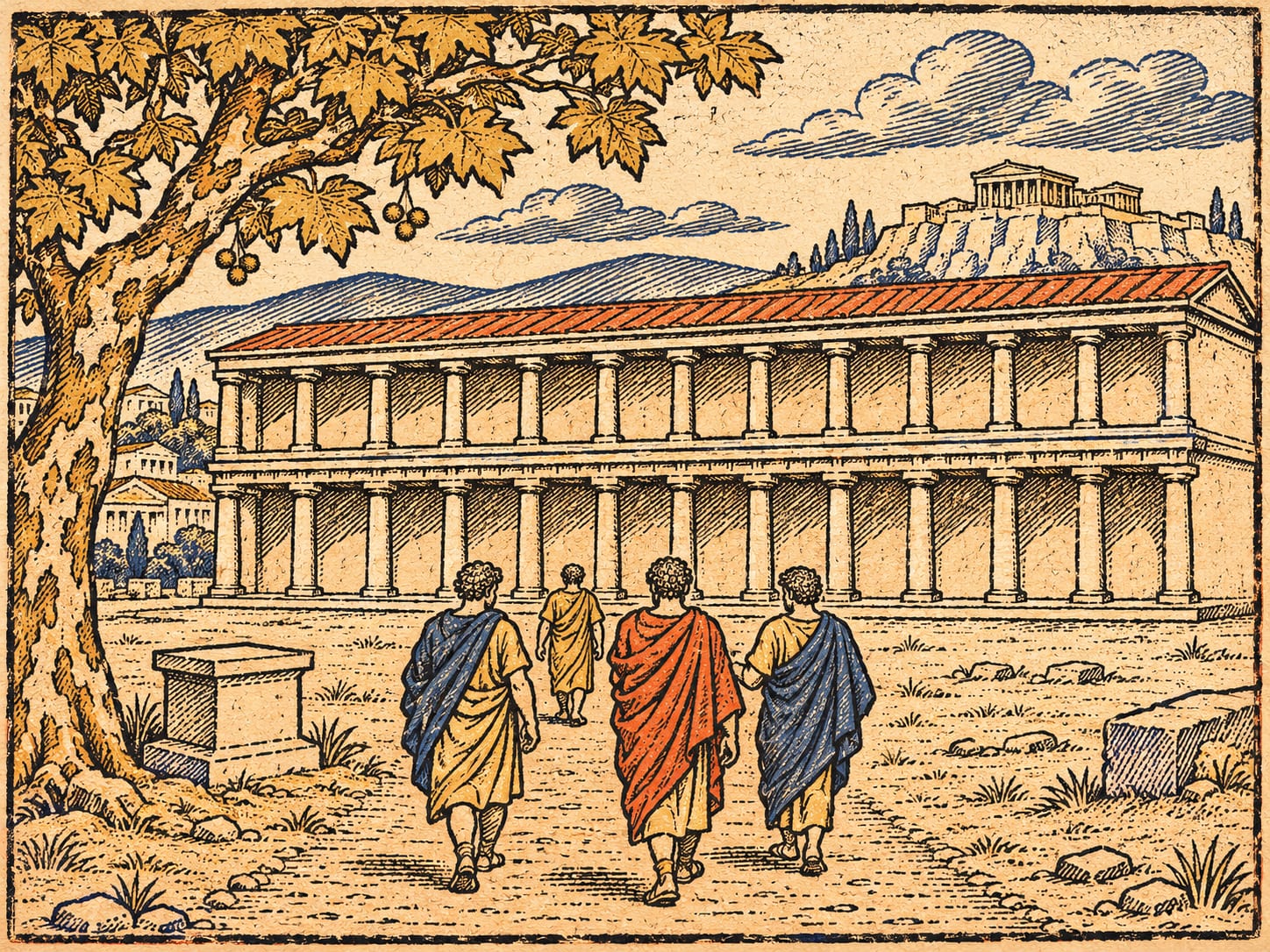
The procedure appears to have had two stages. To begin, the Assembly voted on whether an ostracism should happen that year. If it said yes, a later gathering held the vote itself. The yearly preliminary vote is commonly described by modern scholars, though the surviving ancient evidence is not equally detailed on every step.
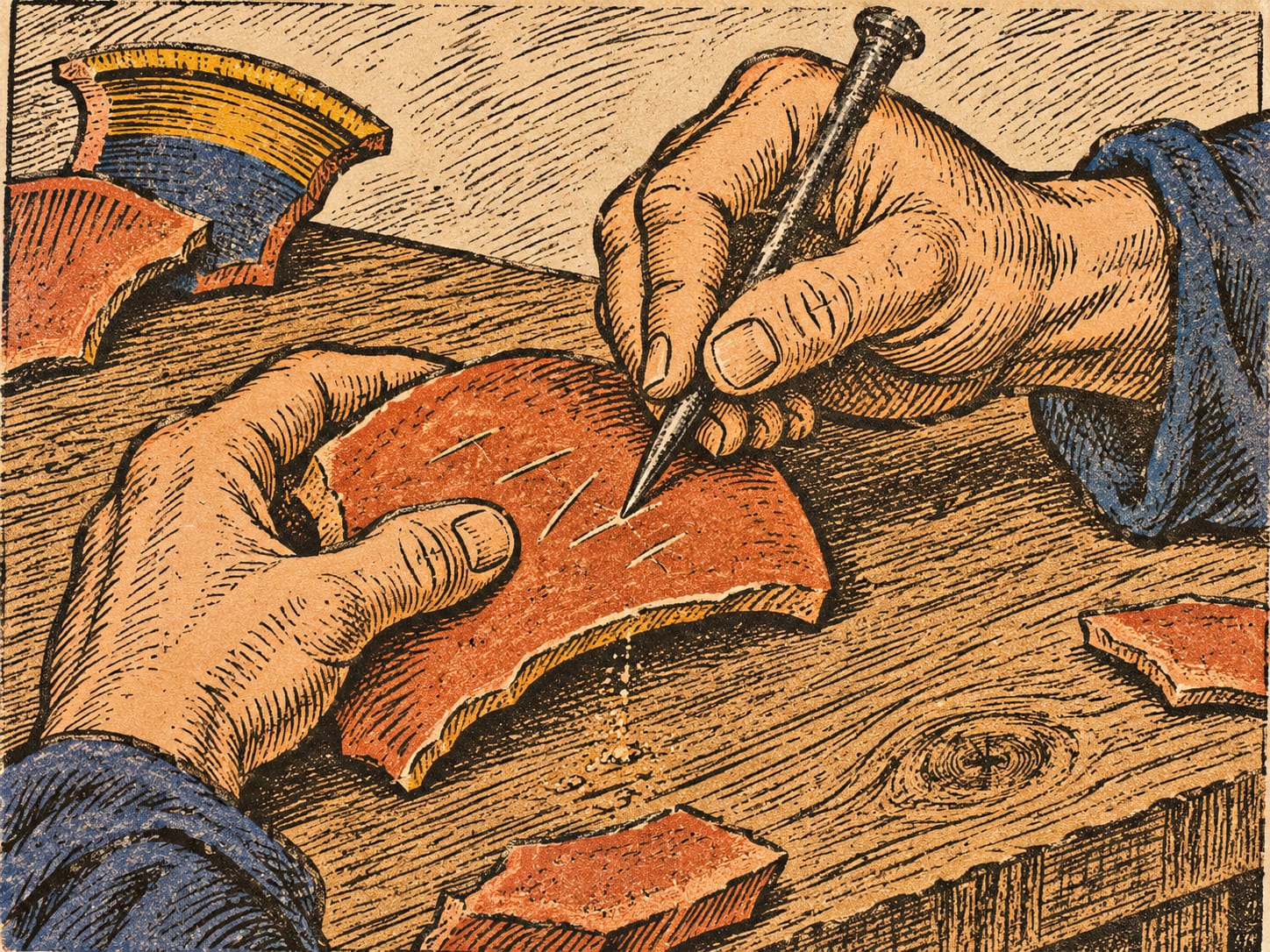
At the ostracism, each citizen wrote the name of the person he wanted removed on a piece of broken pottery, an ostrakon. The sherds went into an enclosed area of the Agora. The archons counted them and then sorted them by name.
Plutarch reports a quorum of 6,000. His wording says that if fewer than 6,000 ostraka were cast, the ostracism was void. Scholars debate whether that meant 6,000 ballots in all or 6,000 votes against the man who left.
The person with the most votes was banished for ten years. Ostracism was not a criminal conviction, and he kept his property and its income. A later civic decision could end the exile early, as Athens did when it recalled exiles during the Persian invasion.
The pottery that survives
The largest known group of ostraka is the Kerameikos hoard in Athens, with around 9,000 voting sherds. The German Archaeological Institute dates it to approximately 471 BC and has published it in a full catalogue.
The Athenian Agora has produced a separate and much smaller collection. Mabel Lang's catalogue lists 1,145 Agora ostraka. About 190 more, almost all naming Themistocles, came from a well on the north slope of the Acropolis.
The Agora excavations of the 1930s turned up important groups. In 1932, excavators found ostraka naming Hipparchus, Themistocles, Hippocrates and Aristides. By 1933 the Agora collection included 247 ostraka, with Themistocles named on 83 and Aristides on 41.
These figures are not one total for every surviving ostrakon. They come from different excavations and different catalogues.
Two sherds can be seen today. A Themistocles ostrakon in the Ancient Agora Museum in Athens is dated to 482 BC. An ostrakon against Aristides, son of Lysimachus, was found in the River Eridanos and is listed in Room 12 of the Kerameikos museum.
What the sherds say
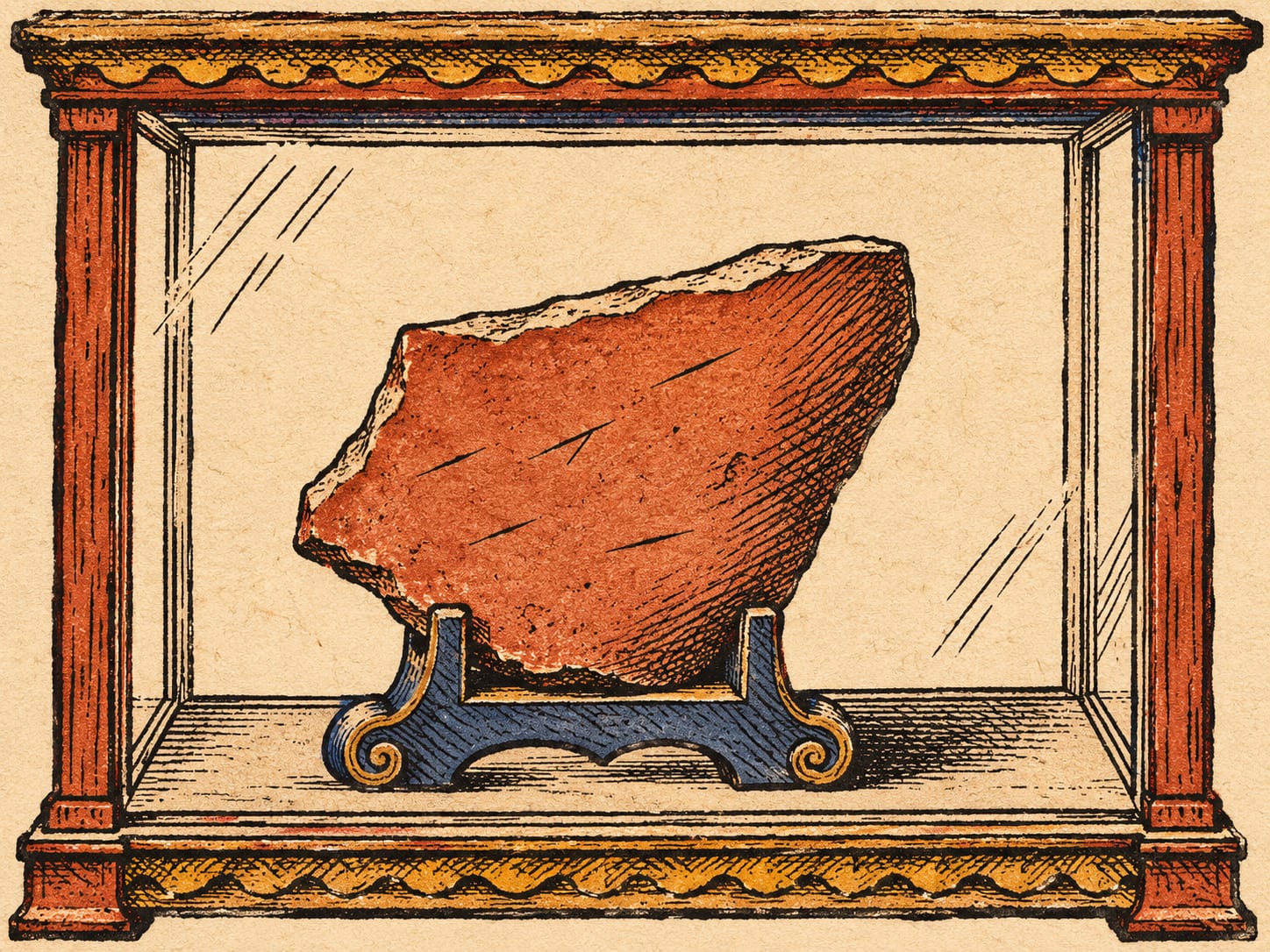
Many voters wrote only a name. Others added an accusation, an order, an insult or a drawing.
One sherd reads "Megakles, son of Hippokrates, moichos," which means adulterer. Another calls Themistocles katapugon, an insulting word tied to sexual dishonour. Others read "Callixenus, the traitor," "Callixenus, son of Aristonymus, should go," "Megacles, son of Hippocrates, should flee" and "Themistocles, son of Neocles, should go." One reads "Cimon, son of Miltiades, should get out of here, and take Elpinice with you." The insults show public hostility. They do not show that the accusations were true.
A Kerameikos sherd naming Kallias, son of Kratios, carries a drawing of a Persian archer. Its reverse bears his name and the word "Mede," meaning Persian or a friend of Persia. The Greek Ministry of Culture describes it as part of a group of several thousand ostraka found in 1966 in the ancient riverbed of the Eridanos. At least 760 sherds from that deposit name Kallias, and seventeen or eighteen more link him with "Mede" or "from the Medes." The charge was probably association with Persia. Why Kallias was singled out is not securely established.
The same deposit holds about 4,176 ostraka naming Megacles. Others call him "silver-loving," or mention horse breeding or his "new hair." Those jabs may hit at wealth, an aristocratic way of life or personal habits. They are not the official reasons for his ostracism, and modern epigraphers disagree about how far such lines were literal charges, comic abuse or political messaging.
Some sherds look prepared in advance. An Agora excavation report describes two ostraka cut from adjoining pieces of one roof tile, written in the same hand and naming the younger Alcibiades. They were found together and seem never to have been cast or counted, so the excavator suggests they were made ahead of time and thrown away. Catalogues list other groups written in the same or similar hands. That makes it likely some voters or helpers prepared batches. It does not show that every ostrakon came from a political machine.
Who was sent away
Xanthippus, son of Ariphron and father of Pericles, is the earliest ostracised man Aristotle names who had no tie to the tyrants. Aristotle places him after Hipparchus and Megacles, and the year is usually put around 485 or 484 BC. He had prosecuted Miltiades after Miltiades's failed attack on Paros in 490 to 489 BC. Modern historians link that to his rivalry with Themistocles and Aristides, though the ancient accounts do not describe the vote that sent him away.
Aristides, son of Lysimachus, was ostracised around 482 BC, with some older lists giving 483 BC. Plutarch says Aristides "always opposed" Themistocles and was ostracised "in consequence of political defeat at the hands of Themistocles." Aristides was recalled before or during the Persian invasion and took part in the defence of Athens.
Themistocles, son of Neocles, was ostracised around 472 to 470 BC, though the date is uncertain. He went to Argos and eventually entered the Persian Empire, where King Artaxerxes I received him. The sequence from ostracism to later accusations to permanent exile is complicated.
Cimon, son of Miltiades, was ostracised around 461 BC. He had persuaded Athens to send hoplites to help Sparta put down the revolt of the Messenians and Helots. Plutarch says the Spartans dismissed the Athenian force as dangerous, and the Athenians came home angry and turned on Cimon and the "Laconizers." Plutarch writes: "Laying hold of a trifling pretext, they ostracised him for ten years." Athens recalled him when it needed military leadership in its conflict with Sparta.
The voter who could not write
The story goes that on the day Aristides was ostracised, a voter who could not write handed him an ostrakon, not recognising him, and asked him to write "Aristides" on it. Aristides asked whether the man had been harmed by Aristides. The voter said he did not know him, but was tired of hearing him called "the Just." Aristides wrote his own name on the sherd.
Plutarch tells it in his Life of Aristides, written around AD 100, several centuries after the ostracism of about 482 BC. It is a literary anecdote, and nothing written in Aristides's own day describes the exchange.
The ostracism itself stands on firmer ground, since ostraka naming Aristides survive, and one lies in the Kerameikos museum.
The exiles come home
Ostracism did not end a man's usefulness. Before the Persian invasion of 480 BC Athens recalled the ostracised, and Plutarch says Themistocles proposed the decree that let temporarily exiled citizens return to help defend Greece.
Herodotus calls Aristides at Salamis "an Athenian who had been ostracised by the people" and judges him "the best and most upright of all Athenians." Aristides came over from Aegina in the middle of the crisis. Though he was Themistocles's bitter rival, he called Themistocles out of the council and told him the Persian fleet had surrounded the Greeks. Then he gave the same news to the other commanders. He later commanded Greek forces on Psyttaleia during the battle.
Themistocles had not been ostracised before Salamis. He stayed in Athens, directed naval policy and helped set up the Greek victory. Herodotus records that he had messages carved on stones at the springs near Artemision, urging the Ionians in Xerxes's fleet to join the Greeks, stand aside or fight with less force.
Why Athens stopped
Athens set up ostracism out of fear of tyranny, and for three years it aimed at the friends of tyrants. Over the decades it was used against men who seemed too powerful, from Xanthippus to Cimon.
The final known use came against Hyperbolus, son of Antiphanes, around 417 to 415 BC. Plutarch says Nicias and Alcibiades both feared an ostracism vote that year. Alcibiades was feared for his boldness, and Nicias was disliked for his wealth, his aloofness and his opposition to popular wishes. Hyperbolus tried to use the quarrel. Plutarch writes that the two rivals "secretly combined together" and turned their supporters against him. Plutarch judged the result a degradation of ostracism, since Hyperbolus seemed unworthy of the company of earlier exiles.
Thucydides gives a shorter and harsher account. He says Hyperbolus was killed at Samos after being ostracised, "not from fear of his influence on position, but because he was a rascal and a disgrace to the city." He does not mention the plot between Nicias and Alcibiades.
After Hyperbolus the procedure fell out of use. Whether it was formally abolished or simply stopped is uncertain.
What can be seen today
At the Ancient Agora, visitors walk through the excavated civic centre and see the remains of the Old and New Bouleuterion, the Tholos area, the Metroon and the Monument of the Eponymous Heroes. The council houses survive as foundations and walls, not as intact buildings. The reconstructed Stoa of Attalos houses the Museum of the Ancient Agora, and ostraka naming Themistocles, Aristides, Cimon and Pericles belong to the Agora collections.
The Kerameikos, at 148 Ermou Street, holds the ancient cemetery, stretches of the city wall, the Sacred Gate, the Dipylon Gate and the channel of the Eridanos. Its museum is mostly funerary sculpture and pottery, and the ostraka from the 1966 deposit tie the site to this story. Confirm with the museum before going if you want to see a particular ostrakon.
Ostracism in Athens
- 508 to 507 BC
Cleisthenes carries out his reforms, with ten tribes and the Council of 500
- 508 to 507 BC
Athenians besiege Cleomenes and Isagoras on the Acropolis for two days, then recall Cleisthenes
- About 487 BC
Hipparchus, son of Charmus, is ostracised
- About 485 or 484 BC
Xanthippus, father of Pericles, is ostracised
- About 482 BC
Aristides is ostracised
- 480 BC
Athens recalls the ostracised before the Persian invasion
- About 472 to 470 BC
Themistocles is ostracised
- About 461 BC
Cimon is ostracised
- About 417 to 415 BC
Hyperbolus, the final known ostracised man, is sent into exile
Sources
- Aristotle, Constitution of the Athenians, sections 20 to 22
- Herodotus, Histories, Book 5 (sections 62 to 78) and Book 8 (sections 22 and 79 to 81)
- Plutarch, Life of Aristides, sections 7 and 8, and his lives of Themistocles, Cimon and Nicias
- Thucydides, History of the Peloponnesian War, section 8.73
- "Ostracism," 1911 Encyclopaedia Britannica
- "Ostracism in Athens," study with a table of known ostracisms, University of Ulster
- Die Ostraka vom Kerameikos, German Archaeological Institute
- Mabel Lang, Ostraka, Athenian Agora XXV, American School of Classical Studies at Athens
- American School of Classical Studies at Athens, history of the 1930s excavations in the Agora, and its Agora visitor information
- Greek Ministry of Culture, ostrakon of Kallias and the Archaeological Museum of Kerameikos
- Ancient Agora site pages on the Old Bouleuterion and the Tholos
- Ancient Agora Museum and Kerameikos Archaeological Museum, ostraka displays
- Society for Classical Studies, paper summary on insults and ostraka; Classical Quarterly article on ostracism and honour
- "Clístenes" and "ostracisme," Gran Enciclopèdia Catalana
Watch the full story on the Flashback Fables YouTube channel, and send it to someone who would love it.