
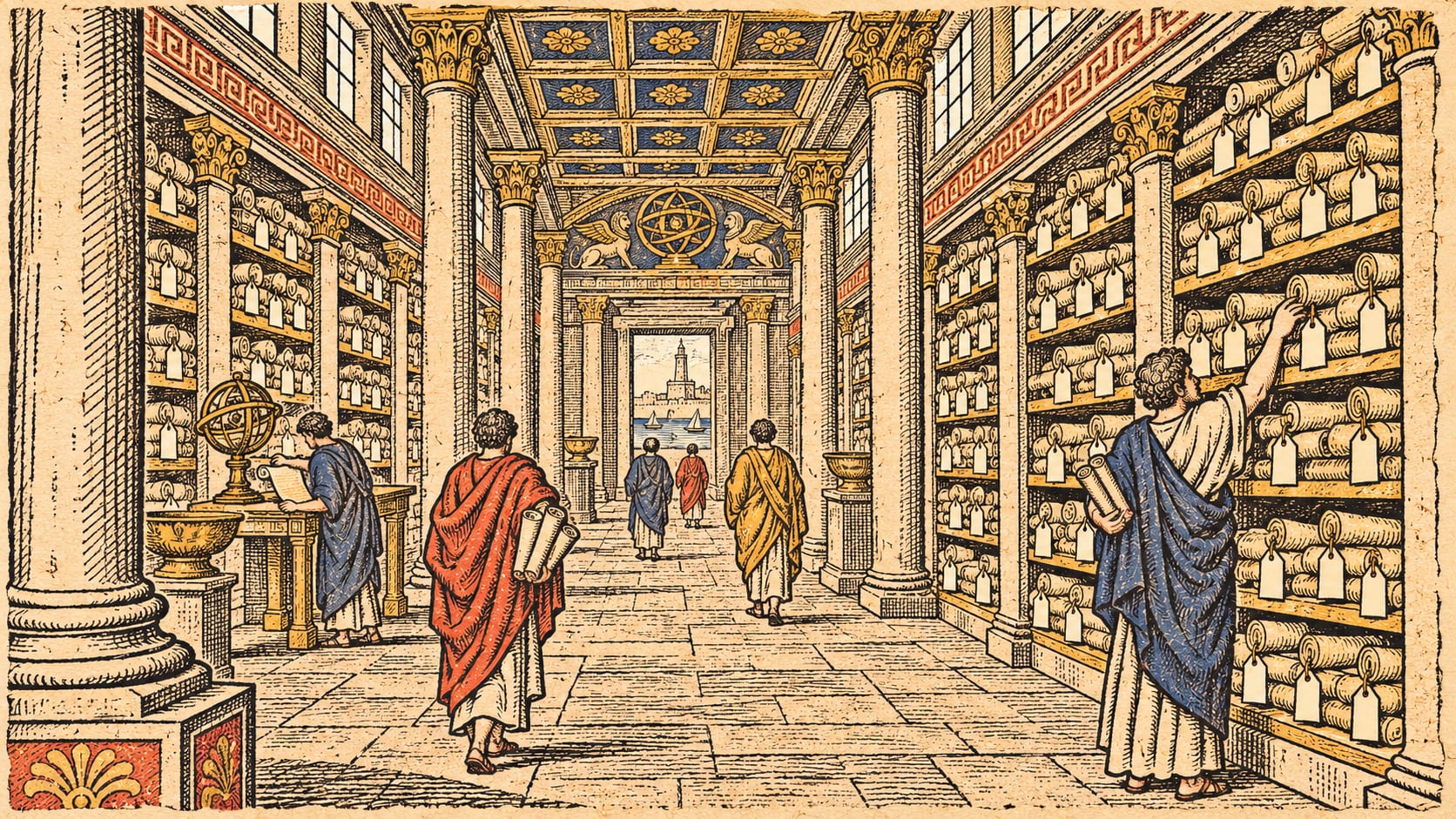
Where did the Library of Alexandria go? Not in one night. It was lost in stages across several centuries, and no single fire or single villain ended it.
Julius Caesar's forces set fire to ships and docks in 48 BCE, and books burned. Around 272 CE, a war wrecked the royal quarter where the Library stood. In 391 CE, Bishop Theophilus led the attack on the Serapeum, a temple that held a daughter library.
The famous story of a caliph ordering the books burned as bathhouse fuel comes from writers who lived centuries after the Arab conquest of the city.
A royal library and the people who ran it
The Library was tied to the Mouseion, a royal research and teaching institution dedicated to the Muses. It belongs to the Ptolemaic dynasty of the third century BCE. Ptolemy I Soter may have started the project, and the earliest surviving traditions credit Ptolemy II Philadelphus with completing or formally establishing it.
The Mouseion and Library employed scholars, poets, editors, scientists and teachers, paid for by the Ptolemaic court. Zenodotus of Ephesus is the earliest chief librarian known by name. Callimachus of Cyrene, active in the third century BCE, compiled the Pinakes, a large catalogue of authors and works.
Eratosthenes of Cyrene became chief librarian around 253 BCE. He was a mathematician, geographer, astronomer, literary scholar and chronologist. Aristarchus of Samothrace, active in the second century BCE, followed Aristophanes of Byzantium as chief librarian and became a leading editor of Homer's poems.
What the Mouseion looked like
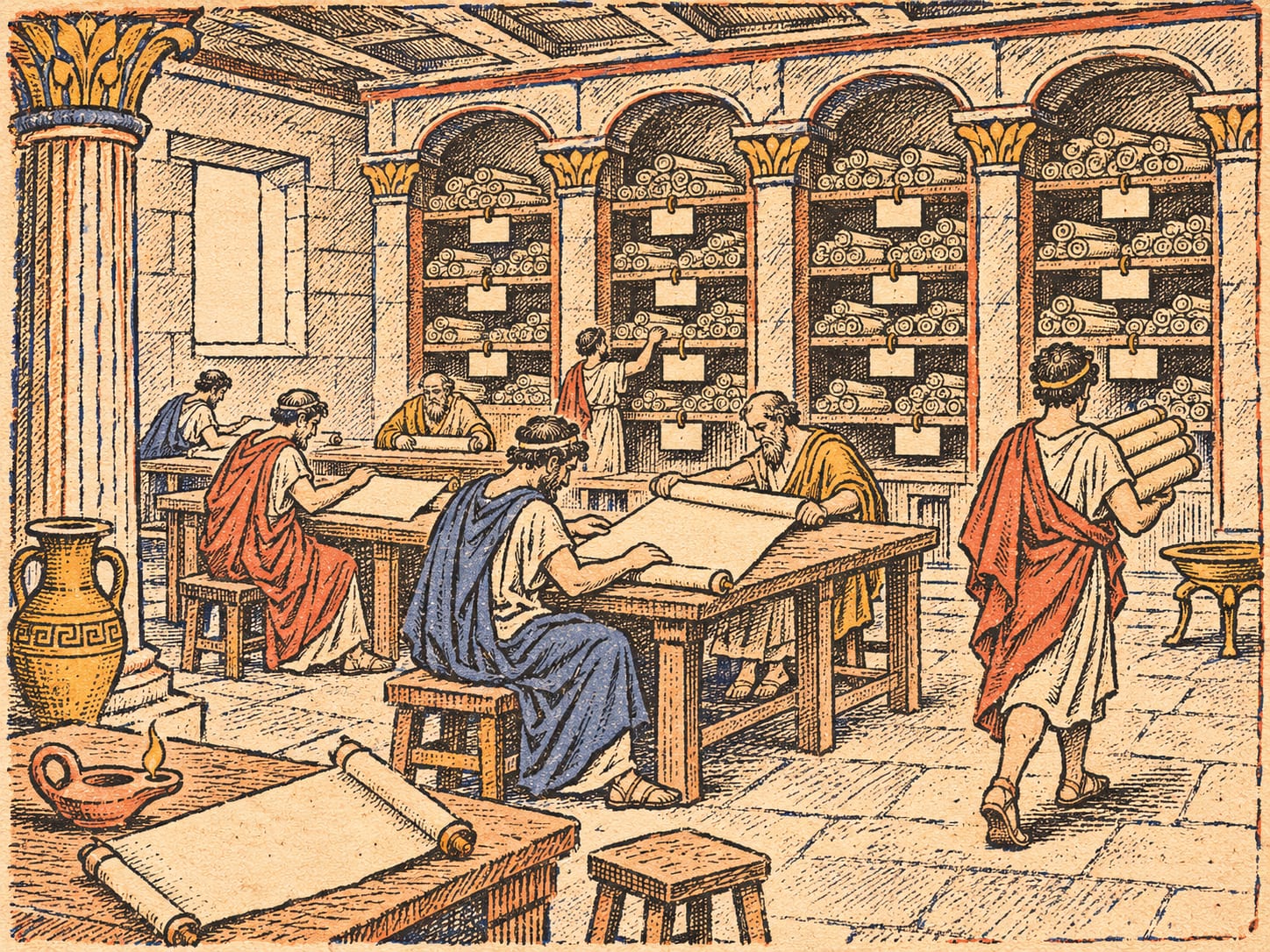
Strabo gives the earliest surviving description of the Mouseion's buildings and members, in his Geography. "A part of the royal palaces is also the Museum," he wrote, "which has a walk, an exedra, and a large house in which is the common mess-hall of the men of learning who share in the Museum."
So, the Mouseion sat inside the palace complex. Its scholars shared a dining hall, and the place had a walk, a meeting or lecture space and a large house. It was a working community of scholars, and not only a room full of books.
How the Ptolemies collected books
The collecting was aggressive, and the ancient tellers loved to say so. The Letter of Aristeas, probably composed in Alexandria in the final two centuries BCE, describes Demetrius of Phalerum as president of the king's library. In its words, he "received vast sums of money for the purpose of collecting together, as far as he possibly could, all the books in the world."
When the king asked how many books there were, Demetrius answered: "More than two hundred thousand, O king, and I shall make endeavour in the immediate future to gather together the remainder also, so that the total of five hundred thousand may be reached." The letter is a court narrative written well after the events, and it contains legendary material.
The physician Galen tells a sharper story about a king he calls only "Ptolemy," usually taken to be Ptolemy III Euergetes. The king ordered that books brought into Alexandria by travellers be copied, with the originals kept for the library. Then he borrowed the official Athenian manuscripts of Sophocles, Euripides and Aeschylus, leaving fifteen talents of silver as a deposit.
Galen reports that after the king "had produced magnificent new copies on the finest writing material," he kept the Athenian books and "sent back to them the copies that he had made." He urged the Athenians to keep the fifteen talents as well. It is an ancient anecdote, passed along in Galen's commentary on Hippocrates, and it shows how the library grew: by purchase, by copying and by keeping.
What the Pinakes shows
The catalogue Callimachus compiled does not survive as a whole. Twenty-five fragments are conventionally collected under his name, numbered 429 to 453 in Rudolf Pfeiffer's edition. Most of them reach us through later writers such as Athenaeus, who preserves classifications for law, history and oratory, and Diogenes Laertius, who preserves notices on philosophers.
From those scraps, scholars have rebuilt how the catalogue worked. Callimachus sorted authors into categories and, within each category, generally put them in alphabetical order. An entry could give an author's name, a short biography, the titles of the works, their opening words and the number of lines.
The categories include epic and other non-dramatic poetry, lyric poetry, tragedy, comedy, history, oratory, law, philosophy, medicine, mathematics, natural science and a miscellany. The catalogue shows a collection that held poetry, drama, prose, law, philosophy, history and technical learning. It does not list everything the Library owned.
How many scrolls did it hold?
Ancient writers gave very different totals, and each one is a claim or an estimate. The figures include about 40,000, 400,000, 500,000, 700,000 and 900,000 scrolls or volumes.
A scroll was not a modern book. A long work could fill many scrolls, and one scroll could hold several short works. Callimachus was credited with 400,000 "mixed" scrolls and 90,000 "unmixed" ones under Ptolemy III. The daughter library at the Serapeum was said to hold 42,800 scrolls.
Roger Bagnall, a modern historian of the ancient world, regards the largest totals as uncertain and possibly exaggerated.
The harbor fire of 48 BCE
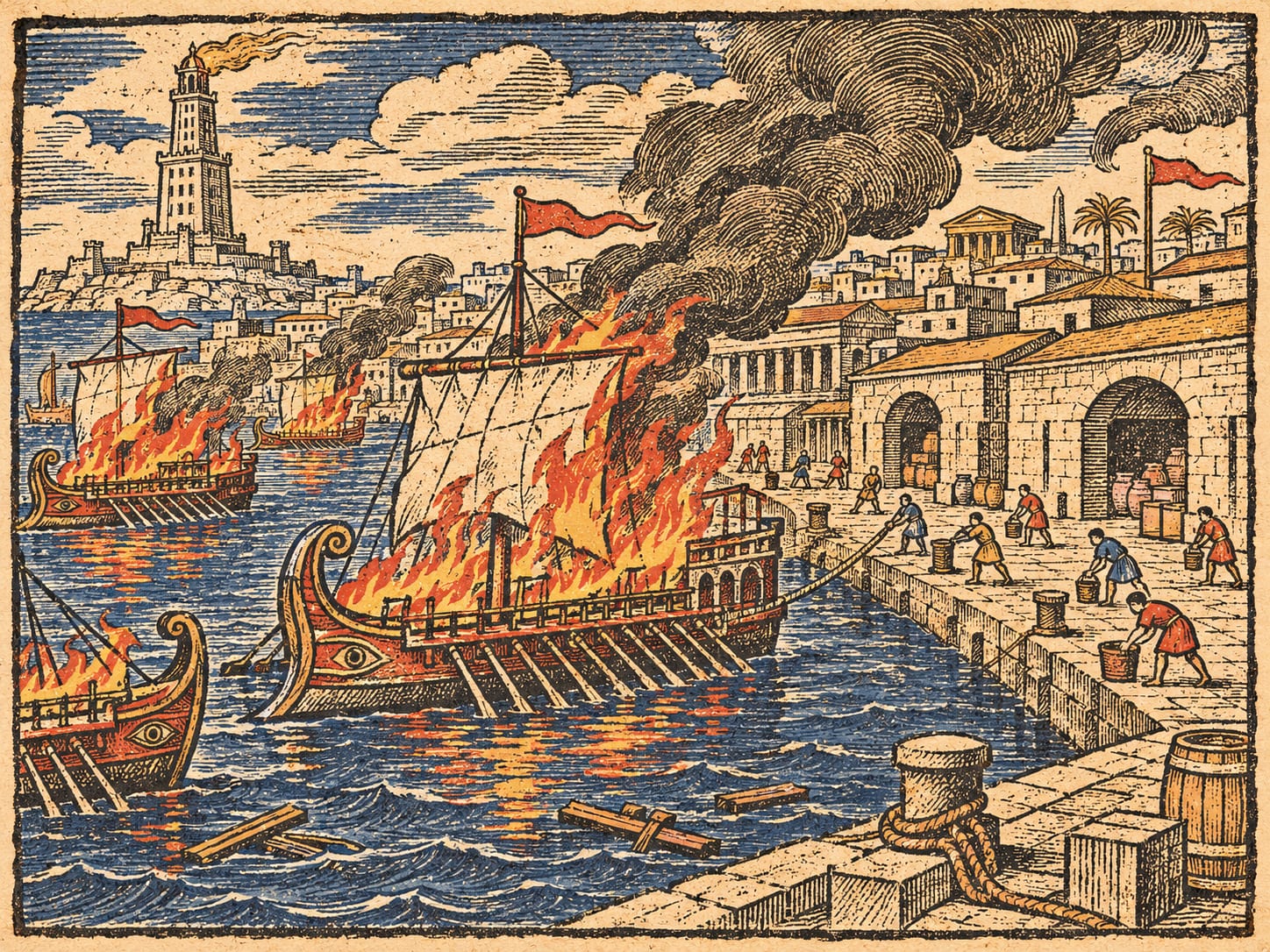
In 48 BCE, during the Alexandrian War, Caesar's forces set fire to ships and dockyard buildings so that the Egyptian fleet could not attack or escape. The fire spread from the harbor.
Four ancient writers describe what burned, and they do not say the same thing.
Plutarch, writing his Life of Caesar in the decades around 100 CE, says the fire spread from the dockyards and destroyed the Great Library. It is the clearest ancient statement that Caesar's fire reached the Library.
Seneca, writing after 49 CE, reports that 40,000 books burned at Alexandria. He does not say whether they were in the Library or in storage. Cassius Dio, writing in the early third century CE, says that docks, grain warehouses and book-storage places burned. His words can mean books sitting in harbor warehouses.
Strabo visited Alexandria around 25 to 20 BCE and wrote about the Mouseion and its scholars as a going concern. He says nothing about a Library that had ceased to exist. Caesar's fire cost Alexandria books, probably including stored or shipped scrolls, but it did not end the institution on the spot.
War in the royal quarter, around 272 CE
Around 272 CE, Emperor Aurelian won Alexandria back from the Palmyrene forces tied to Queen Zenobia. The fighting devastated the Brucheion, the royal quarter that held the palace complex and the Mouseion. Some accounts place the end of the conflict in 273 CE.
The Roman soldier and historian Ammianus Marcellinus described the damage. Alexandria had been "long torn by violent seditions," he wrote, and when Aurelian was emperor, "its walls were destroyed, and it lost the largest half of its territory, which was called Bruchion, and had long been the abode of eminent men."
Ammianus does not say outright that the Library or the Mouseion burned there. Linking the Brucheion with the main Library complex is a reasonable reading, and nobody wrote down an inventory of what was lost.
Later writers keep pointing at the district. Epiphanius of Salamis, in the late fourth century, mentions "the library in the same city of Alexander, in the so-called Brucheion," and describes the district as deserted. Synesius of Cyrene, in the late fourth or early fifth century, still mentions a Mouseion in Alexandria, though whether it was the Ptolemaic institution is uncertain.
Whatever stood of the royal Library probably went down in the ruin of its own district, centuries before any caliph arrived.
The Serapeum in 391 CE
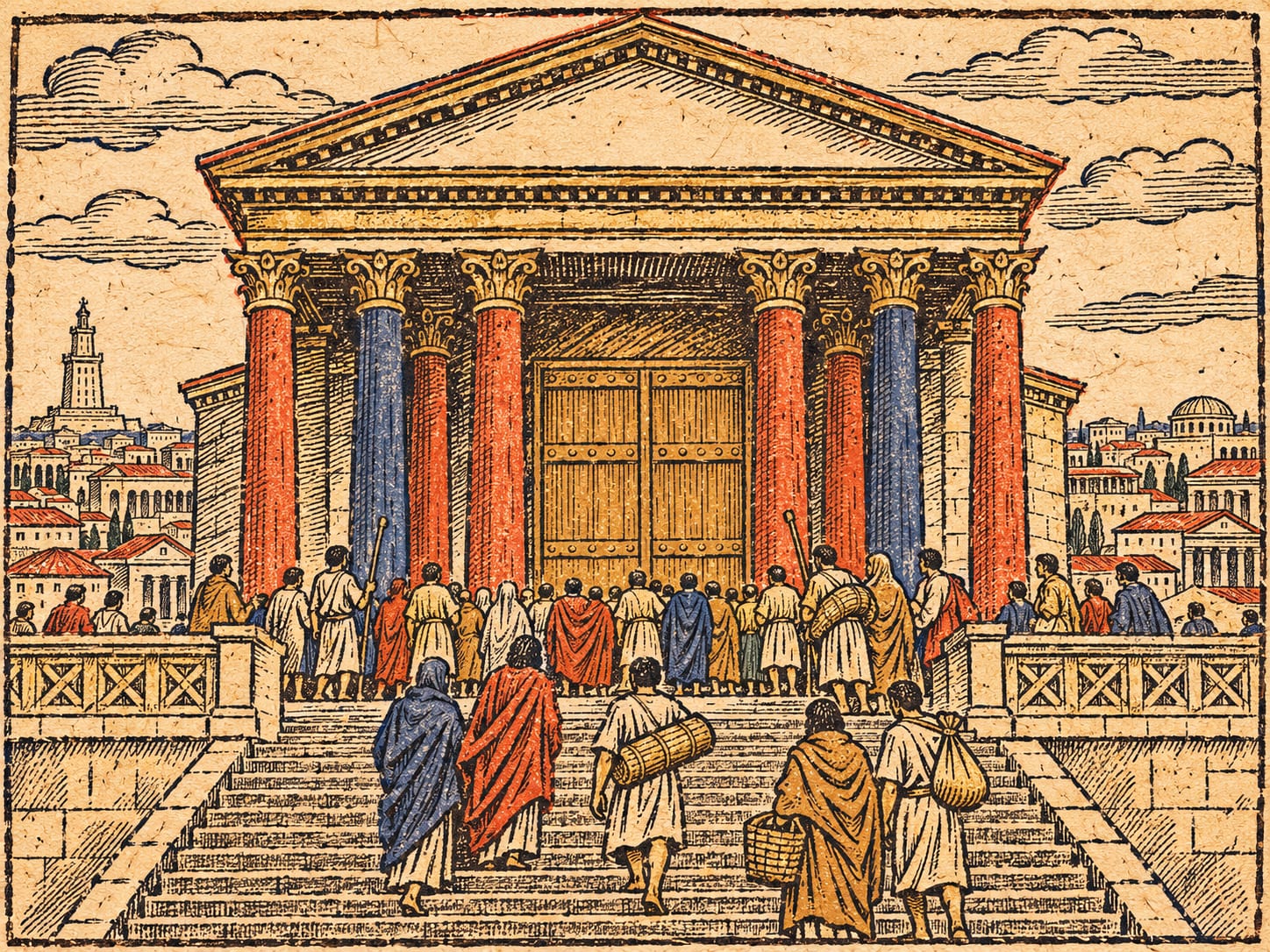
In 391 CE, Emperor Theodosius I authorized the destruction of pagan temples. Theophilus, bishop of Alexandria, led the attack on the Serapeum. That temple housed a daughter or branch library linked to the Alexandrian collections. Some writers give the year as 392.
The fullest list of names comes from Sozomen. He says the pagans seized the Serapeum and made it a citadel. Romanus commanded the Roman forces in Egypt, and Evagrius was prefect of Alexandria. Those inside, Sozomen writes, were stirred to resist by "a man named Olympius, attired in the garments of a philosopher." After the emperor's order was read, the defenders fled.
Socrates Scholasticus writes that the emperor ordered the demolition at the urging of Theophilus: "Then he destroyed the Serapeum." He adds that the grammarians Helladius and Ammonius later left Alexandria, and that he had known them as teachers. Rufinus of Aquileia, writing around 402, assumed his readers knew the place: "I suppose that everyone has heard of the Temple of Serapis in Alexandria." Sozomen's account does not describe a book-burning at the Serapeum.
Two other writers speak about the books. Orosius, writing in the early fifth century, said he had seen book chests in temples, emptied, and that people remembered them being plundered "by our own people in our own time." Aphthonius of Antioch described the Serapeum as a raised sanctuary with colonnades and rooms used for books, "open to those eager to study, an encouragement for the entire city to gain wisdom."
This was a second, separate loss. The Serapeum held a daughter collection. It was not one great library holding every Alexandrian book, and Mostafa El-Abbadi's chapter in the 2008 collection What Happened to the Ancient Library of Alexandria? concludes that the attack of 391 CE ended the temple and its daughter library. The number of scrolls that survived to that day is unknown.
The story of Caliph Omar and the bathhouses
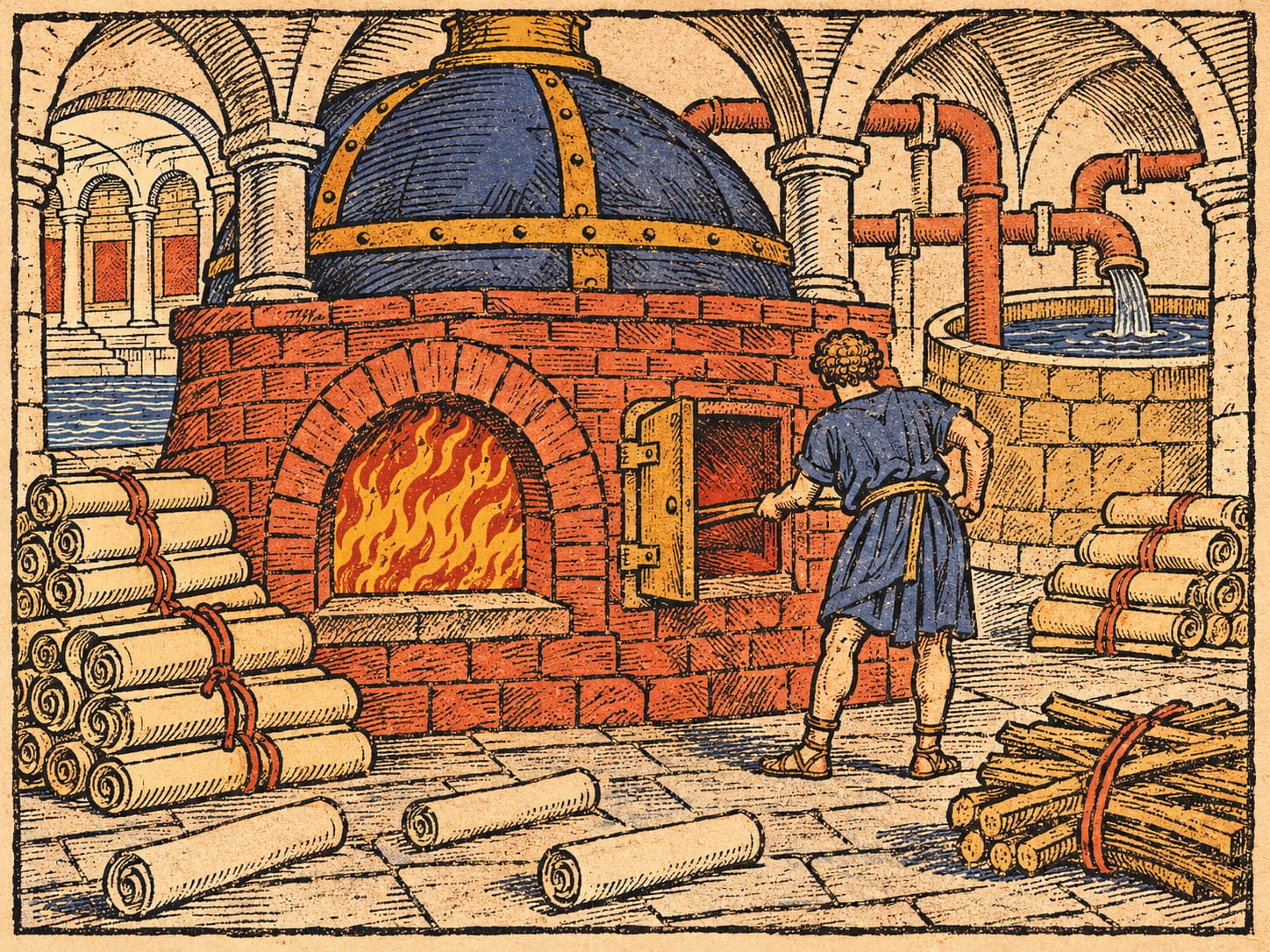
The story goes like this. After the Arab conquest of Alexandria, usually dated to 641 or 642 CE, the commander ʿAmr ibn al-ʿĀṣ asked Caliph ʿUmar ibn al-Khaṭṭāb what to do with the city's books. The caliph supposedly answered that books agreeing with the Qur'an were unnecessary and books contradicting it should be destroyed. The books were then handed out as fuel for Alexandria's bathhouses, and the furnaces were said to need six months to burn them.
It is a legend. The Baghdadi physician ʿAbd al-Laṭīf al-Baghdādī visited Egypt in 1203 and wrote around 1200 or 1203 that ʿAmr burned the library with ʿUmar's permission. The fuller tale, with a conversation with John the Grammarian and the six-month furnaces, appears in Ibn al-Qifṭī's history of learned men, written around 1227.
That is more than five centuries after the conquest. Early Muslim, Coptic, Byzantine and Jewish writers left no matching account. The tale also clashes with the evidence that the main Library, and probably the Serapeum collection, had already vanished or shrunk long before the Arab armies came.
Bernard Lewis, the historian, called the story unfounded. He also rejected the idea that it was invented as anti-Islamic propaganda, because its earliest surviving tellers were Muslim writers.
Three scholars, one picture
Roger Bagnall argues that modern accounts of the Library take uncertain evidence and turn it into one grand story. He doubts the largest collection figures and rejects the idea that a single dramatic fire destroyed a universal storehouse of knowledge. He points to slow institutional decline, patchy evidence and the trap of hunting for one villain.
Bernard Lewis points out that the Serapeum library was gone before the Arab armies arrived. Mostafa El-Abbadi separates the royal Library from the daughter library, and treats the Library's fate as a sequence of losses rather than one event in 642 CE.
Their pictures line up: a harbor fire with real losses, a war in the royal quarter, an attack on the Serapeum, and a late story that has no early witness.
What can be seen in Alexandria today
The ancient Library has not been found by archaeologists. What survives are the places around it. At the Serapeum, in the area of Pompey's Pillar, excavations brought up the great column, underground galleries, statues and architectural fragments. Giuseppe Botti, director of Alexandria's museum, led major digs there from 1894 to 1898, and the site can be visited.
At Kom el-Dikka, a Roman and Byzantine city quarter from the second to the sixth centuries CE, Polish and Egyptian teams have uncovered a Roman theatre, baths with underfloor heating, the Villa of the Birds with its mosaics, and a group of lecture halls. Large-scale excavation began in the 1960s, and the site is an open-air museum.
Part of the royal port and royal quarter lies underwater in the Eastern Harbour. Kamel Abou El-Saadat began modern underwater exploration there in 1961, and Franck Goddio and the European Institute for Underwater Archaeology started a systematic survey in 1992. They mapped piers, breakwaters, Antirhodos Island and the Poseidium peninsula, and remains read as palaces, theatres and temples. Finds from the harbor can be seen in Alexandria's museums, including the Antiquities Museum of the Bibliotheca Alexandrina.
The Library that stands there today
The Bibliotheca Alexandrina is a modern library and cultural complex in Alexandria, built near the presumed site of the ancient Library. The Norwegian firm Snøhetta designed it with the Hamza Consortium, after winning an international competition organized by UNESCO. Construction took place in the 1990s, and it was inaugurated on 16 October 2002.
It is not the ancient Library restored. It is a new complex inspired by the old one. The building was designed to hold up to 4 million volumes at the start, expandable to 8 million, and its open reading room spreads over seven terraces across 20,000 square metres. The annual report for 2002 and 2003 records 255,000 books and 2,000 reading seats.
The cost depends on what is counted. The Bibliotheca's own FAQ puts the Egyptian government's share at about 120 million US dollars and international donations at about 100 million. Egyptian government information gives an estimated project cost of 172 million dollars, with land, the conference centre and consultant fees left out.
Visitors can see the main library, the Antiquities Museum, the Manuscripts Museum, the Sadat Museum, the History of Science Museum, a planetarium, galleries and exhibitions, with guided tours in Arabic, English and French.
So, where did the Library of Alexandria go? It went in pieces: to a harbor fire, to a war in the royal quarter, to the attack on the Serapeum, and to centuries of decline. No photograph, drawing or verified image of the ancient building survives, and its exact layout remains uncertain.
The Library of Alexandria, from founding to legend
- Third century BCE
The Ptolemaic dynasty founds the Mouseion and Library
- Around 253 BCE
Eratosthenes becomes chief librarian
- 48 BCE
Caesar's forces set fire to ships and docks in the Alexandrian War
- Around 25 to 20 BCE
Strabo visits and describes the Mouseion and its scholars
- Around 272 CE
Aurelian retakes Alexandria and the Brucheion is devastated
- 391 CE
Theophilus leads the attack on the Serapeum under Theodosius I
- 641 or 642 CE
The Arab conquest of Alexandria, the setting of the Omar story
- Around 1203
ʿAbd al-Laṭīf al-Baghdādī writes that ʿAmr burned the library
- Around 1227
Ibn al-Qifṭī writes the fuller version of the story
- 1894 to 1898
Giuseppe Botti leads excavations at the Serapeum site
- 16 October 2002
The Bibliotheca Alexandrina is inaugurated
Sources
- "Alexandria: Library of Dreams," Roger Bagnall, New York University archive
- "The Vanished Library," Bernard Lewis, New York Review of Books
- "Demise of the Daughter Library," Mostafa El-Abbadi, in What Happened to the Ancient Library of Alexandria?
- "The Destruction of the Serapeum of Alexandria," Dirk Rohmann, Klio
- Library of Alexandria, Open University, with excerpts from Plutarch and Cassius Dio, and Ammianus Marcellinus 22.16
- Library of Alexandria, Encyclopaedia Romana, University of Chicago
- The House of Ptolemy, E. R. Bevan
- Galen, Commentary on Hippocrates' Epidemics; Letter of Aristeas; Strabo, Geography 17.1.8
- Ecclesiastical Histories of Socrates, Sozomen and Rufinus; Orosius, History Against the Pagans
- Callimachus fragments and the Pinakes, Pfeiffer's edition; Monica Berti, "Greek and Roman Libraries"
- Eastern Harbour and Kom el-Dikka pages, Egyptian Ministry of Tourism and Antiquities
- Feature on the destruction of the Library of Alexandria, National Geographic
- "Alejandría, faro de la humanidad," UNED
- Bibliotheca Alexandrina FAQ, visitor guidelines, and inauguration notice and annual report 2002-2003; Snøhetta project page
Watch the full story on the Flashback Fables YouTube channel, and send it to someone who would love it.