At Easter 1900, sponge divers from the Greek island of Symi sheltered from bad weather near Antikythera and came across an ancient shipwreck off the island's northeast coast.
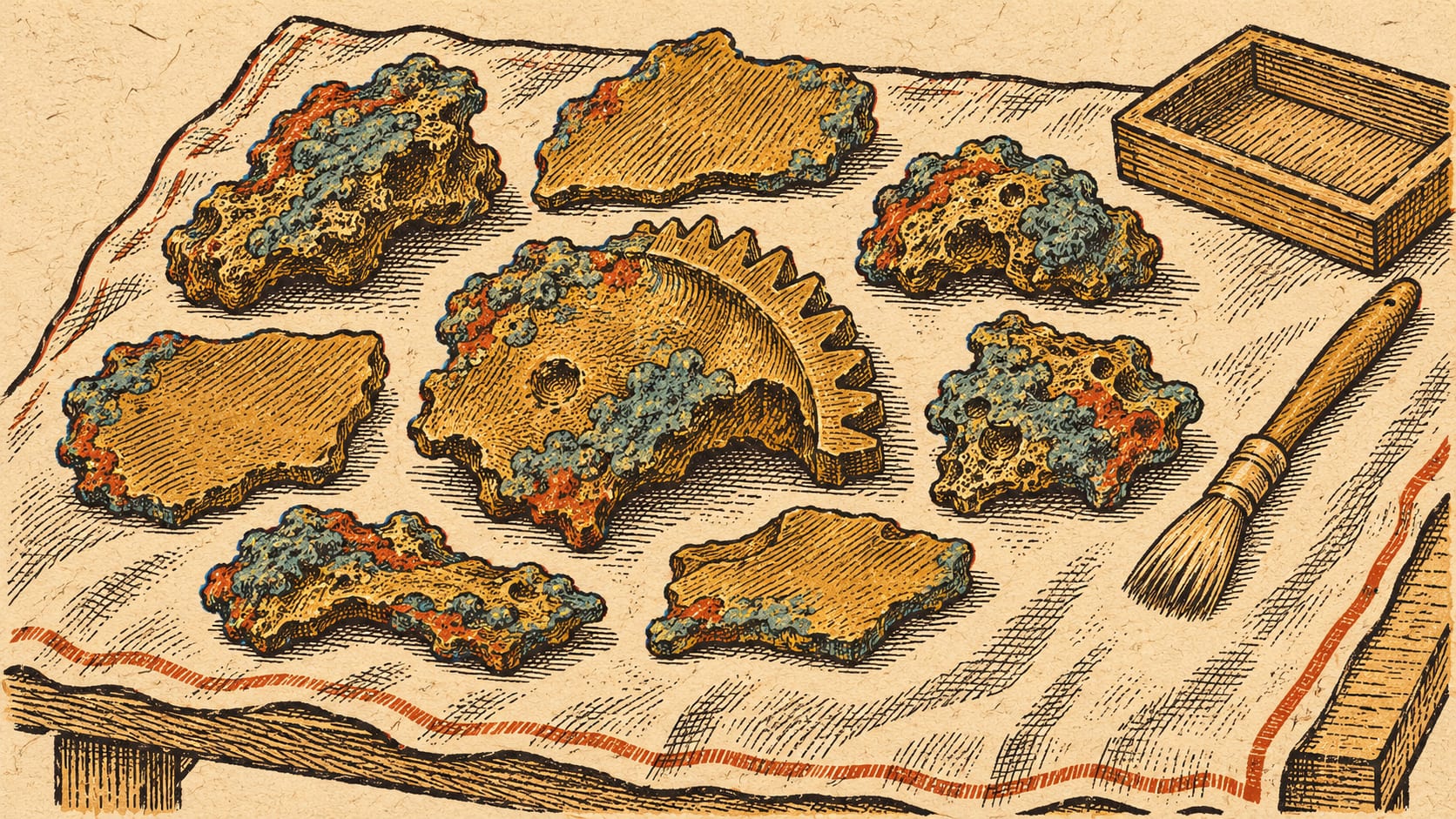
Among the cargo raised over the next two years were corroded lumps of bronze. In May 1902 an archaeologist saw a gear wheel inside one of them. The fragments turned out to be a hand-powered astronomical calculator, and scholars commonly call it the oldest known analogue computer.
Its maker is not known, its date is a range, and only about a third of it survives. What the gears and the Greek writing on them show is still enough to tell what it did.
The wreck off Antikythera
The wreck is generally dated to about 60 to 50 BC, and its cargo held objects from the fourth to the first centuries BC. Greek authorities began supervised salvage in November 1900, helped by the Royal Navy. Greece kept the Julian calendar then, so Greek dates from these years follow it.
Captain Dimitrios Kontos commanded the Symi sponge boat. Among the named divers were Ilias Lykopantis, also called Stadiatis, Kyriakos Mountiadis, Georgios Mountiadis, Ioannis Piliou, Georgios Kritikos, Vasilios Katsaras, Konstantinos Kalafatis and Vasilios Zouroudis. Merkouris Karayanis held the diving rope.
A contemporary account says Lykopantis was the first diver to reach the wreck: "When he reached a depth of about 35 fathoms, he signaled to be pulled up." He came up with "an oversized right forearm which was part of a bronze statue." The newspaper Skrip reported on 6 November 1900, by the Julian calendar, that divers had found "several copper statues" on the seabed and could haul up only "the hand of a copper statue," which looked like part of "an oversized statue of Poseidon."
The Greek state took over. Panagiotis Kavvadias, General Ephor of Antiquities, led the Archaeological Service's side. Spyridon Stais was Minister of Education when the divers reported the wreck, and Professor Anastasios Oikonomou of the University of Athens had persuaded them to tell the government. The Navy lent the troopship Mykali, under Captain Andreas Sotiriadis, and smaller vessels helped because the Mykali was too big to approach the shore safely.
The official excavation ran from November 1900 to 30 September 1901. Through 1900 and 1901 the divers brought up statues, coins, glassware and bronze objects. The National Archaeological Museum in Athens counts the salvage as a major underwater archaeological expedition. The corroded bronze fragments of the mechanism came up in the 1901 season, probably in July. Nobody knew what they were, and they were treated as shapeless corroded material.
The diver who did not come back
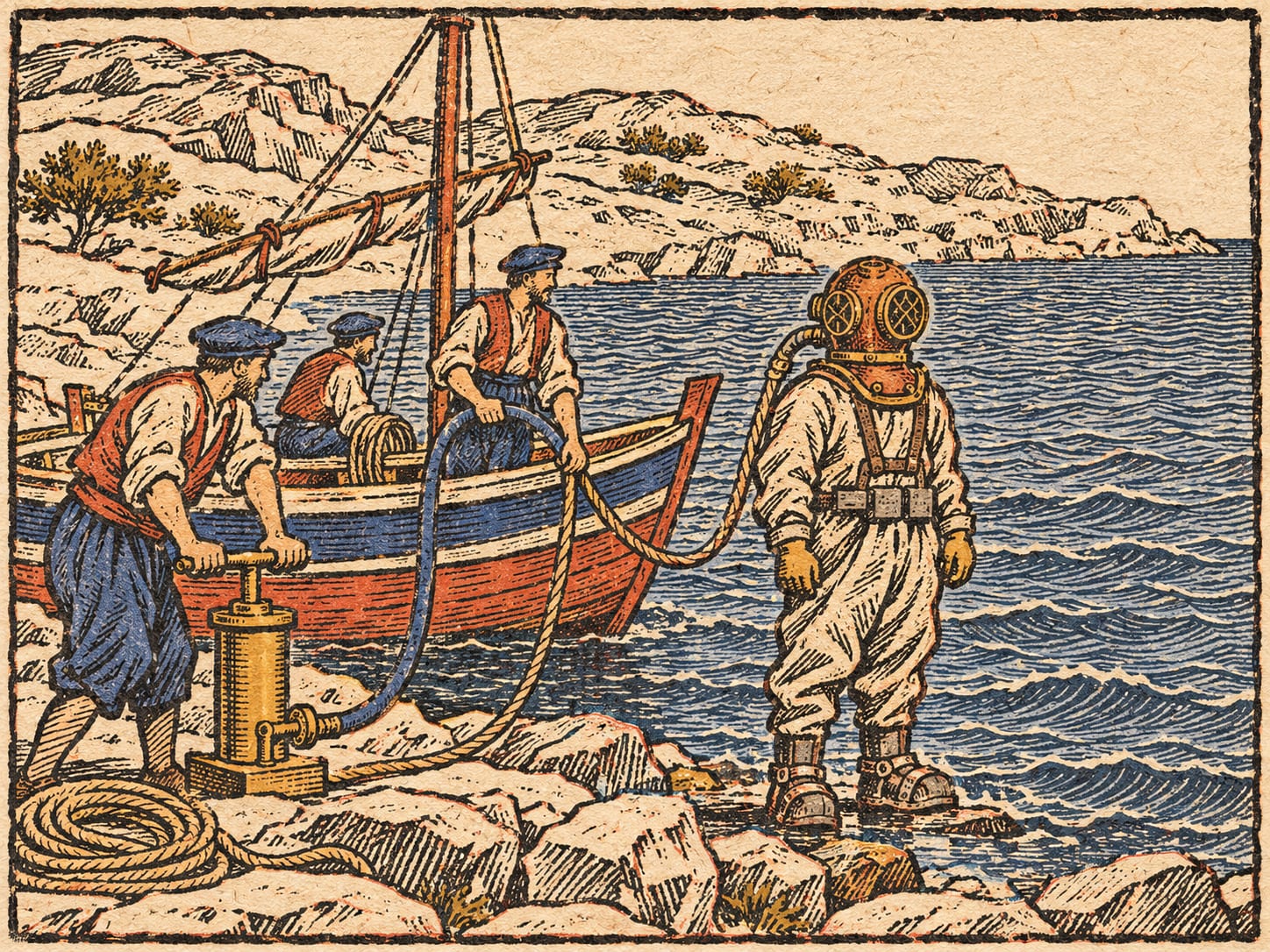
The dives went to about 35 to 40 fathoms, roughly 64 to 73 metres, and a diver could spend only a few minutes on the bottom. Georgios Kritikos died during the salvage. A newspaper chronology records his sudden death on 28 April 1901 by the Julian calendar, which is 11 May in the Gregorian calendar. The same report says a human skeleton was found near the wreck two days later.
Later accounts put the cause down to decompression sickness, the bends. They also say two other divers were left permanently disabled.
A gear in a lump of bronze
In May 1902, archaeologist Valerios Stais was examining the recovered material at the National Archaeological Museum in Athens when he recognised a gear wheel inside a corroded bronze fragment. The Antikythera Mechanism Research Project dates the moment to Saturday, 18 May 1902, by the Julian calendar then used in Greece. Derek de Solla Price's source gave 17 May, and another account puts the museum visit on 20 May. The fragments went on public display in June 1902.
A contemporary account of the find says the finder, looking at one piece more closely, "noticed part of a small gear on it," and then saw "an inscription with distinct greek letters" around the gear. The reading reported in the press was "ΗΛΙΟΥ ΑΚΤΙΣ," or "ray from the Sun."
A newspaper report in To Asty on 23 May 1902, by the Julian calendar, called the object an inscribed bronze plate. It said Ioannis Svoronos had identified it as a kind of astrolabe.
For a while the find was linked to another man. Some accounts credit Spyridon Stais, the former Minister of Education, who was involved in the recovery. The archaeologist who recognised the gear was Valerios Stais, as Konstantinos Trimmis of Cardiff University argued in a study of his career.
Guesses before the gears were counted
Svoronos studied the object in 1902 and published his main account in 1903. He called it an astrolabe, an idea that could not explain the gearing. Adolf Wilhelm, secretary of the Austrian Archaeological Institute in Athens, read the inscription and dated its letter forms to somewhere between the second century BC and the first or second century AD. That ruled out a medieval origin.
Konstantinos Rados, a naval officer and historian, argued in 1905 and 1910 that the device was too complex for an astrolabe, and he compared it with clocks and planetariums. Periklis Rediadis, another naval officer, stayed with the astrolabe idea. Albert Rehm, a classical scholar from Munich, studied the fragments in 1905 and 1906 and called the object a planetarium or astronomical calculating machine.
Ioannis Theophanidis built a mechanical model in the 1920s and 1930s and called the device a "ploognomon," a navigational instrument. Later X-rays showed his gearing was not reliable. Derek de Solla Price took up the puzzle in the 1950s, and in 1959 he described it as an "ancient Greek computer."
What the gears do
Price studied the mechanism in the 1950s and 1970s. Charalampos Karakalos made gamma-ray and X-ray pictures in 1971 and 1972, with help from Emilia Karakalos in counting teeth. Before them, Price could say the mechanism held at least 20 gears. Afterward he and Karakalos could see about 29 or 30.
His 1974 book, Gears from the Greeks, called it "a Calendar Computer from ca. 80 B.C." and argued that the fragments belonged to a sophisticated astronomical calculator. Later work by Michael Wright and the Antikythera Mechanism Research Project changed parts of Price's model, including his differential gear and the planetary claims.

In 2005 the Antikythera Mechanism Research Project scanned the fragments with high-resolution surface imaging and microfocus X-ray computed tomography. Mike Edmunds of Cardiff University led the academic side, with Tony Freeth, John Seiradakis, Xenophon Moussas, Yanis Bitsakis, Agamemnon Tselikas and museum staff Eleni Magou, Mary Zafeiropoulou and Gerassimos Makris. A Hewlett-Packard team under Tom Malzbender used a dome of lights to bring up worn lettering. X-Tek Systems brought an eight-and-a-half-tonne X-ray machine called "BladeRunner" to Athens.
The scans showed 30 bronze gear wheels in what survives, with 27 of them in Fragment A. Only about one-third of the original device is left, split among 82 known fragments.
Tony Freeth and colleagues reported in Nature in 2006 that the mechanism predicted lunar and solar eclipses using Babylonian eclipse cycles, and that its gears reproduced Hipparchus's theory of the Moon's uneven motion. The Moon display used a pin and slot to make the pointer speed up and slow down, the way the Moon's apparent speed does.
In other words, a person turning it by hand could read calendars, eclipses and the rhythm of the Moon off its dials.
The writing on the machine
The inscriptions are in ancient Greek, and they work partly as an instruction manual. They describe the motions of the Sun and Moon and the five planets known to Greek astronomers: Mercury, Venus, Mars, Jupiter and Saturn. They give planetary periods, month names and how the Metonic, Saros and related dials operate.
They also carry eclipse information, including whether an eclipse would be solar or lunar, the predicted hour and a colour description. Athletic festivals appear too, among them the Olympic Games and other Greek competitions.
X-ray scanning let Cardiff researchers read about 3,400 characters on the surviving surfaces. The eclipse colours and other omen-related details suggest the device may have carried astrological meaning as well.
The planets, rebuilt in 2021
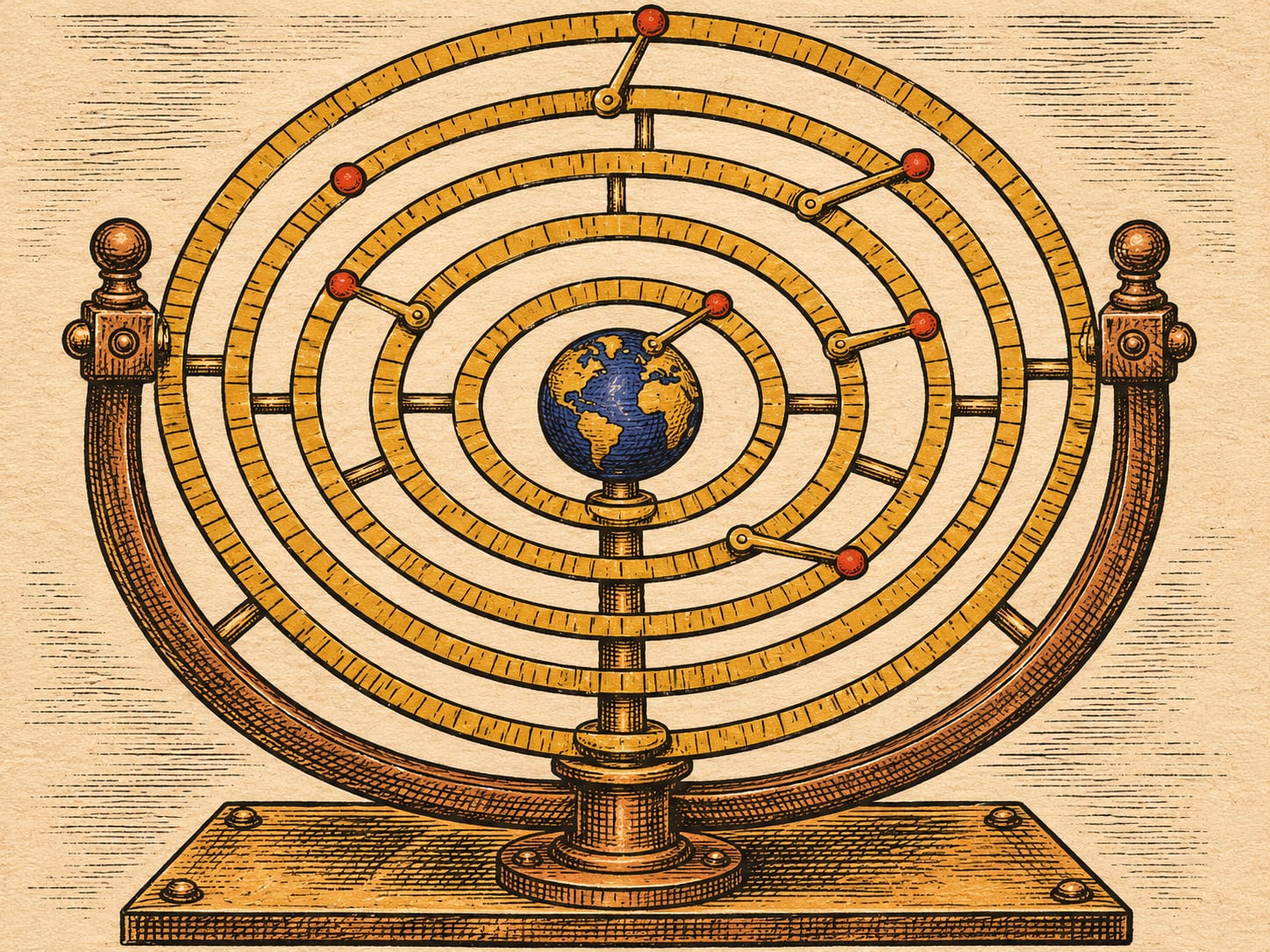
Much of the front mechanism is missing, so the planetary display is partly reconstruction. In 2021, Tony Freeth and colleagues at University College London proposed a new one. It puts the Sun, the Moon and the five known planets on a concentric, Earth-centred display called the Cosmos.
Their model uses nested rings, rotating pointers and marker beads, which the inscriptions describe as planets moving through circles. It draws on planetary periods from the inscriptions, including a 462-year cycle for Venus and a 442-year cycle for Saturn, and it combines Babylonian astronomical cycles, Greek mathematical methods and Greek theories of planetary motion.
Back to the wreck
Jacques-Yves Cousteau's team returned on 12 June 1976 with the research ship Calypso, working with the Greek Archaeological Service. They raised bronze statuettes, jewelry, small finds and coins, including coins from Pergamum that helped date the wreck.
The 2014 "Return to Antikythera" expedition, led archaeologically by Brendan Foley with the Hellenic Ephorate of Underwater Antiquities, mapped the site with autonomous vehicles, sonar and stereo cameras. It found pottery, glass, a lead anchor and a 210-centimetre section of a bronze spear, probably from a larger-than-life statue. Hull timbers Cousteau had raised helped show the ship was bigger than earlier estimates.
The 2015 and 2016 seasons brought up more than 50 objects, among them glass and ceramic vessels, a bone or ivory flute and lead fittings. In September 2017 divers recovered a bronze arm from a statue, missing two fingers. In October 2019, a Greek team led by Theotokis Theodoulou raised an intact amphora from Kos and a wooden ship part with four bronze nails. None of these finds has been identified as another piece of the mechanism.
How old is it, and who made it?
The date of manufacture is a range, because scholars have read different clues. The letter forms in the inscriptions pointed to about 150 to 100 BC, and that range is still often cited. Alexander Jones and other scholars treat about 140 to 60 BC as plausible, and Cardiff University gives a broad estimate of about 200 to 70 BC.
Christian Carman and James Evans, and separately Tony Freeth, proposed that the eclipse calendar starts from an epoch around 205 BC. That is a starting date for the calendar calculations, not a manufacture date.
The maker is unknown. Several names have been proposed, each for its own reason.
- Archimedes of Syracuse, because ancient writers describe his mechanical celestial spheres and a calendar start near 205 BC would sit close to the end of his life.
- Hipparchus of Nicaea, because the gears reproduce parts of his lunar theory and he worked in Rhodes.
- Posidonius of Apamea, who kept a scientific workshop in Rhodes and is linked in ancient testimony with celestial instruments.
- Rhodes itself, a centre of astronomy, mechanical engineering and bronze work, whose festival appears in the mechanism's calendar. Cardiff researchers call it a probable place of origin.
- A workshop, since several different hands show in the inscriptions.
Nothing ties Archimedes, Hipparchus or Posidonius to this object. The evidence points to an ancient Greek, Hellenistic origin, not to a named craftsman.
Is it the oldest known computer?
Scholars commonly describe it as the oldest known analogue computer. University College London says it is known to many by that name, and Cardiff University calls it the oldest example of an analogue computer.
The label is modern, not an ancient name. The surviving object is a geared astronomical calculator that modelled the sky with gear ratios and pointers, not electronics. Because so much is missing, some of its functions are reconstructed, not directly seen.
Seeing it today
The fragments are on show in the National Archaeological Museum in Athens, in the Metalwork Collection, Room 38 on the ground floor, under inventory number X15087. Room 38 also holds other wreck finds, and modern models of the mechanism stand in Room 39. The large Antikythera Youth and Antikythera Philosopher are in the museum's sculpture galleries.
A replica in Hermosillo
On 8 February 2024, the University of Sonora in Hermosillo, Mexico, inaugurated the Mecanismo Antikythera Monumental para Hermosillo. The large replica is used to teach the public about ancient astronomy, eclipses, the Metonic and Saros cycles and Greek mechanical knowledge.
The Antikythera Mechanism, from wreck to replica
- About 60 to 50 BC
The ship carrying the mechanism goes down off Antikythera
- Easter 1900
Symi sponge divers find the wreck
- November 1900
Greek authorities begin supervised salvage with help from the Royal Navy
- 28 April 1901 (Julian calendar, Greece)
Diver Georgios Kritikos dies during the salvage
- 1901
The mechanism's bronze fragments come up, probably in July
- 18 May 1902 (Julian calendar, Greece)
Valerios Stais recognises a gear wheel in a fragment
- 1974
Derek de Solla Price publishes Gears from the Greeks
- 1976
Cousteau's team returns to the wreck with the Calypso
- 2005
X-ray computed tomography scans the fragments
- 2006
Freeth and colleagues publish the eclipse and calendar findings in Nature
- 2021
A University College London team proposes the planetary Cosmos display
- 8 February 2024
The University of Sonora inaugurates a monumental replica in Hermosillo
The ship went down about 60 to 50 BC. A gear inside its cargo was recognised in May 1902.
Sources
- National Archaeological Museum, Athens, exhibition on the Antikythera shipwreck, Metalwork Collection and mechanism application
- Antikythera Mechanism Research Project, history, people and team pages
- Return to Antikythera, "The sponge divers and the original crew" and expedition reports for 2014, 2017 and 2019
- "The First Newspaper References to the Antikythera Shipwreck Discoveries," Nikoli and Seiradakis
- Gears from the Greeks, Derek de Solla Price, 1974
- "Price and the Antikythera Mechanism," Alexander Jones
- "The forgotten pioneer: Valerios Stais," Konstantinos Trimmis, Cardiff University
- "Decoding the ancient Greek astronomical calculator," Freeth et al., Nature, 2006
- "A Model of the Cosmos," Freeth et al., Scientific Reports, 2021
- "Research sheds light on ancient device," Cardiff University
- "Experts recreate a mechanical Cosmos," UCL News
- "The Epoch Dates of the Antikythera Mechanism," Alexander Jones, Institute for the Study of the Ancient World
- "Return to the Antikythera Shipwreck," Scientific American
- Greek Ministry of Culture, underwater research
- University of Sonora news pages on the Mecanismo Antikythera Monumental para Hermosillo
Watch the full story on the Flashback Fables YouTube channel, and send it to someone who would love it.