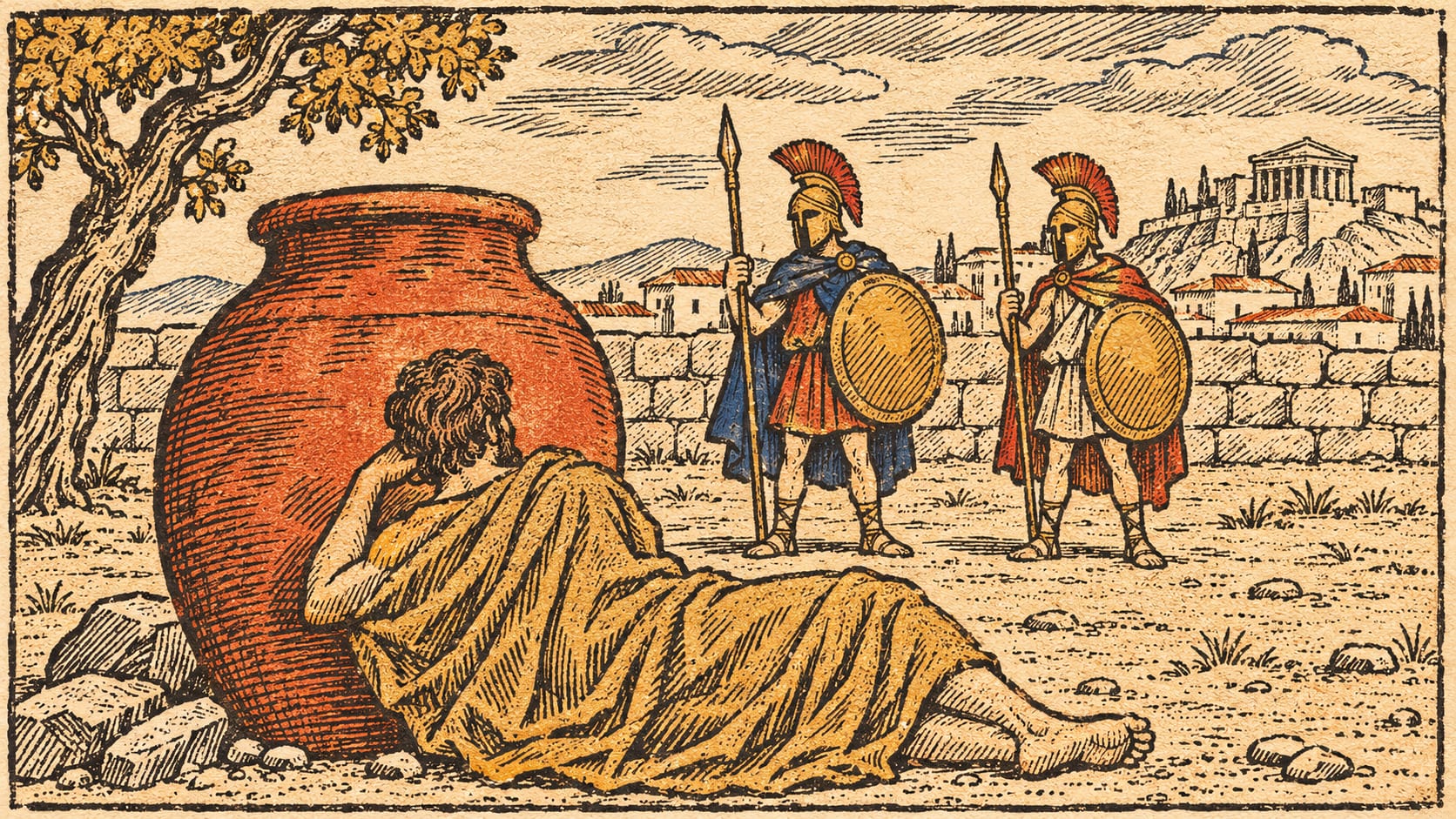
"Stand a little out of my sun." Plutarch gives those words to Diogenes of Sinope, who was lying in the sun at Corinth when Alexander the Great came and asked if he wanted anything.
It is a famous scene, and it is attributed to Diogenes, not documented. No writer of the fourth century BC records it. The earliest telling that survives is Cicero's, from 45 BC, about three centuries after the traditional date of 336 BC.
A meeting between the two men was possible, because both knew the Greek world before Alexander left for Asia in 334 BC. What changes from one teller to the next is the wording, and even who says what.
A philosopher who owned almost nothing
Diogenes of Sinope was a Greek philosopher of the school called Cynicism. Tradition dates his life to about 412 to 323 BC. He was exiled from Sinope and later lived in Athens and Corinth. Diogenes Laertius, who wrote in the early third century AD, presents him as a follower of Antisthenes, though parts of that account are uncertain in date.
Cynics treated philosophy as a way of life, not a body of doctrine. They prized self-sufficiency, few possessions, endurance, frank speech and living by nature instead of social convention. Diogenes set courage against fortune, nature against convention and reason against passion. He trained for it, cutting down what he depended on.
Few, if any, of his own writings survive. What reaches us is sayings and stories about him, kept by later authors. The sun story belongs to that collection.
The banker's son who left Sinope
Diogenes Laertius gives several reasons for the exile, and they all involve money. "Diogenes was a native of Sinope, son of Hicesius, a banker," he writes. "Diocles says that his father, having charge of the public bank, adulterated the coinage, and that Diogenes fled."
Another version has Diogenes taking the money from his father and corrupting it himself. In that telling his father was imprisoned and died while Diogenes fled to Delphi. He asked the oracle not whether he should falsify the coinage but what he should do to become most famous, and the oracle told him to "alter the currency." He understood it literally. A third writer, Eubulides, in a lost work called On Diogenes, said father and son acted together and fled together.
Diogenes lived in the fourth century BC. Diogenes Laertius wrote five or six centuries later, and Diocles and Eubulides survive only through later quotations. What holds steady is that Diogenes was tied to a coinage scandal at Sinope and left the city. Who was responsible, and how the oracle was originally understood, remain in dispute.
Pirates, a slave market and a tutor's job
Another story from Diogenes Laertius puts him on a ship. "He was sailing to Aegina, and was taken prisoner by some pirates, under the command of Scirpalus," he writes. The pirates carried him to Crete and sold him.
When the crier asked what skill he had, Diogenes said: "That of governing men." Then he pointed to a carefully dressed Corinthian named Xeniades and said: "Sell me to that man; for he wants a master."
Xeniades bought him, took him to Corinth, made him tutor of his sons and gave him the management of the whole house. Xeniades, looking over his property, is quoted as saying: "A good genius has come into my house." Laertius ties the tale to Hermippus, probably active in the third century BC, in a work called The Sale of Diogenes.
Cleomenes, another Hellenistic writer, says friends wanted to ransom him. Diogenes refused: "lions did not become the slaves of those who kept them, but, on the contrary, those who maintained lions were their slaves." A third writer, Eubulus, lists what he taught the boys: riding, hunting, shooting with the bow, throwing the javelin, using the sling and walking with dignity, then poetry, history and moral discipline.
All of this survives only in Laertius. No date for the capture is given, and nothing proves each detail of the teaching.
The jar, not the barrel
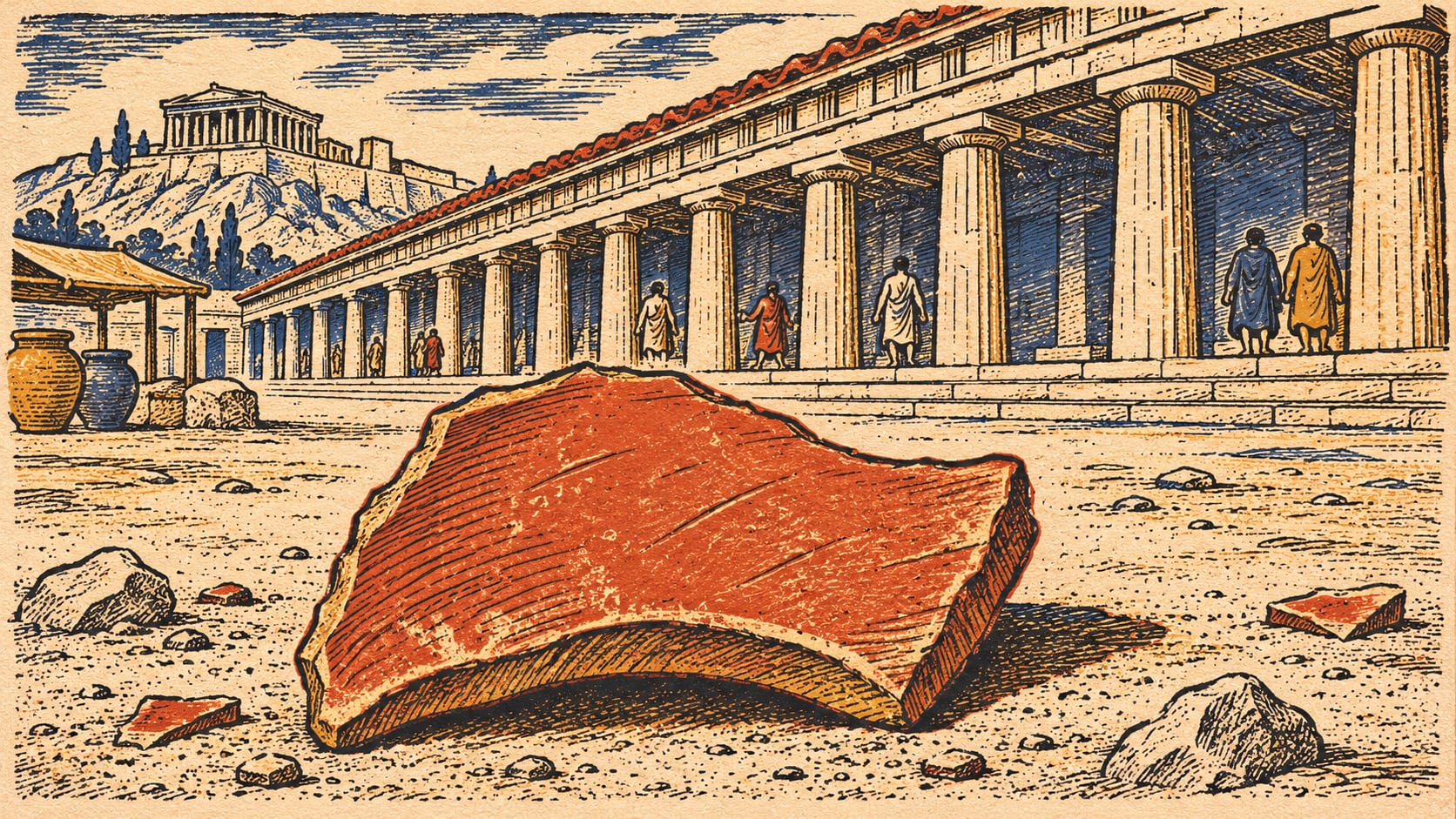
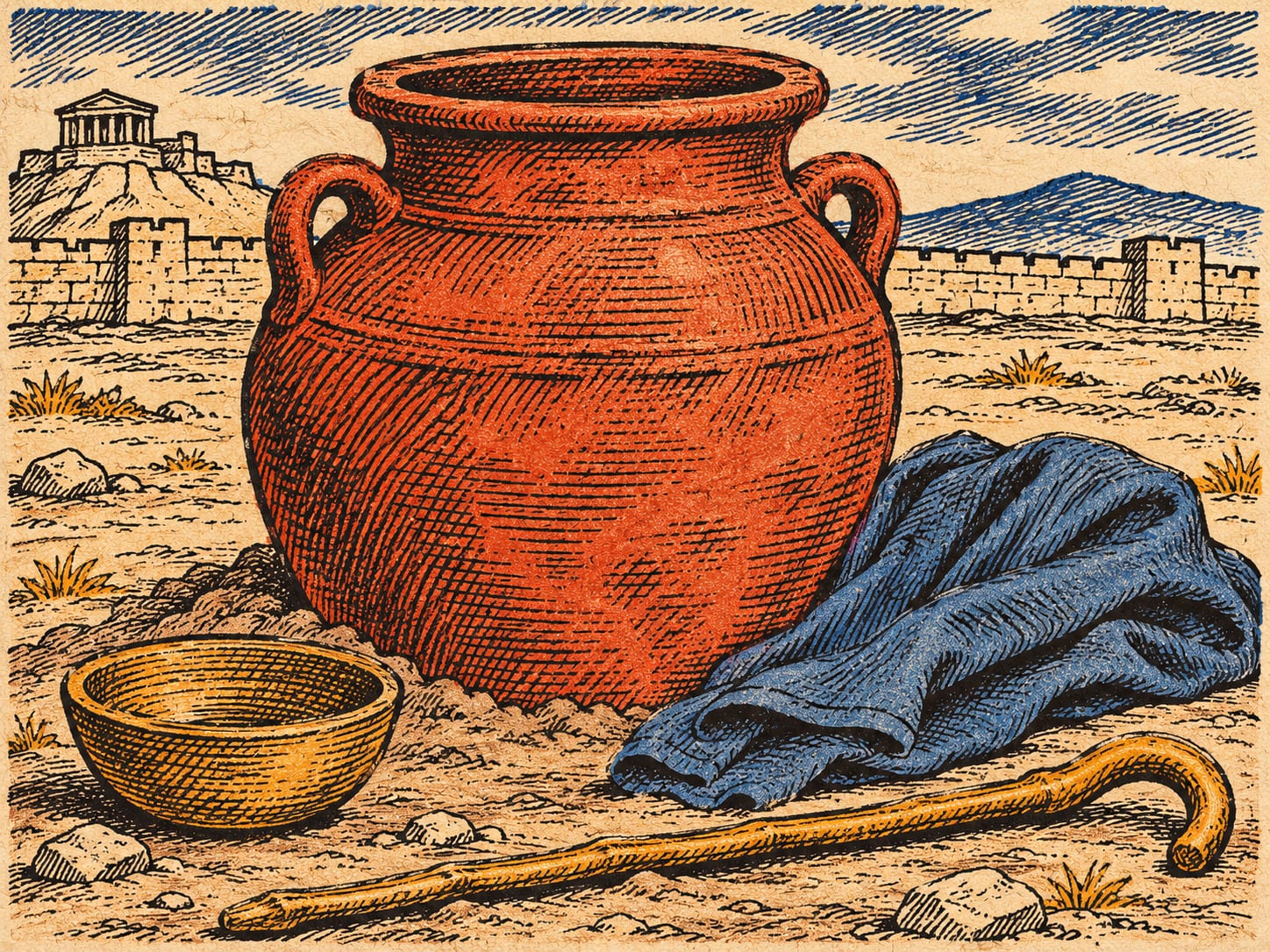
The popular picture is a man in a wooden barrel. Diogenes Laertius, in his Lives of Eminent Philosophers VI.23, describes something different. He says Diogenes lived in a "tub" or large vessel at the Metron in Athens.
The Greek word is commonly understood as pithos, a large ceramic storage jar. The ancient passage does not describe a wooden barrel with metal hoops. That image is a later simplification.
The same writer says Diogenes used the vessel as part of his training in hardship. In summer he rolled in it over hot sand, and in winter he embraced statues covered in snow.
He also tells of a boy who broke the vessel. The Athenians punished the boy and gave Diogenes another one.
In another passage, Philip II is advancing on Corinth, and the Corinthians are repairing walls and preparing weapons. Diogenes, in Laertius VI.69, rolls his jar up and down the Craneion. "For my part I'm rolling my jar so as not to give the impression that I'm the only idler among all these people who are so hard at work," he says.
Corinth, 336 BC
The traditional date of the meeting is 336 BC, after Philip II's assassination. Alexander secured recognition from the Thessalians and the Amphictyonic Council, then called Greek delegates to Corinth. Diodorus Siculus, writing in the first century BC, says Alexander spoke to them in moderate terms, and they passed a resolution "appointing him general plenipotentiary of the Greeks" and agreeing to join an expedition against Persia.
Arrian, in the second century AD, says Alexander was about twenty years old and asked the Greeks gathered in the Peloponnese for the supreme command of the Persian expedition, the post they had already given Philip. Everyone granted it except the Spartans, who replied that their tradition was to lead, not to follow. Plutarch says the Greeks assembled at the Isthmus and proclaimed him their general.
None of these passages lists who attended, and none says Diogenes was there. Plutarch, writing in the late first or early second century AD, tells what happened next. Alexander expected Diogenes to come and congratulate him.
Diogenes stayed in the Craneion suburb instead. So, Alexander went to him and found him lying in the sun.
In Plutarch's Life of Alexander 14, the king asks whether Diogenes wants anything. The reply attributed to Diogenes is: "Stand a little out of my sun."
Plutarch then says Alexander admired the man and told his companions, "If I were not Alexander, I would be Diogenes."
Four writers, four versions
Four ancient writers tell the story, and no two tell it alike. Cicero is the earliest. Plutarch, Diogenes Laertius and Arrian wrote later still, and none of the four stood in Corinth.
The settings differ too. Plutarch puts the scene in Corinth. Diogenes Laertius has Alexander find Diogenes sunning himself in the Craneion and ask him to name any favor. Arrian puts the meeting at the Isthmus.
The wording moves between "sun", "light" and "sunlight". Another translation of Diogenes Laertius gives Alexander's offer as "Ask any favour you choose of me" and Diogenes's answer as "Cease to shade me from the sun." A different rendering of Plutarch has Diogenes say, "I would have you stand from between me and the sun." These are translations of Greek and Latin literary versions written long afterwards, not a transcript made on the day.
The great king and the dog
Diogenes Laertius records other meetings. In VI.60, Alexander comes and stands by him and says, "I am Alexander, the great king." Diogenes answers: "And I am Diogenes the dog."
In VI.32, Laertius sets down the line that Plutarch attaches to the sun scene: Alexander is said to have remarked that if he had not been Alexander, he would have liked to be Diogenes.
Plutarch tells it twice. In a speech in On the Fortune or Virtue of Alexander, I.10, Alexander says: "If I were not Alexander, I should be Diogenes." Then he explains why he cannot. He means to join Greek and foreign peoples, travel to the edge of the world and spread Greek justice, so he must follow Heracles, Perseus and Dionysus and not live Diogenes's frugal life.
He ends with a line that sounds like an answer to the coinage story: "I also, like Diogenes, must alter the standard of coinage and stamp foreign states with the impress of Greek government." The line echoes the coinage story attached to Diogenes's exile.
What the sun reply says about a Cynic
Alexander could offer almost anything. Diogenes wanted only the sunshine the king was blocking. For a Cynic that is the point: Alexander's power could give him nothing he thought necessary.
The reply turns the usual scene upside down. The man with an army asks the man in a jar what he needs, and the answer is that he should move.
Did the meeting happen?
The meeting is possible but not securely established. Alexander and Diogenes lived at the same time, and both had ties to Corinth, Athens and the wider Greek world before Alexander left for Asia in 334 BC. A brief meeting could have taken place.
The dialogue is a separate question. Cicero wrote about three centuries after the traditional date. Plutarch, Diogenes Laertius and Arrian wrote later still, and none was an eyewitness.
P. R. Bosman reads the tradition as a familiar literary pattern, a wise philosopher facing a powerful ruler. He thinks a historical basis is possible, but says the long gap, the differences between versions and the heavy literary shaping stop it being treated as plain history.

Onesicritus, the pupil who sailed with Alexander
Bosman also raises Onesicritus, a pupil of Diogenes who later travelled with Alexander. Diogenes Laertius says some called him an Aeginetan, while Demetrius of Magnesia said he came from Astypalaea. Laertius compares him to Xenophon: Xenophon joined the expedition of Cyrus and wrote the Cyropaedia, and Onesicritus joined Alexander's and wrote of Alexander in the same praising way.
Plutarch calls him the chief pilot under Nearchus, and Arrian also names him as pilot of Alexander's fleet. In India, Alexander sent him to question the ascetics, and Strabo preserves what Onesicritus reported.
An Indian sage named Mandanis, he said, praised Alexander because, "although busied with the government of so great an empire, he was desirous of wisdom; for the king was the only philosopher in arms that he ever saw." Mandanis then asked whether Greek philosophers taught the same things. Onesicritus named Pythagoras, Socrates and Diogenes and said he had studied under Diogenes. Mandanis replied that he thought the Greeks sound-minded in general, "but that they were wrong in one respect, in that they preferred custom to nature."
That is a Cynic's complaint, spoken by an Indian sage and reported by Diogenes's own pupil. Another sage, Calanus, told Onesicritus that if he wished to learn, he should take off his clothes and lie down naked on the same stones, and Mandanis rebuked Calanus for arrogance.
Onesicritus's own writings are lost. Everything above comes through Strabo, Plutarch and Arrian, quoting a work no one can now read. An account by Onesicritus may have fed the sun story, but the tie cannot be shown.
How Diogenes died
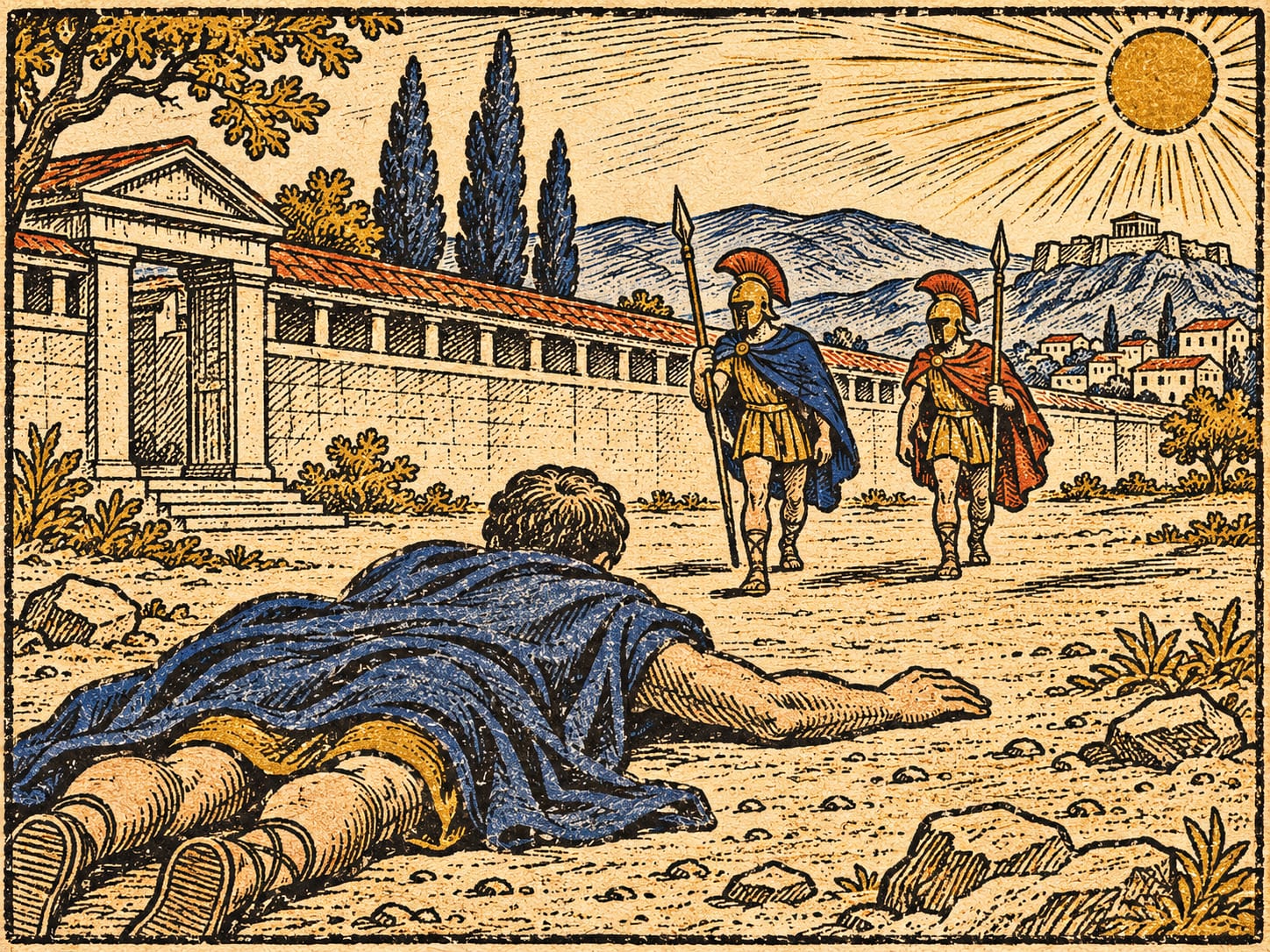
Diogenes Laertius says Diogenes was nearly ninety when he died, and he sets down several accounts that cannot all be true.
- Some said he ate an ox's foot raw and died of the illness that followed.
- The poet Cercidas said he died by holding his breath.
- Another account says a dog bit through the tendon of his foot while he was dividing an octopus among the dogs.
- Diogenes Laertius says his friends found him dead, wrapped in his cloak at the Craneion, a gymnasium near Corinth.
- He also records conflicting instructions about burial, from leaving the body unburied to throwing it into the Ilissus.
Demetrius of Magnesia reportedly said Diogenes died in Corinth on the same day Alexander died in Babylon. It is a tidy ending for a story about two men, and it sits beside accounts of the death that contradict each other. The traditional year is 323 BC.
Where Diogenes was buried
Pausanias, writing in the second century AD, describes the road into Corinth: "As one goes up to Corinth are tombs, and by the gate is buried Diogenes of Sinope, whom the Greeks surname the Dog. Before the city is a grove of cypresses called Craneum."
Diogenes Laertius adds that Diogenes was buried at the gate that leads to the Isthmus. Over him, he says, the Corinthians set a pillar, and on the pillar a dog in Parian marble.
Later, Laertius says, the people of Sinope honored him with bronze statues and an inscription: "E'en brass by lapse of time doth old become, / But there is no such time as shall efface / Your lasting glory, wise Diogenes."
The Craneion, or Kraneion, was a suburb and cypress grove east of ancient Corinth, near the road from the Kenchrean Gate. Excavators found cemeteries and later Byzantine remains in the wider area, and a cemetery found in 1928 lies next to the Craneion. No excavated grave has been tied to Diogenes. The Archaeological Museum of Ancient Corinth displays finds from the wider excavations, and its collection descriptions name no tomb, statue or personal object of his.
Crates, Hipparchia and the pupils
Cynic teaching went on through example, public conversation, short sayings, letters, poems, tragedies and collections of anecdotes, not through any single school building. Laertius names many followers. Monimus of Syracuse was a former slave who became a Cynic after meeting Diogenes's teaching. Onesicritus's sons Androsthenes and Philiscus of Aegina were pupils too. Even the Athenian statesman Phocion, called "the Good," and the philosopher Stilpo of Megara are tied to him.
Crates of Thebes is the main bridge to later Cynics. He was a wealthy Theban who gave away his property and became a Cynic, and Laertius says he flourished around 328 to 325 BC. He taught Metrocles of Maroneia, who had been a pupil of Theophrastus. Metrocles's sister, Hipparchia of Maroneia, married Crates and took up his dress, habits and philosophical life.
Laertius shows her as a philosopher in her own right. In a debate with Theodorus, she argued: "What Theodorus could not be called wrong for doing, that same thing Hipparchia ought not to be called wrong for doing." When Theodorus quoted a line asking why she had left the loom, she answered: "I, Theodorus, am that person; but do I appear to you to have come to a wrong decision, if I devote that time to philosophy, which I otherwise should have spent at the loom?"
Menippus of Sinope, a later Cynic writer, was by Laertius's account a Phoenician by descent and formerly enslaved. His dates are uncertain, but he belongs to the third century BC. Cynic ideas also shaped later Hellenistic moral philosophy, especially Stoicism, though how they passed on is debated.
Erasmus, Lyly and the stage
The sun reply became a proverb in the Renaissance. Erasmus published his Adagia in Paris in 1500 and expanded it repeatedly. He turned ancient sayings into annotated Latin adages for readers of the new learning, and the reply to Alexander traveled as a portable line about independence from rulers, wealth and patronage.
John Lyly put the meeting on stage. A moste excellent Comedie of Alexander, Campaspe, and Diogenes was staged around 1583 and printed in 1584. Lyly gave Diogenes a speaking part and wrapped the encounter in a larger plot with Alexander, Campaspe and the painter Apelles. It keeps the contrast between an emperor's power and a philosopher's independence, but it is no copy of Plutarch's short scene.
An 1846 English retelling, John Cormack's translation of Fénelon's Lives of the Ancient Philosophers, adds even more. Diogenes says, "I am the dog Diogenes." Alexander asks if Diogenes fears him, and Diogenes asks whether Alexander is good or bad. "And who need be afraid of one who is good?" he says. None of this is in Plutarch.
The modern English "Stand out of my sunshine" is a later translation and retelling, not a quotation from a fourth-century BC witness.
Diogenes and Alexander, from Sinope to the art galleries
- About 412 BC
Traditional birth year of Diogenes of Sinope
- 336 BC
Traditional date of the meeting at Corinth, after Alexander becomes leader of the Greek alliance
- 334 BC
Alexander leaves for Asia
- 323 BC
Traditional year of Diogenes's death
- 45 BC
Cicero writes the earliest surviving version of the sun reply
- Late 1st or early 2nd century AD
Plutarch writes his Life of Alexander
- Early third century AD
Diogenes Laertius writes his Lives of Eminent Philosophers
- 1500
Erasmus publishes the Adagia in Paris
- 1584
Lyly's comedy of Alexander, Campaspe and Diogenes is printed
- 1662
Salvator Rosa makes his etching and drypoint of Diogenes and Alexander
- 1860
Jean-Léon Gérôme paints Diogenes with dogs, a lamp and a ceramic vessel
How artists and Spanish tellers kept the story going
Later artists returned to the scene again and again. Salvator Rosa made an etching and drypoint of Diogenes and Alexander in 1662, and the Rijksmuseum holds a seventeenth-century print by Rosa on the same subject. Nicolas-André Monsiau painted Alexander and Diogenes in 1818, now in the Musée des Beaux-Arts in Rouen.
Jean-Léon Gérôme's 1860 Diogenes, in the Walters Art Museum, shows the philosopher with dogs, a lamp and a ceramic vessel. A second-century AD Roman statuette copy of Diogenes sits in the Cornell Cast Collection.
In Spain, the Real Academia de Bellas Artes de San Fernando catalogues Manuel de Adeba Pacheco's 1768 relief Diógenes en la cuba, which shows Alexander and soldiers looking on beside the vessel.
Spanish retellings call him Diógenes de Sinope, Diógenes el Cínico or Diógenes el Perro, and give the reply as "No me tapes el sol". They often say barril, though the ancient evidence points to a ceramic pithos or tub. Spanish classrooms use the story to show Cynic independence and the rejection of wealth.
Sources
- Plutarch, Life of Alexander 14, and On the Fortune or Virtue of Alexander I.10
- Diogenes Laertius, Lives of Eminent Philosophers, Book VI
- Cicero, Tusculan Disputations V.92
- Arrian, Anabasis of Alexander I.1 and VII.2
- Diodorus Siculus, Library of History XVII.4
- Strabo, Geography XV.1.63 to 65
- Pausanias, Description of Greece II.2.4
- P. R. Bosman, "King Meets Dog: The Origin of the Meeting Between Alexander and Diogenes"
- "Following Diogenes," Society for Classical Studies
- "Diogenes of Sinope," Internet Encyclopedia of Philosophy
- Stanford Encyclopedia of Philosophy, "Ancient Ethical Theory"
- William Desmond, Cynics; study of Cynic disciples, SAGE Journals
- Publication history of Erasmus's Adagia, Pharos, 2000; Folger Shakespeare Library record for Lyly's Campaspe
- Walters Art Museum, Blanton Museum of Art and Rijksmuseum records for Gérôme and Rosa
- Real Academia de Bellas Artes de San Fernando, catalogue entry for Diógenes en la cuba
- Archaeological Museum of Ancient Corinth; American School of Classical Studies at Athens, Ancient Corinth excavations
Watch the full story on the Flashback Fables YouTube channel, and send it to someone who would love it.