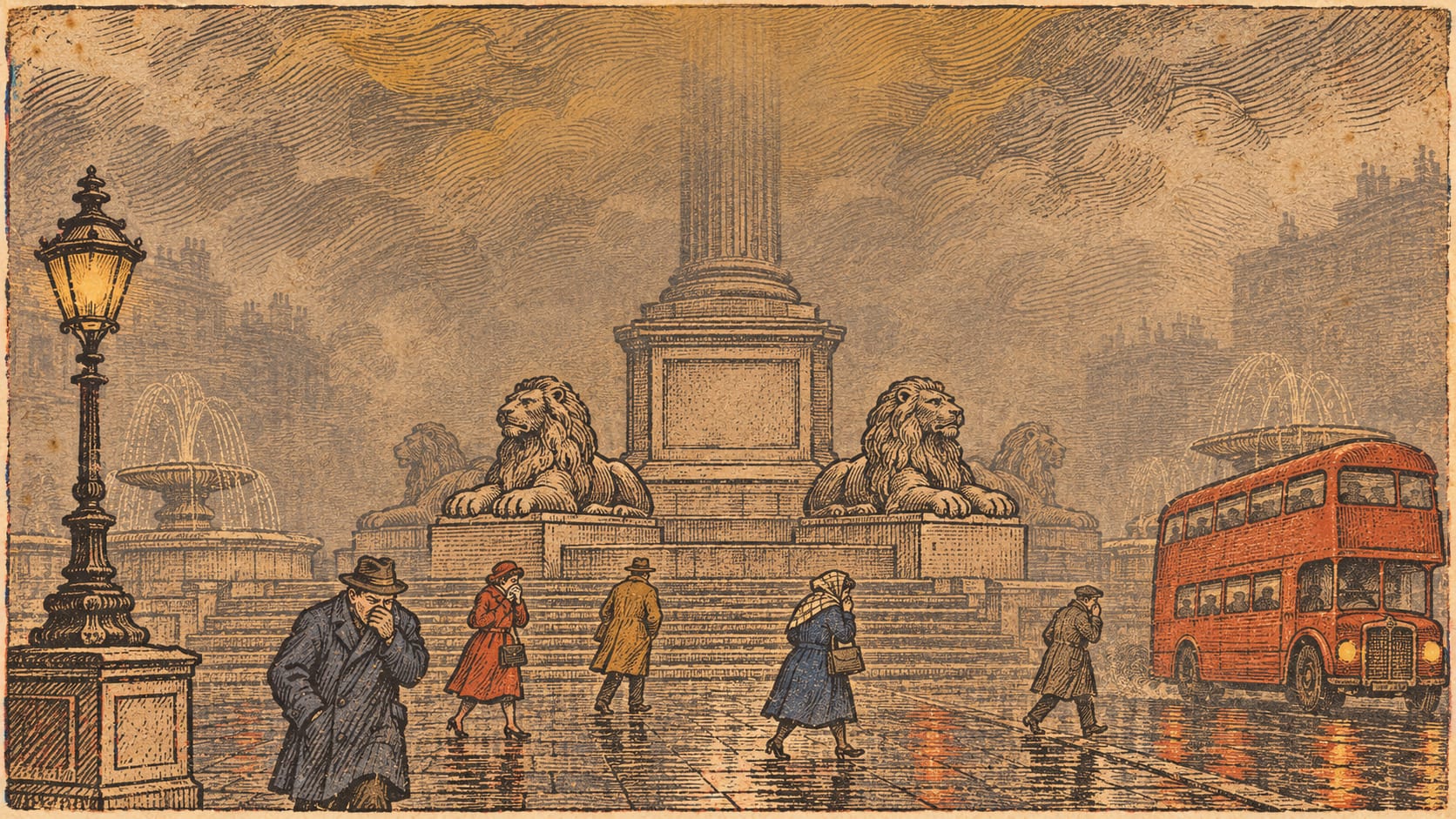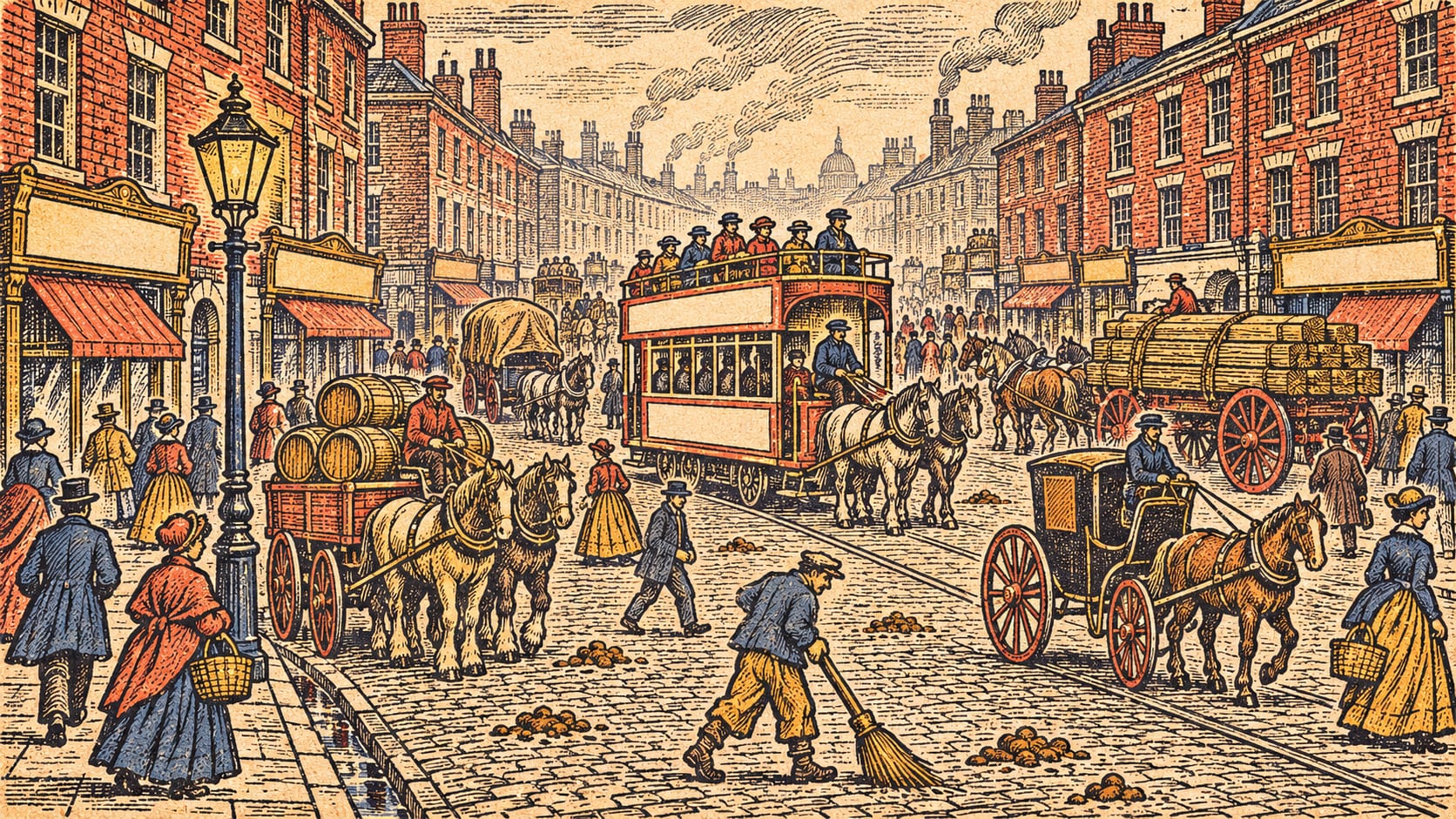
The story goes that in 1894 The Times of London warned that "in 50 years, every street in London will be buried under nine feet of manure." Stephen Davies popularized it in a 2004 article for the Foundation for Economic Education. In 2018, Rose Wild, the archive editor of The Times, called the story false.
The horses behind it were real. London had about 200,000 of them in 1893, New York about 130,000 working horses in 1900, and both cities spent years shovelling, sweeping and selling what they left behind.
The quote belongs to a later telling. The streets, the smell and the sweepers belong to the 1890s.
Where the nine-feet quote came from
Davies's article appeared in The Freeman in September 2004. He wrote that "a commentator in the London Times" had estimated that within 50 years every London street would be buried under nine feet of manure. He named no commentator, no date and no page.
The date 1950 is not in the quote. It is arithmetic, a retelling that turned "in 50 years" into a year. In January 2018 Rose Wild wrote in The Times under the headline "We were buried in fake news as long ago as 1894." She said the paper's archive did not hold the prediction when a reader asked about it.
One newspaper page does fit the date. On 8 June 1894 in New York, the Evening World ran an editorial, "Will They Push the Dirt Away?", about the city's street-cleaning department. It poked fun at a new hand-pushed sweeping machine that Commissioner William S. Andrews had adopted, calling it a "pretty little push-cart." It set the department's budget of $2,027,390 for 1894 against $1,060,000 in 1884, and talked about dust, mud, banana skins and dust piles. A prediction about London does not appear in it.
A second piece of the story arrived with an international urban-planning conference, said to have met in New York in 1898 and to have given up on manure and ended early. A university urban-planning timeline repeats it. A document that does exist from 1898 is George E. Waring Jr.'s report Street Cleaning in New York, 1895-6-7, which describes New York's own street-cleaning work and the methods used in Europe.
How many horses, and how much manure
Peter J. Atkins reconstructed London's numbers: about 200,000 horses in 1893 and roughly 2.135 million tons of horse manure that year. He calls the estimate indicative, built on historical assumptions. William John Gordon had put the horses at 300,000 for 1893, a figure Atkins thinks is probably too high.
The count had climbed fast. Ralph Turvey's estimates give about 11,000 horses in London in the early 1800s, more than 22,000 by 1850, about 70,000 by the mid-1860s and more than 200,000 by 1900. A different 1900 estimate of 600,000 horses in daily use rests on an uncertain basis.
The American Museum of Natural History puts a city horse's output at about 20 kilograms, or 45 pounds, of manure a day, plus roughly 7.5 litres, or 2 gallons, of urine. The exact amount varied with the horse, its work and its feed.
Manhattan had about 130,000 working horses in 1900. New York sanitation histories cite about 2.5 million pounds of manure and 60,000 gallons of urine on the city's streets every day, though totals shift with the boundary used and the year counted.
Who cleaned it up
The manure did not simply pile up. A string of workers and businesses moved it, and the work showed on every busy street.
- Street-cleaning departments and local scavengers used brooms, shovels, carts and mechanical sweepers.
- In London, street orderlies, including boys in organized street-cleaning schemes, collected fresh droppings from busy roads.
- Crossing sweepers cleared muddy, manure-covered crossings for pedestrians, often for small payments.
- Stable owners and dung merchants collected manure and sold it to farmers and market gardeners as fertilizer.
- Carts and barges carried London's manure to farming districts nearby.
The orderlies and the flying dustmen
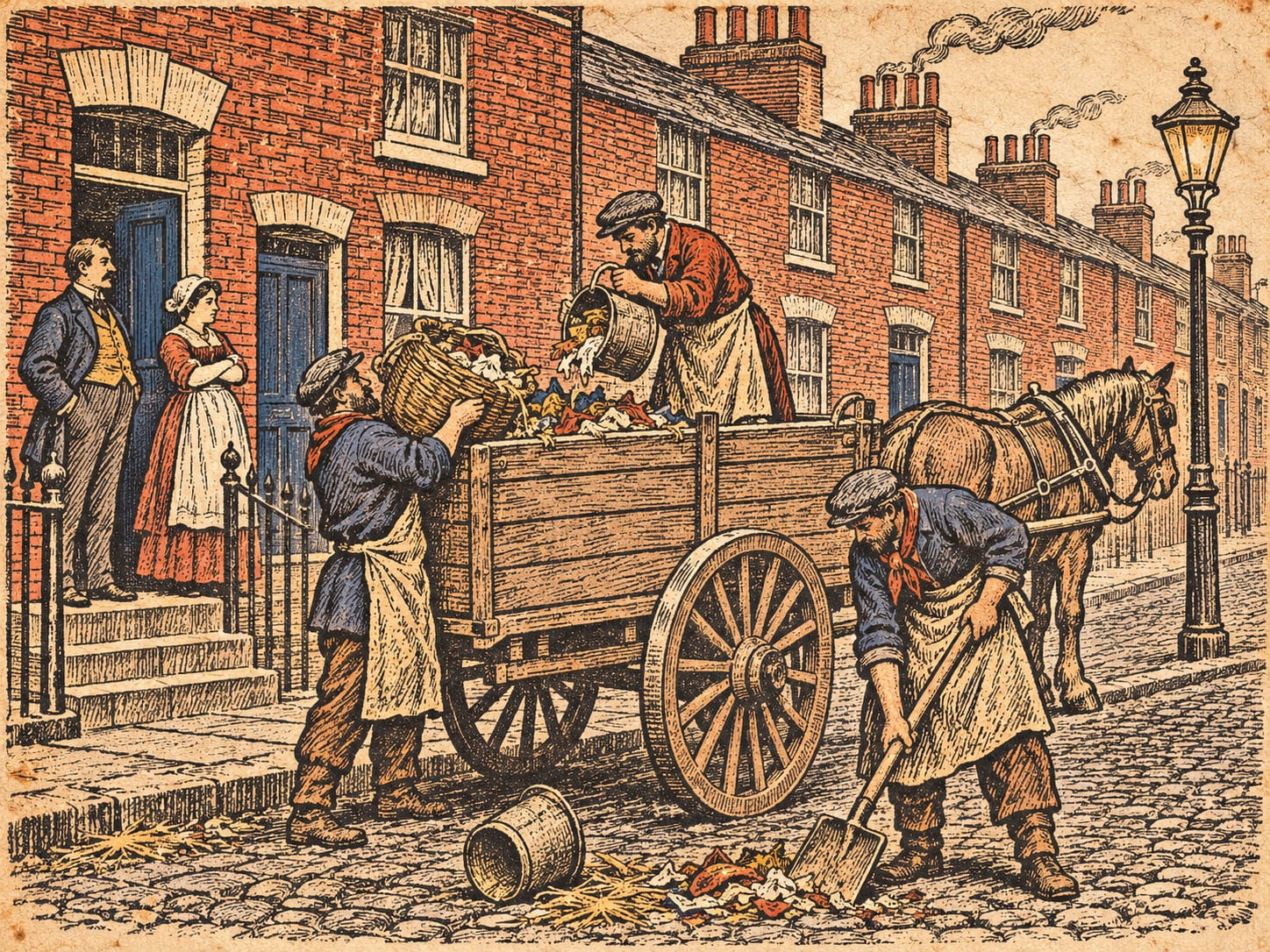
Henry Mayhew described London's street orderlies in 1861 as organized scavengers, not casual sweepers. He wrote that the City alone could produce "200 to 300 cart-loads" of refuse in a week. His plan for cleaning the whole City called for about 250 men and boys: 170 working 6 a.m. to 6 p.m., 30 boys on relief from noon to 10 p.m. and 50 men on nights. He reckoned wages at 6 to 8 shillings a week for boys and 12 for men, and a yearly bill of about £6,405.
A later Victorian account of the City's system describes about 150 boys reporting each morning at Stoney Lane, Houndsditch. Each boy got a defined patch and carried handbrushes, scoops, scrapers and squeegees. A boy began at 6 shillings a week, could rise to 7 shillings and 6 pence, and some earned a 15-shilling pension. The superintendent at Lett's Wharf was known as "the man that cleans the city."
Freelancers worked the same streets. John Thomson and Adolphe Smith's Street Life in London, published in 1877, followed the "flying dustmen," who collected household dust and refuse and moved from parish to parish, sometimes without a parish's blessing. They wrote that Lambeth had about 40,000 rateable houses, each sending roughly three dust-cart loads a year, and that boats hired to carry the refuse cost "one pound sterling per load."
Dung merchants, barges and a falling price
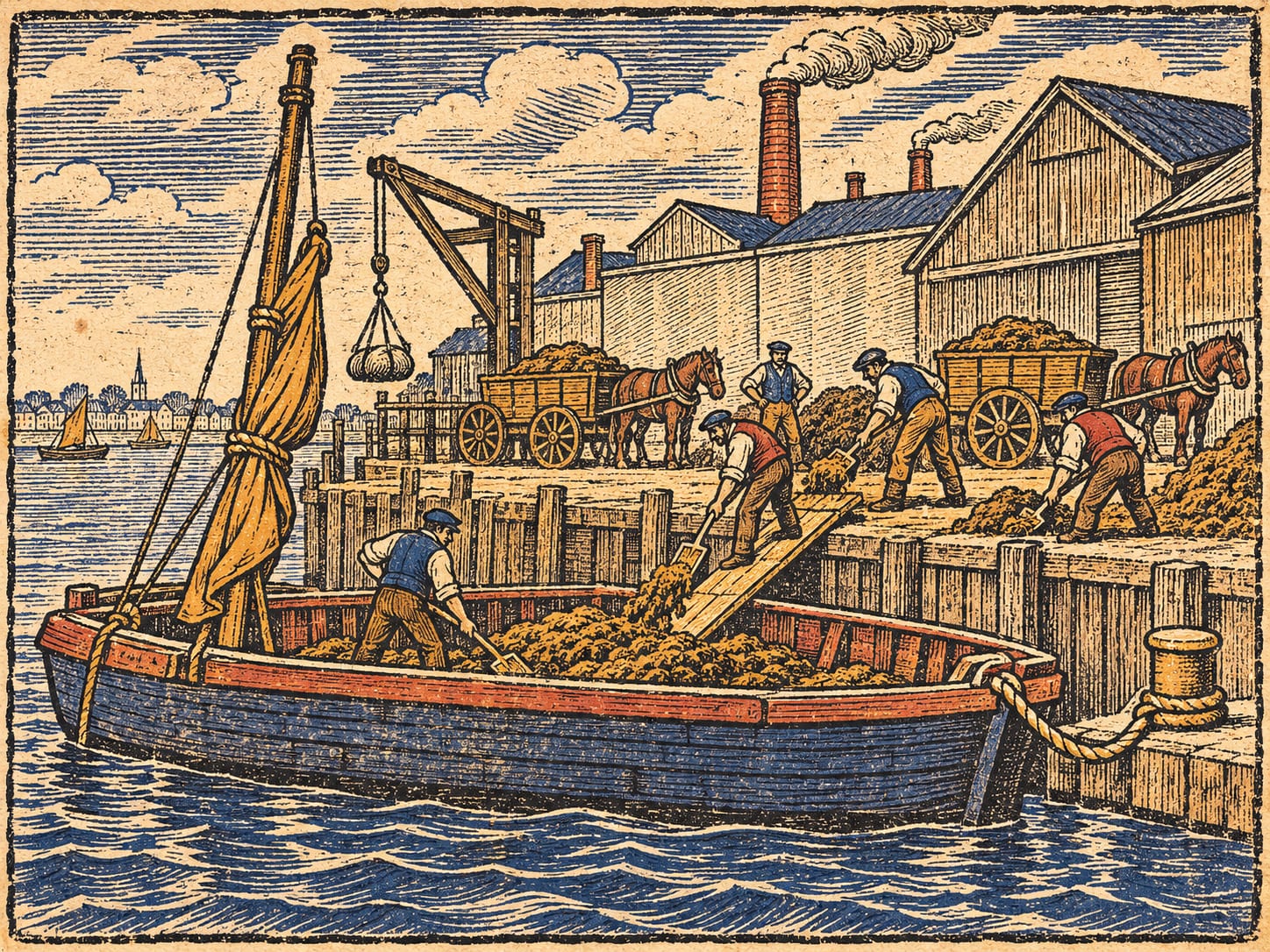
Manure was a trade. Atkins's account of the nineteenth-century market gives a ladder of prices: about 2 shillings and 2 pence a ton at London stables, about 5 shillings a ton delivered by barge to a local wharf, and about 8 shillings and 6 pence a ton at a railway station. Near Barking, a market gardener bought about half his manure in London at 3 to 3 shillings and 6 pence a ton, and the rest reached a station or quay at 5 shillings.
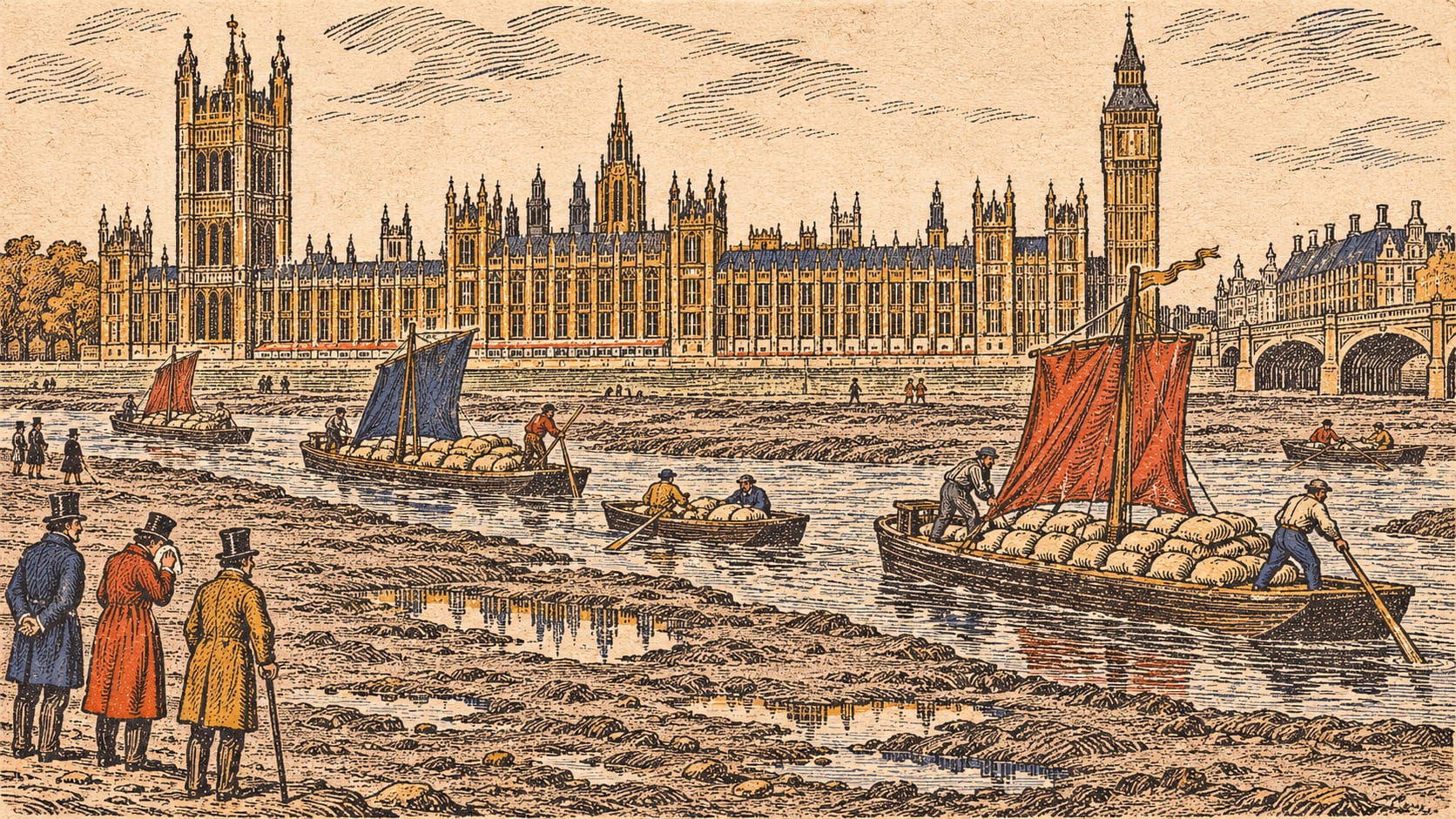
The barges carried the weight. Manure traffic on the Lea Navigation reached 120,000 tons in 1862, more than a third of all goods on that waterway. A barge in one farming case carried about 25 tons, and another account describes loads of 60. Letts' Wharf in Lambeth handled about 30,000 tons of horse manure a year in the 1870s.
The City of London leased Lett's Wharf in 1875, and it was equipped by 1876. In 1880 it received 31,161 cart-loads of house, trade and market refuse and 30,078 cart-loads of street sweepings and slop, with a cart-load running from about 1.25 to 2 tons. It had stables for 30 horses.
By 1893 the price had collapsed. W. J. Gordon wrote in The Horse World of London that manure had once been worth 3 pence per horse per week, but owners were then pleased to be paid even a farthing, and many paid for removal.
Flies, smell and disease
People in the 1890s smelled it. Writers described strong odors, manure heaps and clouds of flies. Medical writers of the day tied rotting waste to "effluvium," bad air and disease, in line with the miasma theory that explained sickness then, as in the Great Stink of 1858.
Later bacteriology showed that flies can carry the organisms behind stomach illness. Horse manure bred flies, and historians have linked manure-fed fly populations with infant diarrhoeal disease in some towns, Preston among them. Shoreditch's medical officer listed street-sweeping quantities, horse-machine brooms and dung and stable manure in his 1892 report.
Waring and the White Wings
New York built a response. George E. Waring Jr., born on 4 July 1833 at Pound Ridge, New York, came to street cleaning from farms and drains. He managed Horace Greeley's farm and Frederick Law Olmsted's Staten Island farm, designed drainage for Central Park from 1857, served as a Union cavalry officer, and designed Memphis's separate sewage system after the yellow-fever epidemic of 1878.
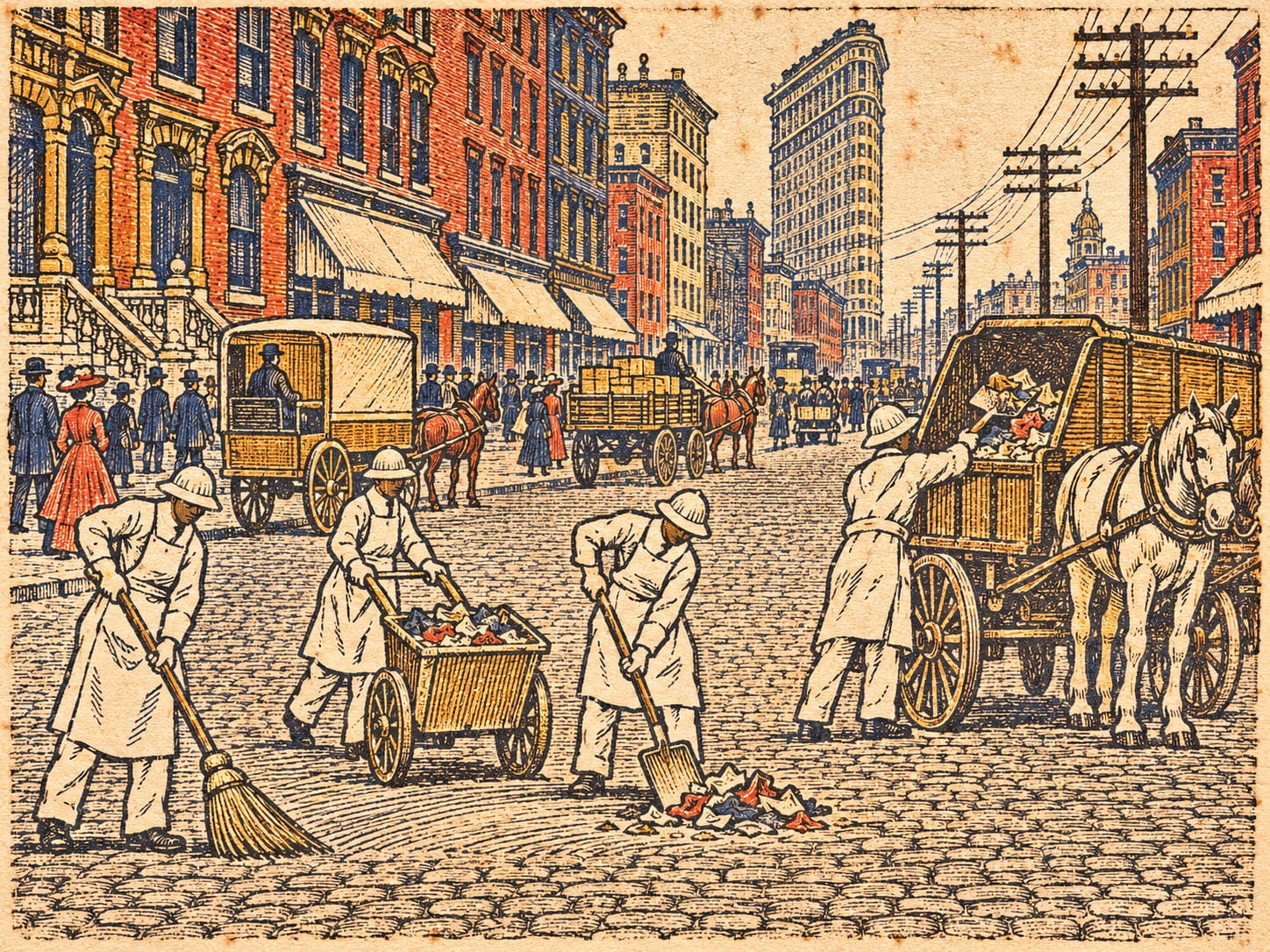
Mayor William L. Strong appointed him commissioner of the Department of Street Cleaning in January 1895, and Waring started work on 15 January. His report for 1895 to 1897 describes a reorganized force, district supervisors, regular day and night routes, mechanical sweepers, carts and systematic collection.
His men became the White Wings, with white uniforms, white caps and strict discipline. A later account puts the uniforms at $1.25 each, two per worker, and the full outfit at $5.78. New men were paid $600 in year one, $660 in year two and $720 in year three. A Library of Congress description of a 1903 Edison film says Waring marshalled about 2,000 workers to clean about 450 miles of streets a day. That film, White Wings on Review, was shot on 29 April 1903.
The department Waring took over had a name for politics. On 5 December 1894 the New-York Tribune reported testimony before the Lexow Committee in which Commissioner Andrews admitted borrowing $1,000 from George W. Plunkitt, whose stables had been leased to the city for the Street-Cleaning Department. The reform of 1895 came after that testimony.
Dead horses on the street
Manure was not the only thing horses left. Clay McShane and Joel Tarr report that 7,000 to 8,000 horses died in Manhattan each year in the early 1880s, against about 1,500 a year in Chicago. During the Great Epizootic of 1872, as many as 36 horses died on Manhattan streets in a single day.
Tarr gives 15,000 dead horses removed from New York City streets in 1880. McShane and Tarr put the likely peak in 1910, when the city reported removing more than 20,595. In one five-day stretch in August 1896, a private contractor removed 1,256. These figures count different things in different years, so they do not add up to one annual death rate.
What replaced the horses
The change came in steps, and each step cut into the horse's work. London's City and South London Railway opened on 18 December 1890 as the world's first deep-level electric underground railway. A petrol-engined bus appeared in London in 1899, and a public motor-bus service began on 9 October 1899 between Kennington and Victoria Station.
Electric trams began replacing horse-drawn trams in London from 1901, and the London County Council's major electric tram network grew after 1903. In New York, electric streetcars replaced horsecar lines through the 1890s and early 1900s.
Ford introduced the Model T in 1908. The moving assembly line at Highland Park in 1913 cut prices and put cars within reach of ordinary buyers, and more than 15 million Model Ts were built between 1908 and 1927.
New York's Board of Health counted the result. Its stable census found 103,125 horses in 1917, 72,081 in 1919 and 62,254 in 1921.
Of the 1917 total, 53,339 horses were in Manhattan, 33,083 in Brooklyn, 7,626 in the Bronx, 6,934 in Queens and 2,143 in Richmond. About 1,000 more, stabled outside the city, worked inside it each day. London has no matching official count for 1920, so the two series cannot be compared directly.
From horse streets to engines
- 18 December 1890, London
The City and South London Railway opens, the world's first deep-level electric underground railway
- 8 June 1894, New York
The Evening World runs "Will They Push the Dirt Away?" on street cleaning
- 5 December 1894, New York
The New-York Tribune reports Commissioner Andrews's testimony before the Lexow Committee
- 15 January 1895, New York
George E. Waring Jr. starts work as street-cleaning commissioner
- 9 October 1899, London
A public motor-bus service begins between Kennington and Victoria Station
- 1901, London
Electric trams begin replacing horse-drawn trams
- 29 April 1903, New York
The film White Wings on Review is shot
- 1908
Ford introduces the Model T
- 1913
The Highland Park moving assembly line begins
Did cars end the problem?
The tidy version has a car roll up and rescue the city. Cities did face serious horse-related waste: manure, urine, dead horses, flies, odors, traffic jams and the cost of street cleaning. The decline of horse transport cut the volume of manure, but cars were one cause among several.
Electric trams, the underground, motor buses, better street cleaning and changing city infrastructure all played a part, and so did Waring's 1895 reform in New York, which came before cars dominated the roads. The streets did get cleaner, over years, through institutions as much as engines. Tellers of the later parable skip that part, and make the change look like one sudden escape.
London's streets were never buried. They were swept, shovelled, carted away and sold to farmers, one barge at a time.
What the horse years left behind
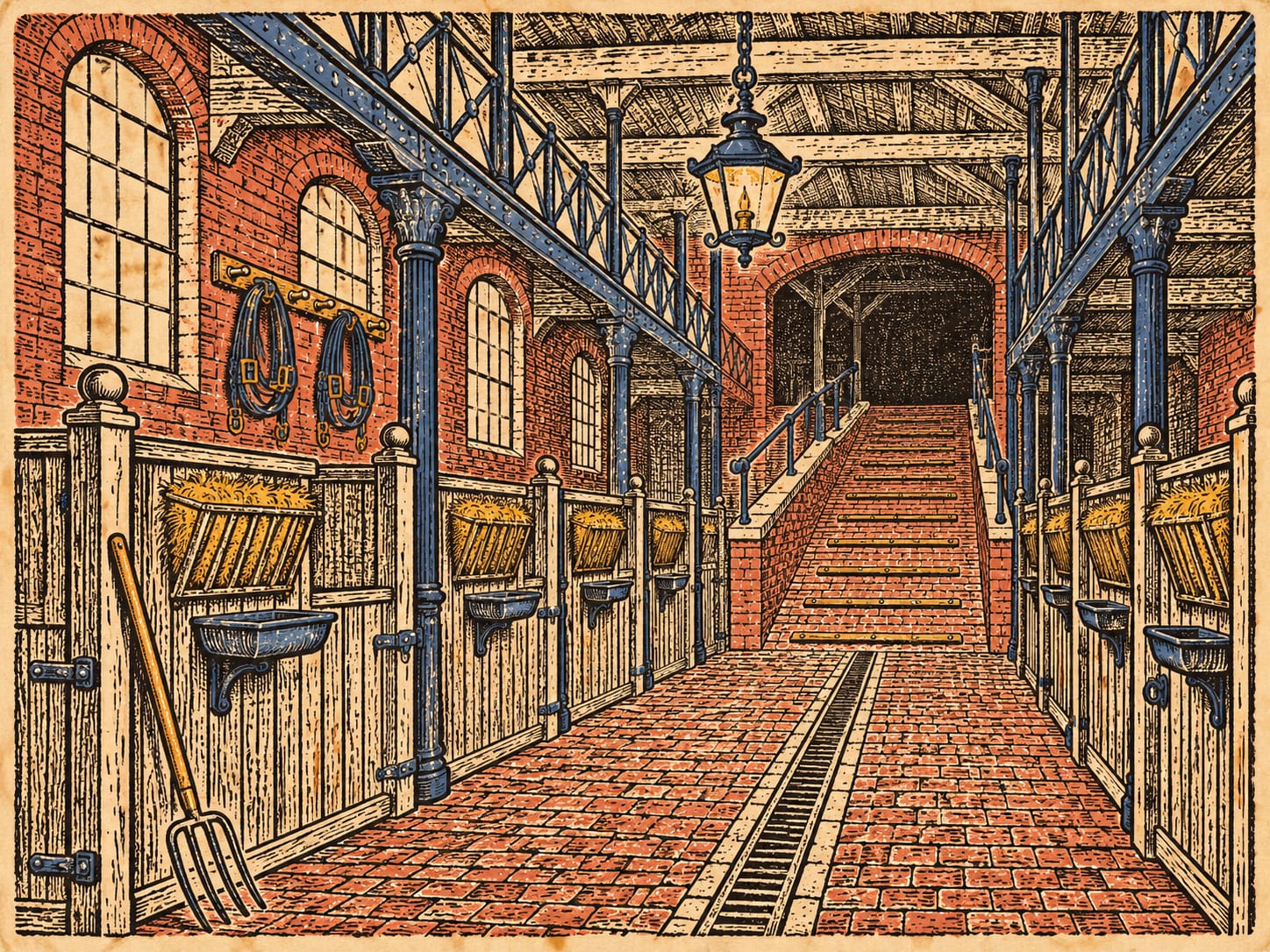
Some of the horse city is still standing. The Camden Railway Heritage Trust describes the stables complex at Chalk Farm, which keeps 60 ground-floor stalls, original brick paving and drainage gullies, upper-floor loose boxes, mangers, hayracks and a horse ramp, with some tethering hooks and one trough.
On Cricket Green in Mitcham, Historic England records a late-nineteenth-century drinking fountain with a horse trough and a lower dog trough. The Metropolitan Drinking Fountain Association began in 1859, added "and Cattle Trough" to its name in 1867, and by 1885 reportedly watered more than 50,000 horses a day at its London troughs.
The London Canal Museum's Horse Power exhibition has a full-sized model horse named Henrietta in a recreated stable. The London Museum holds a photograph of horses drinking at a trough near St Clement Danes church in Aldwych, taken between 1920 and 1933. In New York, the Municipal Archives hold photographs of horse-drawn freight, stables and dead-animal removal.
Sources
- Stephen Davies, "The Great Horse-Manure Crisis of 1894," The Freeman, Foundation for Economic Education, September 2004
- Rose Wild, The Times, 13 January 2018, and the paper's archive correction
- "La gran crisis de las boñigas de caballo de 1894 y el futuro de la humanidad," El País, 2018
- "Will They Push the Dirt Away?", The Evening World, 8 June 1894, Library of Congress
- New-York Tribune, 5 December 1894, Library of Congress
- Peter J. Atkins, Animal Cities, Durham Research Online
- Joel Tarr and Clay McShane, The Horse in the City
- "Horses in the city," American Museum of Natural History
- Henry Mayhew, London Labour and the London Poor, volume 2, 1861
- John Thomson and Adolphe Smith, Street Life in London, 1877
- W. J. Gordon, The Horse World of London, 1893
- Greater London Industrial Archaeology Society, Lett's Wharf
- George E. Waring Jr., Report of the Department of Street Cleaning of New York for 1895-1896-1897, Wellcome Collection
- American National Biography and ASCE biographies of George E. Waring Jr.
- Annual report of the Board of Health of the City of New York, 1921
- Medical Officer of Health report, Shoreditch, 1892, Wellcome Library
- White Wings on Review, 1903 film, Library of Congress
- London Museum, Transport for London and Ford Motor Company histories of trams, the underground, buses and the Model T
- Camden Railway Heritage Trust, Chalk Farm stables; Historic England, Mitcham horse trough; London Canal Museum
Watch the full story on the Flashback Fables YouTube channel, and send it to someone who would love it.