
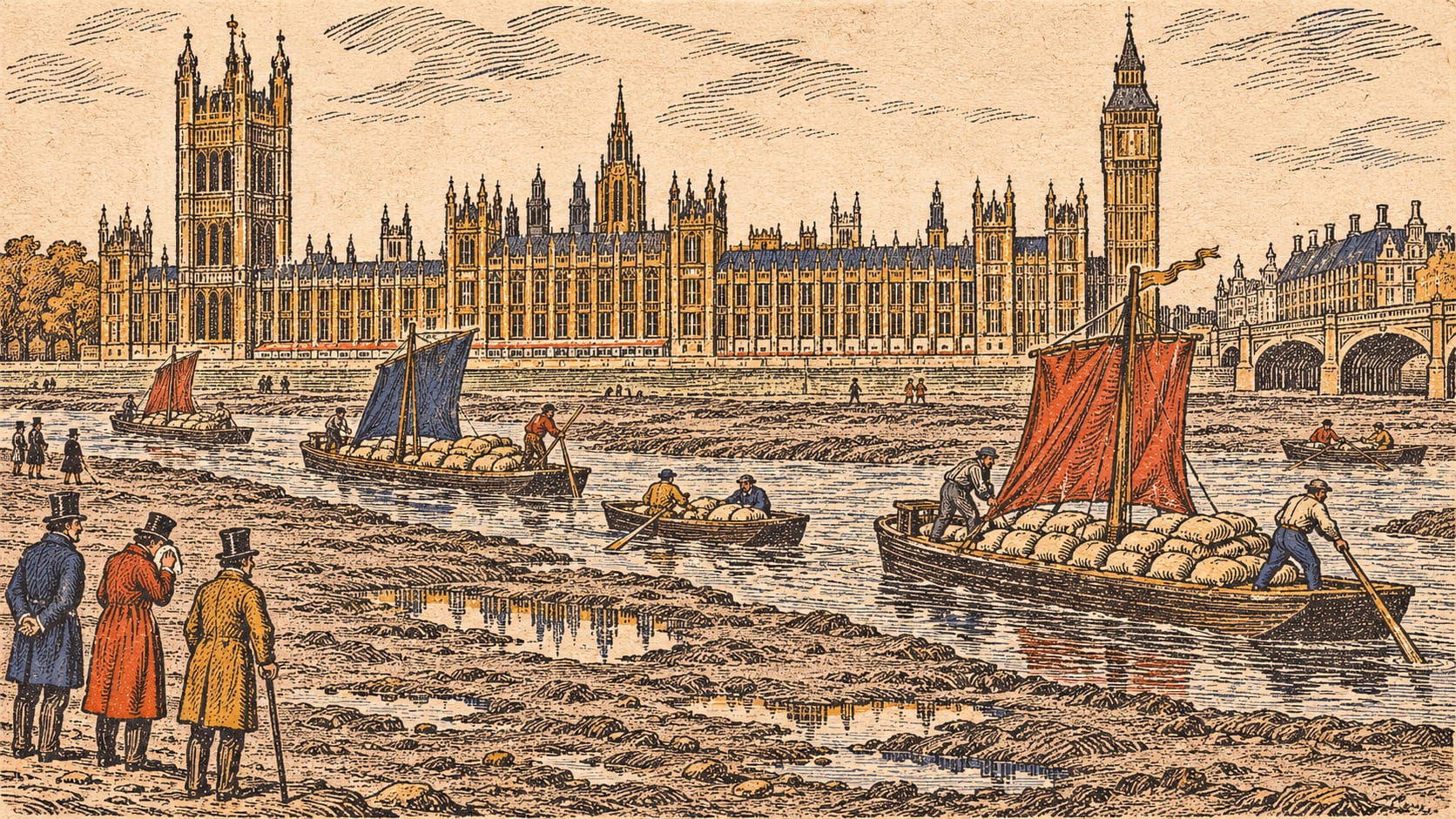
London's Great Stink of summer 1858 came from a hot, dry summer, a shrunken Thames full of sewage, and a smell so bad that Parliament passed a sewer law within weeks.
Three years earlier, on 7 July 1855, Michael Faraday had written to The Times after a steamboat trip between London Bridge and Hungerford Bridge. He called the Thames an "opaque pale brown fluid" and tested it by dropping pieces of white card into the water. The cards vanished before they sank an inch.
The stink itself has no established death toll. What it left behind was a law, a drainage system that still works, and an old argument about what makes people sick.
June 1858: the smell reaches Parliament
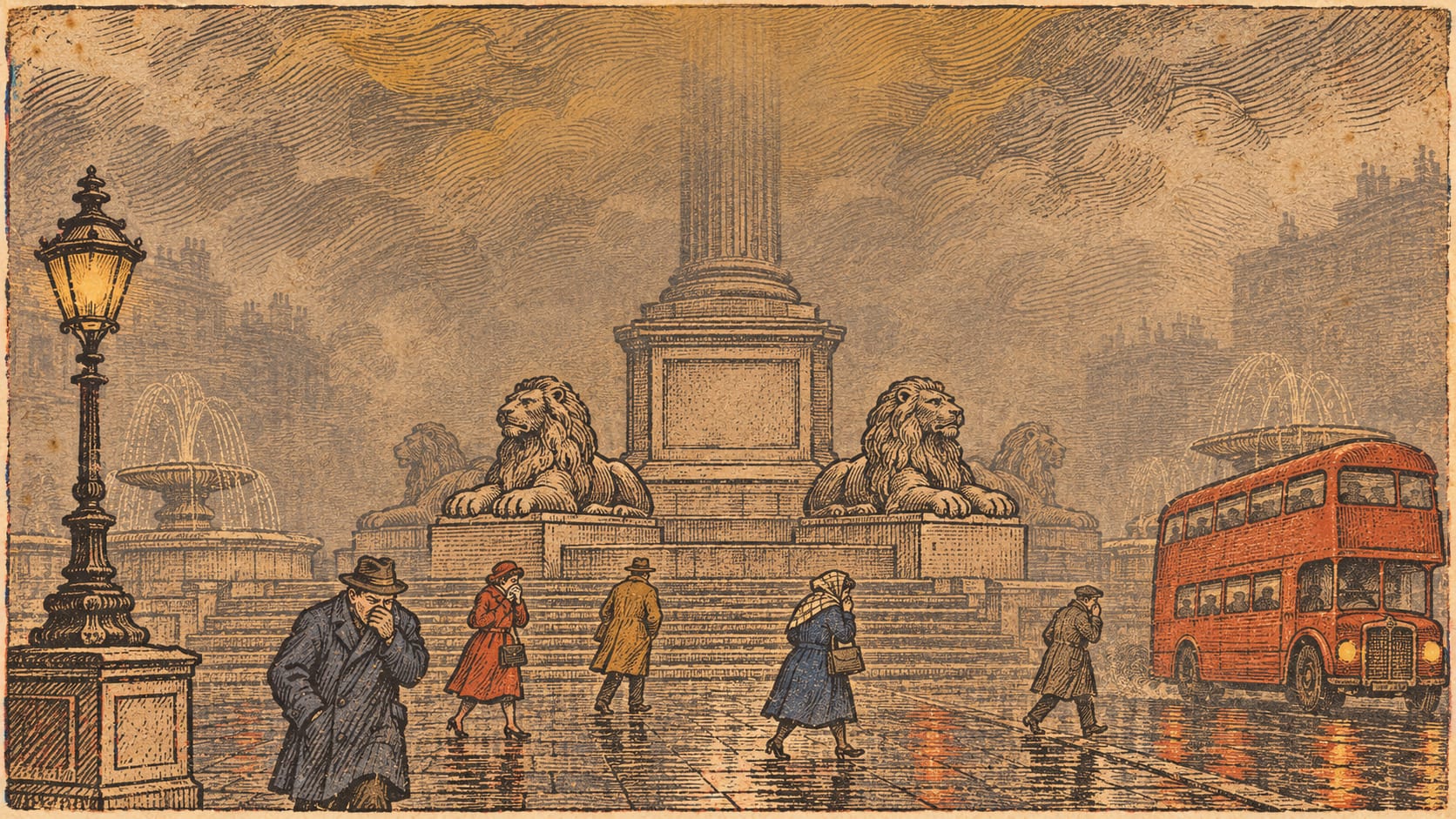
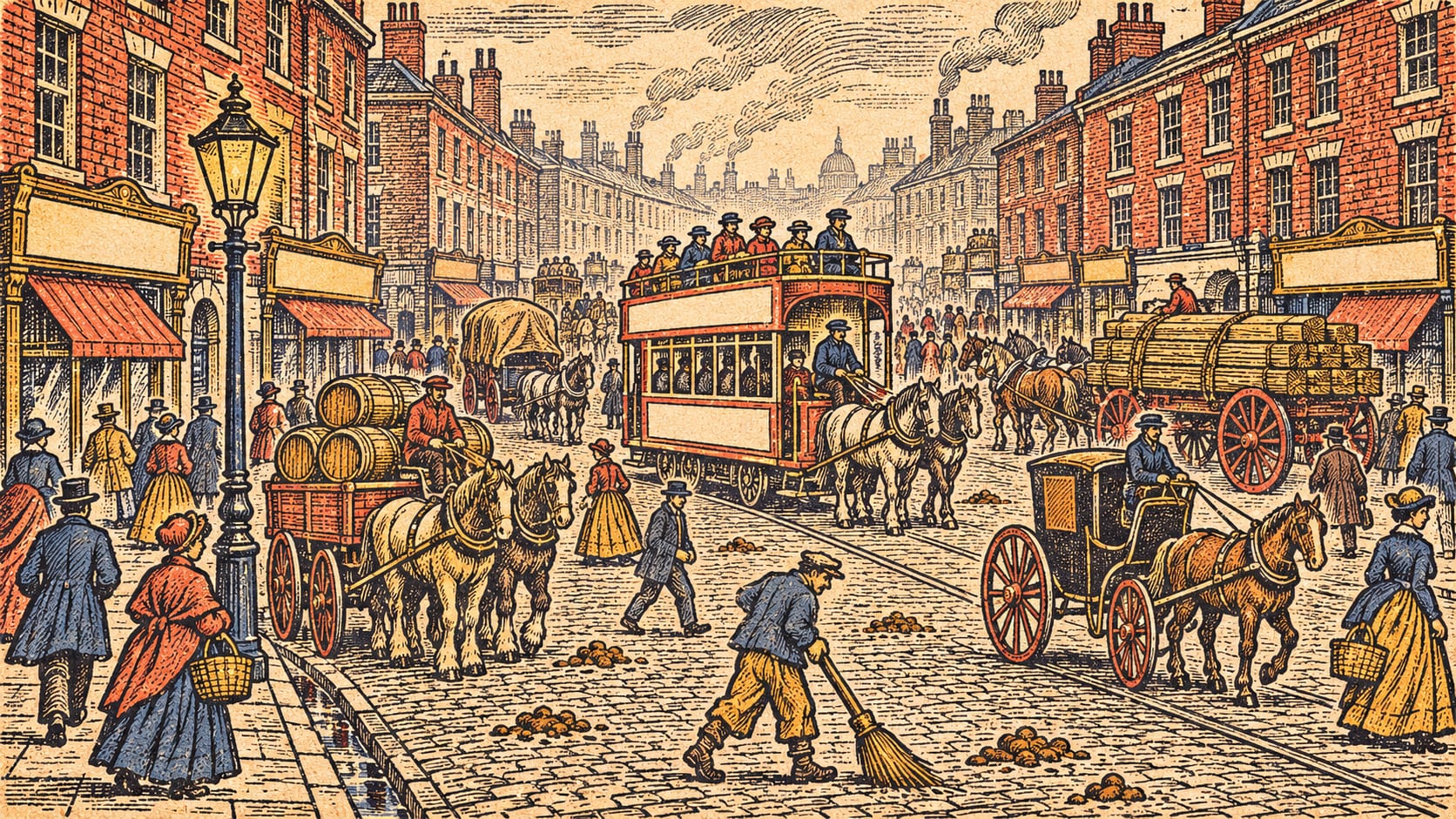
The summer of 1858 was unusually hot and dry. Temperatures stood near 30°C for weeks, and the Thames sank, leaving mud banks covered in sewage. Human waste, animal remains, industrial refuse, slaughterhouse waste and household sewage rotted along the river.
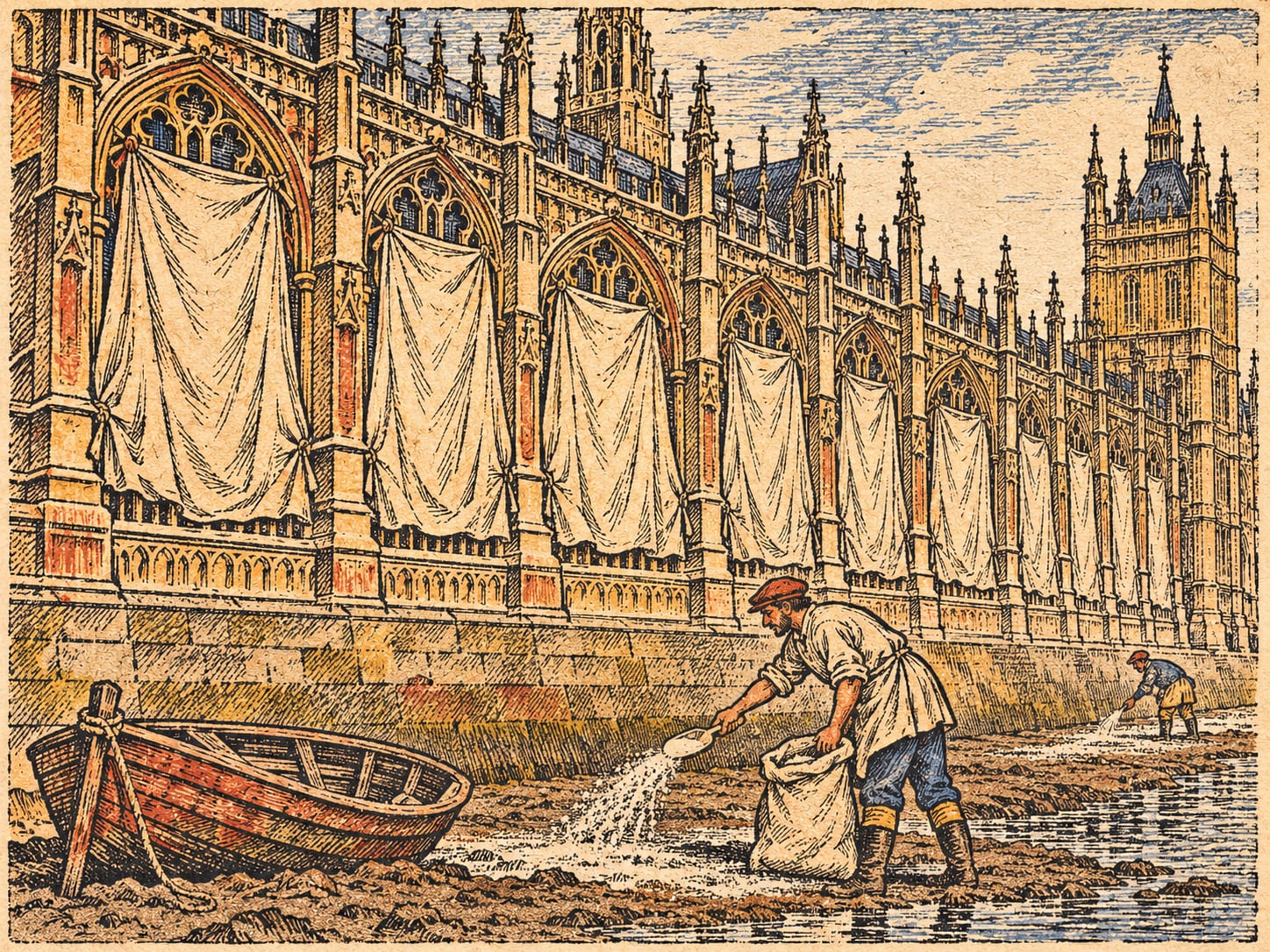
On 11 June, the MP John Brady told the House of Commons that members could not stay in the committee rooms or the library because of the stench from the Thames. By 18 June, officials reported that canvas treated with a weak solution of chloride of zinc and lime hung over the river-facing windows. Four or five boatloads of lime had also been spread near Parliament and over the exposed mud.
Later tellings turned the canvas into curtains soaked in chloride of lime. The Parliamentary Archives catalogue uses that wording too, noting that curtains were soaked in chloride to mask the smell and that the stench badly disrupted business in the Houses of Parliament.
The crisis grew through June and July. It ended quickly once cooler weather and rain came in August.
What London said about the river
The London City Press of 19 June called the Thames "the receptacle of the excreta of near three millions of persons" and said the sun turned it into "a stream of putrefaction." Its verdict was short: "whoso once inhales the stink, can never forget it."
The Wrexham Advertiser of 3 July wrote that "the Thames is now as filthy a pool as exists in the yard of a substantial farmer," and reported people crossing bridges with handkerchiefs over their noses. On 12 July the Morning Post called the river "too nasty to be handled." On 21 July The Times wrote that "the sewage of a mighty city lies in a broad stream under our very noses." It added that the Metropolitan Board had "no money" and "no power," and called the June heat "the last ounce of our burden."
Punch answered in pictures. Its 3 July cartoon was titled "Father Thames Introducing His Offspring to the City of London." On 10 July it ran "The Silent Highwayman," which showed Death rowing on the polluted river.
The phrase "Great Stink" is not the one most 1858 reports used. Reporters wrote of "the Thames," "the river nuisance" and "the pestilential condition of the river."
Inside the House
On 18 June, John Brady stood up in the Commons and called the river a public danger. "God had given to them a most magnificent river," he said, "and they had turned it into the vilest of sewers." He told the House that cartloads of dead fish had been taken out of the Thames.
A week later, on 25 June, the MP Owen Stanley read out a letter from Goldsworthy Gurney, who was responsible for ventilating the Houses of Parliament. Gurney had written: "I can no longer be responsible for the health of the house." Stanley added that Dr John Bredall thought it dangerous for jurors, counsel and witnesses to stay in the nearby courts, because the air might bring on "malaria and perhaps typhus fever."
Away from Westminster, William John Boyle wrote in his diary on 18 June: "At London Bridge the stench was awful." In the House of Lords, the Duke of Buccleuch said that a river-steamer passenger had been overcome by the smell and vomited, and that others had reportedly been carried ashore fainting.
These accounts show how frightened people were of the air. They do not add up to a death toll for the stink.
Why the smell mattered
Many Victorian officials and doctors believed disease came from miasma, a poisonous air produced by rotting matter. On that view the smell was not just a sign of pollution. It was a possible cause of cholera and typhoid.
That belief shaped the response. It drove lime, chloride solutions, ventilation and treated curtains. It also pushed people toward building sewers, because sewage was thought to give off dangerous vapours. The people who feared the smell were acting on what they believed protected them.
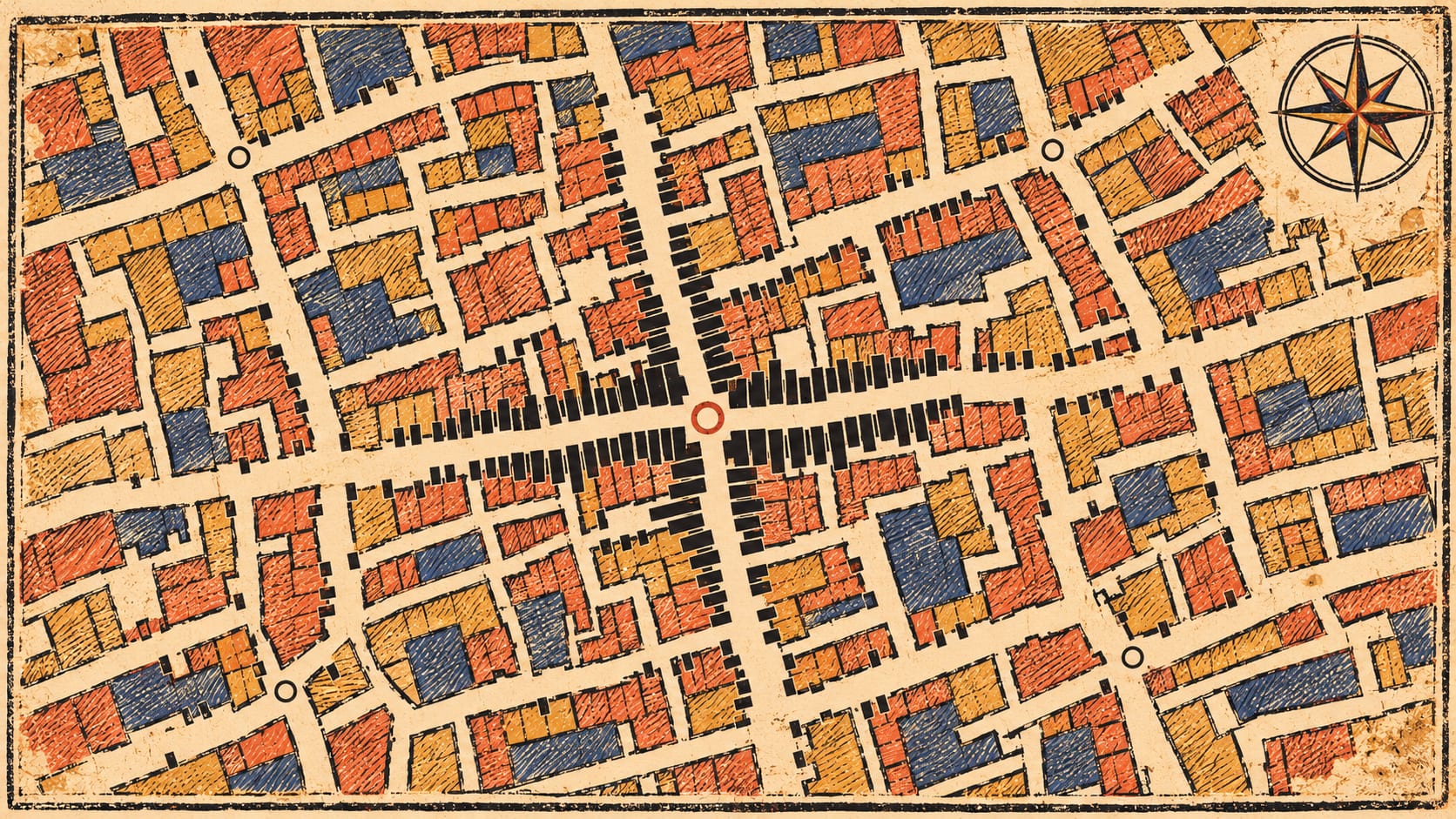
John Snow had already pointed somewhere else. In the August 1854 cholera outbreak in Soho, he mapped deaths around the Broad Street pump and argued that contaminated water carried the disease. William Farr, whose statistics had initially linked cholera to low ground, still treated miasma as important through the 1850s. He revised his view after studying the 1866 London outbreak, which centred on districts supplied with contaminated water.
The law passed in 18 days
On 15 July 1858, Benjamin Disraeli, the Chancellor of the Exchequer in Lord Derby's Conservative government, introduced the Metropolis Local Management Act Amendment Bill. He told the Commons that the Thames had "really become a Stygian pool, reeking with ineffable and intolerable horrors." He proposed a special "Main Sewage rate of the Metropolis" and said the work could not cost less than £3,000,000.
Not everyone liked the plan. Sir Benjamin Hall and others wanted the government to carry more of the cost, because the job was too big for local rates. Mr Butler pointed out that towns outside London also sent sewage into the Thames. Sir William Dunbar opposed public money altogether. Mr Akroyd did not want Parliament to guarantee £3,000,000 without a settled design, and he cited cheaper proposals to deodorise the river instead. Other MPs complained that royal palaces and government offices would benefit without paying the rate.
On 22 July the committee rejected attempts to fix a plan in the bill, so the Board stayed free to choose its own design. A proposal to make the Treasury certify each stage of the work was withdrawn. The Commons passed the bill on 24 July and the Lords took it up on 27 July.
It received Royal Assent on 2 August 1858 as 21 and 22 Victoria, chapter 104. London Museum counts 18 days from the bill's introduction to the law.
The Act told the Metropolitan Board of Works to begin works "as soon as may be" and finish them "with all convenient Speed according to such Plan as to them may seem proper." It allowed up to £3,000,000 of Treasury-guaranteed borrowing and set a metropolitan main drainage rate of threepence in the pound.
A design fight before the smell
The Board and its engineer were already in place before the smell. What the summer of 1858 changed was speed.
In 1854, Joseph Bazalgette and the engineer Henry Haywood had proposed intercepting sewers on both banks of the Thames, carrying sewage east to outfalls near Barking Creek on the north side and a similar distance down the south side. The 1855 Metropolis Management Act then told the Board to keep London's sewage out of the Thames "in or near" the metropolis.
Sir Benjamin Hall, the First Commissioner of Works, used that wording in 1856 to reject the Board's plans. Their outfalls sat too close to London, he argued, and the tide might carry the sewage back. He sent the question to government engineers, including Captain Douglas Galton, who offered a rival design.
The Board asked George Parker Bidder, Thomas Hawksley and Bazalgette to review the referees' conclusions. Their report of April 1858 criticised the government design. The argument delayed the works.
The 1858 Act did not pick between the technical plans. It removed the First Commissioner's veto and left the choice to the Board. Bazalgette's intercepting-sewer plan was adopted, and construction began in 1859.
Bazalgette and the Board of Works
The Metropolitan Board of Works was London's public-works authority, created in 1855 under the Metropolis Management Act. It coordinated major work across the metropolitan area, including drainage, roads, bridges and embankments.
Joseph William Bazalgette became its chief engineer. He was elected engineer on 25 January 1856 and stayed in the post until the London County Council replaced the Board in 1889. He directed the design and building of London's main drainage system, working with a wider team of engineers, contractors and the Board's own administrators.
What he built
Bazalgette's system joined local street drains to large brick-lined intercepting sewers, with pumping stations, outfall sewers and river embankments. The main pumping stations and outfall works were at Deptford, Crossness, Abbey Mills and the Western Pumping Station at Pimlico. The northern outfall system came together at Abbey Mills and ran on toward Beckton. The southern system ran through Deptford toward Crossness.
Published totals differ by what they count. The Institution of Civil Engineers gives about 1,300 miles of sewers, including 82 miles of west-to-east intercepting sewers. London Museum gives about 1,100 miles of street drains feeding 82 miles of new brick-lined sewers.
London Museum puts the bricks used at about 318 million, and other summaries say about 320 million. Thousands of labourers dug the tunnels by hand. The builders also reused existing drains and lost rivers, especially the Fleet and the Tyburn, as parts of the underground network.
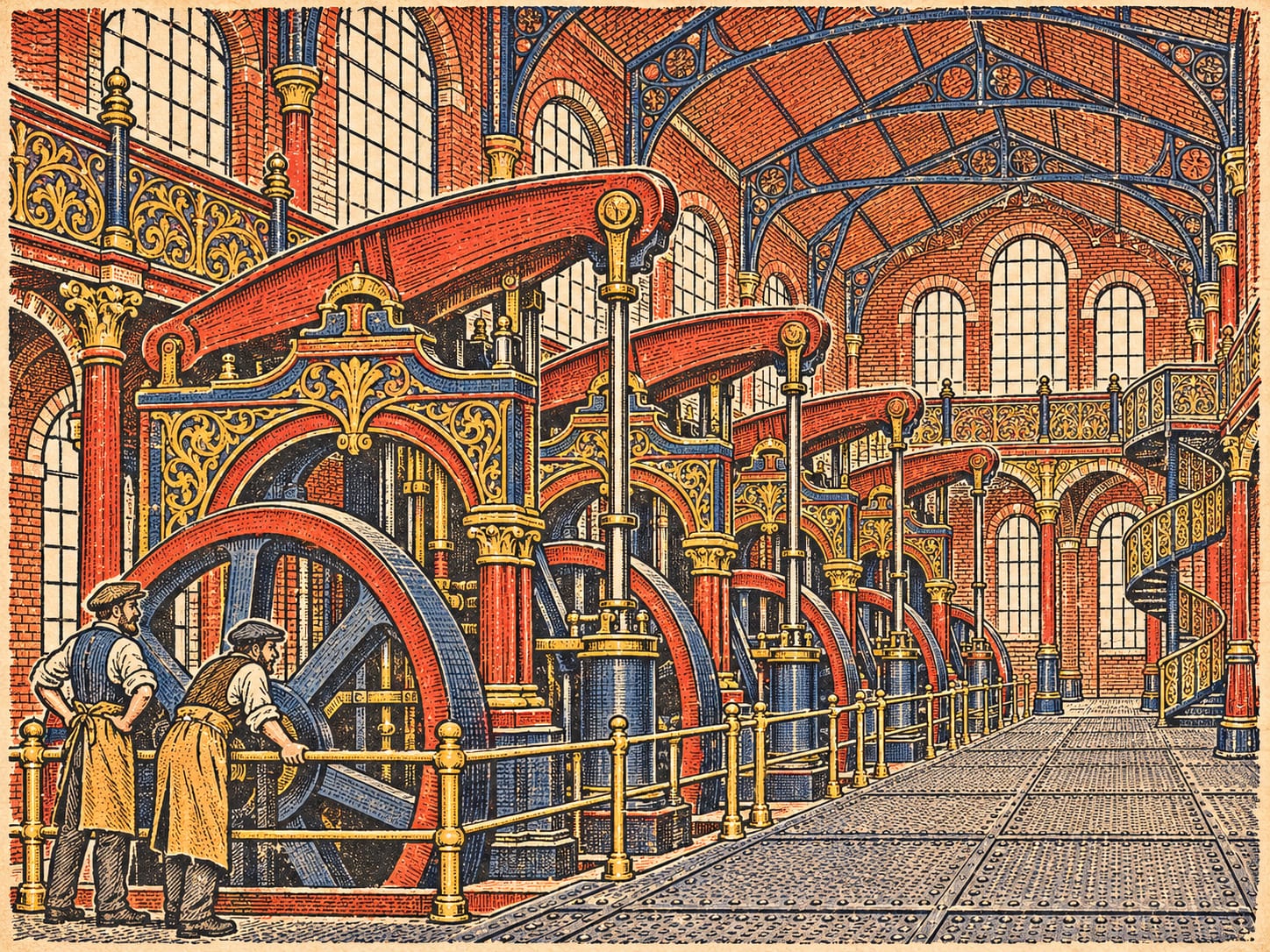
At Crossness, Bazalgette designed the system, Charles Henry Driver designed the building, and William Webster was the contractor. James Watt and Company built the engines and Daniel Adamson and Company of Manchester made the original boilers. Four beam engines stood in the hall, named Victoria, Prince Consort, Albert Edward and Alexandra. Each was a single-cylinder engine of about 125 nominal horsepower, with a 48-inch cylinder and a 9-foot stroke.
On the Northern Outfall Sewer, Edmund Cooper served as resident engineer and George Furness was named as contractor. Driver also gave Abbey Mills its architectural treatment.
The embankments carried sewers and reclaimed land from the river. The Institution of Civil Engineers counts about 52 acres reclaimed by the embankment works as a whole, and London Museum gives about 22 acres for the main embankment construction.
What it cost
Disraeli's £3,000,000 turned out to be only the start. An Act of 1864 authorised another £1,200,000 of borrowing, which brought the main drainage loans to £4,200,000 at an interest rate of 3¾ percent. London Museum gives an earlier parliamentary offer of £2,500,000.
The Bank of England's 1881 loan account gives those figures for statutory borrowing. They are not the final gross cost of every connected sewer, pumping station and embankment.
Did the new sewers end cholera?
The new system greatly cut the risk of sewage fouling central London's water supplies. It did not end cholera at once.
London suffered a major cholera outbreak in 1866. Parts of the East End were not yet properly connected to the new sewers, and the East London Water Company was drawing contaminated water from the River Lea. The official medical report counted 5,596 cholera deaths in London that year, most of them in eastern districts. Stepney, St George-in-the-East, Poplar, Bethnal Green and Whitechapel had especially high death rates.
The 1866 epidemic was London's last major cholera epidemic. Bazalgette's drainage helped protect the areas connected to it and contributed to the end of repeated city-wide epidemics. The 1858 works did not remove cholera overnight, and the Great Stink itself has no documented death toll.
The cards, the cartoon and the letter
Faraday's 1855 letter drew public attention to the pollution of the Thames and helped turn the state of the river into a public issue. The Royal Institution links it to the embankments and intercepting sewers built after the Great Stink.
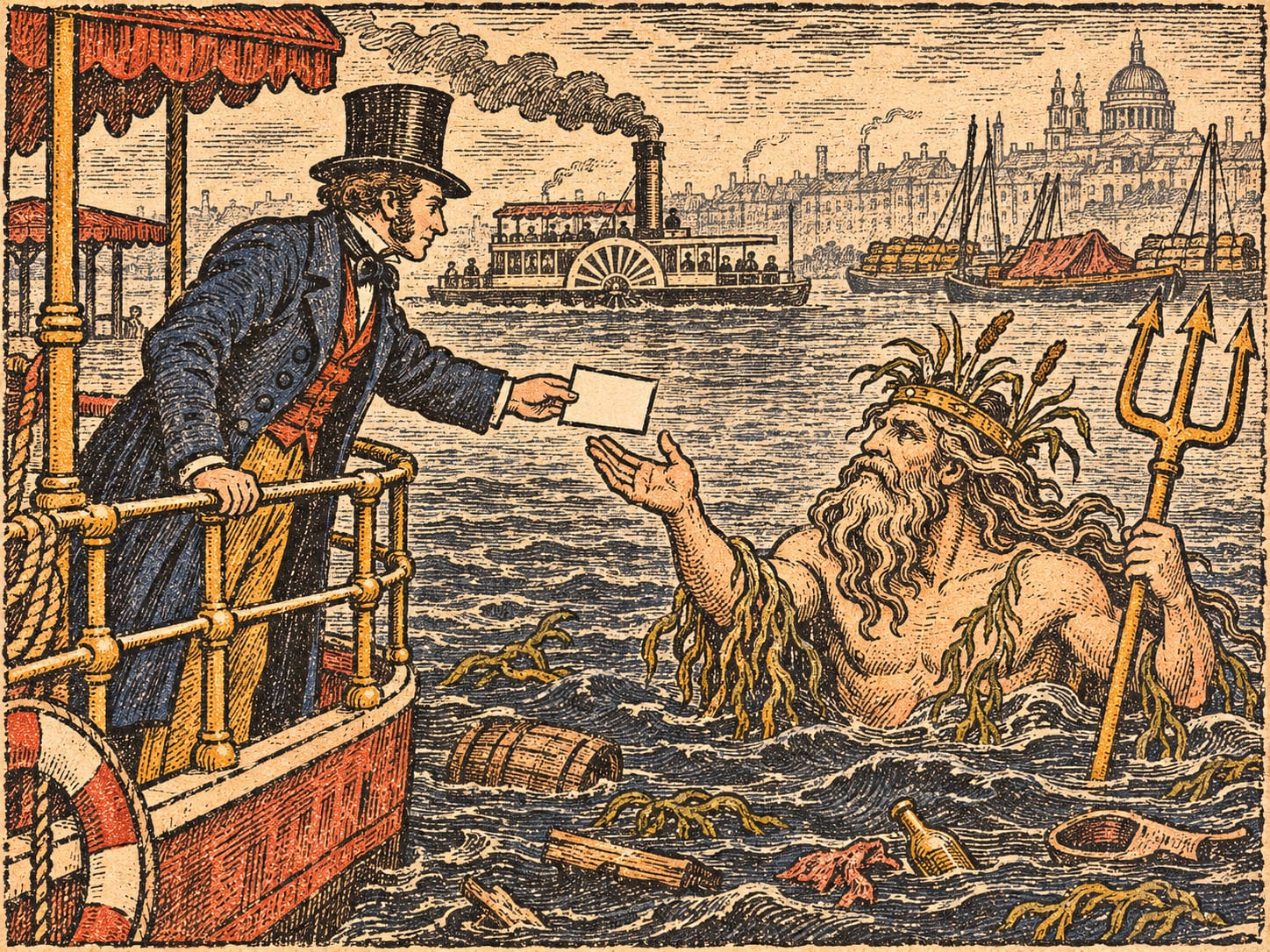
Punch published a cartoon on 21 July 1855 showing Faraday presenting his card to a personified Father Thames.
From Faraday's card to the finished sewers
- 7 July 1855
Michael Faraday writes to The Times about the Thames
- 21 July 1855
Punch publishes a cartoon of Faraday presenting his card to Father Thames
- 25 January 1856
Joseph Bazalgette is elected engineer to the Metropolitan Board of Works
- 11 June 1858
John Brady tells the Commons members cannot stay in the committee rooms or library
- 18 June 1858
Officials report treated canvas over the river-facing windows
- 15 July 1858
Disraeli introduces the drainage bill
- 2 August 1858
The Metropolis Local Management Act Amendment receives Royal Assent
- 1865
Crossness outfall and pumping station opens
- 1866
Cholera kills 5,596 people in London
- 1875
The main drainage project is complete
What became of Bazalgette
Bazalgette stayed chief engineer of the Metropolitan Board of Works until the Board ended in 1889. The main drainage system opened in 1865, though the whole project was not finished until 1875.
His other work filled the London map. He built the Victoria, Albert and Chelsea Embankments, and new or rebuilt bridges at Putney, Hammersmith and Battersea. He freed twelve Thames bridges from tolls. He also laid out major roads, among them Southwark Street, Queen Victoria Street, Northumberland Avenue, Shaftesbury Avenue and Charing Cross Road.
He was made a Companion of the Order of the Bath in 1871. The Institution of Civil Engineers gives his knighthood as 1874. In 1865 he presented his main drainage paper to the Institution and received its Telford Medal, and in 1884 he became its president. He died at Wimbledon on 15 March 1891, aged 72.
Are Bazalgette's sewers still in use?
Yes. Much of the network still carries London's wastewater, though it has been changed, extended and added to. Thames Water describes the original network as about 82 miles of main brick-lined tunnels fed by more than 1,100 miles of street sewers.
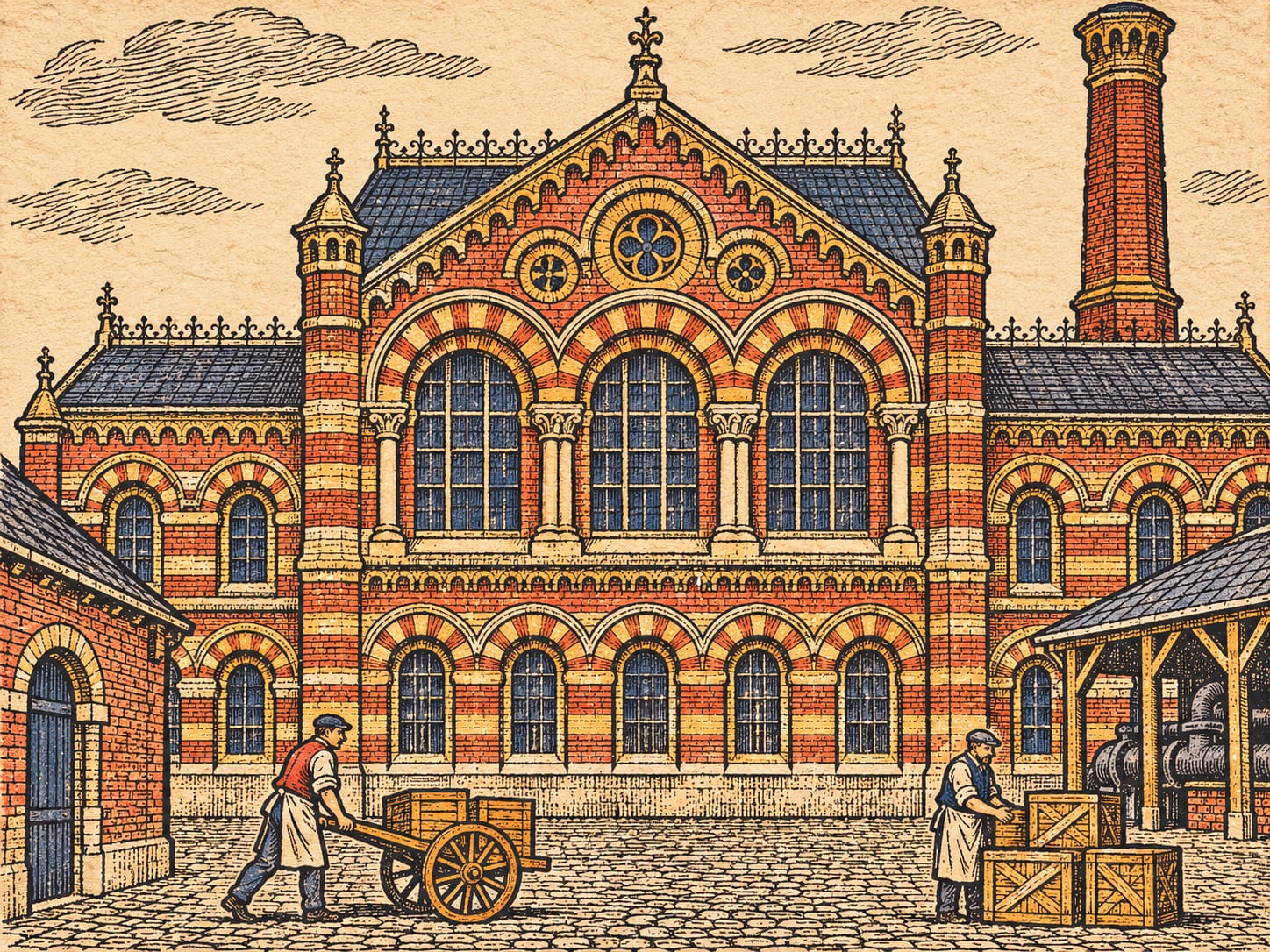
Abbey Mills is still in use. Its Station A, in Stratford, lifted sewage from the low-level sewers into the Northern Outfall Sewer, and its Romanesque architecture and decorated interior earned it the nickname "Cathedral of Sewage." It is not an ordinary walk-in museum. Thames Water has offered occasional guided tours, so anyone hoping to go inside should check its announcements.
The Victorian arrangement cannot always cope with modern London's population and storm runoff. The Thames Tideway Tunnel was built as a modern addition to catch combined sewer overflows and cut the untreated discharges that reach the river.
Crossness today
Crossness Pumping Station in Abbey Wood is a Grade I-listed building run as a museum by the Crossness Engines Trust. Visitors can walk into the ornate Beam Engine House and see its central octagon and cast-iron decoration.
Of the four engines, Prince Consort is fully restored and returned to steam in 2003. Victoria is being restored over the long term, and Albert Edward and Alexandra are largely unrestored. Prince Consort runs on advertised steaming days, usually from 10 a.m. to 4 p.m., with shorter winter hours, and the Trust advises checking its calendar before travelling. Volunteers do most of the restoration.
What stands on the river today
Between Faraday's white card in 1855 and the finished drainage in 1875, London went from a river that swallowed a card in an inch to a city that sent its sewage along intercepting sewers to outfalls near Beckton and Crossness.
The canvas and the lime are gone. The sewers under London's streets are still there, and one of the Crossness engines still runs on steaming days.
Sources
- Hansard, House of Commons, 11 June, 18 June, 25 June, 15 July and 22 July 1858, "State of the Thames" and the Metropolis Local Management Act Amendment Bill
- UK Parliament and Parliamentary Archives, papers on the Thames and its purification
- London Museum, "The Great Stink of 1858" and "How Bazalgette built London's first super sewer"
- Metropolis Local Management Act Amendment, 1858, legislation.gov.uk
- Institution of Civil Engineers, profile of Sir Joseph Bazalgette
- Joseph Bazalgette, "The Main Drainage of London," Institution of Civil Engineers, 1865
- English Heritage, Joseph William Bazalgette blue plaque
- Bank of England, Metropolitan Board of Works loan account, 1881
- British Newspaper Archive, "The Great Stink"
- Thames Water, history of London's sewer system
- Crossness Engines Trust, history, timeline, beam engines and opening days
- Thames Tideway archaeological report
- Royal College of Surgeons of England, "Mapping disease: John Snow and cholera"
- Royal Institution, collection on Michael Faraday in London, and Faraday's letter to The Times, 1855
- Reports of the Medical Officer of the Privy Council, 1875, with the 1866 cholera statistics
- "The final catastrophe: cholera in London, 1866," Cambridge University Press
Watch the full story on the Flashback Fables YouTube channel, and send it to someone who would love it.