
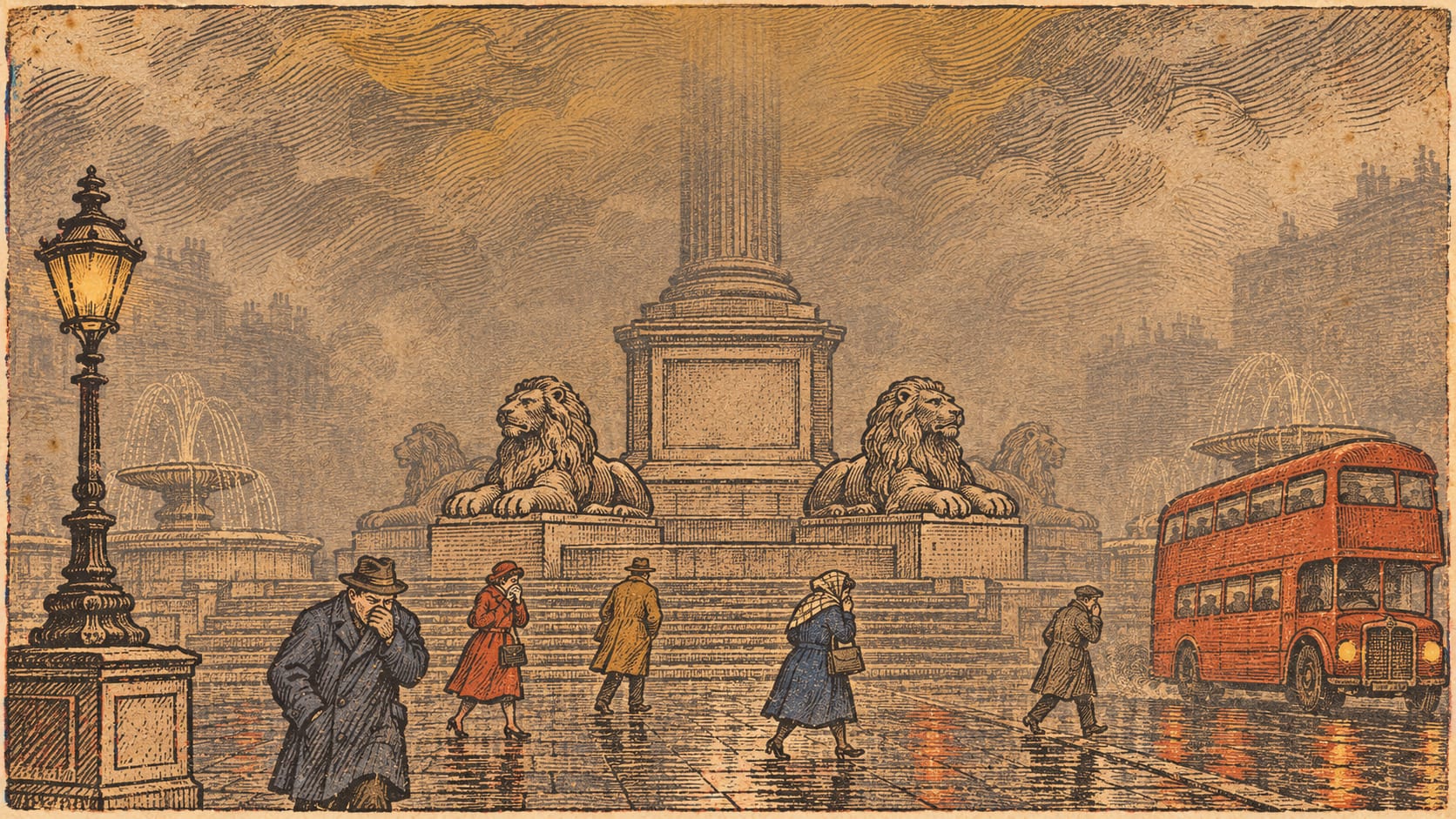
For five days in December 1952, from Friday 5 to Tuesday 9, a fog thick with coal smoke sat over London. The Ministry of Health estimated about 4,000 excess deaths in the fog and its immediate aftermath. A reassessment by Michelle L. Bell, Devra L. Davis and Tony Fletcher, published in 2004, put the toll at about 12,000 for December 1952 through February 1953.
The weather set the trap. A cold anticyclone created a temperature inversion, which held cold air, coal smoke and chemical pollutants close to the ground, and light winds did not clear them. London households were burning large amounts of coal in unusually cold weather, and the smoke had nowhere to go.
The smog helped bring about the Clean Air Act 1956, which let local authorities create smoke control areas.
Five days in December
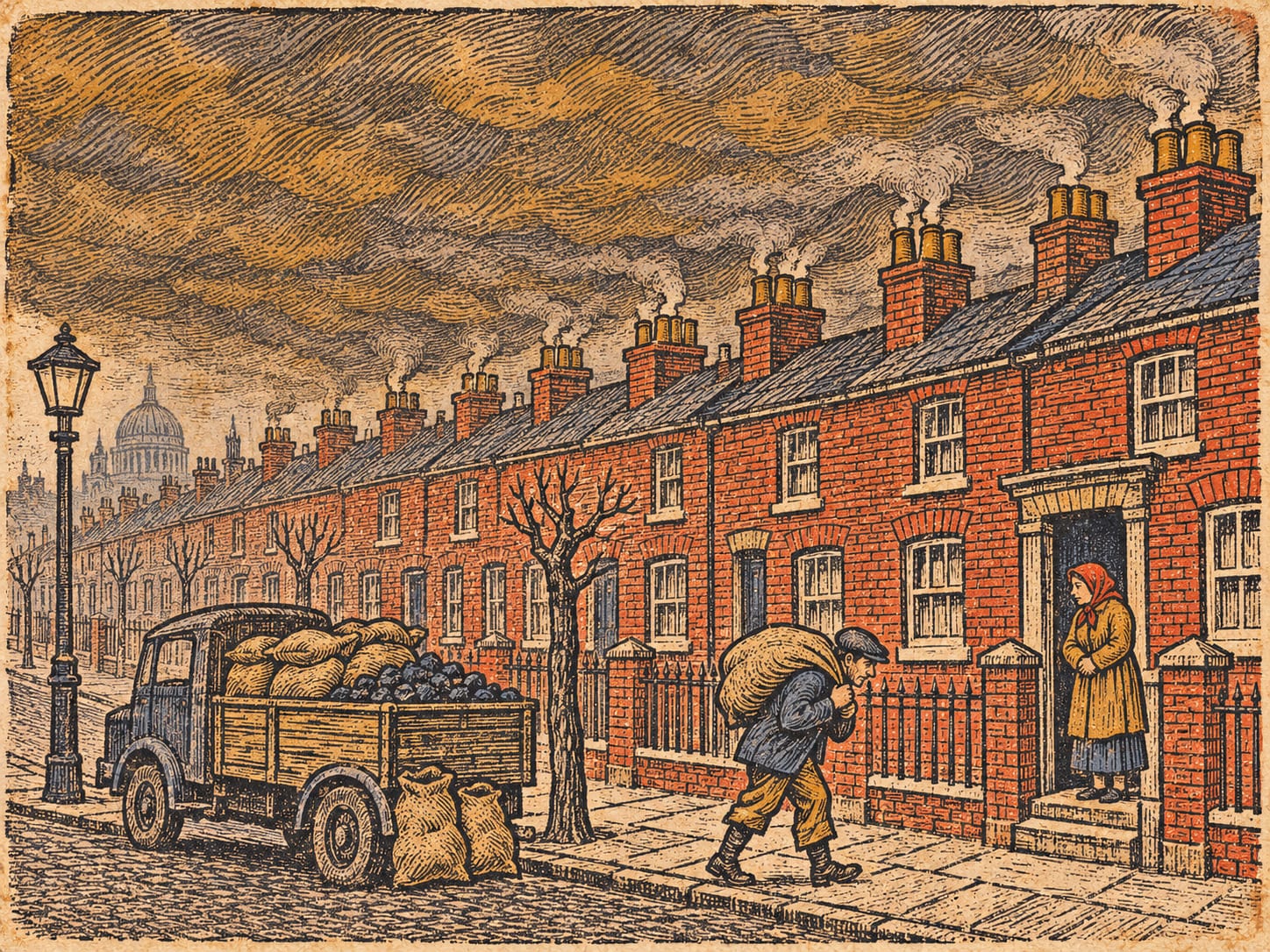
From Friday 5 December to Tuesday 9 December 1952, London lay under smoke-laden fog. Households burned domestic coal for heat, and the coal available at home was relatively sulphur-rich. Its sulphur dioxide turned into sulphuric acid in the fog.
Every day about 1,000 tonnes of smoke particles and 370 tonnes of sulphur dioxide went into the air, and the sulphur dioxide became about 800 tonnes of sulphuric acid. Factory chimneys and pollution drifting in from industrial areas to the east added to it. Domestic fireplaces, power stations and industrial furnaces were the main sources.
So, the fog was both things at once. Natural fog formed under unusual weather, and coal smoke and sulphur pollution made it toxic and slow to clear. Several things pushed London toward coal that week: the cold, domestic heating, post-war fuel policy and a domestic coal supply high in sulphur.
When day went dark
Visibility fell to a few metres in many places, and pedestrians could not find their way through familiar districts at night. On 5 December a Guardian correspondent wrote that visibility was eleven inches or less in parts of London, and that London Transport might not be able to get workers home except by the Underground.
By Saturday 6 December The Times was reporting "Fog holds up London traffic" and "Fog delays air services." By Monday 8 December its headlines read "Transport dislocated by three days of fog," "London buses stopped" and "Cars abandoned," with a football league programme curtailed and a university match postponed. By 7 December, visibility in parts of central London was 10 to 12 yards by day and nil at night. Ambulances were delayed, and the Manchester Guardian of 8 December noted an unusual amount of footpad crime and burglary.
London County Council measured the air at County Hall in Lambeth, and its figures climbed with the fog.
The people inside it remembered the dark in detail. Donald Acheson, later Sir Donald, was a resident medical officer at the Middlesex Hospital that week. At a witness seminar in 2002 he remembered losing his way on the 400 yards between the hospital and Oxford Street, creeping along walls to read the street names. "Visibility was less than three metres, and it was bitterly cold," he said.
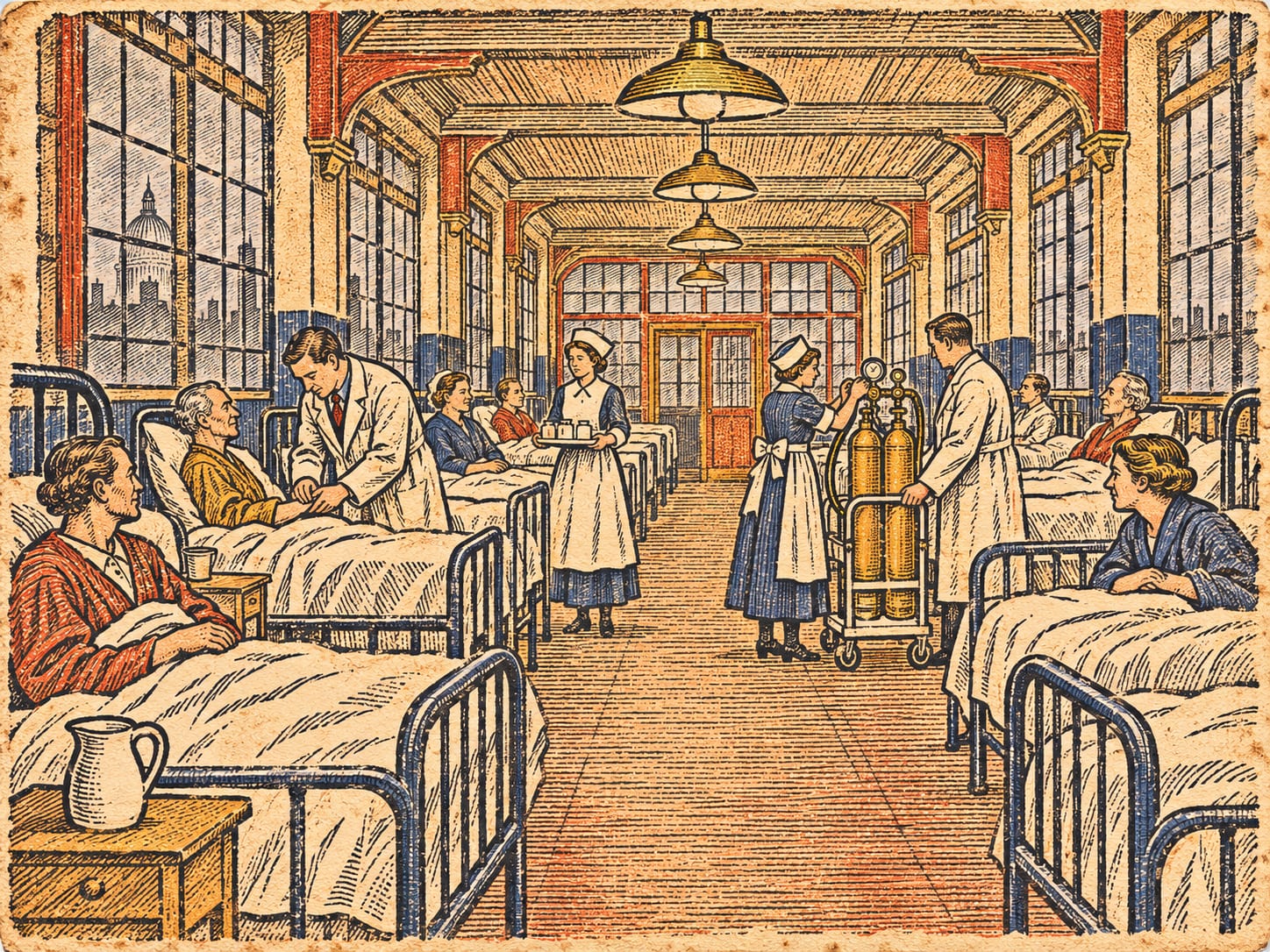
Ambulances filled every bed in the hospital. Smuts blew into the wards and darkened the wash basins and baths, and acute respiratory cases spilled into the surgical and obstetric wards. "The supply of oxygen was stretched to the limit."
Elinor Grace Jones, a nurse at Great Ormond Street Hospital, is quoted as saying: "It was the blackest and worst fog of any that I had ever seen. We wore masks inside the hospital. We had to change them every five minutes."
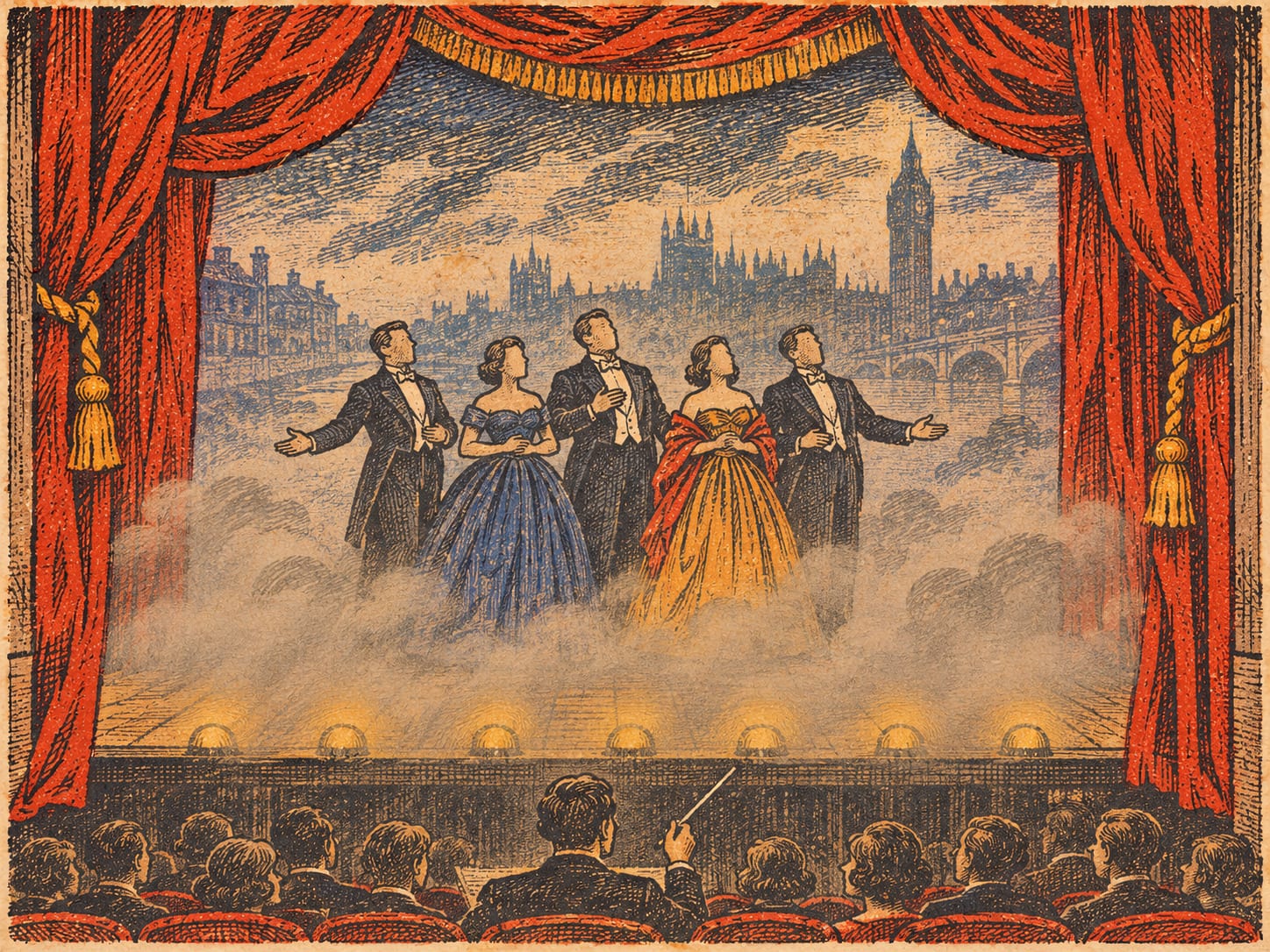
At Sadler's Wells Theatre, La Traviata was abandoned after the opening act, because the smog had come into the building and blocked the view of the stage. Hospitals across London received unusually large numbers of patients with respiratory problems, and ambulance runs were much slower.
Cattle at the Smithfield Show
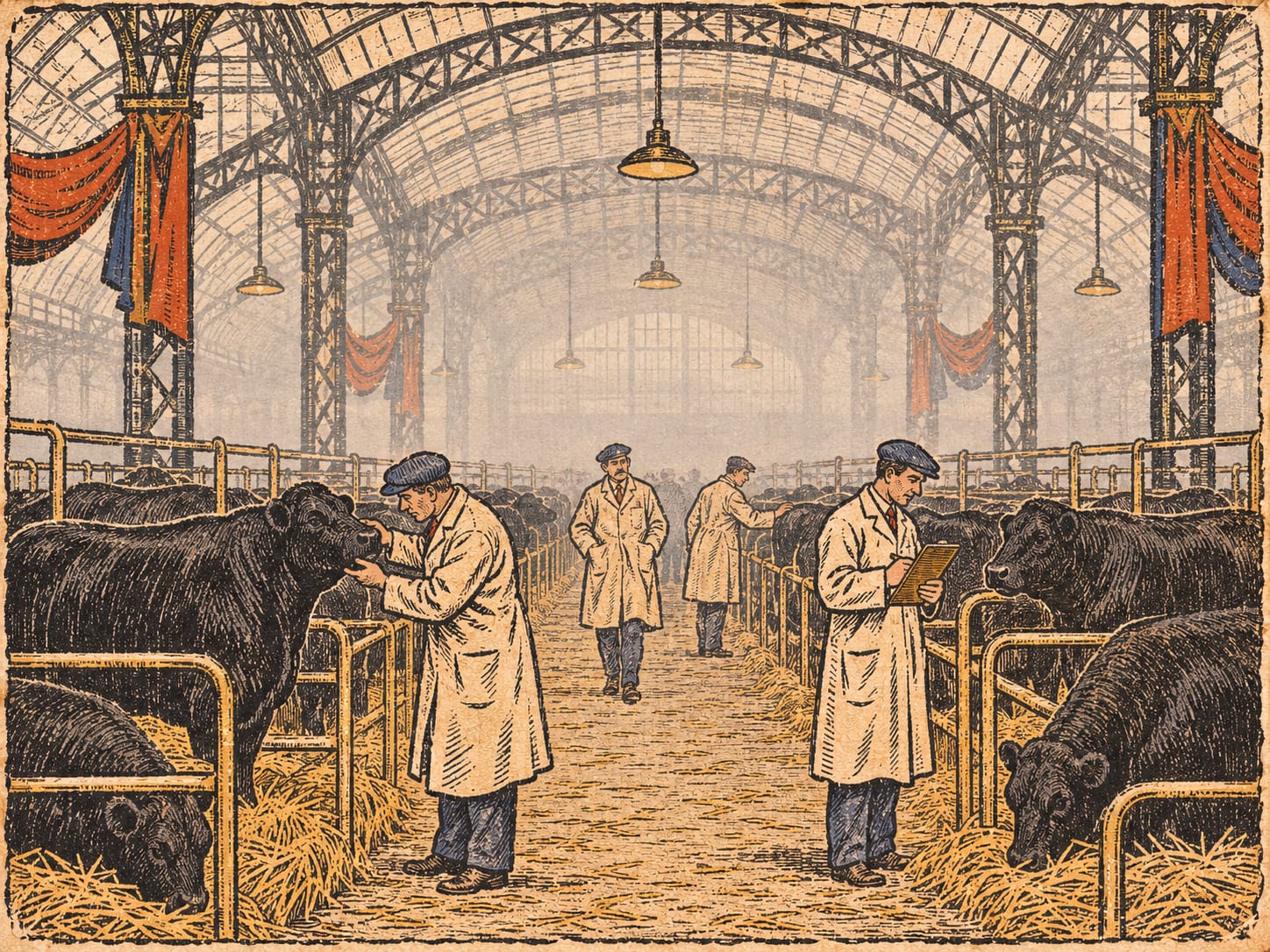
The Smithfield Show was running at Earl's Court that week, and the fog came into the hall. One Aberdeen Angus died. Twelve other cattle were slaughtered, sixty needed major veterinary treatment, and about a hundred more got minor attention. All of them were relatively young and in prime condition. On the Monday, The Times reported that vets had been treating animals "which appeared to have contracted respiratory troubles."
Professor Patrick Lawther later questioned whether the smog caused every one of those cases, so the cattle remain one of the stranger and less certain parts of the week.
Counting the dead
On 18 December 1952, Minister of Health Iain Macleod told Parliament that 4,703 deaths from all causes had been registered in Greater London in the week ending 13 December, against 1,852 in the same week of 1951. Emergency Bed Service admissions were 2,007, against 917 a year earlier. Macleod said the cold had caused some of the rise, but "A large part of these increases must be attributed to the fog." In the two weeks before the smog, Greater London had registered 1,902 and 2,062 deaths.
A later Ministry of Health report, Mortality and Morbidity during the London Fog of December 1952, estimated about 4,000 excess deaths linked to the fog and its immediate aftermath.
In 2004, Michelle L. Bell, Devra L. Davis and Tony Fletcher reassessed the pattern of deaths through February 1953. They estimated about 12,000 excess deaths from December 1952 through February 1953, counting both acute and persisting effects. The 12,000 is a later revision. The Ministry's 4,000 was the original official estimate.
Why the toll took time to see
Early on, the rise in deaths was read as a short surge during a severe fog. The deaths that kept coming in January and February 1953 were partly put down to influenza. Mortality returns also took time to compile and analyse.
Roy Parker was a third-year student at the London School of Economics that December. He remembered that at the start the public treated the episode as a familiar fog, and that the newspapers concentrated on transport, sport, crime and prize cattle, not on illness.
One later account says funeral directors began running short of coffins and florists ran short of flowers, while the full scale of the excess deaths became clear only afterwards.
What Parliament was told
Parliament's early answers were cautious. On 17 December, the MP Mr Driberg asked for an interdepartmental committee to investigate the causes and cure of London fog. Parliamentary Secretary Reginald Molson said no: "A Committee, the Atmospheric Pollution Research Committee, already exists under the Fuel Research Board and includes representatives of all the interested Departments."
On 27 January 1953, Harold Macmillan, Minister of Housing and Local Government, said he was "not satisfied that further general legislation is needed at present," and that changing the country's fuel system could not happen "in the twinkling of an eye." On 19 March, Macleod said that a study of hospital evidence and vital statistics was under way and that the scientific investigation "ought not to be hurried."
On 8 May 1953, MPs criticised the lack of a public inquiry. They cited 4,703 deaths in the week ending 13 December, and 6,000 more deaths in December 1952 than in December 1951. On 21 July the government announced a committee.
The Great Smog and the law that followed
- 5 December 1952
A smoke-laden fog settles over London, and a Guardian correspondent reports visibility of eleven inches or less in parts of the city
- 7 December 1952
Visibility in central London is 10 to 12 yards by day and nil at night
- 9 December 1952
The five days of smog end
- 18 December 1952
Macleod tells Parliament that 4,703 deaths were registered in the week ending 13 December
- 27 January 1953
Macmillan says he is not satisfied that further general legislation is needed
- 21 July 1953
The Committee on Air Pollution, chaired by Sir Hugh Beaver, is announced
- November 1954
The Beaver Committee's final report is published
- 3 November 1955
The Clean Air Bill has its Commons Second Reading
- 5 July 1956
The Clean Air Act 1956 receives Royal Assent
The Beaver Committee
The Committee on Air Pollution was announced in Parliament on 21 July 1953, under Sir Hugh Beaver. Its terms of reference were "To examine the nature, causes and effects of air pollution and the efficacy of present preventive measures; to consider what further preventive measures are practicable; and to make recommendations."
Its members came from town halls, laboratories and industry. Miss A. D. Boyd was a housing manager in Rotherham, Dr J. L. Burn the medical officer of health in Salford, and C. J. Regan the chemist-in-chief of London County Council. G. Nonhebel came from Imperial Chemical Industries, and Professor O. G. Sutton chaired the Atmospheric Pollution Research Committee.
The interim report, in December 1953, was blunt about the chimneys: "The domestic fire is the biggest single smoke producer. In ratio to the coal burnt, it produces twice as much smoke as industry and discharges it at a lower level." The final report, published in November 1954 as Cmd. 9322, called air pollution "a social and economic evil of the first magnitude" and said: "The case for preventive action is overwhelming." It read the smog as cold weather and stagnant air acting on smoke from widespread coal burning, especially domestic open fires, not as weather alone.
Its main recommendations were:
- prohibiting dark smoke, with exceptions;
- requiring new industrial plant to control grit and dust;
- letting local authorities designate smokeless zones and smoke control areas, and giving them most inspection and enforcement, with smokeless fuel required in restricted districts;
- paying grants to convert domestic fireplaces.
The final Act used the term "smoke control areas," though the Beaver Committee had also discussed "smokeless zones."
Passing the Clean Air Act
Sir Gerald Nabarro, Conservative MP for Kidderminster, topped the Private Members' Ballot and in February 1955 introduced a Clean Air Bill built largely on the Beaver recommendations. He withdrew it when the government promised comprehensive legislation of its own. Duncan Sandys, Minister of Housing and Local Government, steered the government bill, with Nabarro and other MPs backing it.
Supporters argued that smoke control would protect health, cut fuel waste and save buildings, and that local authorities, authorised fuels and conversion grants could make it work. Lord Munster called the Beaver evidence a "very convincing indictment" of pollution as a threat to health, and as a source of at least £250 million in material damage every year. Critics did not reject clean air. They objected to the cost, the fuel supply, enforcement and exemptions, and some wanted stronger controls on industry. Sandys defended a compromise between what was desirable and what was practicable.
The Commons gave the bill its Second Reading on 3 November 1955. Report and Third Reading came on 10 April 1956, and the Third Reading passed without a recorded division. The Clean Air Act 1956 received Royal Assent on 5 July 1956.
The Clean Air Act 1956
The Act let local authorities, with a minister's confirmation, designate districts where chimney smoke became an offence unless it came from authorised fuel. It also provided money to help households adapt their fireplaces.
In practice, the policy moved homes away from ordinary smoky coal and toward authorised smokeless fuels, gas, electricity and other lower-smoke heating.
After 1956
Holborn was the first London local authority to complete its smoke control programme, in 1962. By 1969, a Greater London Council review found smoke control covering more than 60 percent of premises and more than 50 percent of Greater London's area. A parliamentary statement in 1968 gave London's coverage as 65 percent of premises, and said that 3.5 million premises in England were under smoke-control orders by the end of 1967. Those figures count premises covered, not homes converted.
Smogs still came. One struck London from 3 to 5 December 1957, and deaths are estimated at about 760 to 1,000. Another came from 4 to 7 December 1962, with deaths estimated at about 700 to 750. The Clean Air Act 1968 then extended the framework: the minister could set limits for grit, dust and fumes, furnaces needed more arrestment plant, and there were new powers over chimney height. In February 1968, Parliament was told that no serious London smog had occurred since 1962.
The air itself changed. Background annual PM2.5 in London is put at roughly 100 micrograms per cubic metre in the 1950s, 50 in the 1960s, 20 in the 1970s and about 15 in recent years. Ambient smoke and sulphur dioxide fell by about 60 percent between 1962 and 1975.
Laws that came before
Britain had pollution rules before 1952. The Public Health Act 1875 treated black smoke from a chimney, other than that of a private dwelling-house, as a nuisance. Local authorities had to inspect for nuisances, investigate complaints and serve abatement notices, and they had to enforce rules that fireplaces and furnaces consume their smoke as far as practicable.
Those were nuisance and enforcement powers. They did not create a national system of domestic smoke control areas like the one in the 1956 Act. The Smoke Abatement Act 1853 and the Alkali Act 1863 had also set pollution controls. The Great Smog was a major turning point in politics and helped produce a landmark national clean-air law. It was not where every form of environmental law began.
The word, and smogs before 1952
The word smog is older than the event. A 1905 report in JAMA described it as a contraction of smoke and fog, referring to London's black fog, and the term is linked to Henry Antoine des Voeux and the 1905 Public Health Congress in London. The 1952 smog made the word known around the world.
Nor was 1952 the only serious pollution fog. London had earlier episodes in 1873, 1880 and 1948. Major industrial smog disasters struck the Meuse Valley in 1930 and Donora, Pennsylvania, in 1948.
The fog cleared on 9 December 1952. The full count of the dead took longer to arrive, and the law followed in 1956.
Sources
- "The Great Smog of 1952," Met Office
- "70 years since the great London smog," London City Hall
- Greater London Authority, Smog Report; "Fifty years on," Greater London Authority
- "Our London correspondent," The Guardian, 5 December 1952; Manchester Guardian reports of 8 December 1952
- Times headlines of 6 and 8 December 1952, as reproduced by Clean Air in London
- The Big Smoke: Fifty Years after the 1952 London Smog, Centre for History in Public Health, London School of Hygiene and Tropical Medicine
- "Intussusception and the great smog of London," Archives of Disease in Childhood
- Ministry of Health statement, 19 December 1952, The National Archives; Mortality and Morbidity during the London Fog of December 1952, Wellcome Collection
- Michelle L. Bell, Devra L. Davis and Tony Fletcher, "A retrospective assessment of mortality from the London smog episode of 1952," Environmental Health Perspectives, 2004
- Hansard, 17 and 18 December 1952, 27 January, 19 March, 8 May and 21 July 1953, and 10 April 1956
- Fernando Sapiña, El reto energético, Universitat de València
- Clean Air Act 1956 and Public Health Act 1875, legislation.gov.uk; Hansard, Air Pollution (Committee's Report), 25 January 1955
- Department of the Environment, London pollution episodes; "A chronology of global air quality," Philosophical Transactions of the Royal Society A
- University of London Press, discussion of the Beaver Report and the Clean Air Act
- "SMOG," JAMA, 1905
Watch the full story on the Flashback Fables YouTube channel, and send it to someone who would love it.