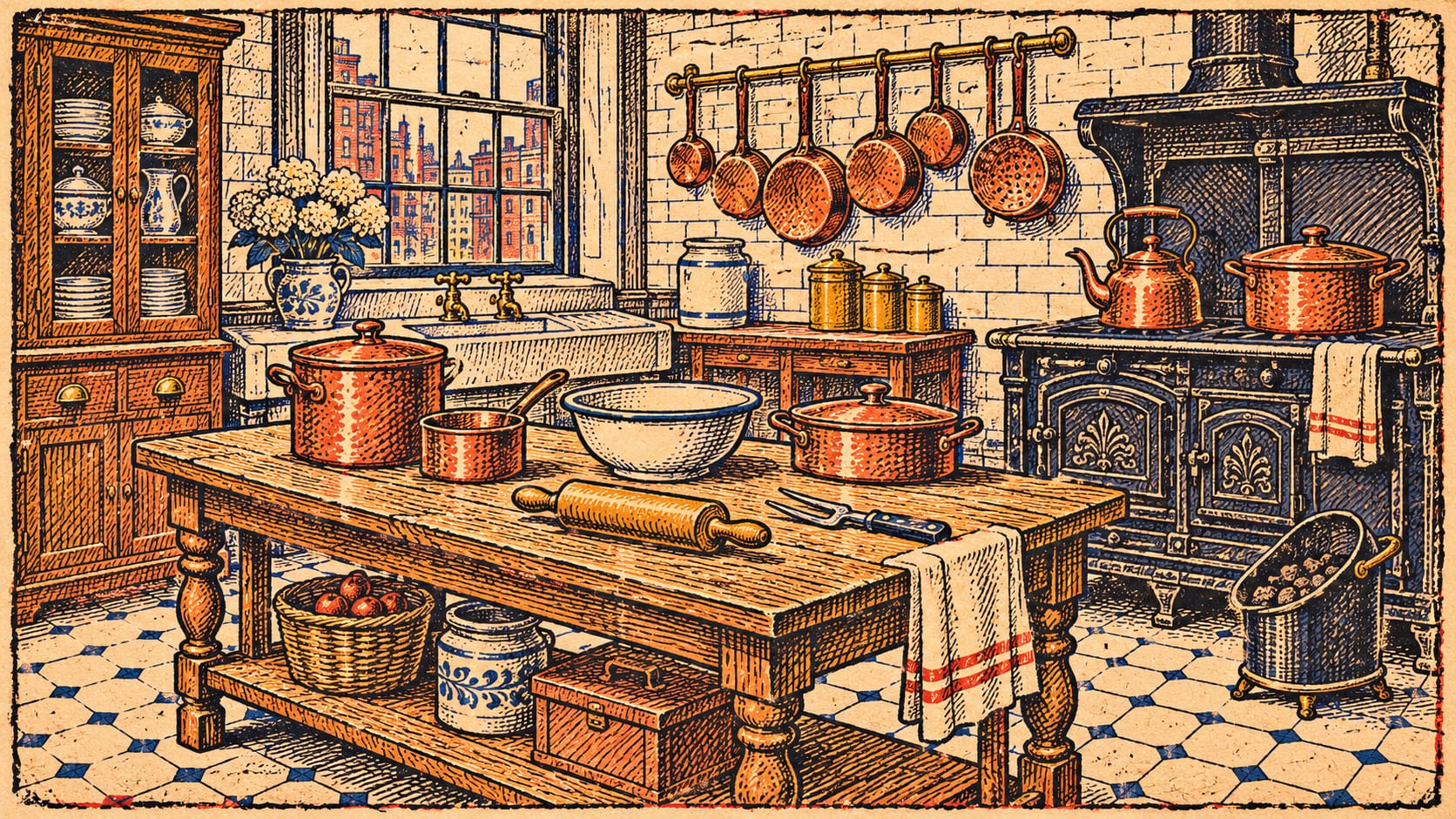
Mary Mallon, the cook known as Typhoid Mary, carried typhoid germs without showing any symptoms, and New York health officials held her on an island for about 26 years. She was held without a criminal trial.
Health authorities linked her to at least several dozen cases of typhoid and three deaths in the households and institutions where she cooked. The exact total is disputed. Her case set public safety against one woman's freedom, and historians still argue over how far officials should have gone.
She was probably born on 23 September 1869 in Cookstown, County Tyrone, Ireland. She died on 11 November 1938 on North Brother Island, where the city had confined her.
A cook in the kitchens of wealthy families
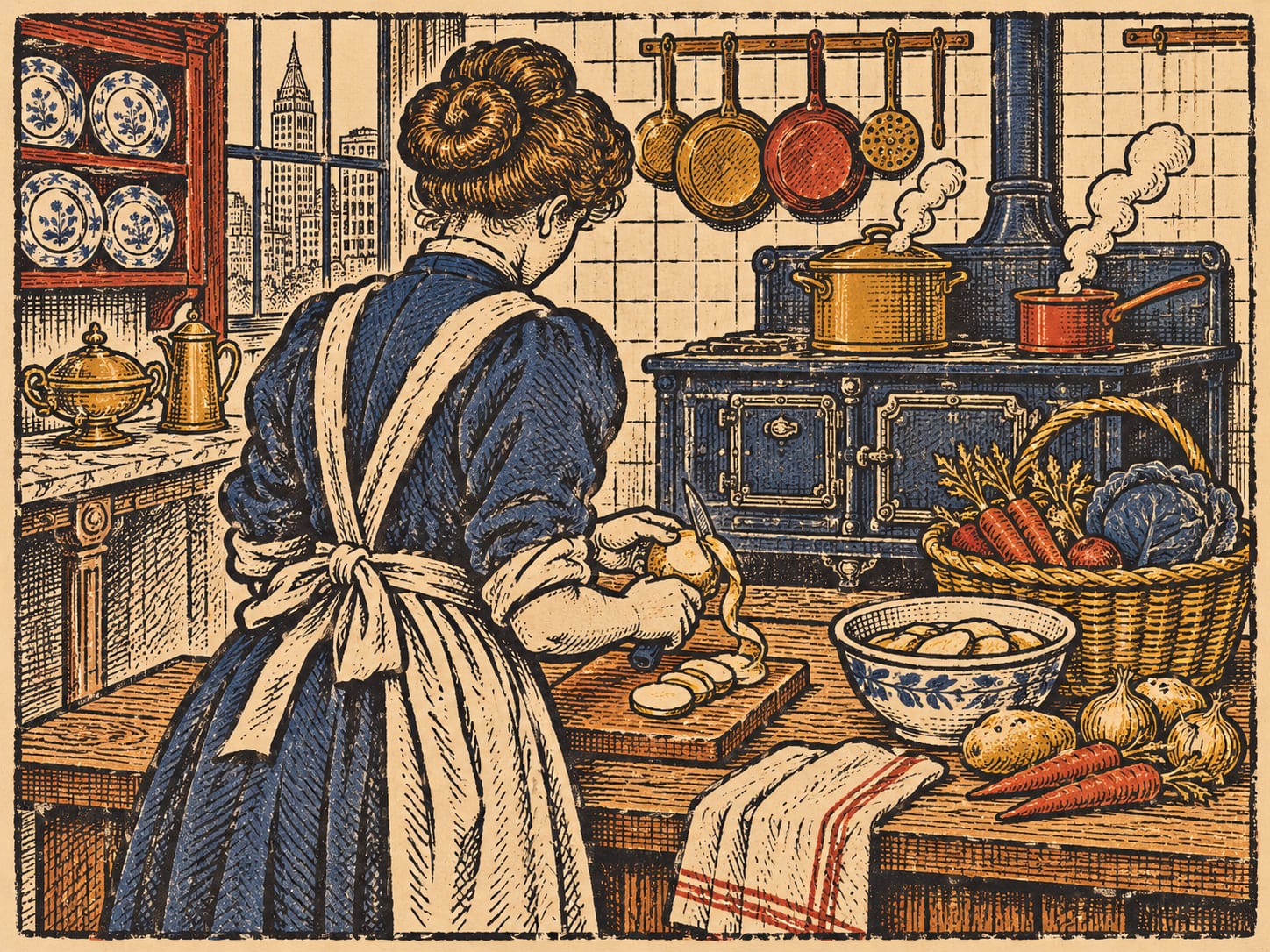
Mallon emigrated to the United States at 14, in 1883 or 1884, and went into domestic service in New York. By the late 1890s she was working as a cook.
Typhoid followed her from house to house. Members of a household in Mamaroneck fell ill around 1900. Cases followed her employment in Manhattan around 1901. Typhoid is also linked to the households where she worked in Dark Harbor, Maine, in 1902, Sands Point, Long Island, in 1904, and Tuxedo Park, New York, in 1906.
Typhoid usually spreads through contaminated food or water, and the woman who prepared the meals showed no sign of the disease.
Oyster Bay, August 1906
At a summer house in Oyster Bay, New York, six of the eleven people in the household fell ill with typhoid between 27 August and 3 September 1906. The cook had left the house after the outbreak.
That winter, George A. Soper, a sanitary engineer, investigated. He went through the usual explanations one by one: the water, the milk, the food, contact with known patients.
How George Soper traced her
Soper turned to the missing cook. He traced her through employment agencies and rebuilt her work history, household by household. Wherever she had cooked, typhoid had turned up more than once.
The trail gave him a name, Mary Mallon, and in early 1907 it led him to a Park Avenue household in Manhattan. There the laundress had fallen ill. Soper reported that a child in the family had died of typhoid and that another worker had been taken to hospital.
Soper asked Mallon for blood, urine and stool samples. She refused. She drove him out of the kitchen with a carving fork.
The New York City Health Department stepped in. Stool tests later showed typhoid bacilli. In June 1907 Soper published his findings in the Journal of the American Medical Association under the title "The Work of a Chronic Typhoid Germ Distributor," presenting the case as that of a carrier who had no symptoms herself.
What a healthy carrier is
A healthy carrier is a person who harbours and sheds an infectious organism while showing no signs of the disease. In typhoid fever, the bacteria can stay in the body and leave it in stool, which spreads the disease through contaminated food or water.
The idea was not new in 1907. Robert Koch had written about the importance of healthy typhoid carriers in Germany by 1902, and German bacteriological stations were studying carriers by 1903. American doctors had recognised carriers of diphtheria in the 1890s.
What was new was the public identification and close investigation of one apparently healthy person as a chronic typhoid carrier in North America. The idea was familiar in medical circles but strange to much of the public, and American public health had not yet put it to wide use.
20 March 1907: the closet
On 20 March 1907, Dr. Sara Josephine Baker of the New York City Health Department went back to the Manhattan home where Mallon was staying. Police officers came with her.
Mallon resisted. She tried to get away from the officials, and she was found hiding in a closet. Baker later wrote: "She came out fighting and swearing, both of which she could do with appalling efficiency and vigor."
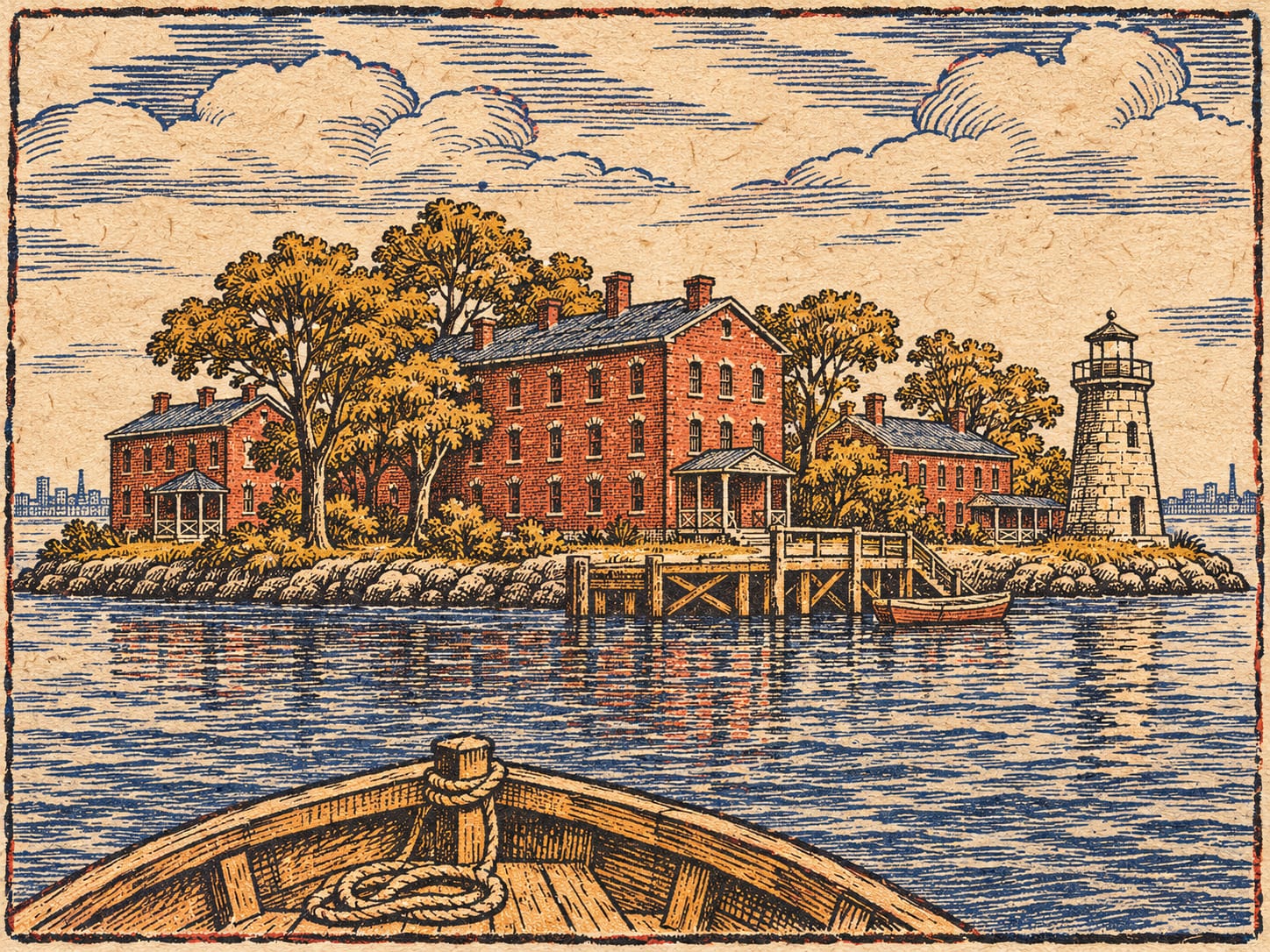
She was taken to Willard Parker Hospital, then moved to Riverside Hospital on North Brother Island. Baker later wrote that Mallon's blood and urine tests were negative, while her stool tests kept showing typhoid bacilli. Health officials tried several treatments during that stay. None cleared the carrier state.
Baker also wrote that Mallon was hard to persuade that a healthy person could pass on typhoid. Mallon said she had never had the disease.
What the laboratory found
William H. Park directed the Health Department's bacteriology laboratory. Between March 1907 and June 1909, the laboratory collected 163 stool samples from Mallon. PBS reports that more than a quarter were negative, while later historical accounts say 120 of the 163 were positive for typhoid bacilli. Her bacilli seemed to come and go in her stool. Her urine samples were negative, and that fed her distrust of the Health Department's conclusion.
Mallon had her own tests done. Alfred Briehof, the man she was living with when she was taken in 1907, carried her specimens to Ferguson Laboratories, and some of those results reportedly came back negative. He died sometime between 1910 and 1914, which left Mallon with no close family in the United States.
The Health Department tried urotropin, hexamethylenamin, laxatives, brewer's yeast and other drugs. None cleared the carrier state, and no antibiotic able to treat chronic typhoid carriage existed in her lifetime. Doctors also proposed removing her gallbladder. Dr. Thomas Studdiford offered to arrange the operation, and Dr. Robert J. Wilson discussed it with her. She refused.
In her own words
A 1909 letter from Mallon was passed to her lawyer, George Francis O'Neill, for use in her habeas corpus petition. PBS NOVA hosts a reproduction. She wrote about the island: "There was never any effort by the Board authority to do anything for me excepting to cast me on the island and keep me a prisoner without being sick nor needing medical treatment."
On the gallbladder, she wrote: "No knife will be put on me. I've nothing the matter with my gallbladder." She described the changing theories about her body this way: "At first I would not take it, for I'm a little afraid of the people, and I have a good right for when I came to the Department they said they were in my [intestinal] tract. Later another said they were in the muscles of my bowels. And latterly they thought of the gallbladder."
And about life on the island: "I have been in fact a peep show for everybody." The letter ends: "I lived a decent and upright life until I was seized, locked up and rechristened Typhoid Mary. Before God, and in the eyes of decent men, my name is Mary Mallon."
Her lawyer and a newspaper
George Francis O'Neill was a young New York lawyer. In the 1909 case he argued that Mallon had been confined without a criminal charge, a trial or a proper legal order. He told the court: "This woman has been a victim of circumstances in having been employed in homes where typhoid broke out, the disease having been unquestionably the result of conditions with which she had nothing to do."
He also warned: "If the mere statement that a person is infected with germs is sufficient, then that person can be taken away from her home and family and locked up and imprisoned for life on North Brother Island."
On 20 June 1909, shortly before the hearings, William Randolph Hearst's New York American ran a major feature on her. It revealed her identity, used the name "Typhoid Mary," and called her "the most dangerous woman in America," with lurid drawings. A local health case became a national story. Historian Judith Walzer Leavitt argues that Hearst's paper may also have helped pay for O'Neill's legal work, though that claim rests on no primary document.
Court, an affidavit and release
In June 1909 Mallon asked the New York Supreme Court for a writ of habeas corpus, arguing that her confinement on North Brother Island was unlawful. She said she had never had typhoid fever and had not infected anyone.
The city relied on two sections of the Greater New York Charter. Section 1169 said the board of health "shall use all reasonable means for ascertaining the existence and cause of disease or peril to life or health, and for averting the same, throughout the city." Section 1170 said the board "may remove or cause to be removed to [a] proper place to be by it designated, any person sick with any contagious, pestilential or infectious disease."
The trouble was the words "sick with." Mallon was not visibly ill, and the city treated a carrier as a danger anyway.
Judge Mitchell Erlanger denied the petition in July 1909 and ordered her to stay. The New-York Tribune reported that he "would not care to assume the responsibility of permitting the release of Mary Mallon from North Brother Island." The court accepted medical evidence that she carried typhoid organisms and could endanger public health, and it allowed her to renew the request after further examination. It was not a criminal case. It asked how far the state could go in isolating a person who might spread a disease.
In February 1910, Health Commissioner Ernst J. Lederle let her go under a written agreement. Mallon signed an affidavit promising not to work as a cook or handle food for others, to take precautions against passing on the disease, and to report to the Health Department at regular intervals. The release letter is dated 26 February 1910, and the city's own history gives the release as 28 February 1910.
Mary Brown at Sloane Maternity Hospital
In 1915, typhoid broke out at Sloane Maternity Hospital in Manhattan. Twenty-five people fell ill and two died. Mallon had been working there as a cook under the name Mary Brown.
Dr. Baker helped locate her again, and the city's health history names the cook there as "Mrs. Brown." Police found Mallon on 27 March 1915 at a house in Queens. She was returned to Riverside Hospital on North Brother Island.
She stayed there until she died on 11 November 1938. The second confinement ran about 23 years. Added to her stay from 1907 to 1910, she spent about 26 years in isolation.
Life on North Brother Island
From 1918, Mallon worked for Riverside Hospital, starting as a domestic helper and later working in the bacteriology laboratory. A 1935 New Yorker profile says she prepared slides, kept records and handled routine work for the pathologists, for $60 a month, and calls her careful, thorough and an avid reader of technical books. Dr. Alexandra Plavska reportedly hired her as an assistant in the 1920s, and Emma Rose Goldberg, who later ran the laboratory, called her dependable and punctual.
She lived in a one-room cottage by the hospital, with a porch, a kitchen, a bathroom, a central oak table, rocking chairs, books, magazines and a small garden. Doctors, nurses, attendants and the Plavska family came to see her. She was allowed occasional trips to Manhattan and went back to the island each time.
The New Yorker says she liked the Saturday Evening Post, Harper's, Good Housekeeping, Ladies' Home Journal, Cosmopolitan and Charles Dickens. She had a dog, and hospital attendants buried it on the island when it died.
In December 1932, a major stroke left her paralyzed and bedridden. Accounts put the date at Christmas morning or at 4 December. She stayed under care at Riverside Hospital for roughly six years.
Her funeral was held at St. Luke's Roman Catholic Church in the Bronx, and reports count nine mourners. She was buried at St. Raymond's Cemetery in the Bronx. Her grave marker carries her name, her death date and the words "Jesus Mercy."
Mary Mallon, from Tyrone to North Brother Island
- 23 September 1869
Mary Mallon is probably born in Cookstown, County Tyrone, Ireland
- 1883 or 1884
She emigrates to the United States at age 14
- 27 August to 3 September 1906
Six of eleven people in an Oyster Bay household fall ill
- 20 March 1907
Dr. Sara Josephine Baker and police take her into custody
- 15 June 1907
George Soper's paper on a chronic typhoid germ distributor appears in JAMA
- 20 June 1909
The New York American runs its feature calling her Typhoid Mary
- July 1909
Judge Mitchell Erlanger denies her habeas corpus petition
- February 1910
Commissioner Lederle releases her after she signs the affidavit
- 27 March 1915
Police find her after the Sloane Maternity Hospital outbreak
- 1918
She begins work for Riverside Hospital
- December 1932
A stroke leaves her paralyzed
- 11 November 1938
She dies on North Brother Island
How many people did she infect?
Three deaths and 51 cases are the common figures in accounts built on the New York health records and on Mallon's later obituary. Other published totals are 53 cases and three deaths, 47 cases and three deaths, and 22 cases for the early period the Health Department discussed.
The totals differ because they count cases linked to households or institutions where Mallon worked. Nobody in 1907 could trace each infection to her through a laboratory chain. Some counts add the outbreaks before 1907 to the 1915 Sloane outbreak, and others count only the cases tied to her in the original investigation.
Other carriers, other outcomes
Mallon was not the only carrier New York found. Published accounts credit Tony Labella, a food worker, with 122 typhoid cases and five deaths. Others split his record into 87 cases and two deaths in New York, then 35 more cases and three deaths after he fled to New Jersey in 1922. He was isolated for about two weeks, by one account, and then allowed to work as a laborer while he reported to health officials.
Alphonse Cotils, a Belgian-born bakery and restaurant owner, was barred from working directly in his bakery. In 1924 he was found working there anyway. A judge gave him a suspended sentence, said he saw the danger, and added that Cotils could not legally be imprisoned only for carrying disease organisms. Cotils kept the business going by telephone.
Frederick Moersch, also written Fred Morsch, was found selling ice cream in 1928, was credited with 110 cases and at least six deaths, and was confined at Riverside Hospital, the 1935 New Yorker reports. His case drew far less attention.
The treatment of these men differed sharply from Mallon's. Occupation, documented conduct, legal readings and the gender and class assumptions of the time all played a part. Nothing shows a single proven reason for every decision.
Why her case still divides historians
Historian Judith Walzer Leavitt and others tie the harshness of Mallon's treatment to who she was: an unmarried, working-class Irish immigrant woman cooking in wealthy kitchens. Her work put her close to powerful families, and her lack of money and influence left her few ways to challenge the Health Department.
Other healthy carriers existed, and some kept working with food. The Dictionary of Irish Biography says Mallon was the only one among tens of thousands of identified carriers to face permanent quarantine, though other carriers resisted cooperation, handled food or infected more people.
The debate has two sides, and each has real weight. Officials had evidence that Mallon carried typhoid and that outbreaks kept following her. Her lifelong detention was still unusual, and historians ask whether education, supervised work, medical monitoring or a less punishing arrangement could have kept the public safe without confining her for life.
Three facts led to the permanent order. She was a confirmed carrier. She went back to cooking after signing the agreement not to. And in 1915 typhoid broke out at a hospital where she was working under another name.
Leavitt argues that officials put their effort into isolating Mallon instead of teaching her hygiene, finding her other work or devising a way for her to avoid spreading typhoid through food.
What changed afterwards
New York moved toward watching and restricting carriers, not isolating each one for life. By Mallon's death in 1938, authorities had identified more than 400 healthy typhoid carriers in the city, and the National Museum of Health and Medicine says none was confined as she was. A 1935 account counted 344 known carriers, kept off food work and checked by inspectors.
Historians treat Mallon's case as a turning point in arguments over public-health power, civil liberties and patient rights.
On the autopsy, accounts disagree. One group of authors writes that a post-mortem found typhoid bacteria in her gallstones, which would mean the gallbladder had kept the infection going. George Soper's 1939 article and a 1990 review say no autopsy was performed. No signed pathology report has surfaced, so the gallstone claim stands as one writer's report. Accounts of her death generally point to the long paralysis and pneumonia or other complications, not to an attack of typhoid.
North Brother Island belongs to New York City now. The Riverside Hospital buildings are abandoned, overgrown and falling in, and the island is a nature preserve where nesting birds use the ruins. The public cannot visit. St. Raymond's Cemetery in the Bronx is still open, and her grave is there.
Sources
- George A. Soper, "The Work of a Chronic Typhoid Germ Distributor," Journal of the American Medical Association, 15 June 1907, and "The Curious Career of Typhoid Mary," 1939
- New York City Department of Health historical booklet
- "Mallon, Mary (Typhoid Mary)," Dictionary of Irish Biography
- "Mary Mallon (1869 to 1938) and the history of typhoid fever," Marineli and others, Annals of Gastroenterology
- Judith Walzer Leavitt, American National Biography, and lecture description, University of Illinois
- Library of Congress, Chronicling America guide to Typhoid Mary
- PBS NOVA, Typhoid Mary pages, including Mallon's 1909 letter
- The New Yorker, 1935 profile of Mary Mallon
- New-York Tribune, 17 July 1909, and The Sun, 30 June 1909
- William H. Park, "Typhoid Bacilli Carriers," Journal of the American Medical Association
- Greater New York Charter, sections 1169 and 1170, as reproduced in the Public Health Observer
- National Museum of Health and Medicine, Typhoid Mary article
- Washington Post, 2015 article on the Sloane outbreak and Mallon's detention
- Harvard Square Library and National Library of Medicine biographies of Sara Josephine Baker
- Christoph Gradmann, "Robert Koch and the invention of the carrier state"
- Wellcome Collection, "Outsiders: The Cook," and Irish Times, "An Irishman's Diary on Typhoid Mary"
- North Brother Island Conservation and Access Study, University of Pennsylvania
Watch the full story on the Flashback Fables YouTube channel, and send it to someone who would love it.