Britain skipped eleven dates in September 1752 to catch up with a calendar that Catholic Europe had used since 1582. Wednesday 2 September 1752, by the Julian calendar, was followed by Thursday 14 September, by the Gregorian count, in Britain and its American colonies.
The dates 3 to 13 September never appeared. Nobody lost eleven days of life: the numbers jumped, and the weekdays carried on from Wednesday to Thursday. The same law moved the start of the legal year from 25 March to 1 January.
The gap traces back to a leap-year rule, a pope's reform in 1582 and a Britain that waited 170 years to follow it.
The leap-year rule that added up to eleven days
The Julian calendar counted every fourth year as a leap year. That made its average year 365.25 days, a little longer than the solar year, and the extra sliver piled up over the centuries.
Pope Gregory XIII's reform fixed it by dropping century leap days unless the year divides by 400. By 1582 the Julian calendar ran ten days behind the Gregorian one. In Spain, Thursday 4 October 1582 was followed by Friday 15 October 1582, and ten dates were omitted. That jump is told in the ten missing days of October 1582.
Britain was still on the Julian calendar when 1700 arrived. By the Julian rule, 1700 was a leap year and had a 29 February. By the Gregorian rule it was not and did not. The arithmetic then stood like this:
- Ten days of drift by 1582.
- One more day after Julian 29 February 1700 had no Gregorian twin.
- Eleven days of difference by 1752.
In other words, a single leap day in 1700 turned a ten-day gap into an eleven-day one.
Why Britain waited 170 years
Britain did not take Pope Gregory XIII's calendar because it came with papal authority attached. England had broken with Rome, and the Church of England claimed an authority of its own, so a calendar from the pope was politically and religiously touchy. The reform itself aimed at two things: dating Easter correctly and stopping the slow slide between the calendar and the seasons.
Protestant states generally kept the Julian calendar for a while, although some brought in reforms of their own. In 1700 the Protestant German states adopted an Improved Calendar. It omitted eleven days, as the Gregorian reform did, but worked out Easter by astronomy instead of the Gregorian tables. Denmark and Norway adopted the Gregorian system that same year.
Sweden took the winding road. It tried a gradual transition, kept the Julian calendar after that plan failed, inserted a 30 February in 1712, and adopted the Gregorian calendar in 1753. Britain's switch came later than many Protestant neighbours' and a year before Sweden's.
Lord Chesterfield brings in the bill
The Calendar (New Style) Act 1750, listed as 24 Geo. II c. 23, was brought into the House of Lords by Philip Stanhope, 4th Earl of Chesterfield. George Parker, 2nd Earl of Macclesfield, backed it and explained the astronomy behind it. The Act's own stated purpose was "for regulating the Commencement of the Year, and for correcting the Calendar now in Use."
Chesterfield left his own account of the day. On 18 March 1751, by the Old Style calendar used in Britain then, he wrote to his son: "I acquainted you in a former letter, that I had brought a bill into the House of Lords for correcting and reforming our present calendar, which is the Julian, and for adopting the Gregorian." He added that "it was notorious, that the Julian calendar was erroneous, and had overcharged the solar year with eleven days."
He was candid about how he pitched it. "I gave them, therefore, only an historical account of calendars, from the Egyptian down to the Gregorian, amusing them now and then with little episodes," he wrote, taking care over his words, his elocution and his action. Seventy-three bishops and peers were present.
Then came Macclesfield. In Chesterfield's telling, Macclesfield "had the greatest share in forming the bill" and "spoke afterward with infinite knowledge and all the clearness that so intricate a matter would admit of." Chesterfield noted, with some pleasure, that the praise went to him instead: "the preference was most unanimously, though most unjustly, given to me."
The Act ordered five things:
- The legal year begins on 1 January instead of 25 March.
- The year beginning 1 January 1752 is called 1752.
- Wednesday 2 September 1752 is followed by Thursday 14 September, and the eleven dates between are omitted.
- Legal documents, courts, meetings and fixed terms use the new dating.
- The reform covers "all his Majesty's Dominions and Countries in Europe, Asia, Africa, and America, belonging or subject to the Crown of Great-Britain."
That wording is why Virginia and Britain's other American colonies changed along with London.
The experts behind the bill
Chesterfield was the political sponsor and the man who steered the bill through the Lords. The science came from a small circle around him. Robert Poole, the historian who studied the reform, names Martin Folkes, president of the Royal Society, and Macclesfield, an eminent amateur astronomer who succeeded Folkes. James Bradley, the Astronomer Royal, sat in the group too.
Edward Cave, editor of the Gentleman's Magazine, encouraged public discussion of calendar reform in print. Archbishop Thomas Herring of Canterbury was consulted about the Easter rules. One adviser kept a low profile: Father Charles Walmesley, a Roman Catholic mathematician, whose part was kept quiet because the reform was being presented in an Anglican and British form.
Newspapers had followed the bill. The General Evening Post carried reports on 19 and 23 February, 30 March and 4 April 1751, and Macclesfield published a technical work that year, Remarks upon the Solar and Lunar Years. Bradley is documented as part of the advisory group, not as the author of any named clause.
Easter and the Prayer Book
Easter was the delicate part. The Act kept the traditional Anglican wording: Easter falls on the Sunday after the full moon that comes on or after 21 March, and moves a week if the full moon lands on a Sunday. What it replaced was the old machinery for working that out.
The Act ordered the old Easter table and the column of golden numbers cut from future editions of the Book of Common Prayer. New tables and rules went in their place. The astronomers explained to Archbishop Herring that the change kept the Anglican method based on golden numbers.
Poole describes the result as a British method that looked different from the Roman Catholic Gregorian tables but produced the same Easter dates. Church of England feast days, holy days and fast days kept their familiar numbers, but after September 1752 they fell eleven natural days earlier. Easter and the feasts that hang from it followed the new tables.
The short year of 1751
Under the old English system, the legal year began on Lady Day, 25 March. The year called 1751 therefore began on 25 March 1751 and ended on 31 December 1751. It ran only 282 days, which makes it Britain's unusually short legal year. The next day, 1 January 1752, began the new one.
That change was separate from the September correction. Britain altered the numbering of its year and the dates inside it, both in the same Act.
The old year start explains the double dates people still run into. Before 1752, a date between 1 January and 24 March could carry two years, depending on which convention the writer used. A date might be written 1 February 1731/32, meaning 1 February 1731 under the English legal year but 1 February 1732 under the January-based count.
Isaac Newton is the standard example. He was born at Woolsthorpe, Lincolnshire, on 25 December 1642 by the Julian calendar, and the matching Gregorian date is 4 January 1643. George Washington was born in Virginia on 11 February 1731 Old Style, often written 11 February 1731/32, and his birthday is 22 February 1732 New Style. The National Park Service notes that some Americans kept marking 11 February while others moved to 22 February.
Scotland and Ireland
Scotland needed only half of the change. James VI had proclaimed 1 January as the start of the Scottish year in 1600, so Scotland did not have to move from 25 March. It did still take the Gregorian date numbering in 1752, with Wednesday 2 September followed by Thursday 14 September.
Ireland needed both halves. It was still on the Julian calendar and the English 25 March legal year in 1752, and the Irish statute book repeats the Act's terms, including the move to 1 January and the omission of 3 through 13 September. Poole notes that some Irish voices objected to Ireland being swept into a British Act, but the objection went nowhere.
The result in short: England and Wales changed both the year start and the dates, Ireland did both, Scotland changed the dates only, and the colonies were included under the Act's wording.
September 1752: the change slips into the diaries
The surviving papers do not show a single dramatic public reaction. Poole reports that diaries and letters took in the change without fuss, while newspapers and almanacs explained it in advance. The ledger kept by the Greenwich observer simply records the start of New Style.
A clerk in Inveraray and Glenaray in Scotland wrote the switch into the parish register. The note, preserved by the National Records of Scotland, reads: "Upon the third of September this year the computation of time has been changed from the Julian to the Gregorian calculation so that the third day of September is reckoned the fourteenth NS and all the dates thereafter in the register are according to the Gregorian or new stile and all the former to the Julian or old stile."
Complaints did surface, and they were about money. A correspondent signing himself Roger Plowland wrote in the London Magazine in 1752 about landlords who used both Old Michaelmas and New Michaelmas. He blamed "lawyers, astrologers and conjurors" for "this jumping September." In Bristol, Felix Farley's Bristol Journal printed pieces on the change on 16 and 21 September 1752, and a Bristol poem listed feared disruptions to markets, rents, taxes and servants' wages. The poem argued a case; it did not prove that all those problems happened.
Across the Atlantic, Benjamin Franklin had explained it all in advance. His Poor Richard Improved for 1752 was printed in Philadelphia in 1751, and its title-page text opens: "Since the King and Parliament have thought fit to alter our Year, by taking eleven Days out of September, 1752, and directing us to begin our Account for the future on the First of January." In the voice of Richard Saunders, it noted that "the legal Year in England used to begin on the Day of the Annunciation; i. e. on the 25th of March."
The almanac also passed on a decision of the Quakers. At their Yearly Meeting in London after the Act passed, they agreed to recommend to their Friends "a Conformity thereto, both in omitting the eleven Days of September thereby directed to be omitted." In Virginia, Colonial Williamsburg's account says the change came without fanfare. The Virginia Gazette's surviving run skips the 4 September 1752 issue and resumes on 15 September.
What happened to rent, wages and birthdays
The Act did not cancel eleven days of real time. It changed the labels attached to dates. Courts and fixed legal terms were to be held "eleven Days sooner" than before when counted by the new numbering. No single rule cancelled rent, wages or debts, and practice varied from place to place:
- Some leases and rents were adjusted so that tenants kept the full natural term.
- Some landlords tried to charge for overlapping Old Style and New Style periods.
- Public payments and quarter days were adjusted for accounting.
- Wages and private debts followed the wording of the contract, the lease or local custom.
- Birthdays were converted by adding eleven days and, for dates before 25 March, often changing the year too.
One explanation printed at the time put the worry to rest in plain words: "The taking 11 Days out of September this Year need not give you the least Uneasiness; for it neither hastens the Payment of money, the Freedom of Servants or Apprentices, or the coming of Age of Minors; but the Number of natural Days included in all Agreements is to be fulfilled." Its example was a bond that would have fallen due on 1 October by the old count. It became payable on 12 October by the new.
The big payment days moved with the calendar. Lady Day, 25 March by the old count, became 5 April. Michaelmas, 29 September, became 10 October. The Bank of England paid dividends at Lady Day and Michaelmas, the South Sea Company at Midsummer and Christmas, and the Crown's financial year began at Michaelmas. The Treasury kept the traditional quarter-day structure but pushed the nominal dates forward eleven days, so its accounts kept the full natural term. A separate Act, 24 George II chapter 48, shortened the Michaelmas law term, and the change threw the City of London's mayor-making ceremonies onto different dates, which took an amending measure to fix.
A reader in 1752 could see the change on a page. The September 1752 page of Poor Richard's Almanac shows a month of nineteen days, with 2 September followed by 14 September, and the National Park Service preserves it.
Britain's tax year still starts on 6 April, and the date is a leftover of the 1752 change. A 1977 answer in the House of Commons traced it to the eleven days added to the old quarter days. Robert Poole follows Lady Day from 25 March to 5 April after the 1752 correction, then adds a one-day shift tied to 1800, when the Julian calendar had a leap day and the Gregorian did not. Later tax law did the rest, so the road from 1752 to 6 April ran through several steps and not one jump.
Old Christmas and the fairs that kept the old dates
Plenty of people simply kept the old days. The Act moved legal and church dates, but fairs and farm work stayed tied to the seasons, so many places held on to the old numbers.
Old Christmas was the stubborn one. Felix Farley's Bristol Journal reported in January 1753: "Yesterday being Old Christmas Day, the same was obstinately observed by our Country People in general, so that yesterday, which was Market-Day by order of our Magistrates, there were but few at Market, who embraced the Opportunity of raising their Butter to 9d. and 10d. a Pound."
From 1752 to 1799, Old Christmas fell on 5 January, because 25 December by the old count came eleven days later. Once the gap widened to twelve days in 1800, it became 6 January, the date English folk calendars still give. Old Michaelmas, 10 October, survived in lease disputes, and Old Lammas on 12 August, Old Martinmas, Old New Year's Day and Old Twelfth Day lingered too.
Fairs show the tug of war. An Oxford notice said: "The FAIR formerly held on the 29th Day of September, will be holden on the 10th Day of October." The same notice moved a fair from St Thomas's Day, 21 December, to 1 January, while the Lent Fair followed the new Easter tables. William Owen's 1756 directory lists more than three thousand fairs.
"Give us our eleven days"
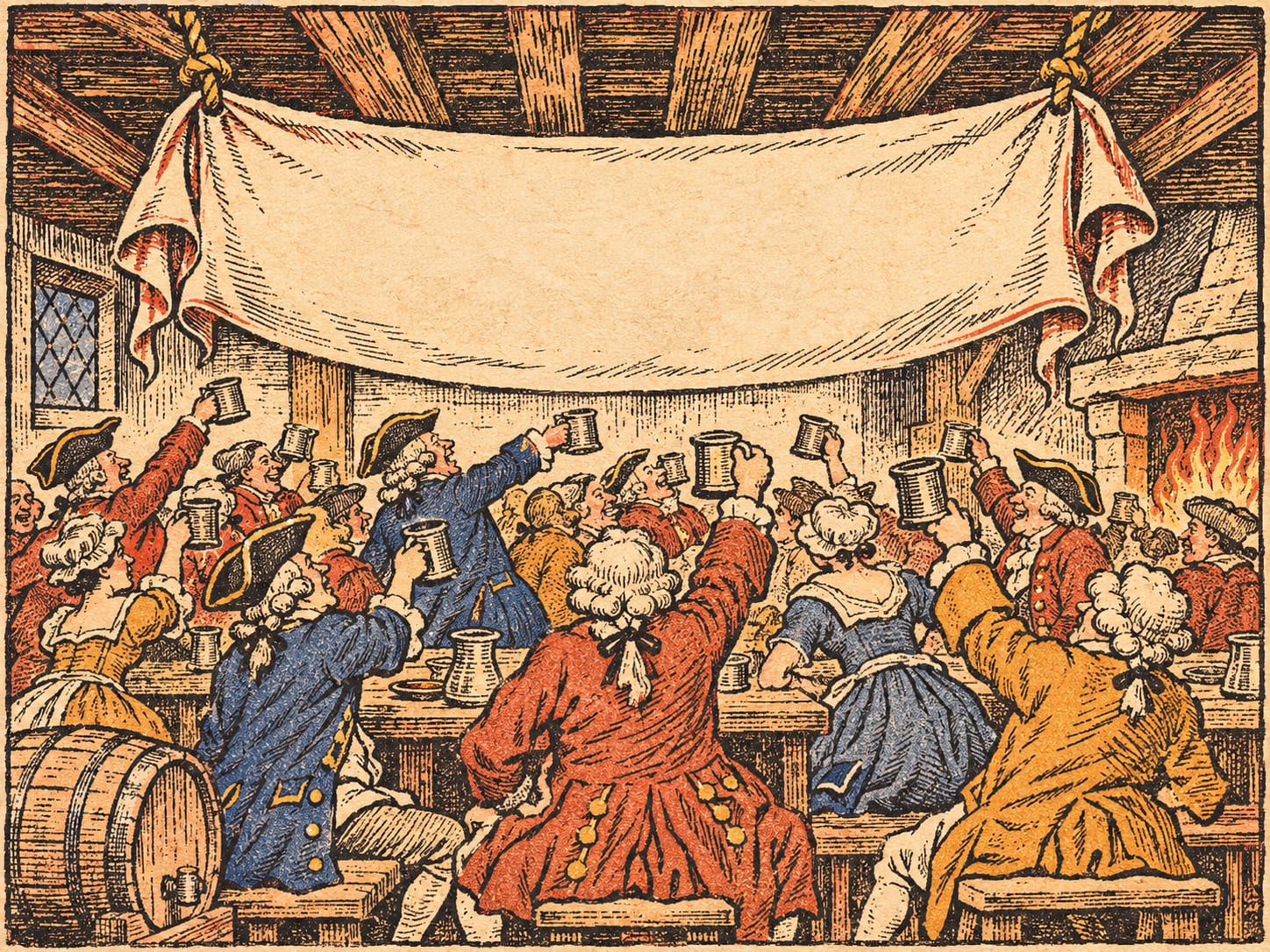
The story goes that angry crowds filled the streets in 1752 shouting "Give us our eleven days." Later retellings repeated it, and it had a handle. William Hogarth's print An Election Entertainment, published on 24 February 1755 in Britain, shows a banner reading "Give us our Eleven Days" in an election scene. The print is political satire, and its banner sits beside jabs at the Marriage Act and the Jewish Naturalisation Act.
People did complain. There were jokes, local quarrels over which date a payment fell on, arguments about rents and quarter days, and political criticism of the government that passed the Act.
The riot picture comes from later. The historian Robert Poole traced the earliest prominent written account to a speech by James Scarlett at the 1820 treason trial of Henry Hunt and others. Scarlett said it was found necessary to "knock eleven days out of the calendar, and it was supposed by ignorant persons that the legislature had actually deprived them of eleven days of their existence." He tied that to Hogarth's picture and described the crowd as "throwing up their hats, and crying out 'Give us back our eleven days'."
Ronald Paulson, writing about the print, read its figures as people rioting over the eleven days. Poole read the story differently. In 1995 he traced it in his article "Give us our eleven days!" and found that the familiar mob was built from later accounts that blurred different kinds of opposition. He found no nationwide calendar riot, and no study of eighteenth-century riots turns one up.
After 1752: who switched when
Britain's change was one stage in a process that ran for centuries. The table lists the switches named above, with the calendar each place moved from and to.
Russia moved from 31 January 1918 to 14 February 1918, by the Julian and then the Gregorian count. Greece adopted the Gregorian calendar for civil records on 1 March 1923, following 15 February 1923 in the Julian calendar. In 1924 the Greek Orthodox Church adopted an amended Julian calendar for church records, and some Orthodox churches still use the Julian calendar for religious observances.
Many Protestant German states went on to take the Gregorian Easter system in the 1770s. Eleven dates vanished from the calendar in September 1752, and not one minute of anybody's life went with them.
From Gregory's reform to the British switch
- 4 to 15 October 1582
Spain goes from Thursday 4 October to Friday 15 October, omitting ten dates
- 29 February 1700, Julian calendar
A leap day with no Gregorian twin widens the gap to eleven days
- 18 March 1751, Old Style
Chesterfield and Macclesfield present the bill to the House of Lords
- 25 March 1751
The legal year called 1751 begins in Britain
- 31 December 1751
The 282-day legal year ends
- 1 January 1752
The new legal year begins on 1 January
- 2 to 14 September 1752
Wednesday 2 September is followed by Thursday 14 September in Britain and its colonies
- 24 February 1755
Hogarth publishes An Election Entertainment
- 1820
James Scarlett tells the court about a crowd demanding its eleven days
Sources
- Calendar (New Style) Act 1750, text reproduced by the Maryland State Archives, and section texts on legislation.gov.uk
- Robert Poole, "Give us our eleven days!", University of Cumbria repository
- Philip Dormer Stanhope, Earl of Chesterfield, letter of 18 March 1751, in The Letters of Philip Dormer Stanhope, Earl of Chesterfield, edited by John Bradshaw
- "The Gregorian Calendar," Encyclopedia Virginia
- "The Gregorian calendar," Royal Observatory of Belgium
- Erhard Weigel Society, calendar reformer essay
- Newton Project, University of Oxford
- "George Washington's Birthday," National Park Service
- UK Parliament Hansard, "Financial Year," 28 February 1977
- William Hogarth, An Election Entertainment, National Gallery of Art and the Morgan Library and Museum
- "The New 'New Year' of 1752," Charleston County Public Library
- Social Security Administration, "Gregorian/Julian Calendar"
- "Changing Times, Changing Dates," Greek Orthodox Archdiocese of America
- "Change in calendar dates in the old parish registers," National Records of Scotland
- Book of Common Prayer tables, Church of England
- Benjamin Franklin, Poor Richard Improved for 1752
- Virginia Gazette holdings and calendar study, Colonial Williamsburg
- Proceedings, American Antiquarian Society, and working paper 2025-20, Federal Reserve Bank of Chicago
- Beginner's guide to customs, English Folk Dance and Song Society; "Why did our ancestors celebrate Michaelmas?", Society of Genealogists
- Calendar (New Style) Act 1750, Irish Statute Book
Watch the full story on the Flashback Fables YouTube channel, and send it to someone who would love it.