Yes, there was a 30 February. Sweden had one in 1712, and a surviving Swedish almanac and a church-register entry both carry it.
It came out of a calendar repair. Sweden dropped the leap day of 1700 as the start of a slow move toward the Gregorian calendar, then stopped following its own plan. In January 1711, King Charles XII ordered a return to the Julian calendar, and two leap days in 1712 put the missing day back.
Leap days exist because the year runs a little longer than 365 days. The Swedish story shows what happens when a calendar fix is left half done.
Why a 365-day calendar drifts
The tropical year, the cycle from one spring equinox to the next, is about 365.2422 days long. A calendar of 365 days falls short by about 0.2422 of a day every year, which is nearly six hours.
Six hours looks small. It piles up. After roughly a century, a calendar with no leap days sits about 24 days away from the seasons it was built to follow.
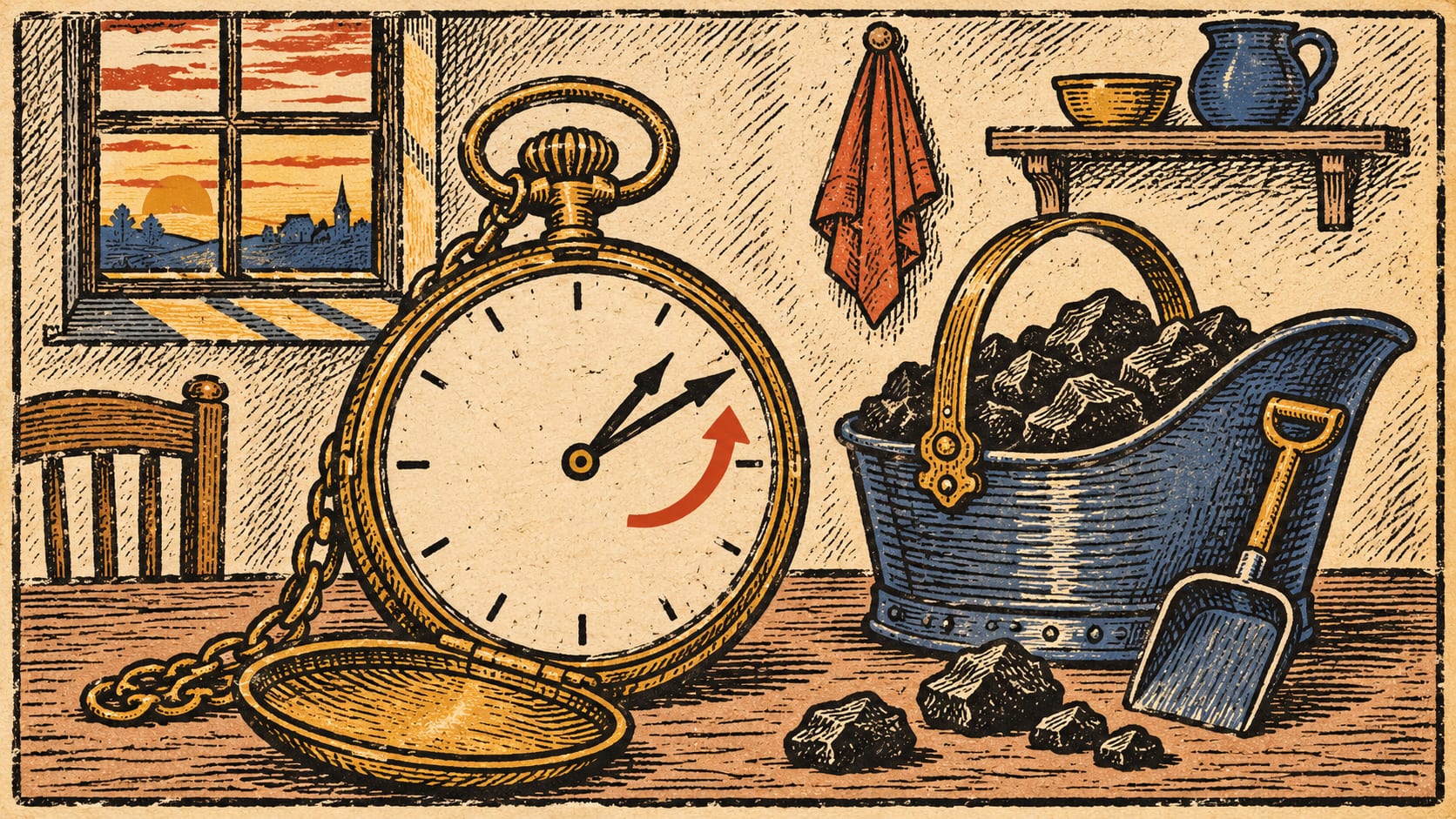
Think of a clock that loses nearly six hours a year. After four years it is off by nearly a full day, and the calendar slides away from spring in the same way.
Caesar's fix
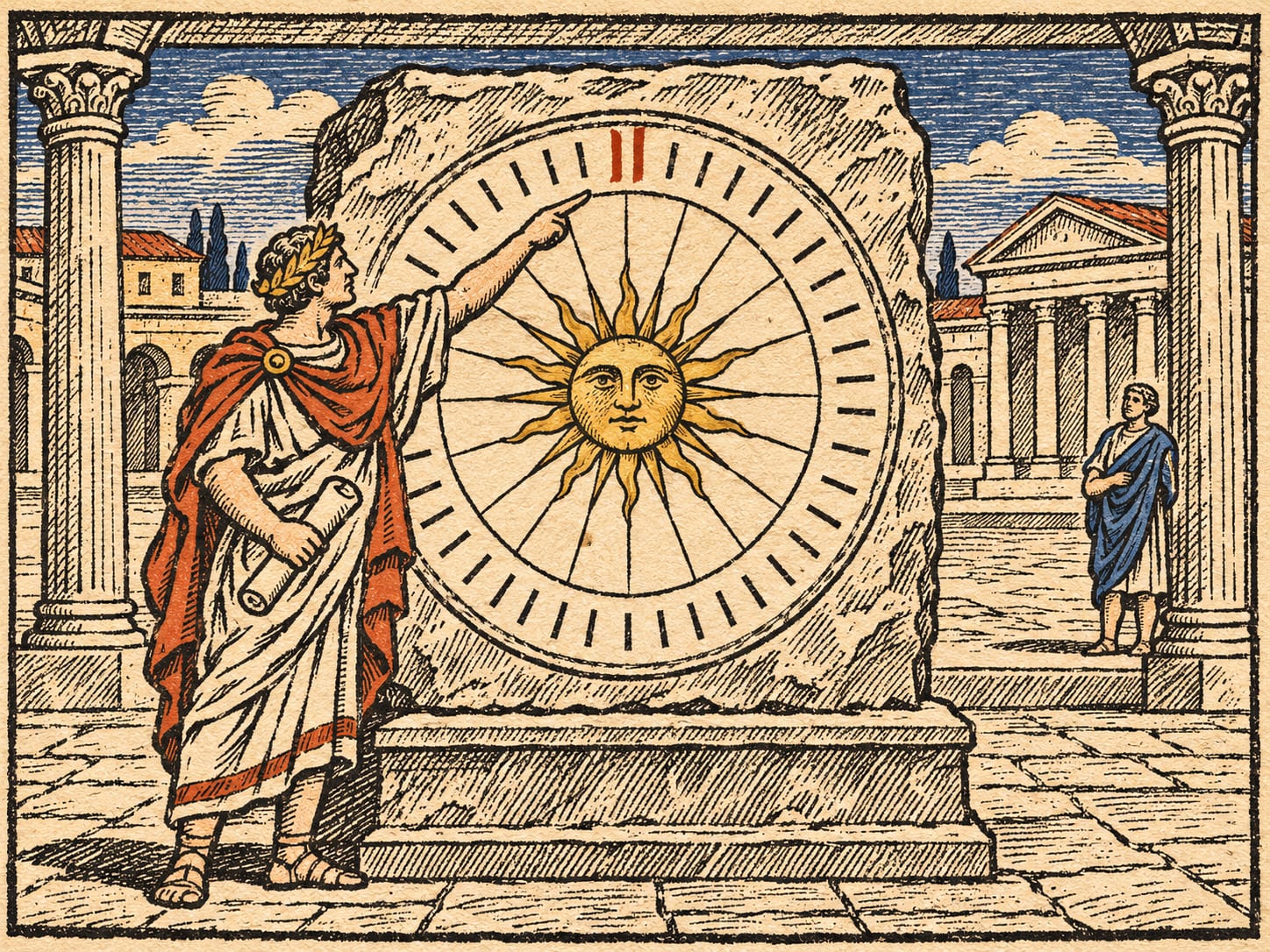
Julius Caesar introduced the Julian calendar in 46 BC, with advice from the Alexandrian astronomer Sosigenes. It used years of 365 days and added one extra day every fourth year.
The Romans did not call the extra day 29 February. They counted days backward, inclusively, from fixed points in the month. The inserted day repeated the sixth day before the Kalends, the opening day, of March. They called it bis sextus, "twice sixth," and that is where the word bissextile, an old term for a leap year, comes from.
That is also why the extra day lands in February. It was tucked in just before the Kalends of March.
The Gregorian rule
By the 1500s, the spring equinox had slid about ten days from where the Church wanted it. The reform had two aims: put the equinox back on 21 March, the date tied to the Council of Nicaea, and stop Easter's calculation from drifting again.
In the bull Inter gravissimas, dated 24 February 1582 in Rome, by the Julian calendar, Pope Gregory XIII wrote that the equinox had moved "by about ten days." The bull ordered ten dates cut from October 1582, so that 4 October was followed by 15 October. It also set the leap-year rule: "that the bissextile day every fourth year shall continue, as the custom is now, except in centurial years, although these were always bissextiles before, and we wish the year 1600 to be bissextile as well; after that, however, the centurial years that follow shall not all be bissextiles, only every fourth centurial year shall be bissextile."
A year is a leap year if it divides by 4, and a century year is not a leap year unless it also divides by 400. So, 1900 was not a leap year, because it divides by 100 but not by 400. The year 2000 was a leap year, because it divides by 400. The rule gives 97 leap years in every 400-year cycle and an average year of 365.2425 days.
The bull itself names the man behind the calculation. It says Antonio Lilius brought Gregory a book written by his brother Aloysius Lilius, who had worked out a new epact cycle. The mathematician Christopher Clavius then explained and defended the reform in a book published in 1603, and it appeared again in his collected mathematical works in 1612. Lilius made the proposal, Clavius backed it with mathematics, and Gregory signed the rule.
The calendar reform that brought in this rule has its own story, told in the October 1582 skip.
Sweden's plan for 1700
Anders Spole, professor of astronomy at Uppsala University, is the name tied to the Swedish plan. He argued for a gradual, politically neutral move toward the Gregorian calendar, not a sudden jump of the papal kind.
In November 1699, by the Julian calendar then in use in Sweden, the government decided to move gradually, by leaving out leap days over a run of leap years. The plan was to omit the leap days of 1700, 1704, 1708 and later years until the calendars matched.
Sweden left out 29 February 1700. The next omissions never happened, and Swedes kept their leap days in 1704 and 1708.
That left Sweden out of step with everyone. Its calendar ran one day ahead of the Julian calendar and ten days behind the Gregorian.
The surviving evidence shows almanac makers working in that muddle. The University of Helsinki's archive of Finnish-Swedish almanacs holds Swedish-language almanacs made for the Swedish Empire, with dates calculated for Stockholm and for Turku. Each almanac maker had to say which calendar the dates followed and work out the days for a particular city. Parish books could differ in how they wrote the date.
A popular telling puts the muddle down to drunkenness or carelessness. What is documented is a gradual reform that was abandoned, then a royal decision to go back to the Julian calendar.
Charles XII orders a return
In January 1711, by the Julian calendar, King Charles XII ordered Sweden back to the Julian calendar. He was abroad when he gave the order, and later tradition places it in correspondence from Bender. To restore the day dropped in 1700, Sweden added two leap days in 1712.
Later accounts give two readings of why. In one, a calendar that matched no neighbour caused trouble for government business and for dealings with other countries. In the other, the Great Northern War pulled attention away from the slow reform until it was simply dropped.
February 1712 therefore ran to 29 February and then to 30 February. The Swedish date 30 February 1712 matched 29 February 1712 in the Julian calendar and 11 March 1712 in the Gregorian calendar. The Swedish year 1712 had 367 days.
The correction was a royal decision, tied to Charles XII. It was not a decision of the Swedish Royal Academy, which did not yet exist in its later form.
The switch to Gregorian, 1753
Sweden settled the matter at the Riksdag of 1751 to 1752, which decided to adopt the Gregorian calendar. A royal ordinance dated 24 February 1752, by the Julian calendar then used in Sweden, set the change for the next year.
The Royal Swedish Academy of Sciences by then held a royal privilege to publish Swedish almanacs. Pehr Wargentin, who became the Academy's secretary in 1749 after Pehr Elvius the Younger died, was the leading astronomical authority tied to the Academy during the later debate.
In 1753, Wednesday 17 February by the Julian calendar was followed by Thursday 1 March by the Gregorian calendar. Swedish summaries keep the working rule short: after 17 February, count 1 March. The skipped dates made up the remaining eleven-day gap between the two calendars, the same gap Britain closed in 1752.
Did the Soviet Union have a 30 February?
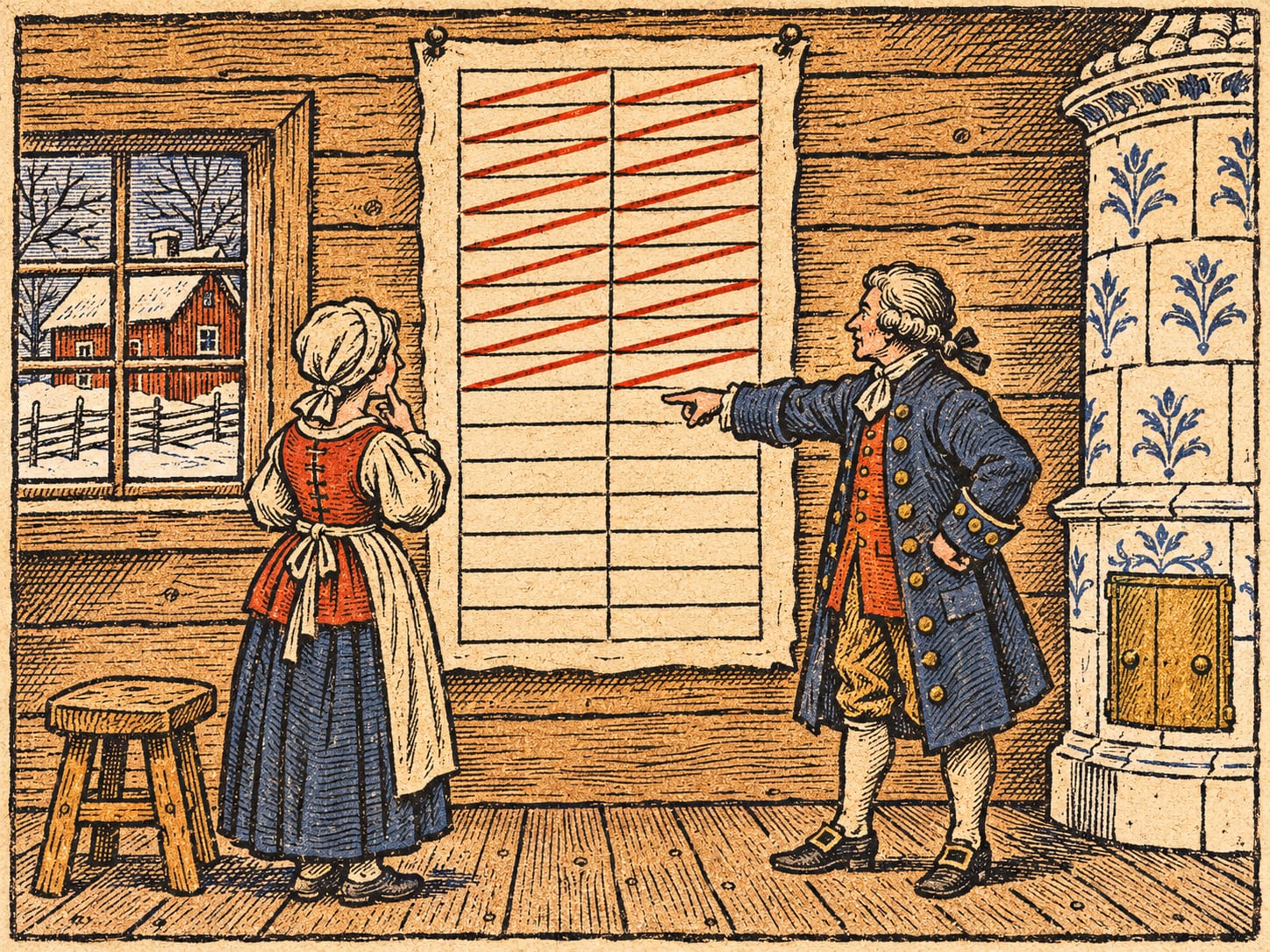
The Soviet Union is often said to have used 30 February in 1930 and 1931. That is disputed, and it is not a second case of the Swedish kind.
In 1930, a Soviet Revolutionary Calendar was proposed, with twelve months of 30 days each and five holidays outside the months. It was rejected. The five-day workweek used from 1929 to 1931 did not create a standard Soviet 30 February either.
Sweden's 30 February 1712 stays the documented civil-calendar example.
Leap day proposals
Another leap-day tradition says women may propose marriage on 29 February. The oldest clearly documented printed reference is a 1606 book, Courtship, Love, and Matrimonie, which describes leap years as a time when women had "the sole privilege" of making advances to men. It names leap year in general, not 29 February alone.
The Scottish version says Queen Margaret, or the Scottish Parliament, passed a law in 1288 that let women propose in a leap year and fined any man who refused. The H. A. Rose article in the journal Folk-Lore says the supposed Scottish law was not an actual statute. It reports a belief that a bachelor who received a proposal in a leap year had to accept or marry the woman. The custom looks older than its Scottish label and wider than Scotland.
The Irish version ties the custom to Saint Brigid and Saint Patrick. That story is also a legend. Where the 29 February custom began is still disputed.
Leap seconds and leap days
A leap second is one second added to Coordinated Universal Time, usually at the end of June or December. It keeps UTC within 0.9 seconds of astronomical time, known as UT1, and it corrects for irregularities in Earth's rotation.
A leap day does a different job. It adds a whole day so the calendar keeps in step with the seasonal year.
Twenty-seven leap seconds have been added since the opening insertion took effect at the end of 30 June 1972. The most recent came at the end of 31 December 2016, and all 27 were additions; no second has ever been taken away. The IERS announcement says no leap second will be added at the end of December 2026.
Leap seconds themselves may be on the way out. In 2022, the 27th General Conference on Weights and Measures decided in Resolution 4 that the allowed gap between UT1 and UTC would widen in or before 2035. The reason given was that inserted seconds can cause failures in satellite navigation, telecommunications and energy systems. The resolution asked the International Committee for Weights and Measures to consult the International Telecommunication Union and others and to prepare a plan by 2035.
Born on 29 February
Law treats leap-day birthdays by place and purpose. In the United Kingdom, Section 6 of the Age of Legal Capacity (Scotland) Act 1991 says that for a person born on 29 February, the anniversary in a non-leap year is 1 March. UK government guidance also uses 1 March for Scottish statutory purposes.
New Zealand school guidance says people born on 29 February choose whether to celebrate in other years on 28 February or on 1 March. That is a practical choice, not a New Zealand statute.
Other calendars, other fixes
Other calendars fix the same drift in other ways. The Hebrew calendar is lunisolar and adds a 13th month, Adar II, in seven years of every 19-year cycle. The Chinese calendar is also lunisolar and adds an intercalary month when needed to keep its lunar months in line with the solar year.
A proposal for the Revised Julian calendar came from an inter-Orthodox meeting in Constantinople in 1923. It allows 218 leap years in a 900-year cycle. A century year is a leap year only when dividing it by 900 leaves a remainder of 200 or 600. That gives an average year of 365.242222 days, a little closer to the tropical year than the Gregorian average.
Several Orthodox churches use the Revised Julian calendar for fixed-date feasts, and others keep the traditional Julian calendar. Until 2800, the Revised Julian and Gregorian calendars agree on ordinary civil dates.
Leap days and Sweden (Swedish dates by the Julian calendar until 1753)
- 46 BC
Julius Caesar introduces the Julian calendar with advice from Sosigenes
- 24 February 1582
Pope Gregory XIII dates the bull Inter gravissimas in Rome
- November 1699
Sweden decides to move to the Gregorian calendar by omitting leap days
- 1700
Sweden omits 29 February, as planned
- 1704 and 1708
Sweden keeps its leap days instead of omitting them
- January 1711
Charles XII orders a return to the Julian calendar
- 1712
Sweden adds 29 and 30 February; the Swedish date 30 February matches 11 March in the Gregorian calendar
- 1751 to 1752
The Riksdag decides to adopt the Gregorian calendar
- 24 February 1752
A royal ordinance sets the change for 1753
- 1753
Wednesday 17 February is followed by Thursday 1 March
- 1923
An inter-Orthodox meeting in Constantinople proposes the Revised Julian calendar
Sources
- US Naval Observatory, "Leap Years," "The Jewish Calendar," and the leap-second announcement
- NASA, "Calendar Calculations" and "Calendars and Their History"
- Royal Observatory of Belgium, "The Roman and Julian Calendars"
- University of Alberta, "The Intercalary Day of the Julian Calendar"
- "Tideräkning i gångna tider," Swedish genealogy archive
- Swedish Linnaeus Society historical publication on the calendar
- University of Helsinki, archive of Finnish-Swedish almanacs, 1623 to 1727
- Swedish almanac page for February 1712, Wikimedia Commons
- Theodosiou and Mantarakis, "Six Calendar Systems in European History"
- Gregory XIII, Inter gravissimas (1582), English translation on Wikisource, and Library of Congress, "Inter Gravissimas"
- H. A. Rose, "Customary Restraints on Celibacy," Folk-Lore, volume 30, and Smithsonian Center for Folklife and Cultural Heritage, "Leap Day Origins and Lore"
- BIPM, Resolution 4 of the 27th General Conference on Weights and Measures, 2022
- NIST, "Leap Seconds FAQs," and IERS, "The Role of the IERS in the Leap Second"
- Age of Legal Capacity (Scotland) Act 1991, Section 6, legislation.gov.uk
- New Zealand Ministry of Education, "Dates and Shapes"
- Hong Kong Observatory, "What Year Is It Today?"
- Orthodox Church in Denmark, account of the 1923 reform, and Timeanddate, "The Revised Julian Calendar"
Watch the full story on the Flashback Fables YouTube channel, and send it to someone who would love it.