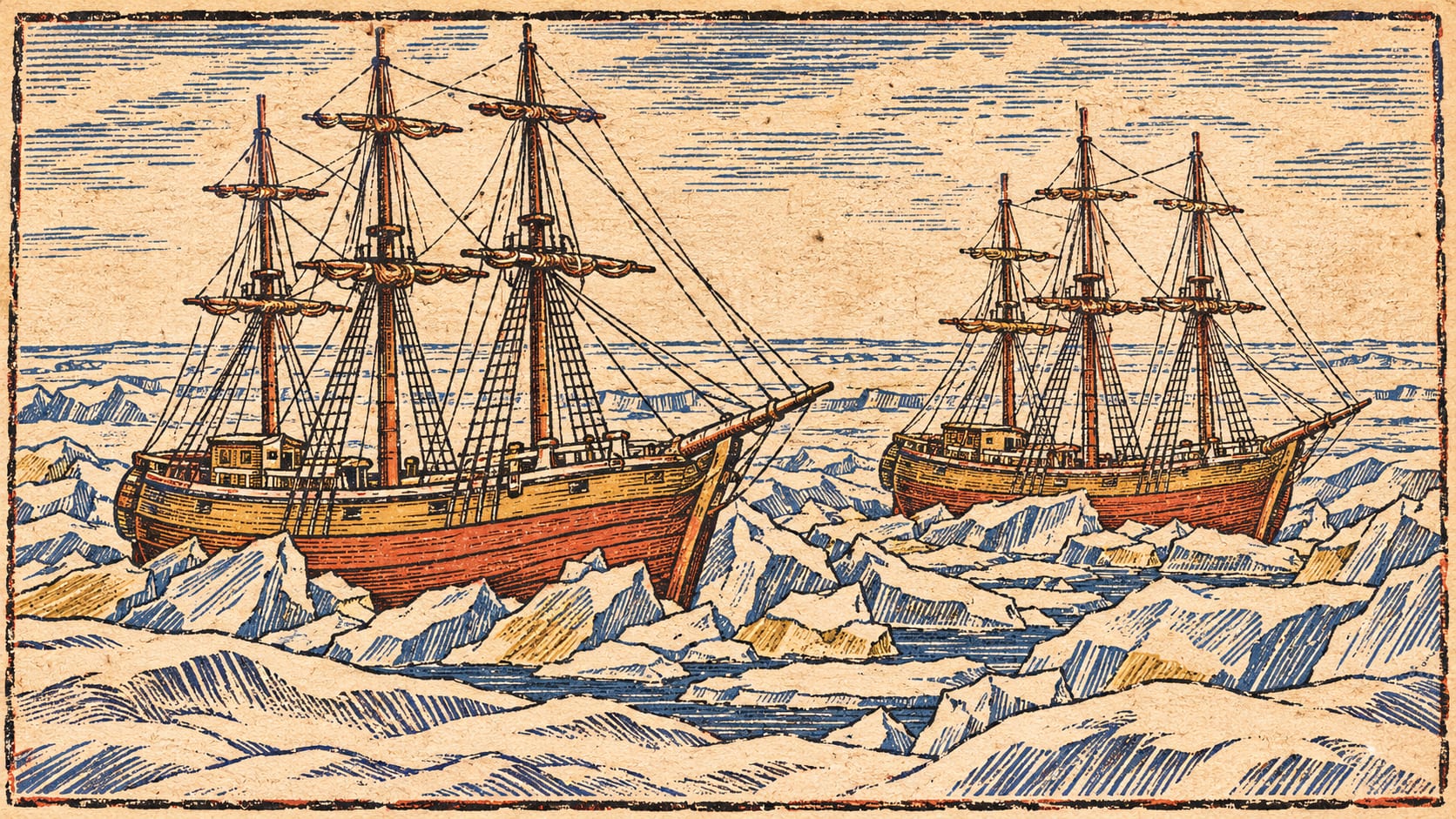
A note left at Victory Point carries two entries. The one dated 28 May 1847 ended with the words "all well." A line added on 25 April 1848 said Sir John Franklin had died on 11 June 1847, that nine officers and fifteen men were dead, that the ships had been abandoned on 22 April 1848, and that the remaining 105 were heading south.
Franklin's expedition left England on 19 May 1845 with 134 officers and crew aboard HMS Erebus and HMS Terror. Its aim was to chart the remaining section of the Northwest Passage, the Arctic sea route between the Atlantic and the Pacific.
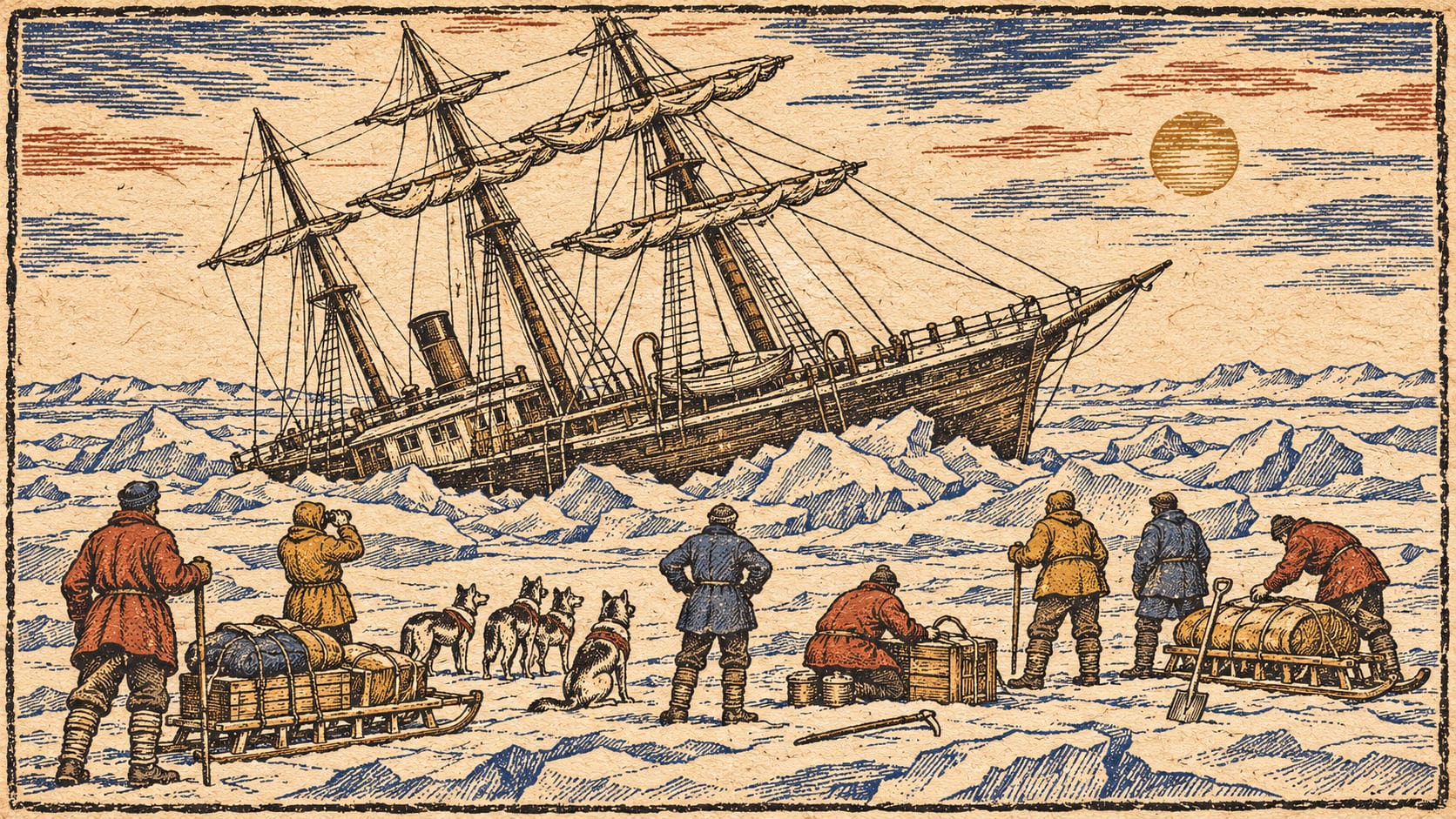
Ice trapped both ships from September 1846, and the survivors left them in April 1848. No man from the expedition was found alive. The search for what became of it ran for generations, and the wrecks were found in 2014 and 2016, with Inuit knowledge central to both finds.
From Greenhithe to Beechey Island
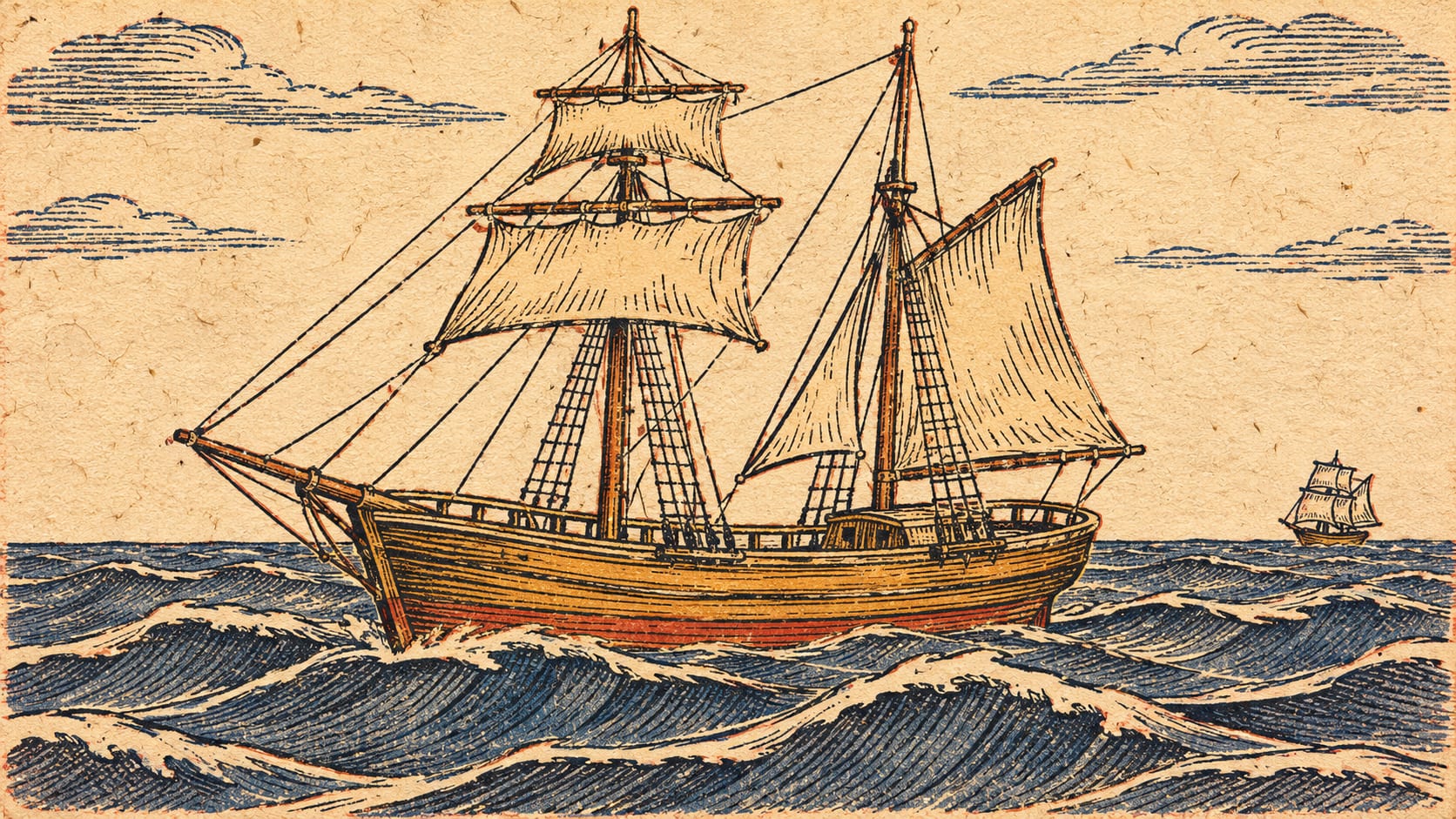
The ships sailed from Greenhithe, England, on 19 May 1845. Five ill or invalided men left aboard the supply ship Barretto Junior at Disko Bay, so 129 men went on. Two whaling ships saw the expedition in northern Baffin Bay in late July 1845.
Before they crossed that bay, the men wrote home. On 3 June 1845, James Fitzjames, commander of Erebus, wrote to Edward Sabine: "this will assure you however that we are all well and happy." On 11 July, from Whale Fish Island, he wrote again: "Sir John is very well and full of life and energy and we are all as happy as possible looking forward to the commencement of our Real Work."
Francis Crozier, captain of Terror, wrote to John Henderson on 4 July: "All going on as well as I could wish, every one has fallen very speedily into their places and things are progressing quietly." Five days later he wrote to James Ross, "I cannot bear going on board Erebus," although Franklin invited him to dine there daily. In the same letter he called the assistant surgeon Harry Goodsir "a most diligent fellow a perfect enthusiast in Mollusca."
John Irving wrote from Terror at Woolwich on 18 April 1845, to his sister-in-law Katie: "Whatever happens, it is the will of God." He added, "this is no common voyage," and warned that two years was a long time without news, perhaps three.
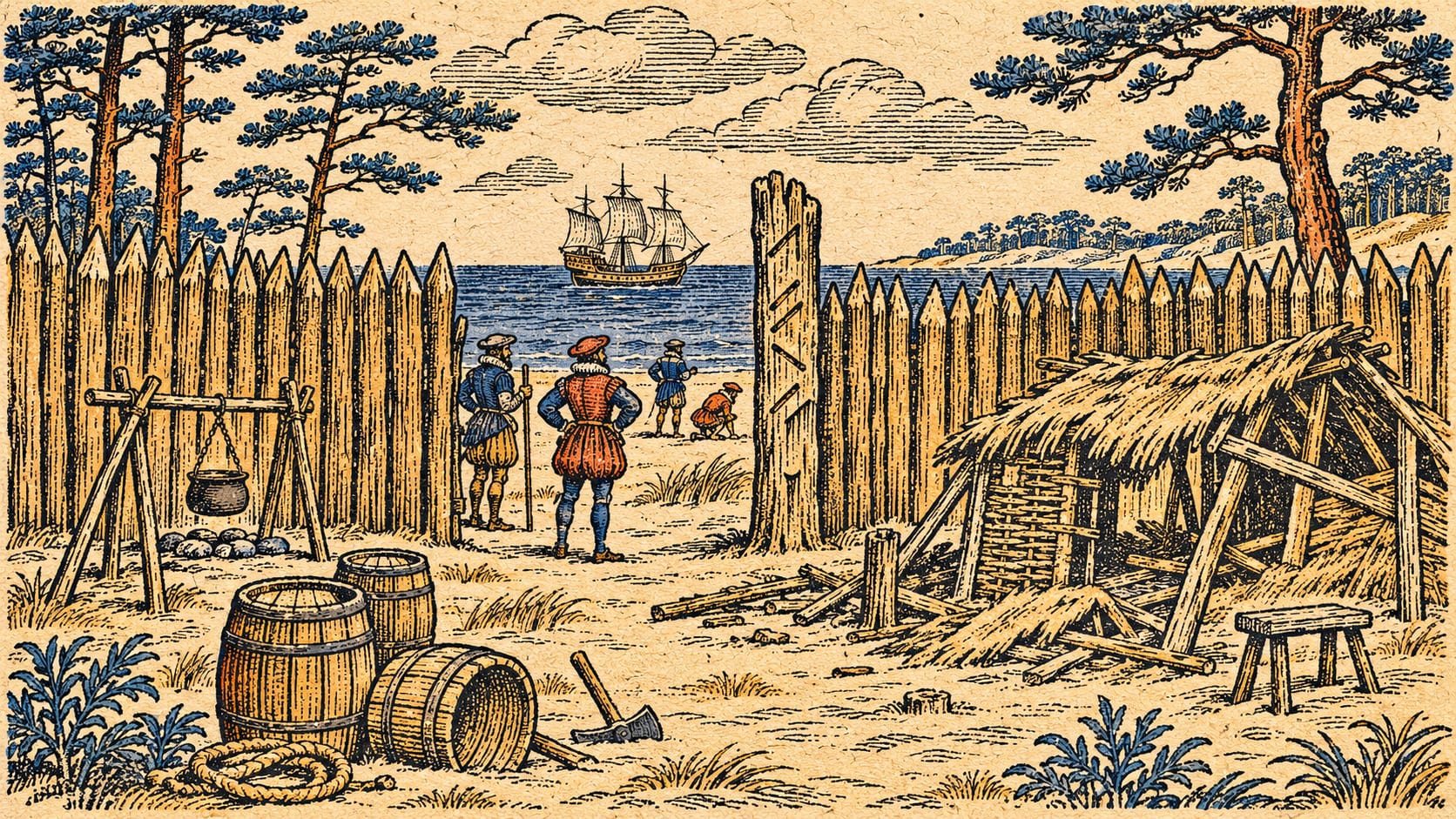
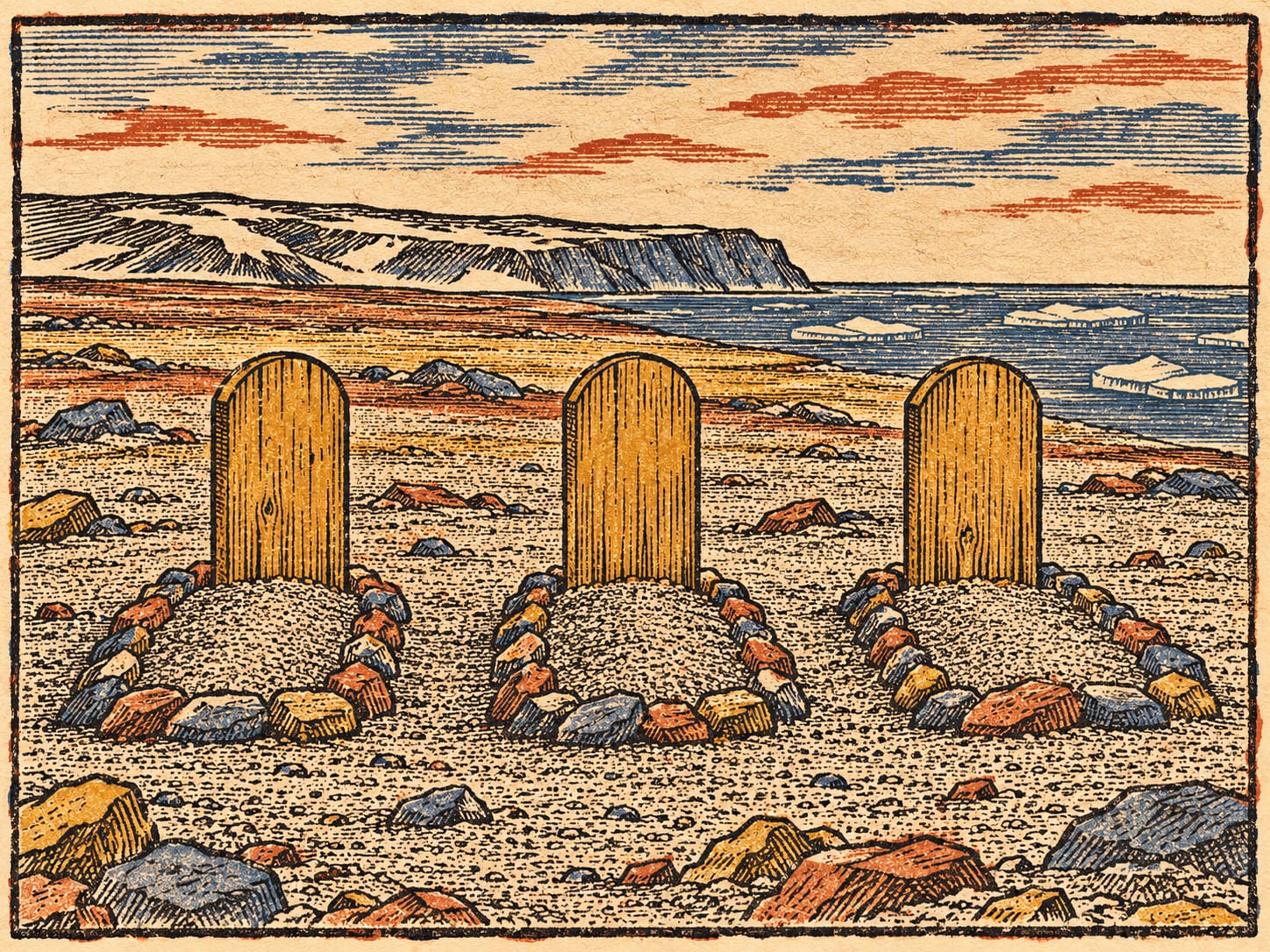
The expedition spent the winter of 1845 to 1846 on Beechey Island. Three men died there, and their graves are still marked: John Torrington on 1 January 1846, Able Seaman John Hartnell on 4 January and Royal Marine William Braine on 3 April.
Opening the graves at Beechey Island
In August 1984, Owen Beattie led a team that exhumed Torrington's body. Hartnell and Braine followed in 1986. The cold had kept the bodies unusually well, so the team could examine soft tissue, hair, bone and clothing.
Torrington's autopsy found severe lung disease, and the researchers reported signs consistent with pneumonia. They also reported high lead levels in tissue and bone. The pooled bone result averaged about 128 micrograms of lead per gram, with a range of 69 to 183.
Lead may have added to the men's illness, and other researchers have pointed to zinc deficiency, scurvy, tuberculosis, botulism or malnutrition. The three bodies show how the expedition stood in 1846. They do not explain the later deaths of all 129 men.
"All well," and what came after
The note that searchers later found at Victory Point holds the two entries. The one dated 28 May 1847 reported that Erebus and Terror had wintered at Beechey Island in 1845 to 1846 and had been stuck in ice since September 1846. It closed with "all well." Graham Gore, first lieutenant of Erebus, put that message in the cairn in May or June 1847.
Eleven months later, on 25 April 1848, a second entry went in with the news. Franklin was dead. Nine officers and fifteen men had died, and Gore was among the dead by then. The ships had been left on 22 April, and the 105 who remained were heading for Back's Fish River.
Captain Francis Crozier and Captain James Fitzjames signed the note. With Franklin gone, Crozier was the senior officer in command. He had commanded Terror before, on James Clark Ross's Antarctic expedition. Fitzjames had commanded the steamship HMS Clio before he joined.
Nothing Crozier wrote tells what happened to him afterward. Inuit testimony that Rae, Hall and Schwatka recorded places the survivors moving south through King William Island toward the Back River.
John Rae hears the Inuit account
On 29 July 1854, John Rae, a surgeon and explorer with the Hudson's Bay Company, wrote his report at Repulse Bay for the Secretary of the Admiralty. He had learned from Inuit at Pelly Bay that a party of white men had died of hunger west of a large river with falls and rapids. About 40 men had been seen travelling south along the western coast of King William Island after their ships became trapped. Bodies had later been found near the mouth of the Back River.
Rae wrote that "Some of the bodies had been buried, probably those of the first victims of famine; some were in a tent or tents; others under the boat, which had been turned over to form a shelter; and several lay scattered about in different directions." He added, "One was supposed to have been an officer, as he had a telescope strapped over his shoulders, and his double-barrelled gun lay underneath him."
He also obtained objects from the expedition, including silverware bearing officers' initials and a medal that belonged to Franklin.
His most disputed sentence read: "From the mutilated state of many of the corpses and the contents of the kettles, it is evident that our wretched countrymen had been driven to the last resource, cannibalism, as a means of prolonging existence." Rae noted that the Inuit he spoke with had not seen the bodies themselves. They had the account from people who had met the travelling party and later visited the site. On 30 December 1854 he wrote that twenty or twenty-five Inuit had repeated the same account over two months.
The Admiralty published the report in October 1854. Lady Jane Franklin rejected the cannibalism claim and argued that Rae had not reached the death sites himself. In July 1856 the Admiralty paid Rae and his companions £10,000 under the 1850 reward for learning the fate of the expedition.
Charles Dickens answered in Household Words on 2 December 1854. He accepted that Franklin and his men were dead. He wrote that there was "no reason whatever to believe" they had survived by eating their companions, and he called the Inuit accounts "very loose and unreliable." He also wrote that Rae had acted properly in reporting what he was told.
The Inuit accounts that kept coming
Charles Francis Hall searched on King William Island in 1860 to 1862 and again in 1864 to 1869, working with the Inuit interpreters Taqulittuq, also called Hannah, and Ipiivik, also called Joe. Inukpujijuk gave Hall a map and told of a ship near the western side of the Adelaide Peninsula. Inuit had found it afloat in ice, with its crew gone, and later boarded it for useful objects. Parks Canada ties that account to the wreck now called Erebus.
Hall wrote from Repulse Bay on 20 June 1869: "This day I have returned from a sledge journey of ninety days to and from King William's Land."
Frederick Schwatka's expedition of 1878 to 1880 also had Ipiivik as interpreter and guide. Its informants included Ikinnelikpatolek, who told of boarding a ship, Ockarnawole, who described bodies and a grave, and Peowat, who described boats near the Back River. Tooktoocheer and her son Ogzeuckjeuwock told of Franklin goods, bodies and sites on the mainland.
Their accounts agree that the survivors moved south from the abandoned ships, and that bodies, boats and equipment lay along the route toward the Back River. They also place one ship wrecked or sunk near the western side of King William Island and another off the Adelaide Peninsula. The English versions passed through interpreters, questioning and editing, and the names appear in several spellings.
What McClintock found
Lady Jane Franklin kept organising searches after the Admiralty cut back its own. The searches of the 1850s had already found where the expedition wintered at Beechey Island, with the three graves and abandoned supplies.
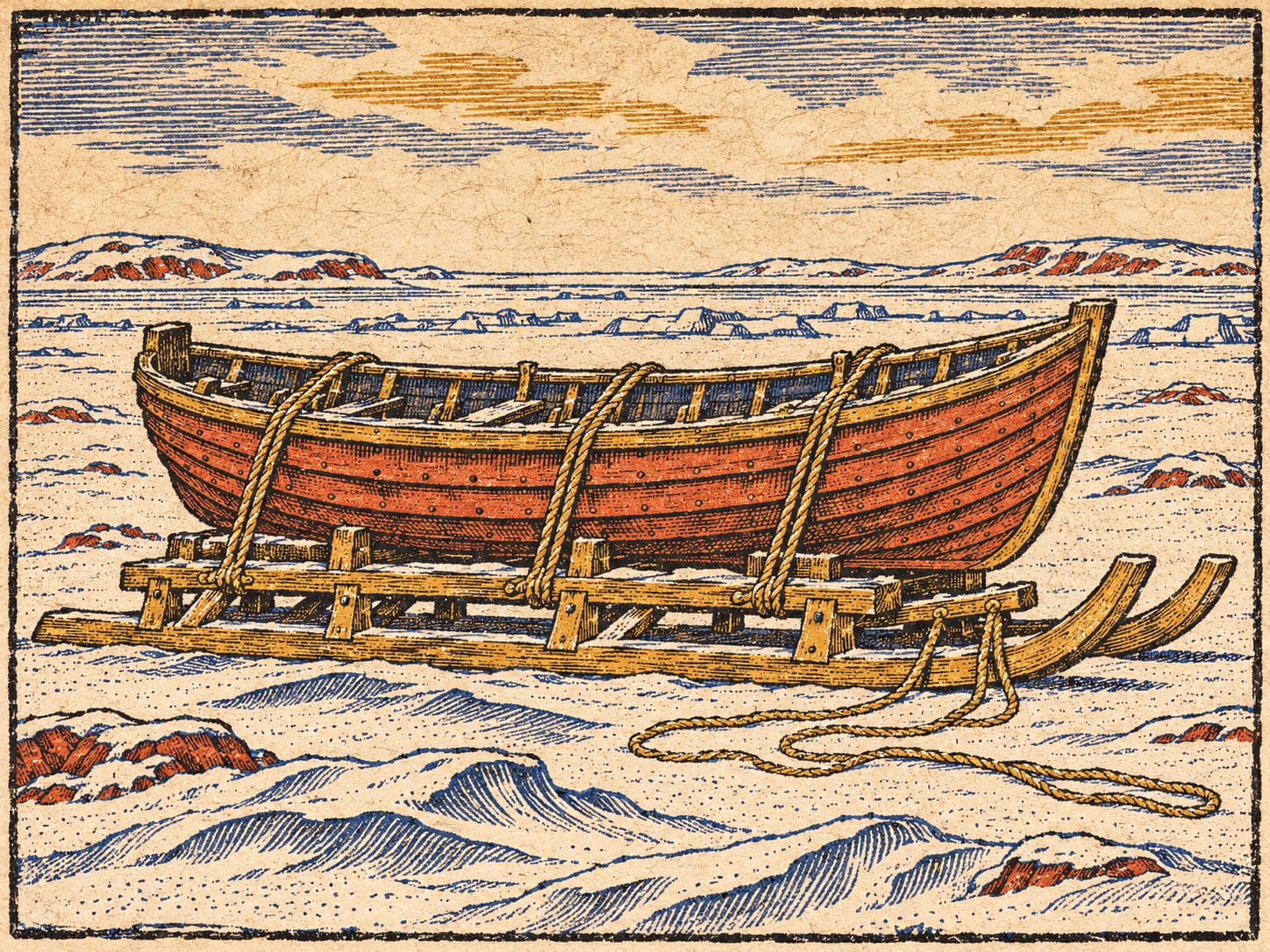
Francis Leopold McClintock sailed the yacht Fox from 1857 to 1859. His parties found silverware and wooden objects from Erebus and Terror in Inuit hands. They also found a sledge carrying a ship's boat, human remains, graves, clothing, books and other abandoned equipment.
Lieutenant William Hobson found the cairn at Victory Point and the written note inside it, which revealed Franklin's death and the abandonment of the ships.
What killed the crews
No single cause explains the collapse. It was probably several things at once, and the debate continues.
Tests found lead in the bones and hair of some crewmen, and lead from tinned food or the ships' water systems was proposed as a contributor. A later reanalysis concluded that the evidence did not show lead poisoning as the main cause of death.
Tuberculosis was found in some remains from Beechey Island, including John Torrington's, and pneumonia is linked to the Beechey graves. Both may have contributed to the early deaths. Neither explains the whole expedition.
Bone changes once read as scurvy can also come from injury or infection, so scurvy is possible but not established as the main cause. Botulism from spoiled tinned food has been proposed too, though the expedition's medical records have not been recovered.
Cold, starvation and exhaustion almost certainly mattered. Inuit testimony, the Victory Point note, the abandoned equipment and the spread of the bodies show that the men left the ships and tried a long march overland.
Cannibalism: what the bones show
Inuit testimony that Rae recorded reported cannibalism among some survivors. Archaeologists later tested it. Owen Beattie's work in the 1980s found cut marks on human bones from King William Island, and a 1997 study reported cut marks on about a quarter of the bones examined, some consistent with removing flesh and separating joints.
In 2015, Jennifer McKinnon, Simon Mays and colleagues reexamined remains representing at least 35 bones. They concluded the pattern pointed to survival cannibalism, which agreed with the Inuit accounts.
Some survivors probably processed and ate human remains in the final stages of the retreat. How many people were involved, how many victims there were and when it happened remain unknown. Cannibalism was not the cause of the disaster. Ice, disease, exhaustion, starvation and exposure did that.
Finding Erebus and Terror
Parks Canada located the wreck of HMS Erebus on 2 September 2014 in the Queen Maud Gulf area, northeast of O'Reilly Island and about 80 kilometres south of King William Island. HMS Terror was found in September 2016 in Terror Bay, west of Gjoa Haven on King William Island. Parks Canada confirmed it was Terror on 18 September 2016.
Inuit knowledge was central to both finds. Louie Kamookak, an Inuit historian and teacher from Gjoa Haven, had spent years collecting place names, oral histories and elders' accounts about the expedition, and he worked with Parks Canada and other search partners from the 1990s on. His knowledge helped mark likely search areas and read the reports about the ships. In 2014, artifacts cached on an island helped steer the search toward Erebus.
Alan Latourelle of Parks Canada described the approach this way: "From the outset, the objective was to use both Inuit oral history and Canada's best technology to search for the shipwrecks."
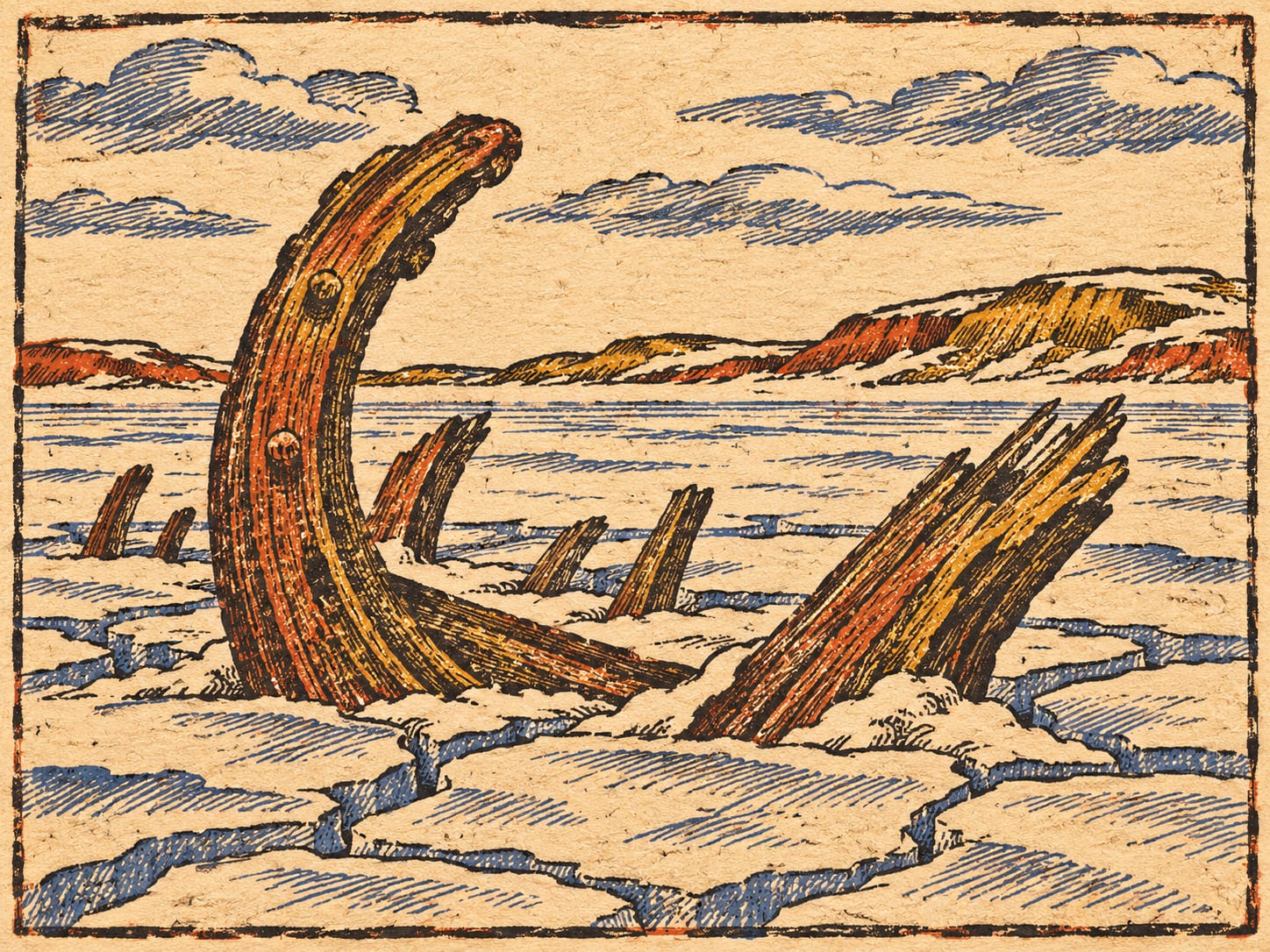
In 2016, Sammy Kogvik, an Inuk from Gjoa Haven on a local search crew, told the team about timber sticking up through the ice in Terror Bay. Parks Canada widened its search there and located Terror.
What the wrecks have given up
Divers raised the brass ship's bell from Erebus during the early dives. It carries the broad arrow that marks British government property, and the date 1845, the year Erebus was refitted for Franklin's expedition. It has since been shown at the National Maritime Museum in Greenwich.
The 2015 season recovered or recorded a cannon, dining plates and a medicine bottle. Later dives brought up ceramics, glass, buttons, personal grooming objects and tools from the officers' and crew spaces. Parks Canada unveiled personal items recovered in 2019 at its conservation laboratory in Ottawa in February 2020.
Terror lies with its interior remarkably intact, with doors, shelves, cabins and fittings still in place. Teams are recording that material where it lies instead of lifting it out wholesale.
Parks Canada photographs, maps and conserves the recovered objects, and they are shared with Nunavummiut. Parks Canada and the Inuit Heritage Trust jointly own them.
Who looks after the wrecks now
The wrecks are protected under the Canada National Parks Act and the Nunavut Agreement. An advisory committee for the sites brought together Parks Canada, the Kitikmeot Inuit Association, Inuit Heritage Trust, the Government of Nunavut and community members from Gjoa Haven and Cambridge Bay.
In March 2023, the Government of Canada and the Kitikmeot Inuit Association signed an agreement that sets out Inuit leadership and a role in management, jobs, training, guardian programs, research and visitor experience. The sites are not open to ordinary visitors, and entry needs a permit.
On Beechey Island, the marked graves of Torrington, Hartnell and Braine can be seen, along with memorials and cairns from later search expeditions. The Victory Point note itself belongs to the National Maritime Museum, which has lent it for exhibitions, including the 2018 Death in the Ice show at the Canadian Museum of History.
The expedition did not return to document a completed passage. Its ships have now been found, and the Inuit who kept their story are part of why.
The Franklin expedition, from Greenhithe to the wrecks
- 19 May 1845
Erebus and Terror sail from Greenhithe with 134 officers and crew
- Late July 1845
Two whaling ships see the expedition in northern Baffin Bay
- 1 January 1846
John Torrington dies on Beechey Island
- September 1846
Ice traps the ships
- 28 May 1847
The Victory Point note reports "all well"
- 11 June 1847
Sir John Franklin dies
- 22 April 1848
The ships are abandoned
- 25 April 1848
A second entry on the note reports the deaths and the march south
- 29 July 1854
John Rae writes his report from Repulse Bay after hearing the Inuit account
- 1857 to 1859
McClintock's expedition finds relics, remains and the Victory Point note
- 1984 and 1986
Owen Beattie's teams exhume the three men buried on Beechey Island
- September 2014
Parks Canada locates Erebus
- September 2016
Parks Canada locates Terror in Terror Bay
- March 2023
Canada and the Kitikmeot Inuit Association sign an agreement on Inuit leadership at the wrecks
Sources
- Parks Canada, "Franklin's 1845 expedition," "Searching for Franklin," "Finding HMS Terror," artifact galleries, "Who's who in the Franklin expedition" and Inuit traditional knowledge pages
- Royal Museums Greenwich, copy of the Victory Point record and "Letter to Sir John Franklin"
- Royal Museums Greenwich, "Dr John Rae" and "Death in the Ice"
- Franklin letters archive, Canadian Mysteries: Fitzjames, Crozier and Irving letters, Rae's report, Dickens in Household Words, Hall's letter of 20 June 1869 and the Schwatka testimony
- John Rae, Dictionary of Canadian Biography
- Canadian Museum of History, "A Very Special Piece of Paper"
- Historic England, "Research sheds new light on Franklin expedition"
- Medical disaster study of the Franklin expedition, PubMed Central
- "Health of nine Royal Naval Arctic crews, 1848 to 1854," Polar Record
- Reanalysis of the supposed role of lead poisoning in the Franklin expedition of 1845 to 1848, Polar Record
- "Finding the dead: bodies, bones and burials from the 1845 Franklin Northwest Passage expedition," Polar Record
- "Evidence for end-stage cannibalism," International Journal of Osteoarchaeology
- "The Final Days of the Franklin Expedition," Arctic
- Government of Canada and Kitikmeot Inuit Association agreement, March 2023
Watch the full story on the Flashback Fables YouTube channel, and send it to someone who would love it.