
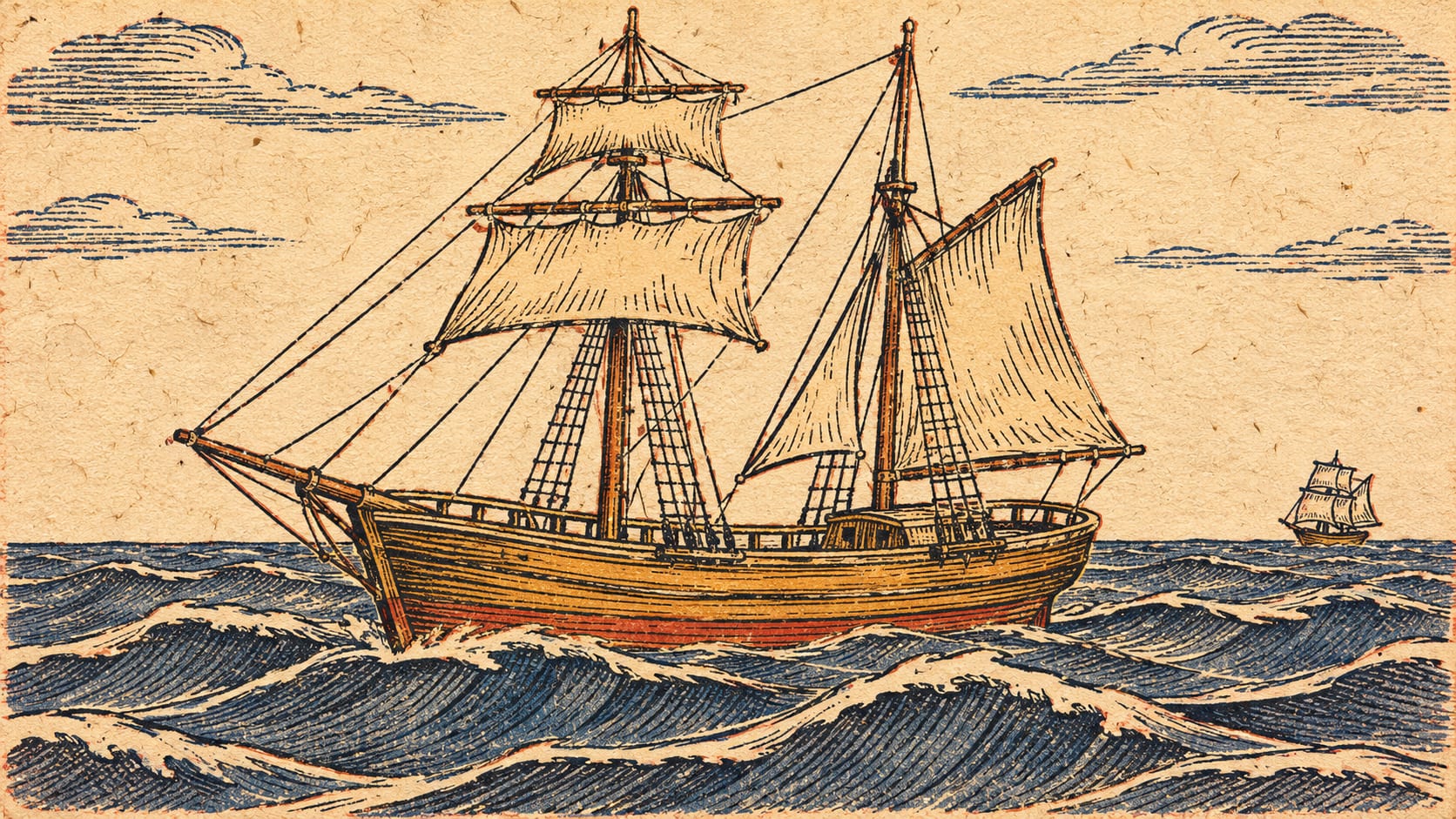
What happened to the ten people aboard the Mary Celeste? Nobody has established it. On 4 December 1872, the crew of a British brigantine found her drifting in the Atlantic, seaworthy and still loaded, with no one on board.
Captain Benjamin Spooner Briggs had sailed from New York on 7 November with his wife Sarah, their two-year-old daughter Sophia and a crew of seven. The ship's only boat was gone, and the people in it were never traced.
A court at Gibraltar looked for murder, mutiny and piracy and found no proof of any. The hot breakfast on the cabin table belongs to later stories, not to the 1872 testimony.
A half-brig out of New York
The Mary Celeste was a Canadian-built, American-registered half-brig. She was launched at Spencer's Island, Nova Scotia, in 1861 under the name Amazon, and later became the Mary Celeste.
James H. Winchester was her principal owner in 1872, and Captain Briggs held a one-third share. On 7 November she left New York Harbor for Genoa, Italy. In her hold were 1,701 barrels of industrial alcohol shipped by Meissner, Ackerman & Co.
The ten who sailed
Ten people sailed aboard her. With Captain Briggs were his wife, Sarah Elizabeth Cobb Briggs, and their daughter Sophia, who was two. The first mate was Albert G. Richardson and the second mate Andrew Gilling. Edward William Head served as steward and cook.
Four sailors made up the rest of the crew: Volkert Lorenzen, Boz Lorenzen, Arian Martens and Gottlieb Goodschaal.
The Briggs family's seven-year-old son, Arthur, stayed behind in Massachusetts. The final entry on the ship's slate placed her near Santa Maria in the Azores.
Letters from the little home
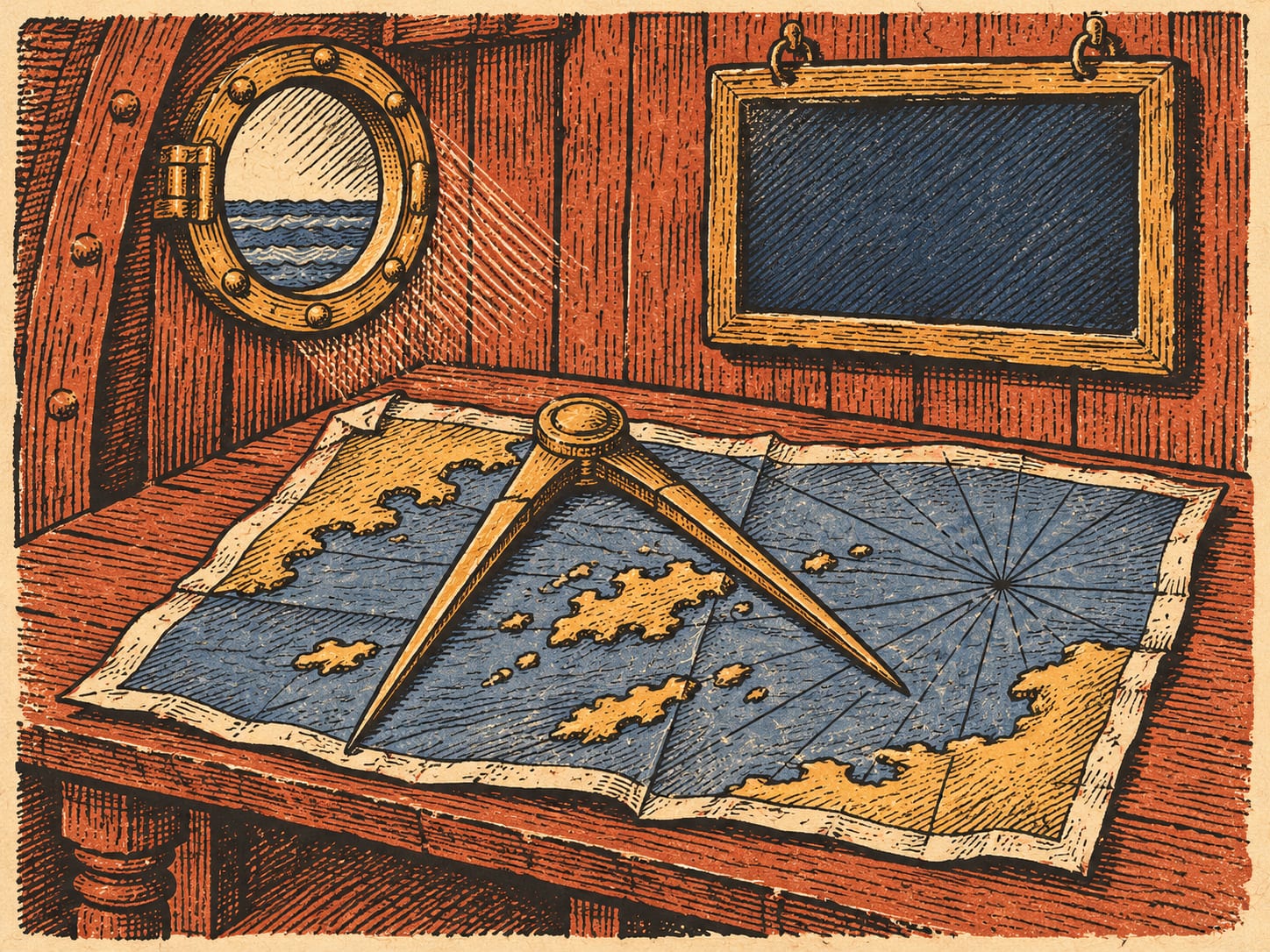
Sarah and Sophia joined the ship in New York. On 27 October 1872, Sarah wrote to Arthur: "Well, Sophy and I got here all right this morning, and father met us at the boat and brought us over to his vessel, which is the brig Mary Celeste." She told him that Sophia was playing with her dolls, visiting the ship's cat and sleeping in the family's cabin. On 2 November she wrote to her sister Mary and called their quarters "our little home."
Benjamin wrote to his mother from New York on 3 November: "It seems real homelike since Sarah and Sophia got here, and we enjoy our little quarters." He thought well of his crew: "We seem to have a very good mate and steward and I hope I shall have a pleasant voyage." Of Arthur he wrote: "We both have missed Arthur and I believe we should have sent for him, if I could have thought of a good place to stow him away."
The letters are held in the Benjamin Spooner Briggs Papers at the Phillips Library of the Peabody Essex Museum. They show a family settling in and a captain at ease. They say nothing about what came after.
4 December 1872: the *Dei Gratia* finds her
Captain David Reed Morehouse and the crew of the British brigantine Dei Gratia found the Mary Celeste about 400 miles east of the Azores, between the islands and mainland Portugal. The Dei Gratia's log recorded the date as 5 December, because a ship's nautical day changed at noon.
Morehouse stayed on his own ship. His first mate, Oliver Deveau, boarded with John Wright and found nobody aboard. Morehouse's cable afterward described the vessel in two words: "ABANDONED SEAWORTHY."
Deveau told the court that the Mary Celeste still carried most of her alcohol, food and water. He reported about three and a half feet of water in the hold, a pump taken apart, hatches open or out of place, and no boat. He said the chronometer and the navigation instruments were gone. The cabin was wet, so wet that the captain's bed had to be dried, and personal possessions were still on board.
He described the galley this way: "The Galley was in a bad state, the stove was knocked out of its place, and the cooking utensils were strewn around."
Deveau did not think there had been a fight. "It did not occur to me that there had been any act of violence," he testified. "There was nothing to induce one to believe or to show that there had been any violence."
John Wright, Charles Lund, Augustus Anderson and John Johnson of the Dei Gratia also gave testimony. They agreed on the missing people, the water, the disturbed hatches and the absent boat. They differed over smaller details such as the skylight, the sounding rod, the cabin windows and the galley.
The Gibraltar inquiry
The Vice-Admiralty Court of Gibraltar heard the salvage case from December 1872. The Gibraltar Chronicle reported on 13 December that the Dei Gratia had fallen in with the brigantine Mary Celeste, "bound to Genoa laden with alcohol, derelict," and that Morehouse could not account for her abandonment.
Frederick Solly-Flood, Gibraltar's Attorney General and Queen's Proctor, suspected murder, mutiny or a conspiracy involving the Dei Gratia crew. He ordered more inspections and treated stains, a sword and damage near the bows as possible evidence of violence.
John Austin, Gibraltar's Surveyor of Shipping, examined the ship for about five hours on 23 December. He found matching damaged strips on both sides of the bow, each about two and a half feet above the waterline. He believed they were recent and made by a sharp instrument. He also reported that the hull, masts, yards and spars showed no sign of seriously heavy weather.
In the captain's cabin Austin found a sword. "It appeared to me as if it had been smeared with blood and afterwards wiped," he said. Dr J. Patron tested the stains from the deck and the blade, and his answer was plain: "there is no blood either in the stains observed on the deck of the Mary Celeste or on those found on the blade of the sword."
Captain Shufeldt of the USS Plymouth rejected mutiny. He thought the bow damage was splintering from the bending of the planks during rebuilding and later pressure from the sea. He suggested that a temporary leak or a panic, perhaps sharpened by the presence of Briggs's wife and child, might have led to an evacuation.
Solly-Flood stayed suspicious. In letters to the Board of Trade on 22 and 23 January 1873, he proposed that the crew had drunk the alcohol, murdered Briggs, Sarah, Sophia and the chief mate, and escaped. The court found no proof of murder or of any other foul play.
American papers, among them the New York Herald, the Boston Post and the New-York Tribune, printed the missing captain, family and crew, the missing boat and the salvage case, and some repeated talk of piracy and murder. A Treasury Department circular reprinted in March 1873 asked anyone with information to come forward.
Morehouse and his crew were allowed to leave Gibraltar on 21 December 1872, and the Mary Celeste went back to her American owners on 25 February 1873. Chief Justice Sir John Cochrane gave judgment on 14 March 1873. The Dei Gratia crew received £1,700, about one-sixth of the ship and cargo's insured value. That was a deliberately limited salvage award, not a finding that they had committed a crime.
Six explanations, and where each one stops
The fate of the ten remains unestablished. Each of the main explanations has something that fits and something that does not.
Alcohol vapour. Nine barrels were empty when the cargo was unloaded at Genoa, and red-oak barrels leak more readily than white-oak ones. A sudden release of vapour might have made the crew fear an explosion and leave in the boat for a while. The boarding party reported no smell of fumes and no fire damage. The Gibraltar testimony records no explosion, and nine empty barrels was not described as unusually many.
Pump, navigation and storm. One pump was found partly taken apart, there was water in the pump well, and the slate placed the ship near Santa Maria. A reconstruction made for Anne MacGregor's 2007 documentary proposed that a faulty chronometer, rough weather and a fouled pump led Briggs to order an evacuation near land. But the pump gear was reported in good condition, the ship was still seaworthy, and the court did not establish that an emergency had occurred.
Waterspout, seaquake or severe weather. Water in the cabin, a displaced galley stove, a displaced binnacle and missing sails could all fit rough weather. Surveyor John Austin reported no sign that the hull, masts or spars had suffered seriously heavy weather, and the ship stayed navigable.
Piracy. The ship was found without her people, with the boat gone and some navigational equipment missing. But the valuable alcohol was still aboard, possessions were largely intact, and the Gibraltar evidence showed no violent seizure.
Mutiny or drunken violence. Solly-Flood's January 1873 theory was the crew drinking the alcohol and killing the family and the mate. The court found no proof of murder. The American consul, Horatio Sprague, described the crew's character in positive terms, and later claims about missing possessions never became a case for mutiny.
Insurance fraud against the rescuers. The salvage claim made some people suspect a conspiracy. The court found no evidence that the Dei Gratia crew had caused the disappearance.
The Gibraltar court established only this: the ship was found deserted, the boat was missing, the vessel could still sail, and what happened to the people aboard could not be shown.
What later investigators tried
In 2002, Anne MacGregor began a modern investigation for the documentary The True Story of the Mary Celeste. Her team rejected piracy and mutiny as poor fits for the ship's condition. She noted that the nine empty barrels were red oak, a more porous wood, and that the main hatch had been secured when the boarding party arrived.
In 2006, the chemist Andrea Sella showed an alcohol-vapour explosion model on a Channel 5 programme. It showed how a vapour flash could build pressure without leaving major structural damage. It did not use real alcohol, so it showed a possible mechanism and nothing more.
A 2007 documentary investigation put together a combined scenario: a faulty chronometer, rough seas, a possibly fouled pump and a mistaken judgment of the ship's position. It offered a way an evacuation could have begun, and no conclusion. The people in the boat were never traced.
Conan Doyle and the breakfast table
In January 1884, The Cornhill Magazine printed an anonymous short story, "J. Habakuk Jephson's Statement," by Arthur Conan Doyle. It renamed the ship "Marie Celeste," changed names and circumstances, and offered a sensational fictional explanation involving a vengeful formerly enslaved man. It helped turn a salvage case into a worldwide ghost-ship legend.
The popular picture of a table laid for breakfast, hot tea and a half-eaten meal does not appear in the 1872 Gibraltar testimony. Deveau had described a wet cabin and a galley in disorder. Charles Edey Fay named "food still warm on the cabin table," "a chicken sizzling on the galley stove" and "the lifeboat in the davits" as later embellishments.
The breakfast-on-the-table version was printed in McClure's Magazine in 1905, and a more elaborate one in The Strand Magazine in 1913. The deserted ship, the missing boat and the ten missing people were strange enough without them.
What became of the ship and the people she left
After Gibraltar, Captain George W. Blatchford took the ship to Genoa, where the alcohol was unloaded in good condition, and then to Boston. Winchester tried to sell her, and later said that public suspicion made it hard and cost him about $8,000. She was eventually sold to David Cartwright and Harrison of Brooklyn, who said they owned her for about five years and lost about $5,000.
Arthur Briggs, the son left behind, had stayed in Marion, Massachusetts, with his grandmother to go to school. He grew up, and he died in Massachusetts on 31 October 1931. Benjamin's brother Oliver Briggs was also a sea captain, and family accounts say the two brothers had hoped to leave the sea and open a hardware business in New Bedford. That plan never went ahead.
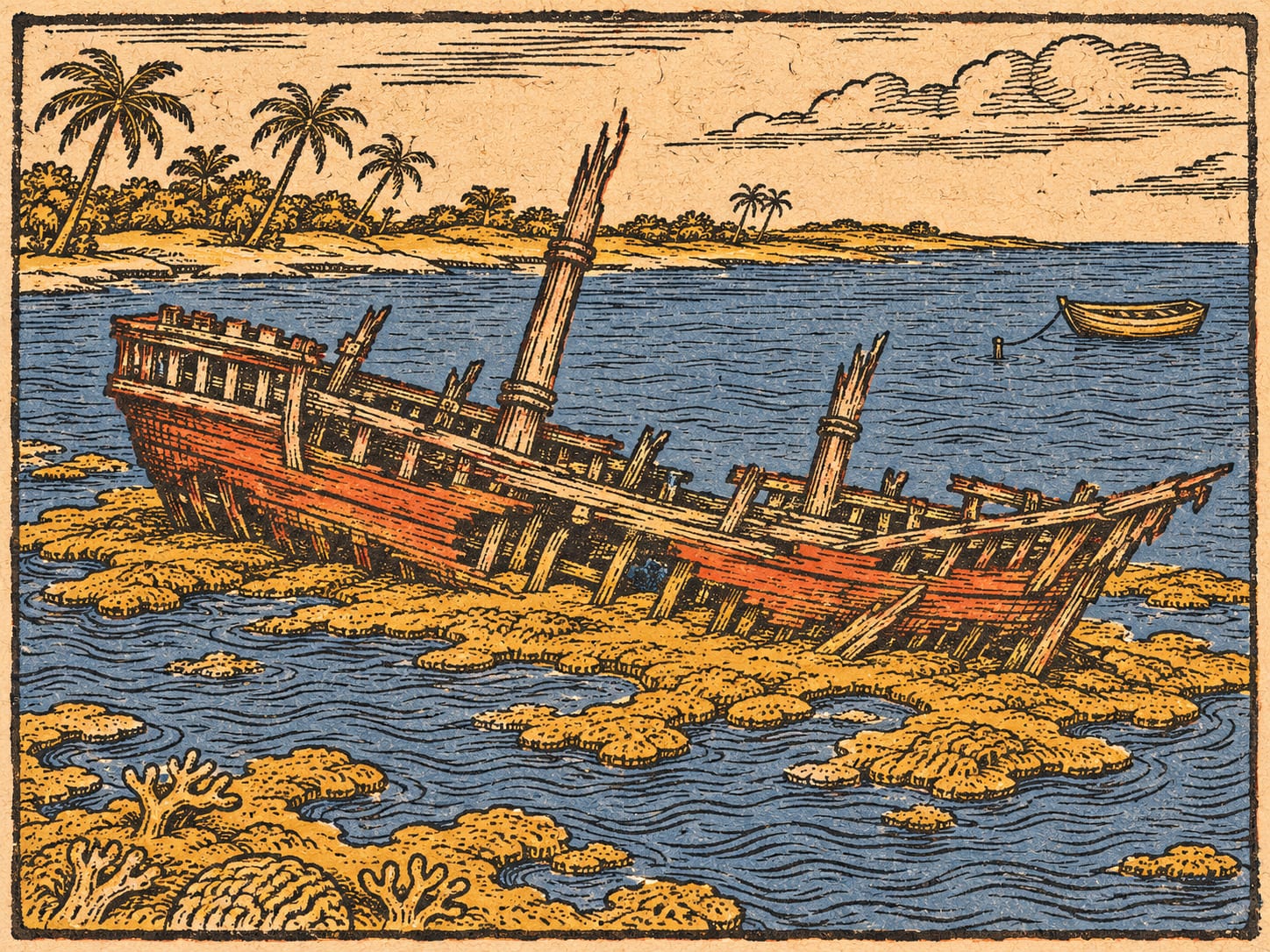
On 3 January 1885, the Mary Celeste was deliberately run onto Rochelais Reef, also called Rochelois Reef, near Miragoâne and Gonâve Island in Haiti. Captain Gilman Parker had loaded a low-value cargo and tried to make an insurance claim. The ship stayed on the reef instead of sinking, and Parker and his first mate were later convicted of barratry.
That insurance fraud belongs to 1885. It tells us nothing about what happened to the crew in 1872.
The 2001 wreck, and the tree rings
On 9 August 2001, Clive Cussler's National Underwater and Marine Agency and John Davis's ECO-NOVA Productions announced that their expedition had found the ship's remains on a Haitian reef. The archaeologist James Delgado identified the wreck from its dimensions, its iron and bronze fastenings, its Muntz-metal sheathing and wood samples. Dr David Etheridge found the wood consistent with construction in northern New England or the Canadian Maritimes.
Cussler said: "With so many stories written about MARY CELESTE, it was time to write the final chapter, although the true story of her missing crew may never be solved." Delgado said: "We can safely say the final resting place of the infamous MARY CELESTE has been found."
Then Scott St George of the Geological Survey of Canada ran tree-ring analysis on the timber, with the Laboratory of Tree-Ring Research at the University of Arizona. "The outermost ring suggests the timber was from trees still growing in 1894," he said, "but the Mary Celeste sank 10 years before that." He added that longleaf pine was unlikely to have gone into a ship built at Spencer's Island, Nova Scotia.
The 2001 identification is disputed. Whatever lies on that reef, it says nothing about the ten people of 1872. The people in the boat were never traced.
Where the story can be visited
At Spencer's Island, Nova Scotia, a memorial stands where the ship was built as the Amazon. It marks her origin and is not a surviving part of the vessel.
The Gibraltar Courthouse at 277 Main Street stands on the site of the court that heard the salvage case, and the Government of Gibraltar names the Mary Celeste as one of the building's most famous proceedings. It is a working legal building, not a museum for the ship, so visitors should confirm access first.
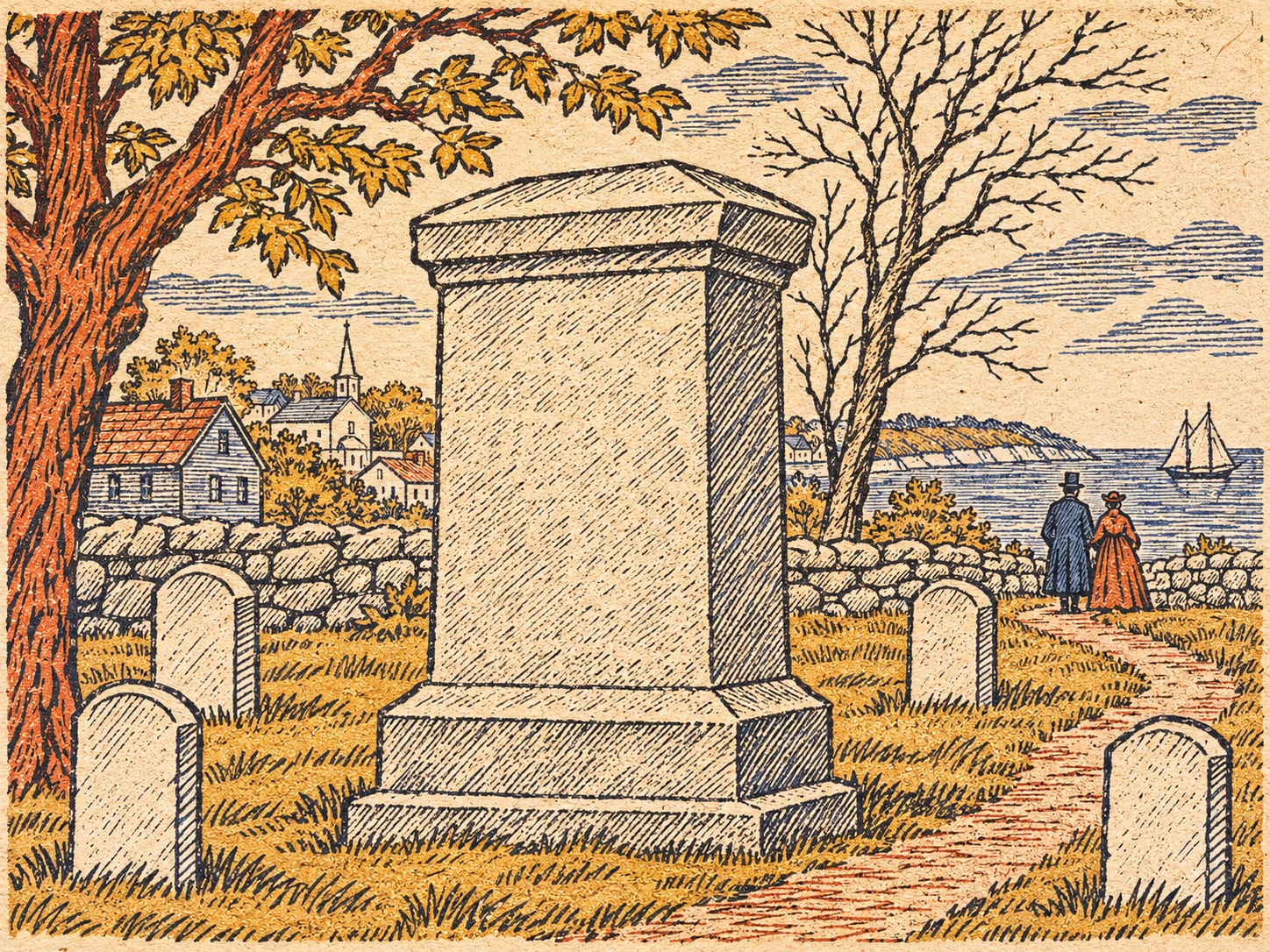
In Marion, Massachusetts, Evergreen Cemetery holds a Briggs family memorial for Benjamin, Sarah and Sophia, whose bodies were never recovered. It marks them and is not a grave for remains tied to the ship. The Sippican Historical Society in Marion keeps a Mary Celeste Room.
The Peabody Essex Museum's Phillips Library holds the Briggs papers, including Sarah's letters, and the museum also keeps objects tied to the case, among them the captain's sword and a lap desk. Individual objects may not always be on display, so confirm with the museum before visiting.
The Mary Celeste, from launch to wreck
- 1861
The ship is launched at Spencer's Island, Nova Scotia, as the Amazon
- 27 October 1872
Sarah Briggs writes to Arthur that she and Sophia have joined the ship
- 7 November 1872
The Mary Celeste leaves New York Harbor for Genoa with 1,701 barrels of industrial alcohol
- 4 December 1872
The Dei Gratia finds her about 400 miles east of the Azores, with no one aboard
- 13 December 1872
The Gibraltar Chronicle reports the find
- 21 December 1872
Captain Morehouse and the Dei Gratia crew are allowed to leave Gibraltar
- 23 December 1872
Surveyor John Austin examines the ship for about five hours
- 25 February 1873
The ship is returned to her American owners
- 14 March 1873
Chief Justice Cochrane gives judgment and the salvors receive £1,700
- January 1884
Conan Doyle's story appears in The Cornhill Magazine
- 3 January 1885
The ship is deliberately run onto Rochelais Reef, Haiti
- 9 August 2001
A Haitian wreck is announced as the Mary Celeste, an identification now disputed
Sources
- "Abandoned Ship: The Mary Celeste," Smithsonian Institution
- "Courthouse," Government of Gibraltar heritage pages
- Mary Celeste salvage inquiry sworn testimony at Gibraltar, document archive, and the Fay transcription of the court record
- Surveyor John Austin's report and Dr J. Patron's report, as published on maryceleste.net
- Gibraltar Chronicle, December 1872 to March 1873, Gibraltar Garrison Library
- Benjamin Spooner Briggs Papers, Phillips Library, Peabody Essex Museum
- Old Dartmouth Historical Sketches, No. 74, New Bedford Whaling Museum
- The Odyssey of the Mary Celeste, Canadian Department of National Defence
- "Mary Celeste, Facts Not Fiction," maryceleste.net
- Arthur Conan Doyle, "J. Habakuk Jephson's Statement," The Cornhill Magazine, January 1884
- National Underwater and Marine Agency expedition report, 2001, and The Independent on the tree-ring analysis
- "What Happened to the Mary Celeste?" HISTORY
- "El extraño caso del Mary Celeste," Revista General de Marina
Watch the full story on the Flashback Fables YouTube channel, and send it to someone who would love it.