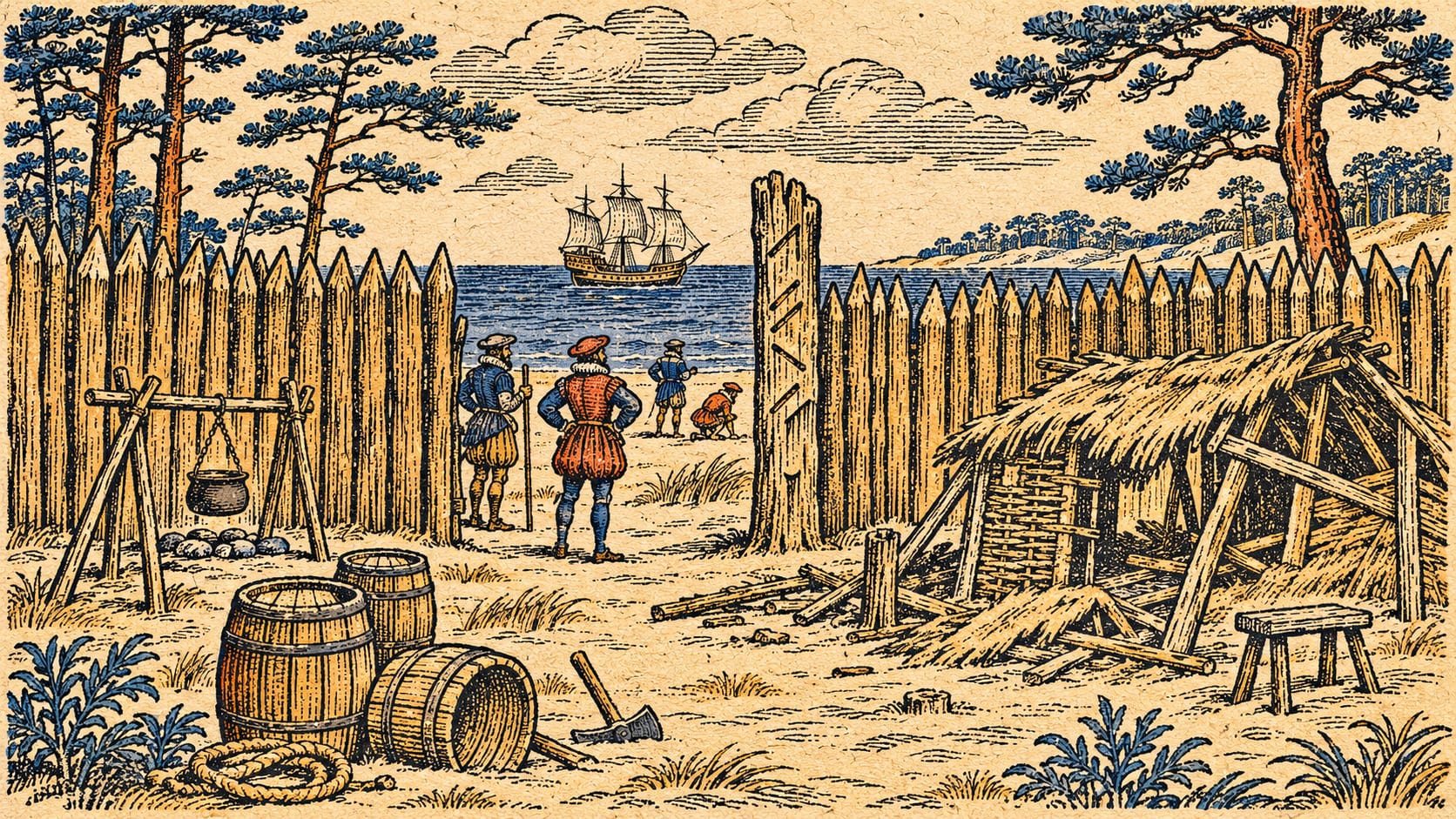
On 18 August 1590, John White, governor of the English colony of 1587, walked into the settlement on Roanoke Island and found it empty. The houses had been taken down. A substantial palisade now enclosed the site.
About 115 colonists had been left there in 1587, among them White's granddaughter, Virginia Dare, who was born on the island. At the entrance to the palisade, a word was carved into a post or a tree: CROATOAN.
That word, three letters on a tree, and no sign of a fight are what the colonists left behind. Where they went has never been settled, and every theory comes with its own clues and its own gaps. Dates in this story follow the Julian calendar the English used at the time.
Why English settlers were on Roanoke Island
Roanoke came in two waves. In 1585, Sir Walter Raleigh organized a military colony on the island, with about 600 sailors, soldiers and other participants. Ralph Lane is associated with that expedition.
The 1587 expedition was a different kind of venture. It was meant to be a permanent settlement, and the plan was for it to stand on the Chesapeake Bay. The charter named John White governor and gave him twelve assistants, among them Ananias Dare, Roger Baylye, Christopher Cooper, John Sampson and Simon Ferdinando.
The colonists are commonly counted as 115 people. National Park Service figures run to 117 or 118, depending on whether assistants, sailors, deaths and children born after arrival are counted.
The roll Richard Hakluyt printed is headed "The names of all the men, women and children, which safely arrived in Virginia, and remained to inhabite there. 1587." It sorts the people into men, women, boys and children, children born in Virginia, and the Native men who came back from England with the expedition. Among the women stand Elynor Dare, Margeery Harvie, Agnes Wood, Joyce Archard, Jane Pierce and Rose Payne. Among the boys are James Sampson, Robert Ellis and Thomas Archard. The list gives names and groups, not ages or trades, and spellings vary from one transcription to the next.
Manteo, Wanchese and the death of George Howe
Two Native men had sailed to England with the 1584 expedition and came home with the English. Manteo was a Croatoan man from the Outer Banks. Wanchese belonged to the Roanoke community associated with Dasemunkepeuc. Manteo kept working with the English as an interpreter and go-between. Wanchese went back to his own people and turned against the English colony.
Soon after the settlers landed in 1587, George Howe, one of the assistants, went into the water near Hatorask to catch crabs. Native men attacked him and shot him with arrows. The English believed the attackers were Roanoke people from Dasemunkepeuc.
The colonists believed Wanchese led those people and planned to strike back. Manteo guided the English party, but the village was empty. The people they found there were Croatoan men gathering supplies from the abandoned Roanoke settlement, not the men the English meant to punish. The party attacked the wrong people. White's account says that Manteo, "somewhat grieved at this mishap, did nevertheless remain with us."
On 13 August 1587, Manteo was baptized in the Church of England. The English account says that "by the commandement of Sir Walter Ralegh," he "was christened in Roanoak, and called Lord thereof, and of Dasamongueponke, in reward of his faithfull service." The title was an English grant, not necessarily one the communities it named accepted. Manteo's later fate is unknown.
Five days later, on 18 August 1587, Virginia Dare was born on Roanoke Island. She was the daughter of Eleanor Dare and Ananias Dare, and the granddaughter of the governor. The roll names another child born in the colony, a Harvie, whose given name is not recorded.
Why John White sailed away
Eleven days after his granddaughter's birth, on 29 August 1587, White left Roanoke for England. He went to bring back more settlers, food, tools and supplies.
The colonists had reasons to want him gone on that errand. They faced food shortages, worsening relations with nearby Algonquian communities and the approach of winter. They asked White to return to England for help, and he reached England on 8 November 1587.
Then a war got in the way. England and Spain were enemies, and the Anglo-Spanish war delayed his return voyage. Raleigh meant to resupply the colony in 1588, and White expected a ship to leave that spring. But Queen Elizabeth I needed English ships for the nation's defence, and in 1588 they were needed to resist the Spanish Armada. Privateers and relief captains were more interested in attacking Spanish shipping.
In 1589 Raleigh assigned much of his colonial patent to a group of investors, who became the "Governor and Assistants of the Cittie of Ralegh in Virginia." Richard Hakluyt and the London merchant Thomas Smythe were among the backers. Raleigh's attention was turning to Ireland. White had to find passage with privateers and merchant-backed vessels, and in 1590 he sailed on the Hopewell, tied to the merchant John Watts and other private investors.
White was finally able to return to Roanoke in August 1590, close to three years after he left.
Roanoke, from settlement to empty palisade
- 1585
Sir Walter Raleigh organizes a military colony of about 600 on Roanoke Island
- 13 August 1587, Julian calendar
Manteo is baptized on Roanoke Island
- 18 August 1587, Julian calendar
Virginia Dare is born on Roanoke Island
- 29 August 1587
John White leaves for England to bring supplies and settlers
- 8 November 1587
White reaches England
- 1588
English ships are needed to resist the Spanish Armada
- 18 August 1590
White reaches the abandoned settlement and finds CRO and CROATOAN carved
- 4 February 1593, Julian calendar
White writes to Richard Hakluyt from Ireland
- 1937
The Dare Stones are publicized in the United States
- 1941
An investigation publicizes the Dare Stones as forgeries
What John White found on 18 August 1590
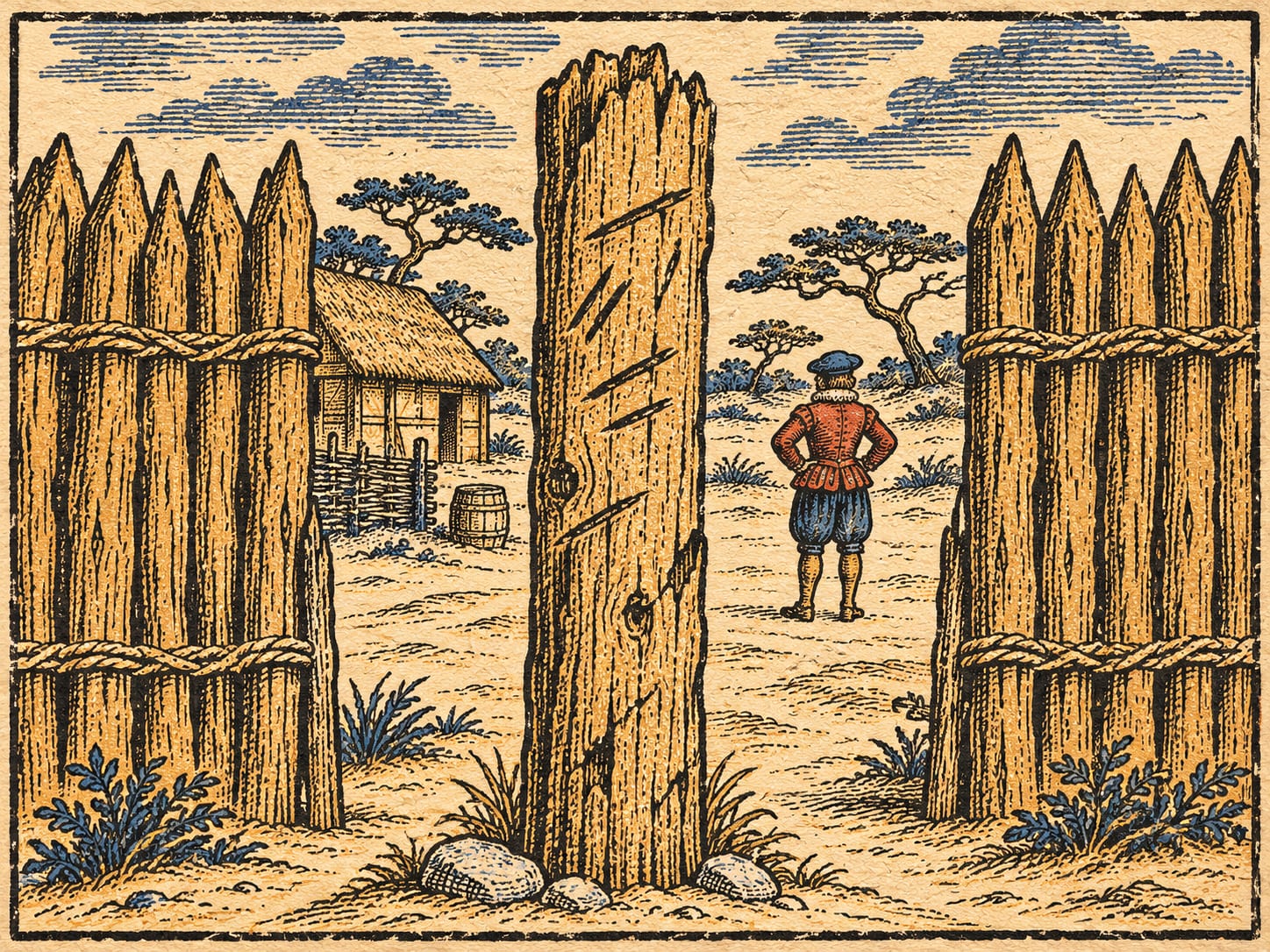
The houses had been taken down, and the site had been enclosed with a palisade. On a tree, White found the letters CRO. At the entrance to the palisade, carved into a post or a tree, stood the full word, CROATOAN. It appeared without a cross or any other sign of distress.
He reported no bodies, no battle scene and nothing that looked like an emergency. Some heavy equipment and supplies had been left behind, including iron bars, lead, firearms and shot.
The carvings point toward Croatoan, which was the name of both an Indigenous people and the island now called Hatteras Island. They do not say what happened afterward. White himself took them as good news: "I greatly joyed that I had safely found a certain token of their safe being at Croatoan, which is the place where Manteo was born, and the savages of the island our friends."
The agreed signal, and the missing cross
Before he sailed in 1587, White had given the colonists an instruction. If they moved away from Roanoke, they were to carve the name of their new location on a tree, a post or a door.
If they had been forced to leave because of danger or attack, they were to carve a cross over the letters. White found CRO and CROATOAN, and no cross. He read that as a sign the move had not been made under immediate duress.
That was White's reading of the agreed signal. It did not show that the colonists had survived, or that they had reached Croatoan.
The storm that kept the ships from Croatoan
White meant to follow the carving. The rescue fleet was the Hopewell, the John Evangelist and the Little John, and White's narrative, printed by Hakluyt, tells what happened next.
The weather turned. "The wind and seas were so greatly risen," White wrote, "that we doubted our cables and anchors would scarcely hold until morning." The next morning, "it was agreed by the captain and myself, with the master and others, to weigh anchor, and go for the place at Croatoan, where our planters were."
Then the gear failed. "When the anchor was almost aboard, the cable broke, by means whereof we lost another anchor." A third anchor was let fall, and "came so fast home that the ship was almost aground by Kenrick's mount." White's tally: "We had but one cable and anchor left us of four, the weather grew to be fouler and fouler, our victuals scarce, and our cask and fresh water lost."
It was decided to sail south for Saint John or another island to find fresh water, and the ships did not go on to Croatoan. White's narrative also names the cost in men. Captain Abraham Cooke and Captain Edward Spicer led boats, and Spicer's boat overturned. Cooke pulled four men from the water. Spicer, Ralph Skinner, Edward Kelley, Thomas Bevis, Hance the surgeon, Edward Kelborne and Robert Coleman drowned.
Where Croatoan was, and who lived there
Croatoan was a neighbour the colonists knew. Manteo, a Croatoan man, had lived with the English and served as an interpreter. The Croatoan community had kept up friendly relations with the English.
The carved word named a place and a people the colonists had reason to trust. That is the strongest documentary clue in the story, and it is where one theory starts: that some or all of the colonists went to live with Croatoan communities.
On Hatteras Island, archaeologists have recovered sixteenth-century European objects, including English pottery and metal items, from areas associated with the Croatoan people. The finds fit contact, trade, or the presence of some colonists. They could also have moved through trade, so they do not show that the whole settlement relocated there or joined the community.
What the ground has turned up
Archaeology has confirmed English activity in the Roanoke region. It has not located the colony's final home.
At Fort Raleigh, the National Park Service reports a barrel found offshore in 1982, a copper necklace recovered near the Thomas Hariot Trail in 2008, and fragments of tin-glazed earthenware found in 2016.
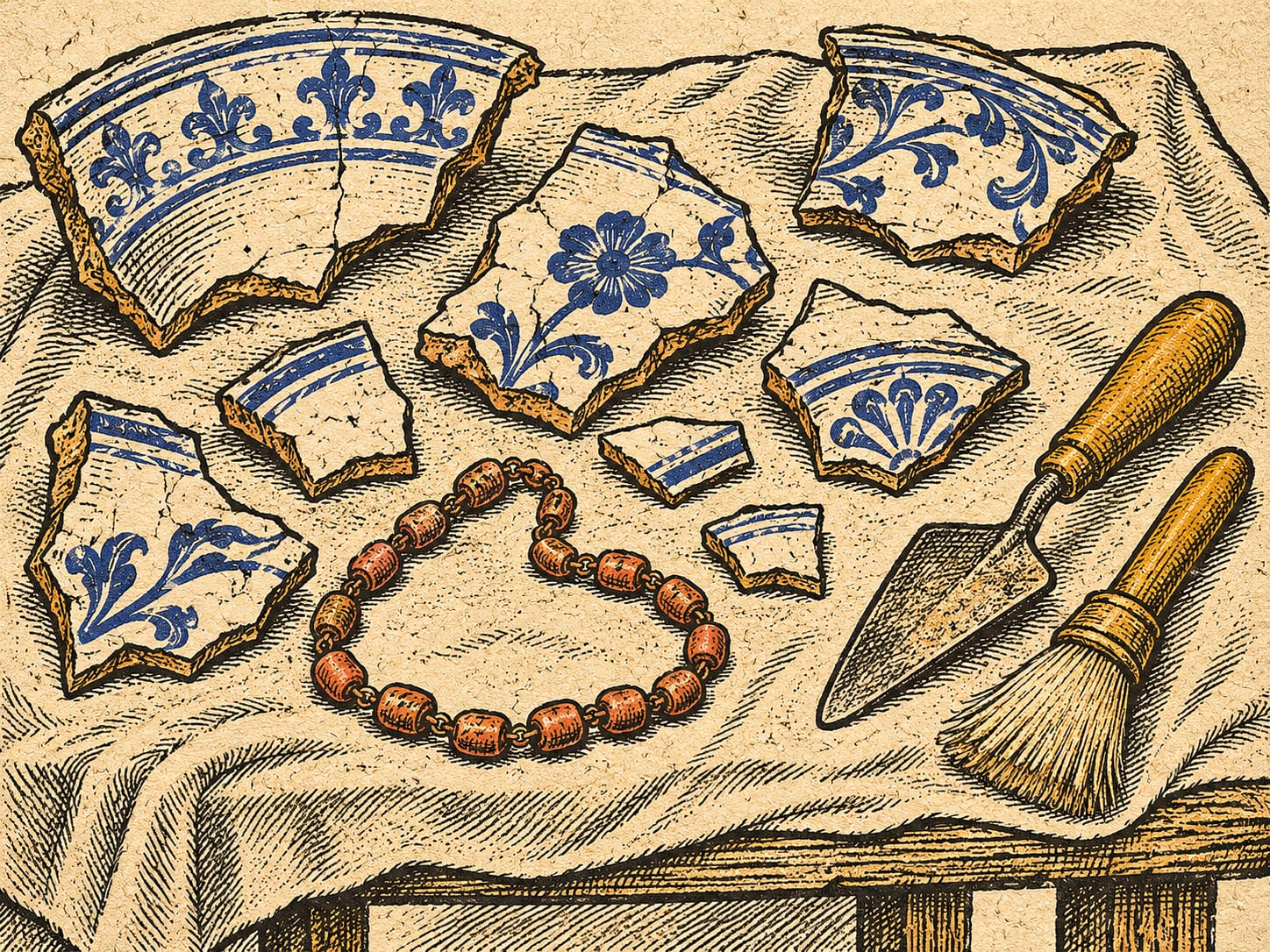
On Hatteras Island, Mark Horton of the University of Bristol and Louisa Pittman dug eight test pits at Buxton and Frisco in November 2009. Frisco was a Native site from the Middle Woodland period. A Buxton pit held Croatoan material mixed with European material, including an unfired musket ball, earthenware and a pipe. In 2012 a two-week dig turned up Croatoan pipes and pottery, lead shot, English gunflints, iron objects, glass trade beads and possible longhouse structures. By 2016 the Croatoan Archaeological Society and the Bristol team had opened about 75 pits, with deposits running from roughly 10,000 BCE to about 1750.
Horton read the Hatteras finds as consistent with English people living among the Croatoan. Scott Dawson of the Croatoan Archaeological Society argued that the entire colony joined the Croatoan and stayed well fed. Other historians have pointed to trade, shipwrecks, later visitors, castaways, pirates or runaway servants as ways the objects could have arrived. Horton did not claim that every colonist went to Hatteras.
David Phelps's Cape Creek digs in the 1990s produced thousands of artifacts, among them a sixteenth-century gunlock and a gold signet ring. The ring came from a seventeenth-century soil layer, so it does not tie back to the 1587 colonists.
Across Albemarle Sound, First Colony Foundation Site X, in Bertie County near Salmon Creek and the western end of the sound, turned up in a 2007 shovel-test survey. Excavations in 2012 and 2014 opened 79 square meters and found at least 34 features. Nineteen of the 21 tested were Native American; at least two were historic. The English pottery and objects came from plow-disturbed soil rather than a sealed feature. They include Surrey-Hampshire Border ware, North Devon jars, nails, bricks and a lead cloth seal from Augsburg, Germany, from the late sixteenth century. A Native village, Mettaquem, stood nearby.
The foundation's archaeologists, among them Nick Luccketti and Bly Straube, read Site X as a late sixteenth-century English presence tied to Raleigh's colonizing. Their working hypothesis is that a small group of Roanoke survivors may have spent time there. It does not claim Site X was where most of the 1587 colonists went. The site has produced no confirmed Roanoke buildings, graves, human remains or settlement layer tied to the 1587 group.
In 2012, British Museum curators examined the two paper patches on John White's map of the region, "La Virginea Pars." Imaging showed a fort-like symbol beneath the northern patch, near the head of Albemarle Sound. It may mark a planned inland settlement. It does not say what became of the colonists.
What English writers heard later
The English never saw the colonists again. What they gathered instead came second-hand, from Native informants, interpreters and Jamestown officials, and it points in several directions.
William Strachey, writing around 1612, named a Native informant, Machumps. Strachey wrote that at Ritanoe "the Werowance Eyanoco preserved seven of the English alive, four men, two boys, and one young mayde, who escaped the massacre and fled up the river of Chanoke." That was about twenty-five years after the colony vanished, and the places he names are still debated.
John Smith's map from the Jamestown years carries a note usually transcribed as "Here remayne the 4 men clothed that came from Roonock to Okanahowan." In 1609 the Virginia Company told Governor Thomas Gates to search for four English colonists who supposedly had escaped "from the slaughter of Powhatan of Roanocke" and were living under another werowance's protection. That was a search order, not a report that anyone had been found.
In 1709, John Lawson wrote in A New Voyage to Carolina that "The Hatteras Indians, who either lived on Roanoke-Island, or much frequented it, tell us, that several of their ancestors were white People, and could talk in a Book, as we do." He was passing on what Hatteras people told him, more than a century after the colony disappeared. None of these three names Virginia Dare or any other colonist.
Five theories, and what stops each one
Each explanation has a clue pointing toward it and a gap that keeps it from being settled.
White had told the colonists to move about 50 miles inland if they left Roanoke. The fort-like symbol under the patch on his map points toward the western Albemarle Sound, and later English reports described possible survivors, or people of European descent, living among Indigenous communities.
Jamestown colonists recorded reports that some earlier English settlers had been killed in fighting before Jamestown was founded. Those reports were written years after the disappearance, and no archaeological find has tied the Roanoke colonists to the Chesapeake region.
A group that scattered could have left few identifiable remains. A Spanish attack is possible in the wider context of the war, since Spanish officials monitored English activity in North America, but nothing in the surviving Roanoke story describes one. What is firm is narrower: the site was abandoned, CRO and CROATOAN were carved there, and no distress cross was.
What became of John White
White never went back to America. After 1590 he lived at Newtown in Kylmore, Ireland, on land tied to the Munster plantation. From there, on 4 February 1593 by the English calendar of the time, which is 14 February by the Gregorian calendar, he wrote to Richard Hakluyt, who printed the letter with White's account of the 1590 voyage.
White put part of the blame on how the expedition was run. The misfortunes would not have happened, he wrote, "if the order set downe by Sir Walter Ralegh had bene observed, or if my dayly and continuall petitions for the performance of the same might have taken any place." He called the voyage "as lucklesse to many, as sinister to my self." He was out of money. "Wanting my wishes," he wrote, "I leave off from prosecuting that whereunto I would to God my wealth were answerable to my will."
He still hoped for the settlers. He committed "the relief of my discomfortable company the planters in Virginia, to the merciful help of the Almighty," and took his leave. That letter is the latest known document in which White writes about the colonists. He probably died in Ireland around 1606; the exact date and place are not known.
Raleigh organized no successful relief expedition. His 1595 voyage to Guiana was presented as tied to Virginia and exploration, but it did not rescue the Roanoke colonists, and no Raleigh-backed expedition after that found the settlement.
The Dare Stones
In 1937, a carved stone was presented to the public by Louis Hammond, who said he had found it near Edenton, North Carolina. Its inscription purported to come from Eleanor Dare. It described the colonists moving inland, suffering attacks and disease, and losing most of their members.
The stone appeared during intense public attention to the 350th anniversary of Virginia Dare's birth and the opening of Paul Green's outdoor drama The Lost Colony. It drew attention at Emory University.
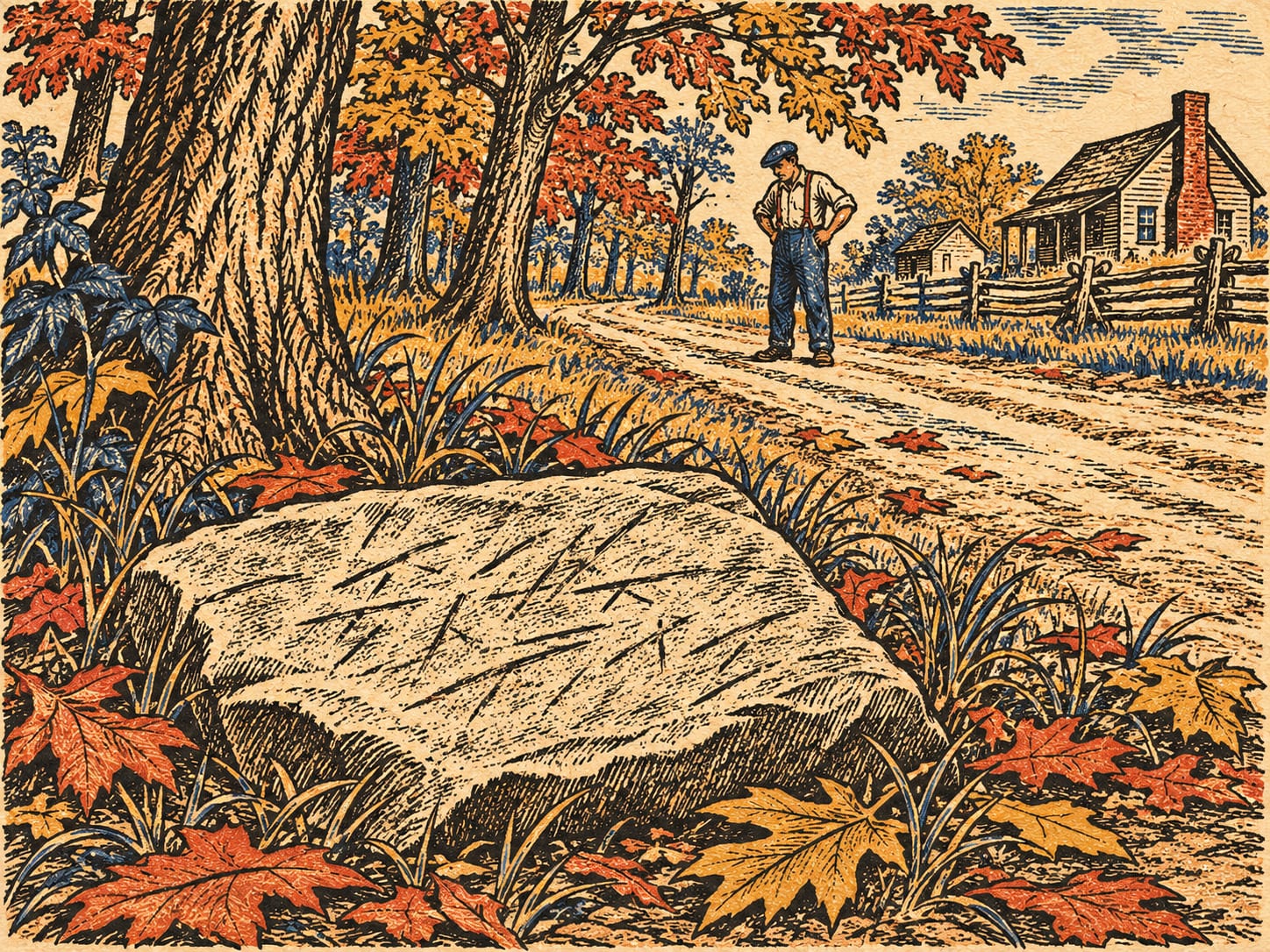
Then a reward was announced for more stones, and dozens turned up, many tied to Bill Eberhardt, a stonemason. Investigators found inconsistent provenance, wording that did not fit the sixteenth century, unusual spelling, questionable use of initials and similarities among the inscriptions. Haywood J. Pearce Jr. eventually acknowledged that he had been deceived.
A 1941 investigation publicized the stones as forgeries. Historians and museums rejected them as evidence. Some later supporters have argued that the original stone could be genuine, but it is not accepted as a solution to the Roanoke disappearance.
The Lumbee and the theory of 1885
In 1885, Hamilton McMillan, a North Carolina legislator and local historian, proposed that the people North Carolina then recognized as the "Croatan Indians" were descended from Croatoan people and from survivors or descendants of Raleigh's colonists. He pointed to the carved word, Hatteras traditions, English surnames and reports of people with European features in Robeson County.
The Lumbee tradition has never been uniform, and the Lumbee position is that Lumbee ancestry includes several Native peoples, which may include Croatoan or Hatteras ancestry. Its claims are not limited to descent from the Lost Colony. Historian Virginia DeMarce and genealogist Paul Heinegg have both argued that English surnames alone cannot establish descent from Roanoke colonists. J. Cedric Woods's 2004 genealogical study traced some Lumbee families to Tidewater Virginia and North Carolina, and cautioned that matching surnames cannot prove the same families moved.
So, the link between Roanoke and the Lumbee is a nineteenth-century theory, not a documented sixteenth-century identification. The debates about it concern Lumbee origins and federal recognition, not whether the Lumbee people are who they say they are.
What Fort Raleigh shows today
Fort Raleigh National Historic Site tells the story of England's Roanoke voyages: the 1585 military settlement, the 1587 colony, John White's return in 1590, Virginia Dare, the Indigenous communities of the region and the archaeological work since.
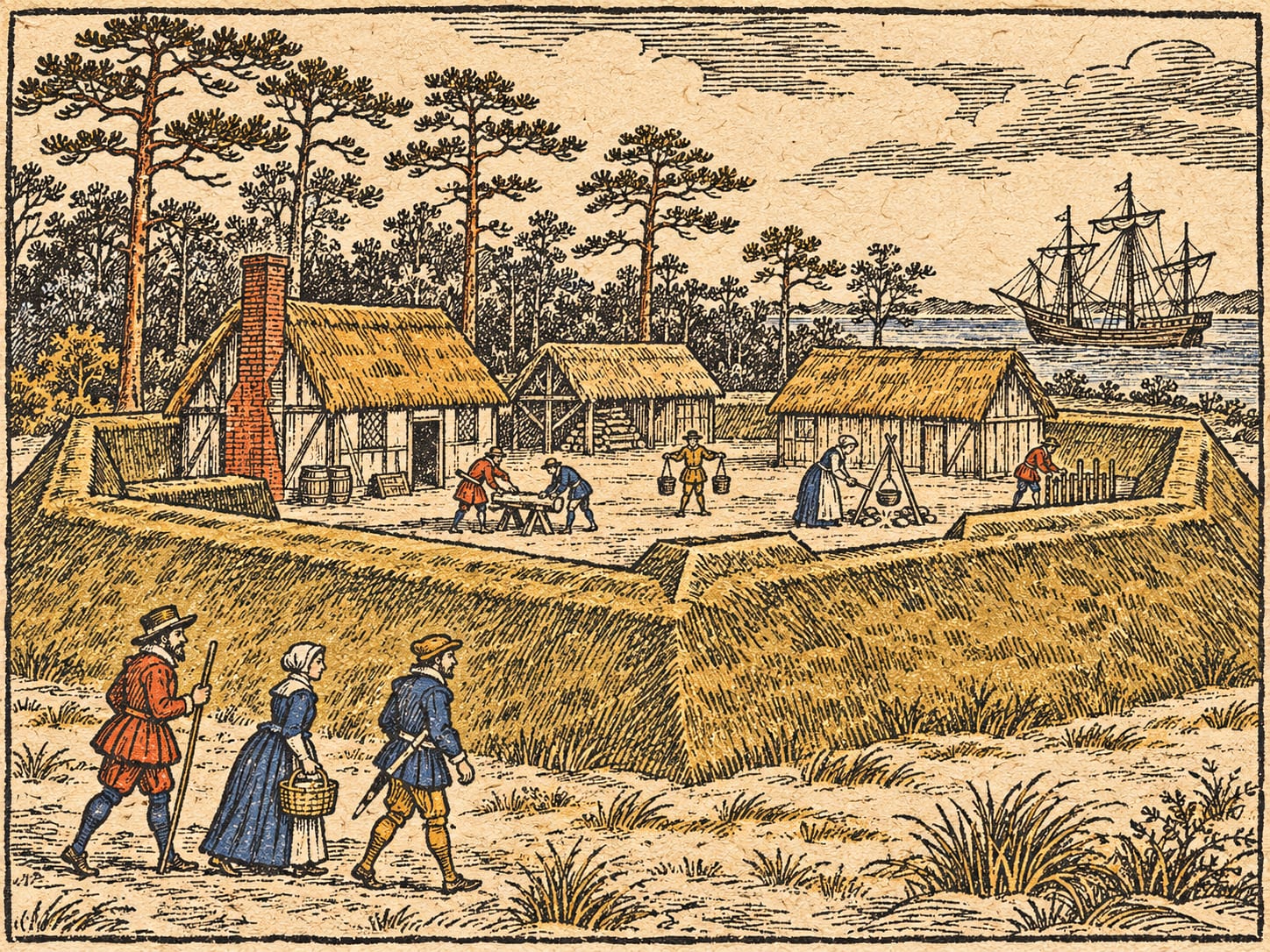
The earthwork was reconstructed in 1950 using studies of the ditch, slopes and interior dimensions. Visitors can see it, the Lindsay Warren Visitor Center with its 17-minute film and late sixteenth-century artifacts, the Thomas Hariot Trail, the Freedom Trail, the 1896 monument and the outdoor production The Lost Colony. The tree and post that bore CRO and CROATOAN are not preserved, and their exact locations are unknown. The park grounds are open year-round with no entrance fee.
Beside the fort, the Elizabethan Gardens were begun on 2 June 1953 by the Garden Club of North Carolina as a memorial, and opened on 18 August 1960, the 373rd anniversary of Virginia Dare's birth. They are a twentieth-century memorial landscape, not a colonial garden.
The Lost Colony opened on 4 July 1937 at the Waterside Theatre, written by the North Carolina playwright Paul Green. Its opening season had 37 scheduled performances and drew about 50,000 spectators. The drama stopped during the Second World War and has run as a seasonal outdoor show since. It is a dramatized interpretation, not a documentary reconstruction.
Sources
- "Participants of the Lost Colony Voyages," National Park Service
- "1587: The Lost Colony" and "1590 Rescue Voyage," National Park Service
- "Major Theories of the Lost Colony," "Archaeology at Fort Raleigh," and "Manteo," National Park Service
- Fort Raleigh National Historic Site brochure and frequently asked questions, National Park Service
- "Commemorating Fort Raleigh," National Park Service
- John White's 1590 narrative, in Richard Hakluyt, The Principal Navigations, National Humanities Center
- Letter of John White to Richard Hakluyt, 1593, in The Principal Navigations
- "John White Returns to Roanoke," Encyclopedia Virginia
- Hakluyt Roanoke Colonies, East Carolina University
- William Strachey, Historie of Travaile into Virginia Britannia, and John Lawson, A New Voyage to Carolina
- "Site X Archaeological Brief" and British Museum map findings, First Colony Foundation
- "Have We Found the Lost Colony?" American Heritage, and "Back to Square One With Lost Colony?" Coastal Review
- "La Virginea Pars," British Museum
- "The Dare Stones," NCpedia
- "The Dare Stone, Hoax or Message?" IFLScience
- "Lumbee's Self-Identification as Croatan Indians," U.S. Congressional hearing record, and Lumbee origins bibliography, Appalachian State University
- History of the Elizabethan Gardens, and About The Lost Colony, The Lost Colony outdoor drama
- Interview with James Horn, Boston University Historical Society
Watch the full story on the Flashback Fables YouTube channel, and send it to someone who would love it.