
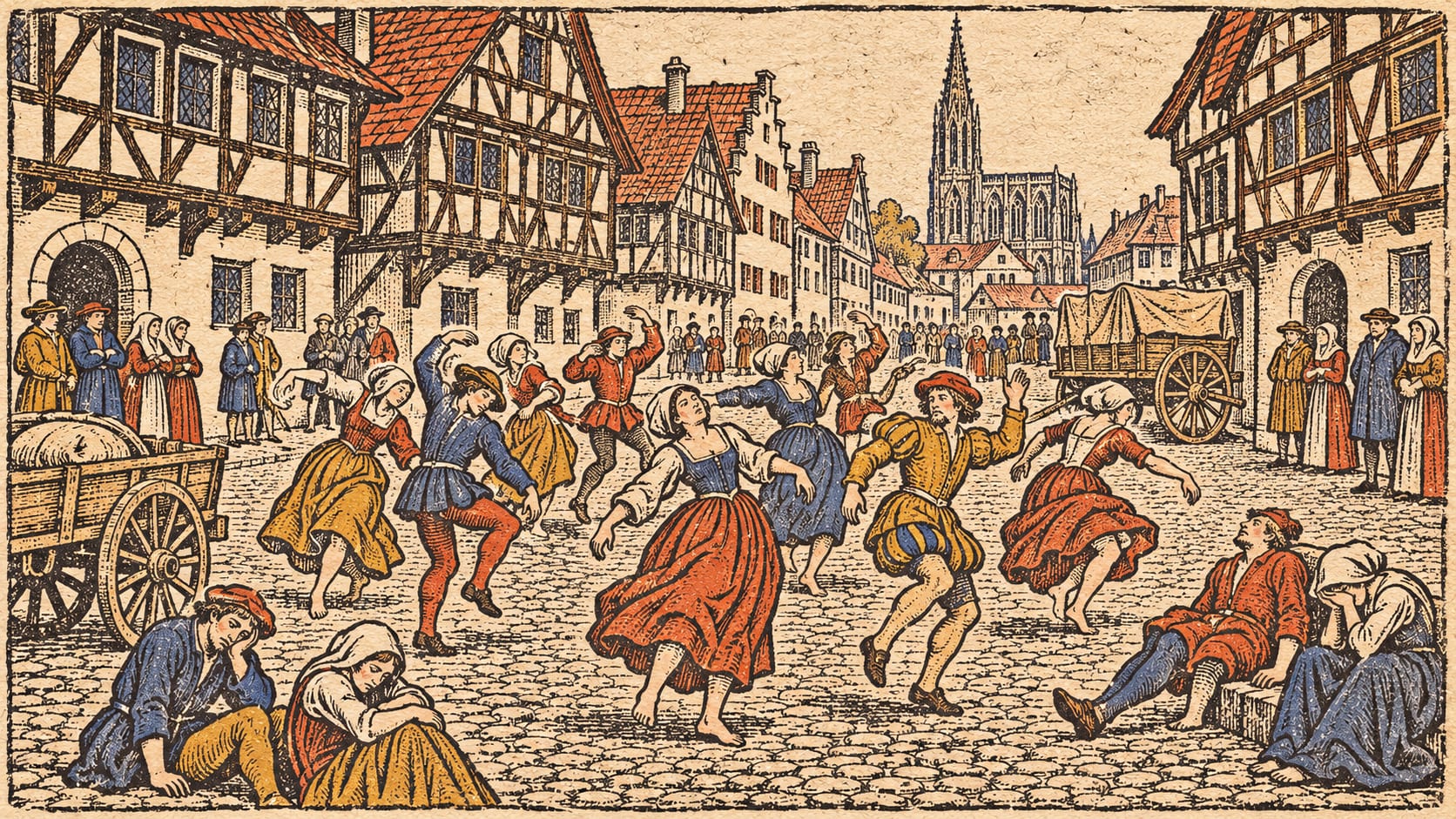
Yes, it happened: in July 1518, dozens of men and women danced in the streets of Strasbourg for weeks, and later chroniclers said many of them died.
How many died is unknown. Chroniclers writing decades later said many danced to death, and the city's own orders name no count. The numbers that circulate today, 400 dancers and 15 deaths a day, are later estimates.
Strasbourg's rulers treated it as an illness. They called in the city's doctors, sent dancers by wagon to a shrine of Saint Vitus in the hills above Saverne, and on 2 August 1518 banned public dancing. Strasbourg used the Julian calendar then, and the 1518 dates below follow it.
Strasbourg in the summer of 1518
Strasbourg probably held about 20,000 people around 1500, and a figure in the low tens of thousands is reasonable for 1518. The spring had been hard. Frost in April 1518 sent grain prices sharply up.
From Pentecost to Saint Martin's Day, the Magistrate opened the municipal granaries and sold 50,000 quartauts of grain, each of 117 litres, at 8 sous. The market price stood at 18 or 19 sous. The city's grain store, built in 1441, could hold nearly 60,000 hectolitres, so the city had reserves and spent them to hold prices down.
Nothing in the city's papers calls the summer a famine. The Magistrate's letter of 25 July calls the dancing an "unusual illness". One 1518 ordinance says the dancing illness had appeared "again", which does not by itself show an earlier outbreak in Strasbourg.
The city knew other diseases. It had used religious processions during earlier appearances of syphilis and during plague years. Hieronymus Brunschwig had written on surgery and syphilis, and Hans von Gersdorff published a major surgical work in 1517. The 1518 papers diagnose the dancers with neither plague nor syphilis.
Frau Troffea and the start of the dancing
On 25 July 1518, the Strasbourg Magistrate answered a request from Bishop Wilhelm von Honstein for a report on the illness. The letter says: "It began with one woman, and afterward other people began to dance. We kept these people under guard for several days and questioned the doctors."
The doctors called it a natural illness, caused by an astral conjunction and by the heat of the time. The Magistrate added: "Nevertheless, it is slowly coming to an end." It was not. A note in Sebastian Brant's hand, dated 3 August in the scholarly discussion, still calls it a "horrible episode" of "sick, dancing persons".
The letter does not name the woman. The name Frau Troffea comes later. Beat von Duntzenheim wrote his chronicle after 1541 and was probably born after 1515. His manuscript burned in the Strasbourg library fire of 1870, and one passage survives in Léon Dacheux's nineteenth-century publication. In translation it reads: "the madness began with a woman who first danced continuously for four days. A few days later there were already thirty-four dancing, and in the fourth week the number rose to more than two hundred."
Paracelsus later named her Frau Troffea and wrote that she danced alone for three days after leaving her house on 14 July 1518. Paracelsus was not there, and his text does not name Strasbourg, though the link is probable.
The start date varies too. John Waller places the start of the dancing on 14 July 1518. Strasbourg historical research puts the opening gatherings on 15 July, the feast of Saint Margaret. In the Gregorian calendar, those two Julian days fall at about 24 and 25 July.
So Frau Troffea is a later name for the unnamed woman in the city's letter. Her identity, her starting day and the length of her solo dance, three days in one telling and four in another, all come from chronicles written years afterward.
How many danced
The outbreak ran for several weeks in July and August 1518. The number of dancers depends on who is counting, and when.
Wilhelm Rem was an Augsburg merchant who kept a chronicle covering 1512 to 1527, and he was not in Strasbourg. He wrote that in the summer of 1518, Saint Vitus's dance "came upon very many people at Strasbourg, so that on one day it seized about 15 people." He added that it went on a long time, "so that dancing, piping, and drumming were forbidden."
Fifteen people seized in a day is what Rem wrote. Fifteen dead is a later reading of his line. Hundreds may have taken part, and no final total survives.
How many died
The death toll is not established. Daniel Specklin was born in 1536 and became Strasbourg's architect-engineer. He wrote about six decades after the event: "They danced day and night until they collapsed from exhaustion." Later in the same account he says, "Many danced until they died."
A later poem and later chronicles say the same. John Waller's 2008 article reads the chronicles as reporting dozens of deaths from exhaustion. The figure of 15 deaths a day is a later estimate built on Rem's 15 new sufferers.
The city's own 1518 papers speak of sick and dancing people and never of the dead. Whatever the number, these were Strasbourg's own men, women and children, and the council answered with doctors, wagons and a ban.
What the council did
The Strasbourg Magistrate treated the outbreak as a medical problem. It kept dancers under guard for several days, a commission questioned families about the children who were dancing, and the Magistrate consulted the city's doctors. The Ammeister, the city's annual leader, was Andres Drachenfels.
On Friday 23 July 1518, the day after Saint Mary Magdalene's Day, three delegates met on the matter: Claude Bocklin, Caspar Hoffmeister and Martin Herlin. They decided to tell citizens whose children were dancing "that they should care for them and keep them at home, or else contribute to their expenses."
A man named Staden Jerg was summoned. He said he was a poor servant who could not keep his son at home, and he asked that the boy be kept with the others or taken to the saint. His female relative collected 15 schillings for his son, and the wardens of the carpenters' guildhall kept the money.
The same day, the delegates ordered the sufferers split into groups, each with attendants who were to stay with them. They ordered wagons for the trip to Saverne: one three-horse wagon from the hospital steward and two from the cathedral's Frauenhaus, three wagons in all, enough for about 60 people. Three or four priests were to be arranged with the dean of Saverne, and each group was to attend a sung mass and be led around the altar. Each person was to give one penny after the mass, and the attendant paid for anyone who could not.
The 25 July letter says those affected had already been watched and taken to Saint Vitus. The city also planned a sung mass with litanies in Strasbourg churches on 28 July, considered a Saint Vitus chapel in the cathedral, and ordered a candle weighing one hundredweight for the saint, with one sung mass and three low masses.
On 2 August 1518, the Magistrate banned public dancing in Strasbourg and its jurisdiction until Saint Michael's Day, 29 September, under a fine of 30 sous. The ban named kettledrums and drums. It allowed honorable people to dance privately at a wedding or a priest's inaugural mass, as long as they used string instruments and not drums. Brant's note gives the reason: public dancing got in the way of the sufferers' recovery.
Sebastian Brant, the secretary who signed the ban
Sebastian Brant signed the 2 August order. He was a trained jurist and a former professor at Basel, and in 1494 he had published the satire Das Narrenschiff in Basel. He returned to Strasbourg in 1501 as a legal adviser to the council and became city secretary at the start of 1503. He held the post until he died on 10 May 1521.
Das Narrenschiff is about folly and vice in general. It does not report the dancing. City mandates on the Passion plays from 1512 to 1518 show him regulating public performance, noise and crowd behavior. They concern the plays, not the dancing illness.
His Annales, partly built on council minutes and his own notes, burned in the 1870 library fire. Passages copied by later scholars survive. They give the council's reading that the illness was natural and came from "heated blood", and they describe the move to Saint Vitus and the ban on public dancing.
The stage and the musicians: Specklin's version
A better-known story gives the council a different plan. Specklin says that guildhalls were placed at the dancers' disposal, that a platform was built in the horse market and another in the grain market, and that people were hired and paid to dance with them to drums and fifes. "None of this helped," he writes.
The pilgrimage to Saint Vitus is better backed. The council's instructions of 23 July and the letter of 25 July both mention it. Specklin adds that the sufferers were sent by wagon beyond Saverne to Hohlenstein, given crosses and red shoes, and had masses said for them. He writes that a cross was drawn above and below the shoes with chrism and that they were sprinkled with holy water in the name of Saint Guy. "This cured almost all of them," he says, and adds: "There was also much swindling in all this."
So, there are two accounts of the council. In the city's own papers, it supervises, consults doctors, sends dancers to a shrine and bans dancing. In Specklin's chronicle, written about sixty years later, it turns the markets into dance floors. The red shoes, the crosses and the oil belong to the later telling.
What the doctors advised
The city's doctors called the illness natural. They blamed an astral conjunction and the heat of the season, and Brant's Annales describe it as overheated blood. The letter does not name the doctors.
Their advice, as the council passed it on, was practical:
- Do not give the dancers wine.
- Give them barley water.
- Give them bread or porridge made from barley and oats.
- Play music on dulcimers, violins, lutes or small organs.
- Leave out kettledrums and fifes.
None of it mentions ergot poisoning, demonic possession or mass psychogenic illness. It reflects the medicine of 1518, in which heat and disturbed bodily fluids could make a person sick.
Paracelsus wrote about Saint Vitus's dance in a treatise composed around 1531 to 1532 and published in later editions. He discussed imaginary diseases, possession and dancing illness, and he repeated the story of Frau Troffea, but he did not witness the 1518 outbreak.
Saint Vitus and the shrine above Saverne
Saint Vitus, also called Saint Guy, was a Christian martyr whose cult spread from Italy into France and Germany from the ninth century. By the early modern period he was one of the Fourteen Holy Helpers, invoked for epilepsy, convulsions, tremors and other illnesses of movement. In southern Germany and Alsace, people called on Saint Vitus and Saint John the Baptist against dancing illnesses. The phrase "Saint Vitus's dance" could name the saint's help or the illness itself.
The pilgrimage to Hohlenstein existed before the end of the fifteenth century. A donation book from 1508 shows donors coming from Alsace, Lorraine and neighboring regions. Strasbourg's order of 23 July sent its dancers to a place the region already trusted.
Hohlenstein is now the Grotte Saint-Vit, about three kilometres southwest of Saverne. It is a natural sandstone cave with a chapel above it. A hermit's house stood there by 1520, when Diebold von Furchhausen appears as a hermit, and a chapel in the cave is documented by 1542. The upper chapel was rebuilt in 1581 and the hermitage in 1590. Later the site became a farm, and the chapel and farm buildings burned in 1865.
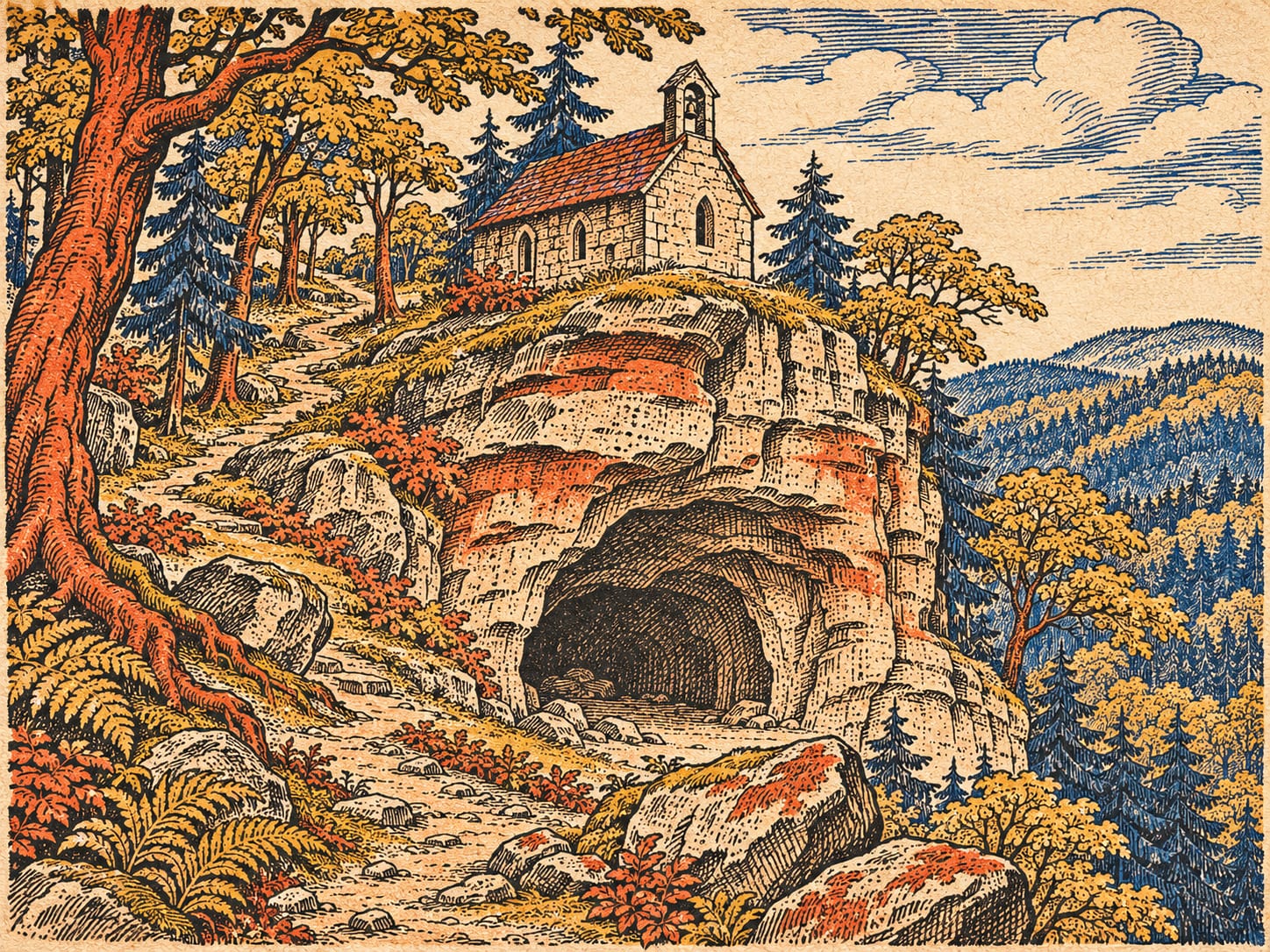
In the seventeenth and eighteenth centuries the cave chapel was dedicated to Saint Aurelia. In 1818 the cult of Saint Vit moved back into the cave with the former altar from the upper chapel, and the present arrangement dates from 1947. Visitors can see the cave chapel, the ruins of the upper chapel and farm buildings, and the woodland above Saverne. Statues from the site are kept in the Saverne museum and parish church.
Was it ergot?
One theory blames ergot, a fungus that can contaminate rye and other grain. Ergotism can cause hallucinations, convulsions, tremors and damage to blood vessels. Writers who proposed it pointed to famine, poor harvests and food shortages in the region, and the pharmacologist Eugène Louis Backman is the name usually tied to the idea.
Medical historians who have looked at Strasbourg reject it as the best explanation. The Strasbourg accounts describe sustained dancing over hours, days and weeks. Ergotism produces spasms and convulsions, not coordinated dancing that goes on for that long. It is also not contagious, and the crowd in Strasbourg grew as the weeks went on.
Strasbourg's own papers describe no ergotism, no gangrene and no grain poisoning. Ergot is not ruled out, but it explains the dancing poorly.
A stress illness, and older dancing outbreaks
Another theory is mass psychogenic illness: a group developing similar symptoms or behavior through shared fear, expectation, religious belief and imitation, with no single poison or germ behind it. John Waller reads the Strasbourg outbreak this way, as a stress-related collective disorder shaped by famine, disease, religious anxiety and belief in the power of Saint Vitus.
That reading does not say the dancers were pretending. The behavior could have been involuntary and physically real while still being shaped by what people around them expected.
Strasbourg was not the only place. Chroniclers reported dancing outbreaks long before 1518:
- Kölbigk, around 1021: eighteen men and women danced and sang near a church on Christmas Eve, and some later accounts say people died from exhaustion.
- Erfurt, 1237: about 100 children danced and jumped outside the city.
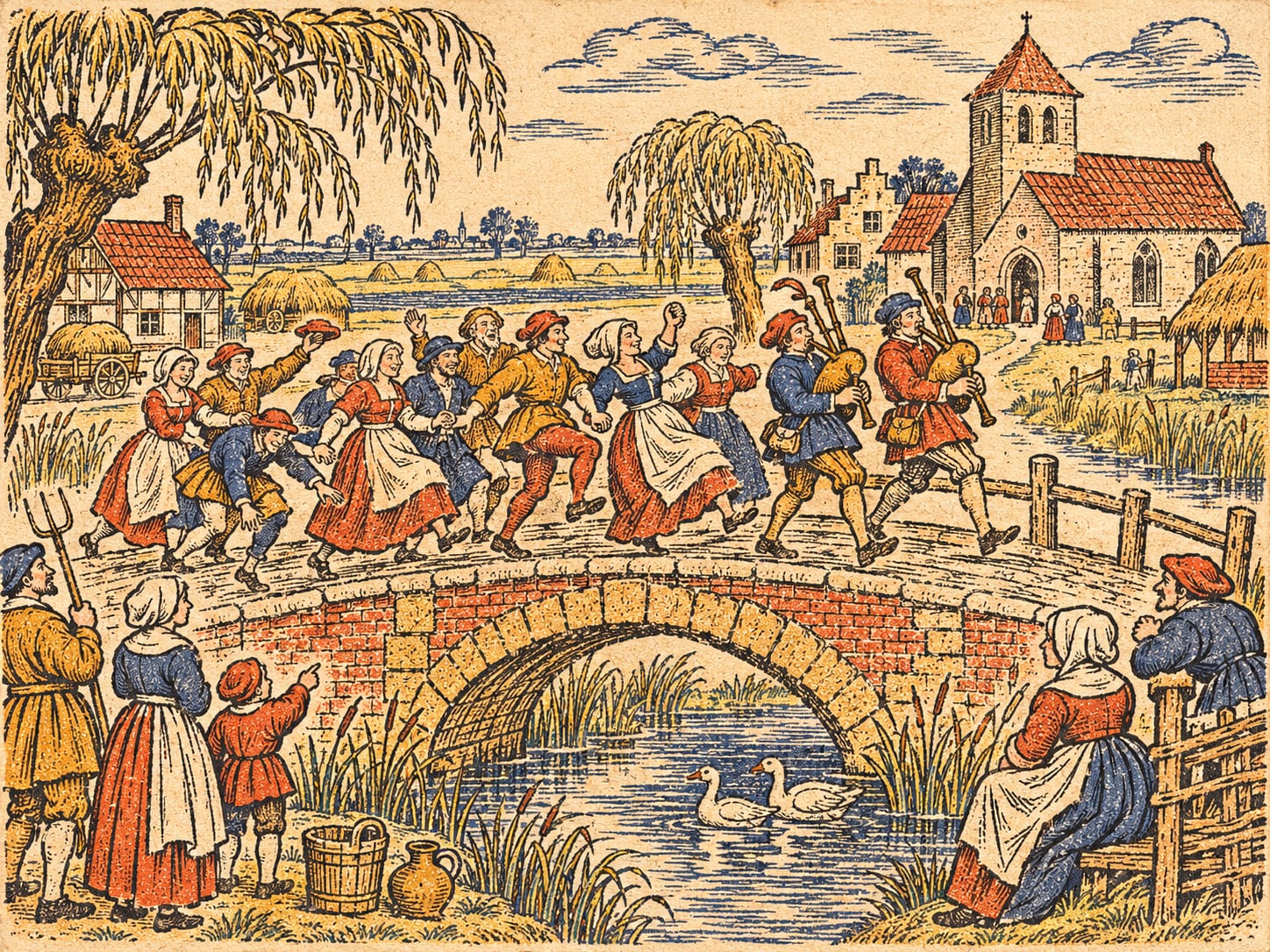
- Maastricht or Utrecht, 1278: about 200 people danced on a bridge over the Meuse, though the place and details vary from one account to the next.
- Aachen, Liège and Maastricht, 1374: a large dancing movement spread through the Rhineland and the Low Countries.
- Zurich, 1418: a group of women danced inside a church.
Closer to Strasbourg's own time, dancing pilgrims were reported arriving at Obernai in 1463 from Saint-Jean-de-Bassel and possibly Metz. Around 1536, one woman was said to dance in a public place in Basel for a month.
The 1374 movement is the best documented. Tilemann Elhen von Wolfhagen's Limburg Chronicle describes people racing and dancing in pairs for half a day, sometimes falling and being trampled, and saying that the dancing helped them. Chroniclers located dancers at Aachen, Cologne, Maastricht, Herstal, Liège, Ghent and Fosses. Maastricht issued a decision about the dancers on 18 November 1374, and Ghent took action too. Authorities treated the movement as a public disturbance.
Strasbourg belonged to a recurring pattern, called Saint John's dance, Saint Vitus's dance or dancing mania. Each outbreak may have had its own cause.
The dancing outbreak in Strasbourg, July and August 1518 (Julian calendar)
- 14 July 1518
John Waller's date for the start of the dancing; Paracelsus later has Frau Troffea leave her house on this day
- 15 July 1518
Feast of Saint Margaret, the day Strasbourg research gives for the opening gatherings
- 23 July 1518
The delegates order affected people taken to Saint Vitus's shrine at Hohlenstein, prepare three wagons and hear Staden Jerg
- 25 July 1518
The Magistrate writes to Bishop Wilhelm von Honstein that the illness began with a woman and spread
- 28 July 1518
A sung mass with litanies is planned in Strasbourg churches
- 2 August 1518
A council order signed by Sebastian Brant bans public dancing until 29 September
On 23 July 1518, the delegates named one dancer in their order: the son of a poor servant called Staden Jerg. His relative collected 15 schillings for him, and the carpenters' guildhall wardens kept the money. The ban of 2 August survives in the Strasbourg archives, with Sebastian Brant's signature on the page.
Sources
- Strasbourg Museums, teachers' exhibition dossier on the 1518 dancing epidemic
- Strasbourg exhibition press dossier, "Fièvre de la danse"
- Clementz, "La danse de 1518," Heidelberg University Library, 2018
- Wilhelm Rem, Cronica newer geschichten, in Die Chroniken der schwäbischen Städte, volume 25, edited by Friedrich Roth, Leipzig, 1896
- John Waller, "In a spin: the mysterious dancing epidemic of 1518," 2008
- John Waller, A Time to Dance, A Time to Die, Oxford Academic review
- "Alors, on danse?", Histoire des sciences médicales
- "La dansomanie de 1374: hérésie ou maladie?", Persée
- Article on ergotism, University of Salamanca, Medicina y Cine
- Sebastian Brant, order prohibiting public dancing, Strasbourg, 2 August 1518, Archives municipales de Strasbourg
- Sebastian Brant biography, University of Strasbourg; "Brant and Strasbourg Passion plays," OpenEdition Journals
- Grotte Saint-Vit, Mérimée heritage record, French Ministry of Culture
- Drury, "Imitation of Faith," on Paracelsus
- German History in Documents and Images, introduction to the early sixteenth century
- Daniel Specklin's chronicle, written around 1580
- Pieter Bruegel the Elder, "The Dancing Mania," 1564, Albertina, Vienna
Watch the full story on the Flashback Fables YouTube channel, and send it to someone who would love it.