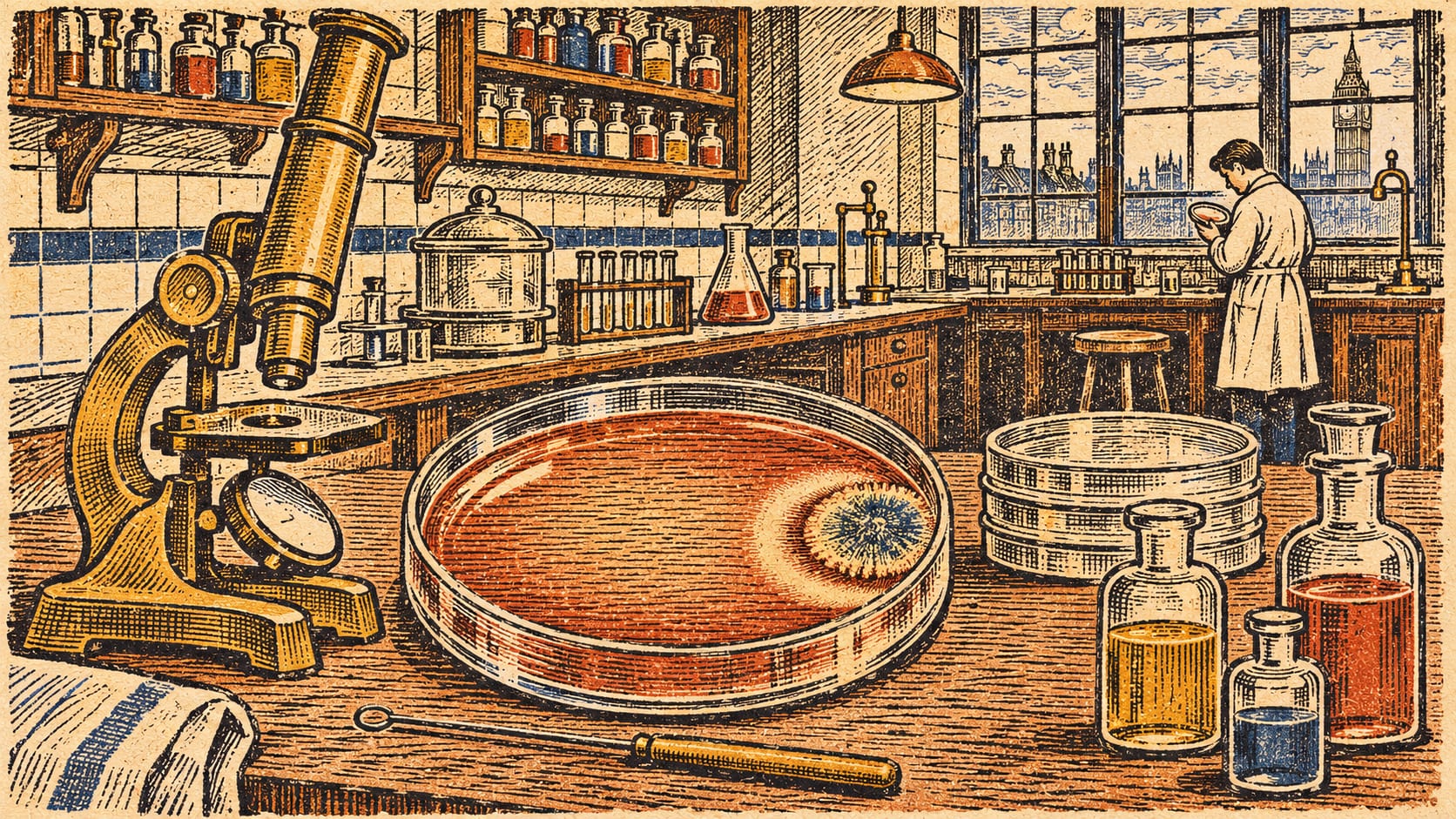
Alexander Fleming saw a mould clear bacteria off a culture plate on 28 September 1928. The Oxford team began treating a patient with penicillin on 12 February 1941, more than twelve years later.
The gap was filled by other people. Howard Florey, Ernst Chain, Norman Heatley and their Oxford colleagues made penicillin usable, and American researchers in Peoria, Illinois, learned to produce it in quantity. In 1945, Fleming, Chain and Florey shared the Nobel Prize in Physiology or Medicine.
The story runs from a contaminated plate in a London hospital to a mouldy cantaloupe in Peoria.
What Fleming saw in September 1928
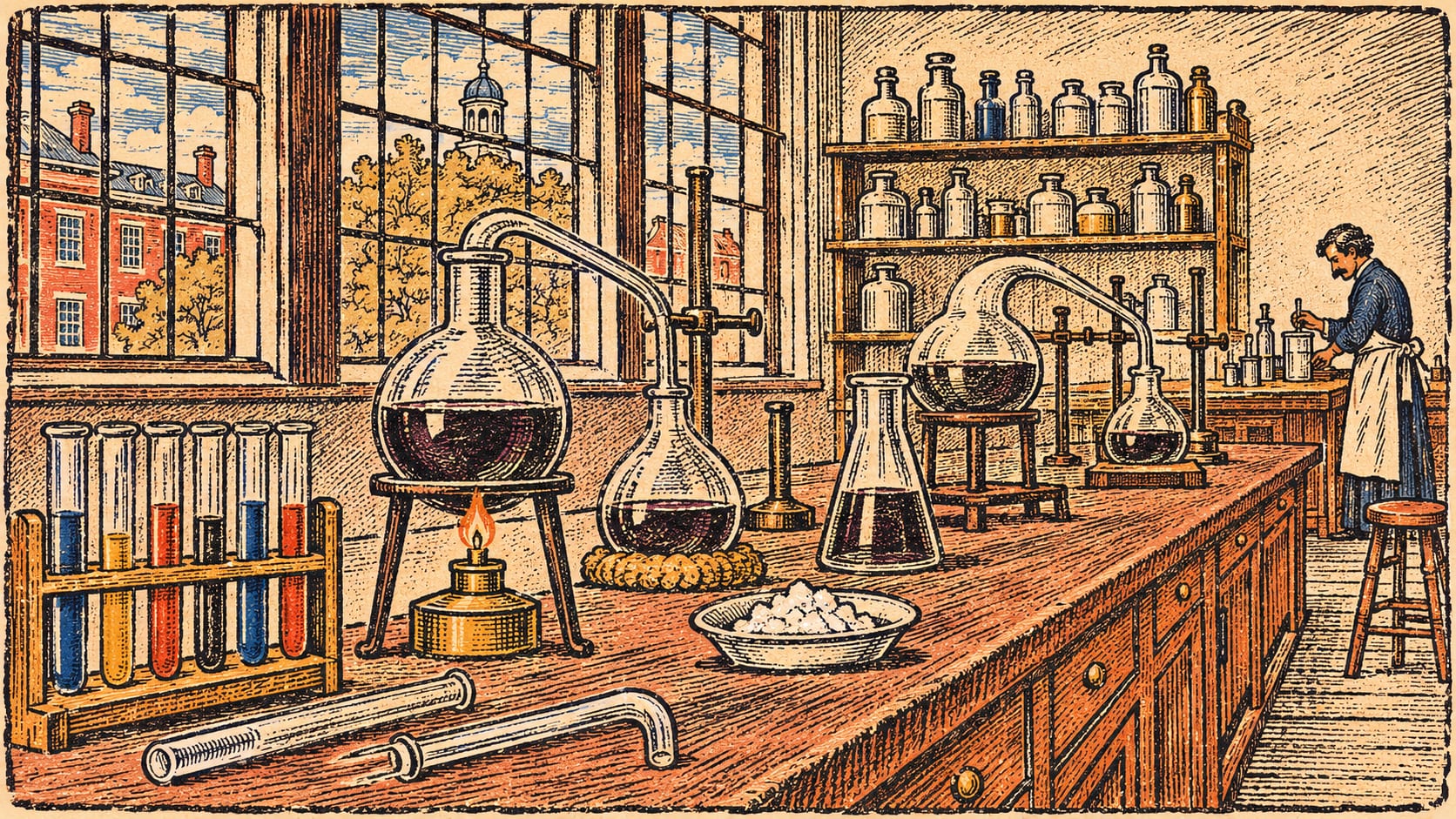
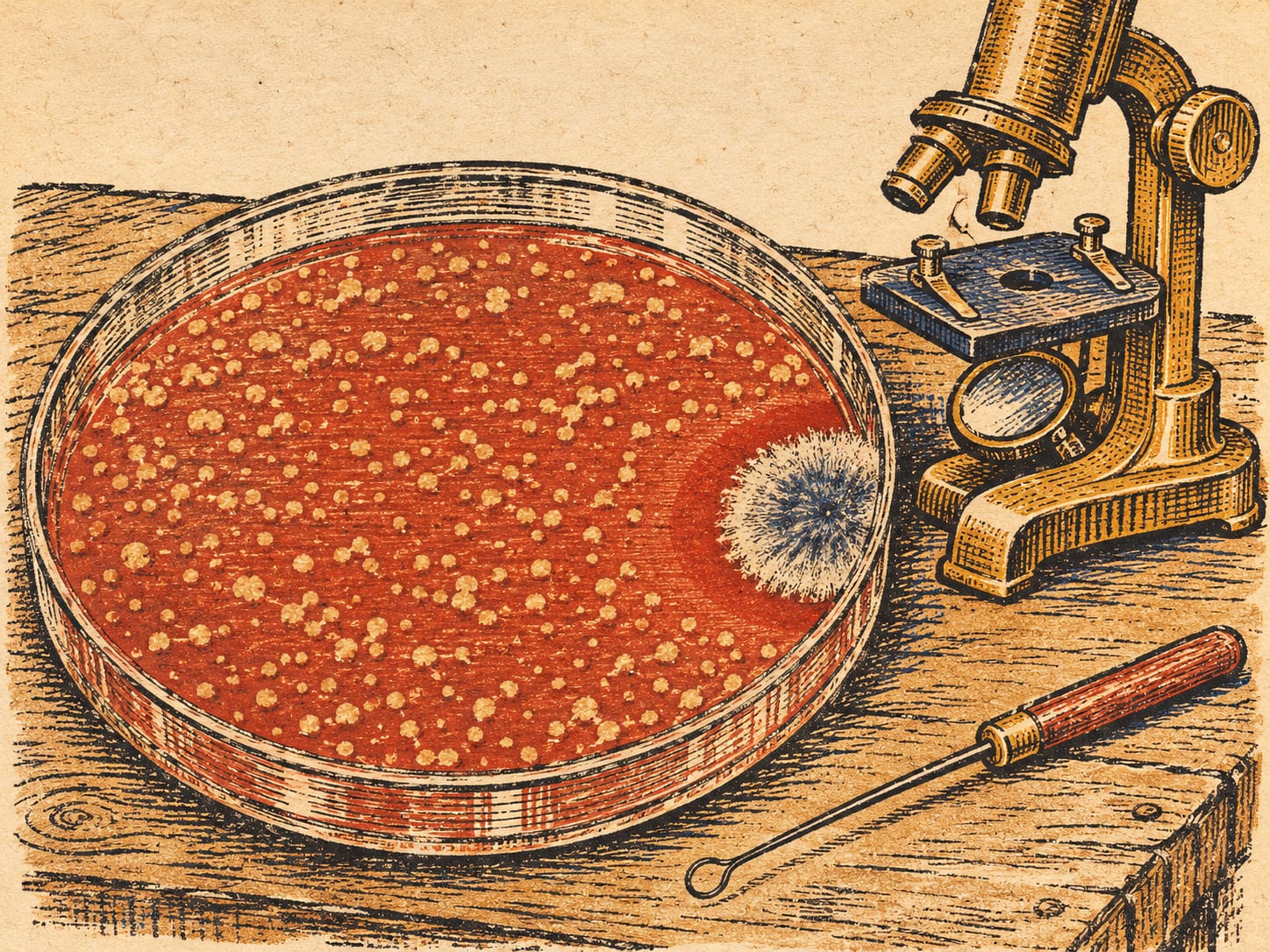
On 28 September 1928, Fleming examined a contaminated Staphylococcus culture plate at St Mary's Hospital in London. A colony of Penicillium mould had grown on it. Around the mould was a clear zone where the staphylococci had turned translucent and were being destroyed.
Fleming isolated the mould, identified it as Penicillium notatum, and named its antibacterial substance "penicillin."
He published in June 1929, in the British Journal of Experimental Pathology, volume 10, number 3, pages 226 to 236. The paper carried the title "On the Antibacterial Action of Cultures of a Penicillium, with Special Reference to their Use in the Isolation of B. influenzae." In it, Fleming reported that the mould produced a substance that held back several disease-causing bacteria: staphylococci, streptococci, pneumococci, gonococci, meningococci and the diphtheria group. The substance was apparently non-toxic to animals, and he suggested it might be useful as a treatment.
In his 1945 Nobel lecture, he described the discovery in plain terms, as "the contamination of a culture plate of staphylococci by a mould."
Others were in the room, or close by. Daniel Merlin Pryce, a former research student, examined Fleming's cultures with him around the time of the observation. Stuart Craddock and Frederick Ridley then worked with Fleming, trying to extract and purify penicillin from the mould culture. Their work ran into 1930, and it did not produce a stable, purified medicine. In January 1929, Craddock himself was treated with Fleming's crude penicillin for sinusitis, without success.
The open window and the forgotten dish
The popular telling goes like this: spores of mould drifted in through an open laboratory window while Fleming was on holiday, and he came back to a spoiled dish. In the most dramatic version, he forgot a dish on a windowsill.
Some of that is firm. Fleming was away from the laboratory during the relevant period, and he noticed the plate after he returned. The windowsill and the holiday are a simplified reconstruction.
The window itself is disputed. Historians Ronald Hare and Milton Wainwright have questioned it. Later evidence suggested the mould may have come from a mycology laboratory below Fleming's room. Pages are missing from Fleming's notebooks, and the exact order of events is not fully settled.
Why penicillin sat unused for ten years
Between 1929 and 1939, penicillin remained largely unused. Fleming's preparation was a weak crude culture fluid that was hard to concentrate, unstable, and easily destroyed during chemical processing. His laboratory was bacteriological rather than chemical, and his attempts to concentrate and stabilize the substance failed.
Fleming later wrote that there was often no supply when a suitable patient appeared. He also said the penicillin had to be concentrated, and that much of the crude culture fluid had to be removed before it could be used widely in medicine.
The sulphonamide drugs introduced in the 1930s took away some of the pressure to develop penicillin. Interest came back after Ernst Chain found Fleming's 1929 paper and proposed investigating penicillin at Oxford.
Oxford, 1939 to 1941
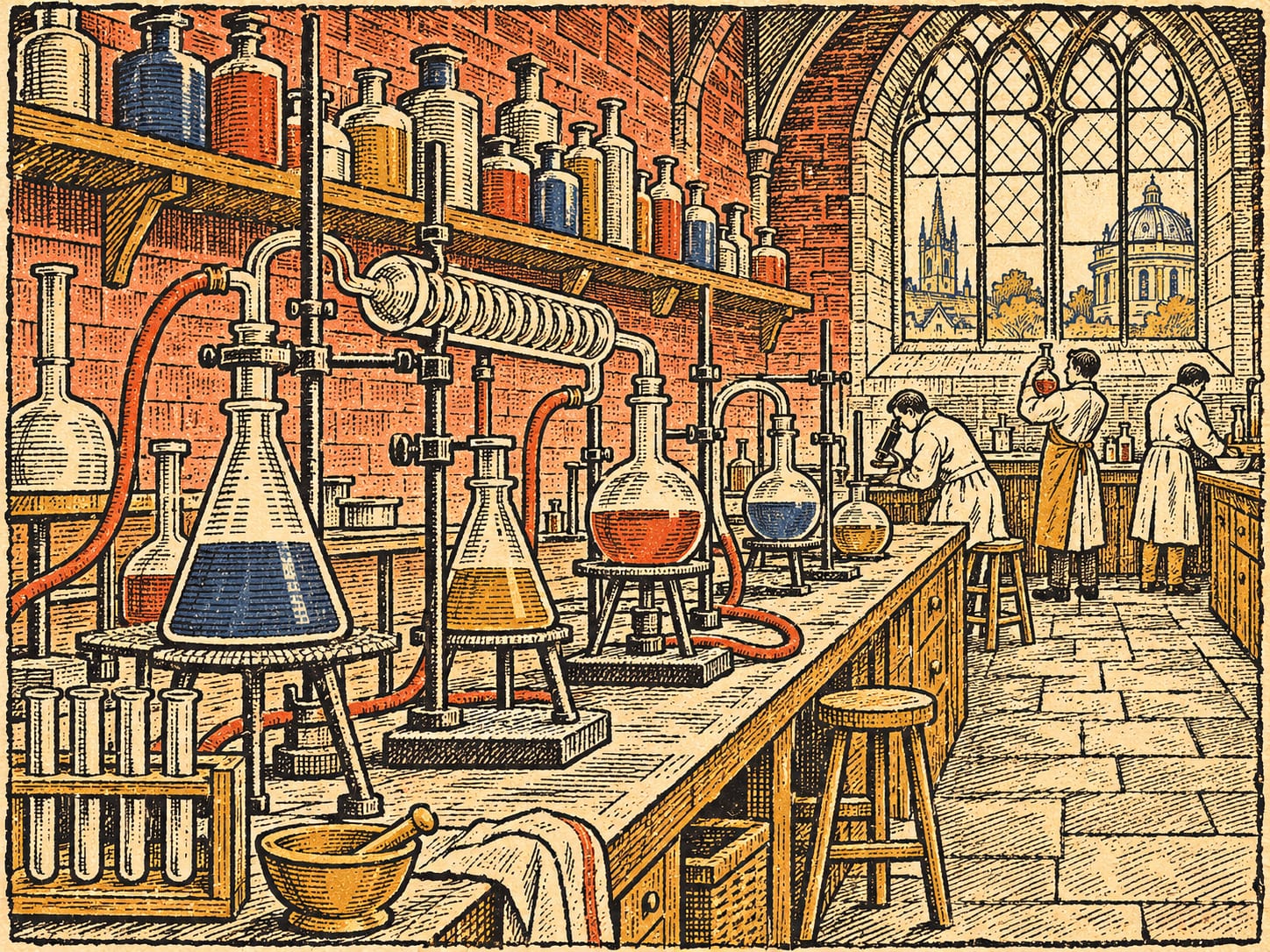
In 1939, at the Sir William Dunn School of Pathology at the University of Oxford, Howard Florey, Ernst Chain, Norman Heatley and their colleagues began systematic work on isolating and testing penicillin. Chain worked on extraction and purification. Heatley developed practical methods for growing the mould and recovering penicillin, including extraction and assay techniques. Florey directed the biological and medical programme.
Money came in small amounts. The Medical Research Council began special support for Florey's penicillin work in 1939, and by April 1944 the government said the MRC had provided about £7,000 for work specially on penicillin. Toward the end of 1939 Florey sent the Rockefeller Foundation a prospectus titled "A Chemical Study of the Phenomenon of Bacterial Antagonism" and asked for $5,000 for one year. The Foundation granted it at once.
By the end of 1940 Florey was writing: "There is good ground for hoping that this substance will be much more effective than the sulfonamides, hence the prosecution of the work is of urgency and importance." The Foundation made a second $5,000 grant. When Warren Weaver visited Florey in England in April 1941, he noted that the project could be "more revolutionary than the discovery of the sulfa drugs."
Heatley's bedpans and biscuit tins
Heatley turned the Dunn School into a small production plant. Mould needs surface area, so he grew it in whatever vessels offered some: sheep-dip cans, pie dishes, bedpans and biscuit tins. He then designed stackable rectangular ceramic vessels. James Macintyre and Co. made 700 of them, and a batch was seeded on 25 December 1940. Its penicillin treated the six Radcliffe Infirmary patients of 1941.
He also built a semi-automatic "counter-current" extraction apparatus. It moved penicillin between acidic and alkaline solutions so that impurities could be separated and the unstable drug concentrated. Much of the active penicillin passed through a patient unchanged, so the team collected patients' urine, carried it back to the Dunn School, extracted the penicillin again and reused it.
The 1941 Lancet paper names who did what. Chain and Florey planned and started the work. Chain and Edward Abraham did most of the chemistry. Heatley devised the assay and ran production. Margaret Jennings and Florey ran the biological tests. Arthur Duncan Gardner studied the bacteriology and the growth of the mould, and Charles Fletcher gave penicillin to the patients. Ten technicians produced supplies, among them D. Callow, R. Callow, E. Cooke, S. A. Cresswell and G. Glister. Ethel Florey is not listed as an author, but later accounts describe her giving and recording treatment during the larger Oxford series.
The mice, May 1940
In the Lancet of 24 August 1940, under the title "Penicillin as a Chemotherapeutic Agent," the Oxford group reported a brown, water-soluble powder: "From the culture medium a brown powder has been obtained which is freely soluble in water. It and its solution are stable for a considerable time and though it is not a pure substance, its anti-bacterial activity is very great."
On 25 May 1940, the team ran the major mouse protection experiment. Mice were infected with lethal bacteria. Some received penicillin and survived longer or recovered, and the untreated control mice died. Penicillin could work inside a living animal, not only in a culture dish.
An injection of 10 milligrams caused no visible harm in a 23-gram mouse. In one group of 50 treated mice, 25 were alive on day 10. In another group of 25, which received 19 milligrams over ten days, 18 were alive on day 10, while the controls died. The authors added a caution: "It must be emphasised that the results of these preliminary tests have been obtained with an impure substance."
Albert Alexander and the six patients
On 17 January 1941, Fletcher gave 100 milligrams of penicillin intravenously to Elva Akers, a woman dying of inoperable cancer. It was a safety test. About ninety minutes later she developed a fever and shivering fit, because the preparation still held fever-causing impurities. The Lancet paper did not name her.
Then came a patient with a real infection. Albert Alexander, a 43-year-old reserve police constable, had been admitted to the Radcliffe Infirmary in Oxford on 12 October 1940 with infection of the face, scalp and both eye sockets. It began at a sore near the corner of his mouth. Staphylococcus and Streptococcus were both involved. Sulphapyridine had failed, and he had abscesses, infection of the bone in his right upper arm and infection in his lungs.
On 12 February 1941, Fletcher began intravenous penicillin: 200 milligrams, then 300 milligrams every three hours. Fletcher later wrote that Alexander began to feel better within a day. After four days the improvement was striking. After five days he had no fever, was eating well, and the abscesses around his face and eyes were clearing.
Then the supply ran out. His urine had been collected, and the penicillin in it was recovered and reused, but there was not enough. His infection returned, and he died on 15 March 1941.
The other five patients of 1941 were treated with the supply Heatley's vessels produced. A 15-year-old boy with an infected hip operation wound received repeated 100-milligram doses, interrupted by shortage, and the result was called equivocal. A 48-year-old labourer with a four-inch carbuncle received hourly doses from 3 May, and by 10 May the carbuncle had almost cleared.
A boy of four and a half, admitted on 13 May with a dangerous cavernous-sinus infection after measles, improved on intravenous penicillin. He later died of a ruptured aneurysm, and the autopsy showed the infection almost entirely overcome. A 14-year-old with staphylococcal septicaemia and early bone infection after a fall had his fever fall, his pain go and his hip work well. A six-month-old baby with a urinary infection was given penicillin by mouth, and the infection cleared. Penicillin was also put on four eye infections. The authors wrote: "In all these cases a favourable therapeutic response was obtained."
Penicillin, from culture plate to Nobel Prize
- 28 September 1928
Fleming examines a contaminated culture plate at St Mary's Hospital, London
- June 1929
Fleming's paper on the mould appears in the British Journal of Experimental Pathology
- 1939
Florey, Chain, Heatley and colleagues begin work at Oxford
- 25 May 1940
The Oxford team runs the mouse protection experiment
- 24 August 1940
The Lancet prints the Oxford results on the brown powder
- 12 February 1941
Albert Alexander begins treatment at the Radcliffe Infirmary
- July 1941
Florey and Heatley travel to the United States with a brown powder containing penicillin
- 14 March 1942
Anne Miller begins penicillin treatment at New Haven Hospital
- August 1942
Fleming treats his friend Harry Lambert with Oxford penicillin
- 1943
Production rises sharply and penicillin reaches Allied military use
- 11 December 1945
Fleming gives his Nobel lecture
Peoria, Illinois, and a mouldy cantaloupe
In July 1941, Florey and Heatley travelled from Britain to the United States carrying a stable brown powder containing penicillin. A Rockefeller Foundation travel grant paid for the trip, because American facilities were further along for this kind of work. They were sent to the United States Department of Agriculture's Northern Regional Research Laboratory in Peoria, Illinois.
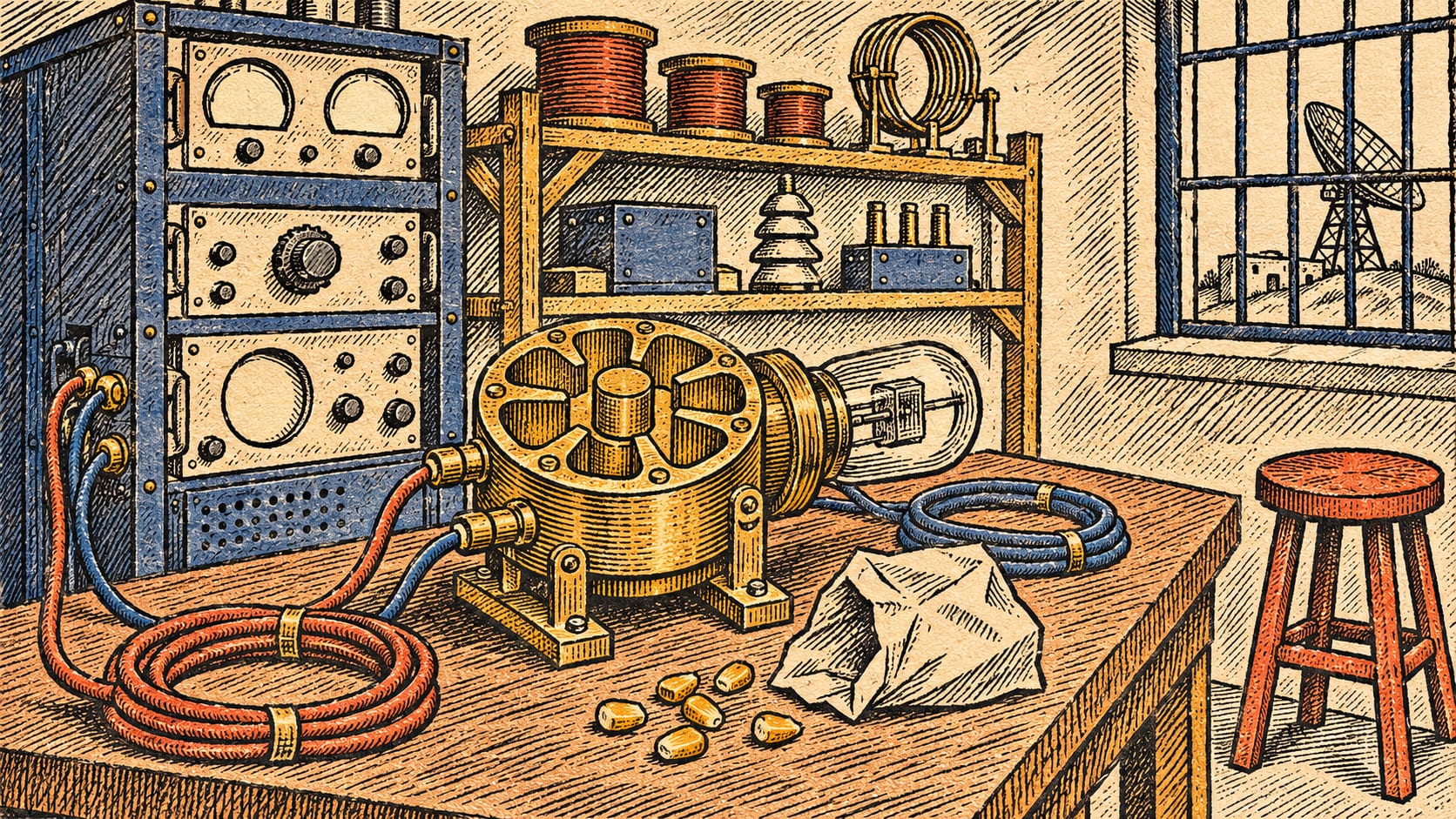
There, Andrew J. Moyer improved the culture medium by adding corn steep liquor, a by-product of wet corn milling, and later lactose. By 26 November 1941, those changes had raised yields about tenfold. Moyer also developed deeper culture vessels for larger-scale production.
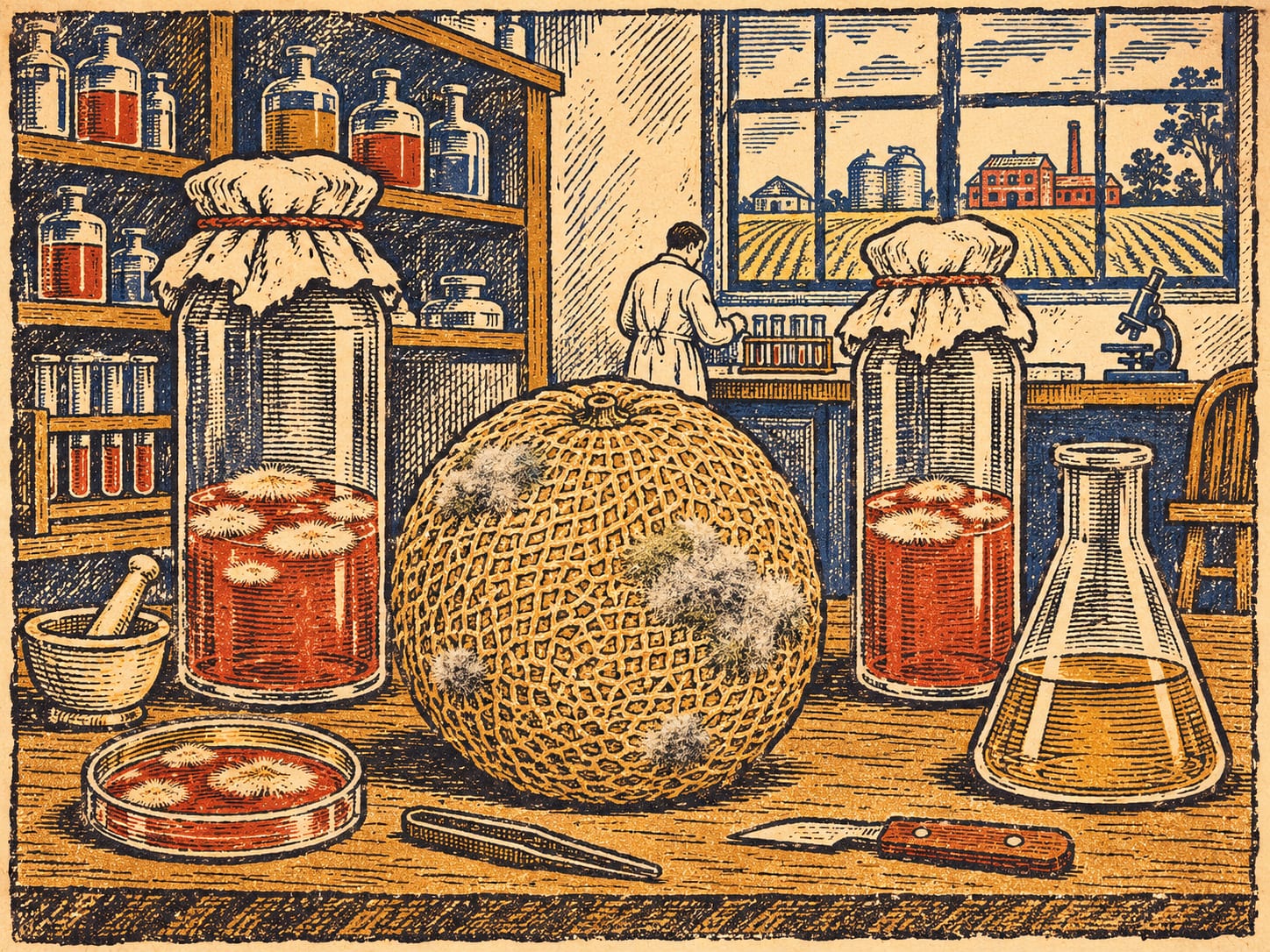
The Peoria researchers then went looking for a more productive mould. In 1942, Mary Hunt found a heavily productive Penicillium strain on a mouldy cantaloupe in Peoria. It produced much more penicillin than Fleming's original strain and became important to industrial production.
Anne Miller in New Haven
In March 1942, Anne Miller lay in New Haven Hospital in Connecticut with septicemia after a miscarriage. Surgery, blood transfusions and other treatment had not helped, and her fever had stood at 103 degrees Fahrenheit or higher for several weeks.
Her physician, Robert Fulton, knew Howard Florey from Oxford. Supplies were tightly controlled and tiny, and penicillin was flown to New Haven in secret. On 14 March 1942, Miller began systematic penicillin treatment. Her temperature came back to normal within about a day, and she recovered. Fulton's diary notes that nurses watched her appetite and temperature for several weeks.
Harry Lambert and the Times
Harry Lambert, a friend of Fleming, was dying of meningococcal meningitis. In August 1942, Fleming got Oxford penicillin for him. Fleming's letter to Florey of 28 August 1942 is described in the Royal Society's catalogue as saying that Lambert was bacteriologically cured, that penicillin had saved his life, and that Fleming was sending back all the penicillin he had left.
The treatment became public. On 27 August 1942 the Times ran an article titled "Penicillium," and it did not give Fleming or the Oxford team enough credit. Sir Almroth Wright wrote to the Times on 31 August to defend Fleming's claim. Robert Robinson replied on 2 September for Florey and Oxford.
Florey disliked the publicity. In October 1942 he complained to the BBC about publicizing "a substance of therapeutic value which is unprocurable except in minute amounts." The publicity had brought a "flood of pathetic letters from as far away as Western Australia and Saskatchewan." In December 1943 he told a BBC audience that it was "very right and proper" for the armed forces to have the supply, because of its value for war wounds.
The word "penicillin" turned up in seven Times articles in 1942, fourteen in 1943, ninety-three in 1944 and eighty-four in 1945.
How production grew
By 1943, output had risen sharply, and penicillin was available in quantity for Allied military use, including the treatment of wounded soldiers in the 1944 Normandy campaign. Four American pharmaceutical companies began large-scale production.
The numbers show how fast it moved. The United States made about 21 billion units in 1943, about 1,633 billion in 1944 and an estimated 6,852 billion in 1945. Britain's government reported monthly averages, so its figures do not line up directly with the American annual totals.
Dorothy Hodgkin and the shape of the molecule
In 1942, Dorothy Crowfoot Hodgkin began working out penicillin's molecular structure at Oxford, using X-ray crystallography. She and her colleagues kept at it through the wartime secrecy period and had the structure by 1945. The key result was a four-membered beta-lactam ring fused to a thiazolidine ring. The full results were not published until 1949.
Her work was not part of the 1945 prize. In 1964 she received the Nobel Prize in Chemistry for structure determinations that included penicillin, vitamin B12 and insulin.
Why Oxford did not patent penicillin
The Oxford group did not patent the basic discovery or its clinical production work. British medicine had a tradition against privately patenting medical discoveries, and the view was that the public should get the benefit of publicly supported research.
Florey is quoted as saying: "The people have paid for this work and they should have the benefits made freely available to them." Chain urged patent protection, at least to keep unscrupulous firms from using the work. Florey asked senior British scientists, who advised that patenting a public medical discovery would be unethical.
Years later, a quotation attributed to Florey says that the decision "has cost us very many millions of dollars and no doubt will go on doing so." Penicillin-related patents did exist: American researchers and companies patented improved production methods, including submerged fermentation.
Who shared the 1945 Nobel Prize
The 1945 Nobel Prize in Physiology or Medicine went jointly to Sir Alexander Fleming, Ernst B. Chain and Sir Howard Florey "for the discovery of penicillin and its curative effect in various infectious diseases."
On 11 December 1945, Fleming gave his Nobel lecture and credited Chain and Florey by name. He called them his "co-participants" in the award and said they had obtained his Penicillium notatum strain and succeeded in concentrating penicillin. Their results were published in 1940, he said, and purification had turned a laboratory observation into an industrial medicine.
He also put his own part in proportion. "My publication in 1929 was the starting-point of the work of others who developed penicillin especially in the chemical field," Fleming said.
Did penicillin save Winston Churchill?
The story goes that Fleming, or Fleming's father, saved Winston Churchill twice: once by rescuing him from drowning, and again by supplying penicillin when Churchill developed pneumonia in 1943.
Churchill's doctors used something else. He was treated for the pneumonia with "M&B," a May and Baker sulphonamide drug. Lord Moran's diaries refer to "M&B" and say nothing of penicillin being flown to Churchill in the Middle East.
Fleming and Churchill did meet. On 27 June 1946, Churchill consulted Fleming about a staphylococcal infection that appeared to have resisted penicillin. That shows the two men had contact. It does not show that penicillin saved Churchill in 1943. The drowning story is not supported by the documents Churchill's biographer, Sir Martin Gilbert, cited.
Fleming's warning about underdosing
In the same Nobel lecture, on 11 December 1945, Fleming warned about resistance. If people took too little penicillin, he said, microbes could be exposed to amounts too small to kill them and become resistant. That had happened in the laboratory, he wrote, and had "occasionally happened in the body."
He gave an example. A person with a sore throat uses too little penicillin and selects resistant streptococci. He passes them to his wife, and her pneumonia does not respond. The patient and the wife were an illustration, not a reported case.
Fleming closed the point in six words: "If you use penicillin, use enough."
Sources
- "On the Antibacterial Action of Cultures of a Penicillium," Alexander Fleming, British Journal of Experimental Pathology, June 1929, via PubMed Central
- Fleming's Nobel lecture, 11 December 1945, and Florey's 1945 Nobel lecture, Nobel Prize
- 1945 Medicine laureates, Nobel Prize
- "Penicillin as a Chemotherapeutic Agent," The Lancet, 24 August 1940, and "Further Observations on Penicillin," The Lancet, 16 August 1941
- Charles Fletcher, personal account, British Medical Journal, 1984
- "Alexander Fleming," Science History Institute
- "The Discovery of Penicillin," CDC
- "Stuart Craddock," Wellcome Collection, and Heatley extraction-apparatus record, Wellcome Collection
- "New Light on the History of Penicillin," Ronald Hare
- Penicillin pages, Oxford Health Histories and Primary Health Care, University of Oxford
- Back From the Dead exhibition, Museum of the History of Science, Oxford
- Annual reports of 1941 and 1943, Rockefeller Foundation; Hansard, 5 April 1944
- Fleming and Lambert papers, British Library; Fleming letter to Florey of 28 August 1942, Royal Society catalogue
- "The role of the media in influencing public attitudes to penicillin," SciELO
- "A Potted History of Penicillin," UK government review
- Penicillin timeline, USDA Agricultural Research Service
- "Penicillin: A Wartime Accomplishment," 1946, and Hansard, Penicillin Control, 27 June 1946
- "Descubrimiento y desarrollo de la penicilina," American Chemical Society
- "Dorothy Hodgkin, Penicillin and Insulin," National WWII Museum
- Medical Journal of Australia, Florey biography, and React Group study of antibiotic development
- "Sir Alexander Fleming Twice Saved Churchill's Life," International Churchill Society
Watch the full story on the Flashback Fables YouTube channel, and send it to someone who would love it.