
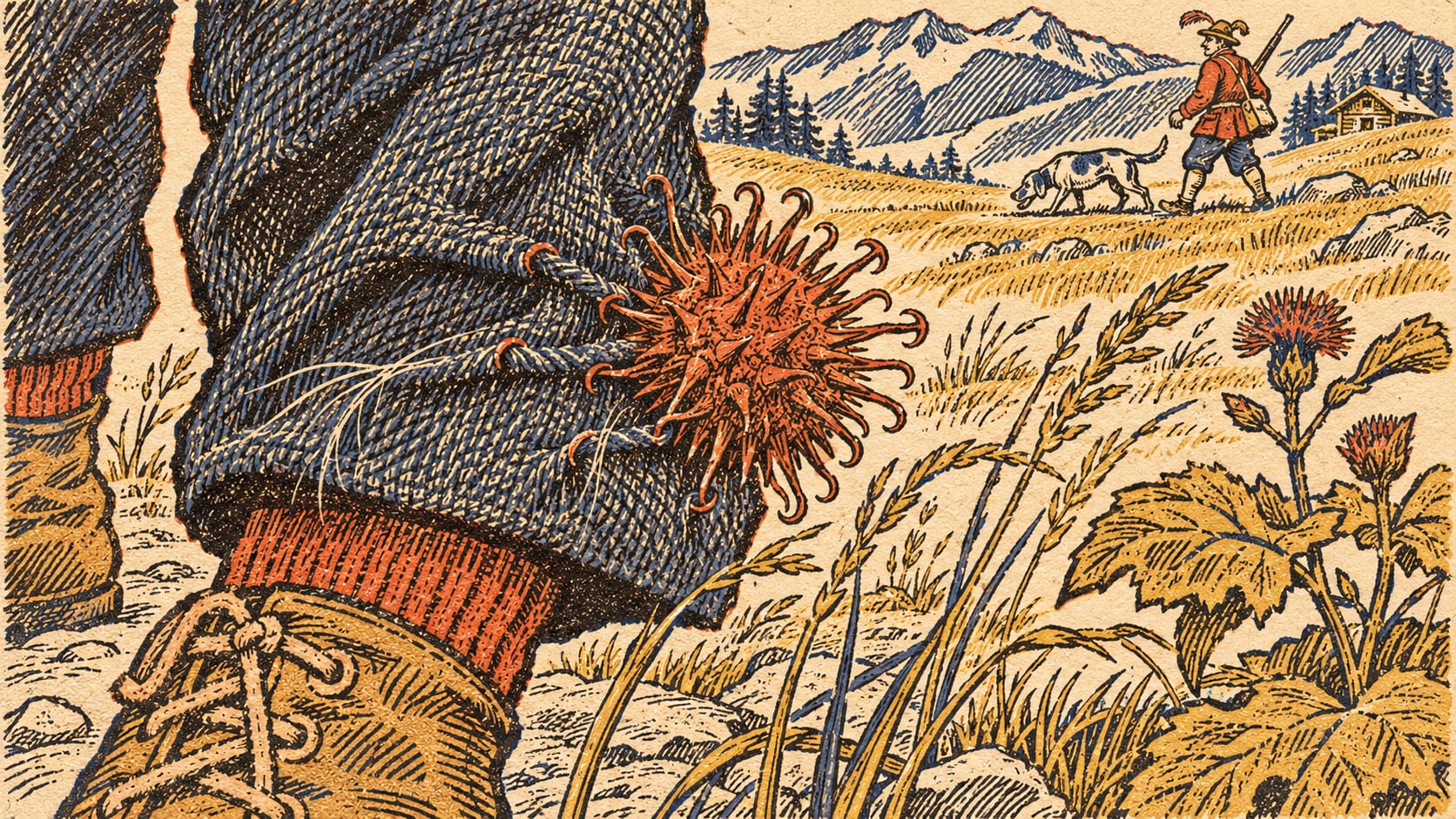
Georges de Mestral, a Swiss engineer, spent about a decade turning the burrs that stuck to his trousers into a fastener. He named it Velcro, from two French words, velours and crochet, meaning velvet and hook.
The idea came from a hunting walk in the Jura Mountains in 1941, by his own later account. NASA did not invent Velcro, though its use on Apollo missions made the fastener famous around the world.
The path from that walk to a working product ran through a Swiss patent application filed on 22 October 1951, a weaver in Lyon, a banker, a loom that snipped nylon loops into hooks, and a great deal of nylon.
The walk in the Jura Mountains
De Mestral was born on 19 June 1907 at Saint-Saphorin-sur-Morges, near Lausanne. He studied engineering at the university in Lausanne and finished his diploma in 1930, and biographies describe the field as mechanical or electrical engineering. He worked in the machine shop of a Swiss engineering company, and he had paid for his studies with odd jobs.
He told the story of the walk himself. In 1941 he went hunting in the Jura Mountains, and burdock burrs clung to his trousers and to the fur of his Irish Pointer.
Later tellers repeat his account with small differences. Some put the outing in 1948, some call it a walk and not a hunting trip, and some name the plant as cocklebur instead of burdock. The invention itself stands on solid ground, because the patent filings show what he built from the idea.
What the burr looked like under a microscope
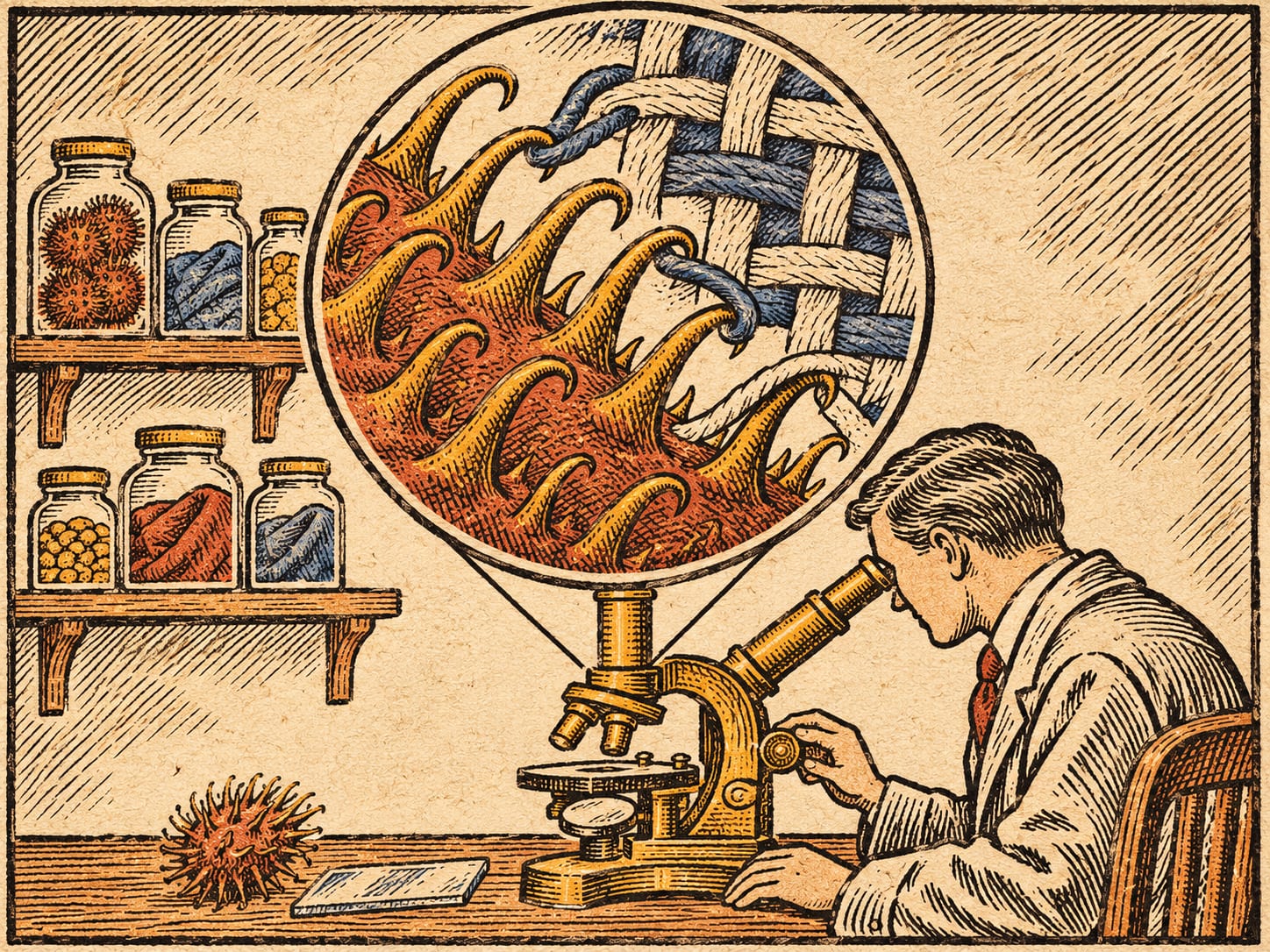
He put a burr under a microscope. The surface was covered in many small, curved hooks. Those hooks caught on the loops in woven cloth and on strands of animal fur.
That was the whole principle. A fastener built the same way would need two textile surfaces, one covered in small hooks and the other in loops. Press them together and the hooks catch the loops. Pull the layers apart and the connections let go gradually, one after another.
A decade to make a working fastener
The idea was simple. Making it was not. The loop side was comparatively easy to weave. Producing thousands of small, durable hooks was the hard part.
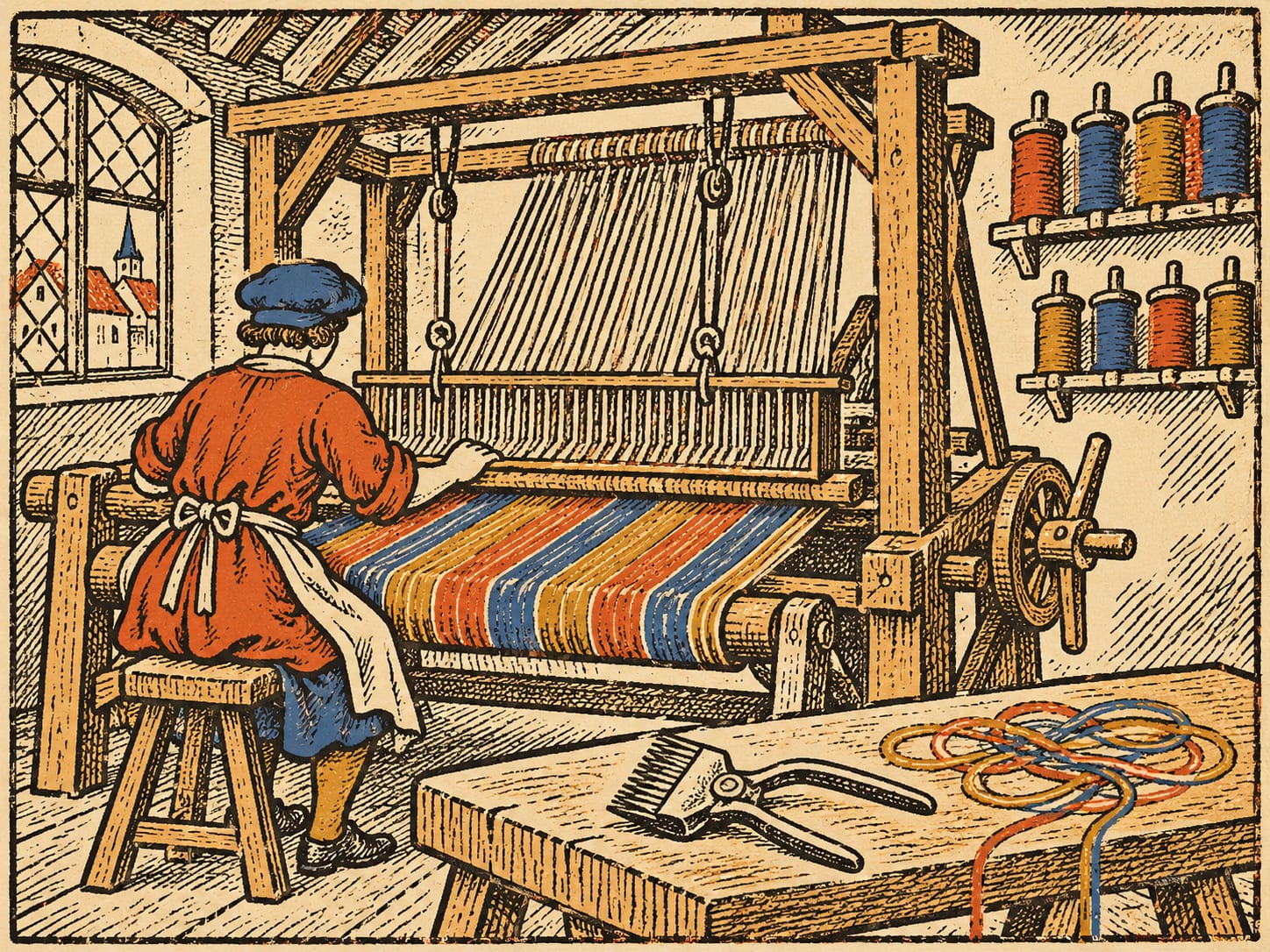
De Mestral consulted fabric experts in Lyon, France, and worked with textile manufacturers. One weaver there used a small hand loom to make two cotton tapes, one carrying loops and the other hooks. Pressed together, the cotton strips worked. But cotton was soft and wore out quickly, and he dropped it.
Nylon proved more suitable, because it was durable and could keep the shape of a hook. A Spanish Patent and Trademark Office publication describes heating nylon with infrared rays to produce rigid hooks. All of this took about ten years.
The loom, the heat and the knife
De Mestral's own patent describes the method in his words. It opens: "My invention has for its object a velvet fabric including a foundation structure constituted by a weft and a warp incorporating threads that are cut at a predetermined length so as to form a raised pile." The cut ends of the pile were to be "material-engaging means," and he described loops that were heated and cut to produce "a hook-shaped end."
The patent drawings show how. A woven base of warp and weft threads carries extra threads of synthetic resin, which are pulled into loops around small transverse metal bars. A heated bar fixes the loops in shape. A knife running in a groove then cuts each loop, leaving a hook and a discarded straight strand. One drawing shows two pieces of hook-bearing fabric laid over each other at an angle, so that their hooks interlock.
He designed a loom able to weave about 300 aligned loops per square inch. A trade magazine of April 1959 reports that he adapted the principle of barber's clippers to make a loom that snipped nylon loops into hooks. By 1955 he had still not solved production of the hooked half on an industrial scale, and a later patent, No. 3,009,235, describes improved loom lancets.
The patents and the dates
The Swiss patent application, CH295638, was filed on 22 October 1951. The Swiss Federal Institute of Intellectual Property and the company's own timeline give the Swiss grant as 16 March 1954.
The patent most often named in English is American. U.S. Patent No. 2,717,437, titled "Velvet type fabric and method of producing same," was filed on 15 October 1952, claiming priority from the Swiss filing of 22 October 1951. It was granted on 13 September 1955, which is why the National Inventors Hall of Fame describes de Mestral's VELCRO patent as a 1955 patent. It names "George de Mestral, Prangins, Vaud, Switzerland" as inventor and says he was "assignor to Velcro S.A., Fribourg, Switzerland."
Claim 1 describes weaving warp and weft threads together with extra threads of synthetic resin, forming loops on one surface, heating the loops so that they keep their shape, and cutting them near their outer ends. Each cut loop is a hook.
A further American patent, No. 3,009,235, "Separable fastening device," was granted to de Mestral on 21 November 1961. He had applied for it on 9 May 1958, claiming priority from a Swiss application of 2 October 1957. It belongs to the continuing development of the fastener and is not the original 1951 filing.
Where the name Velcro comes from
"Velcro" joins two French words, velours, meaning velvet, and crochet, meaning hook. De Mestral used the name for the invention and for the company.
Velcro S.A. was formed in Switzerland in 1952 by de Mestral, Alfred Gonet, André-Louis Burnier and Jean Michaud. Gonet was a Swiss banker, and a 1959 trade magazine says de Mestral's development work was subsidized by him. Burnier was a notary in Nyon who helped form the original company and stayed with the Velcro companies for nearly fifty years. The company was based in Fribourg, and de Mestral later made fasteners at his own factory, Velcrotex SA, in Aubonne.
Sales spread to other countries through the 1950s. The company opened a factory in Manchester, New Hampshire, in 1957 and began manufacturing in Spain in 1959.
The company treats VELCRO as a trademarked brand, not as the general word for every hook-and-loop fastener. That is why a plain product description often says "hook and loop" instead.
The early customers: tapes, cuffs and diapers
The original product was a pair of textile tapes, one bearing hooks and the other loops. The patent pitched them as replacements for zippers, buttons and press studs, and it also proposed closures for clothing and curtains and brushes for clothes and shoes.
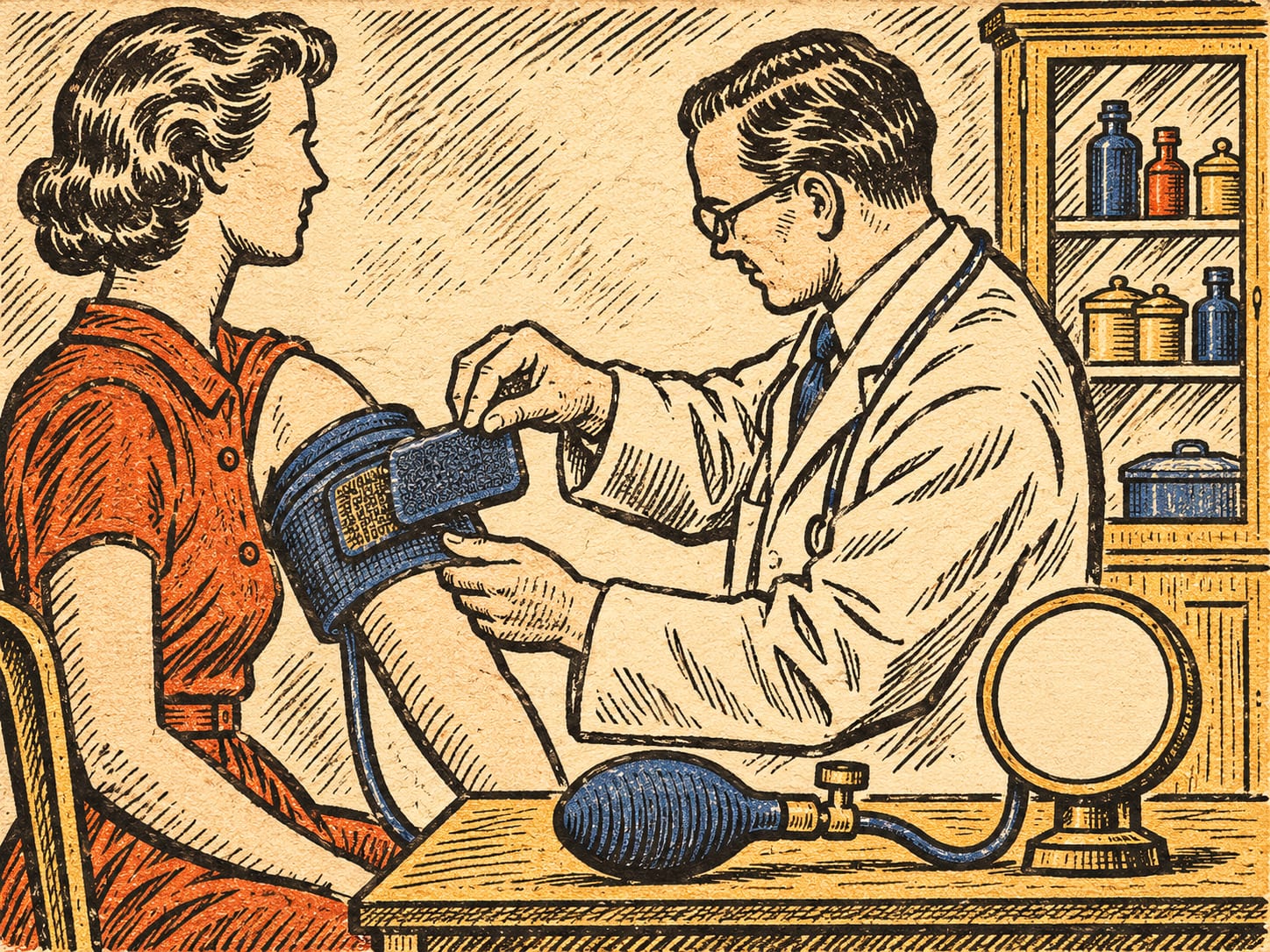
Early users found other jobs for it. A 1958 report in the Journal of the American Medical Association describes self-adhering nylon tape for blood-pressure cuffs, bandages, braces, diapers, knee caps, splints and surgical garments. A trade magazine in April 1959 reported tests on blood-pressure bands, clothing for disabled people, temporary exhibits, conveyor belts, printing presses and diapers.
Writers of the day reached for comparisons. TIME described it on 8 September 1958 as a nonmetallic, zipperlike fastener made of "two strips of fabric, one with thousands of tiny nylon hooks, the other with thousands of equally tiny nylon loops." Columnist Sylvia Porter called it a "zipperless zipper."
From skis and children's shoes to Apollo
Fashion did not welcome the new fastener. The early material looked rough and unattractive to many designers. At a 1959 fashion show at the Waldorf-Astoria, the New York Times called it "the end of buttons, toggles, hooks, zippers, snaps and even safety pins." The Medford Mail Tribune reported that the demonstration ran "everything from diapers to golf jackets, tourniquets to trousers," and that American Velcro of Manchester, which had begun production the previous August, was turning out 125,000 yards a week.
The fastener gained ground through industrial and medical customers, then sports equipment, skiing and outdoor products, and children's shoes and clothing.
Then came space. NASA used hook-and-loop fasteners during the Apollo program to secure instruments, keep equipment organized and help astronauts in their spacesuits and in zero gravity. NASA administrator James Webb said Velcro pads in the Apollo 204 capsule, later designated Apollo 1, allowed "frequently used items to be easily attached and removed." The version made for space used polyester hooks and Teflon loops woven into Beta glass tapes, and it later flew on Skylab and on every Shuttle flight. By 1969, Velcro was in use on Apollo 11 equipment and spacesuits.
The fire in the Apollo 204 capsule also brought a warning. In the investigation afterward, NASA stated that an oxygen fire spread along the surface of Velcro faster than through the material itself. That finding was part of the assessment after the fire, and it did not name Velcro as the cause.
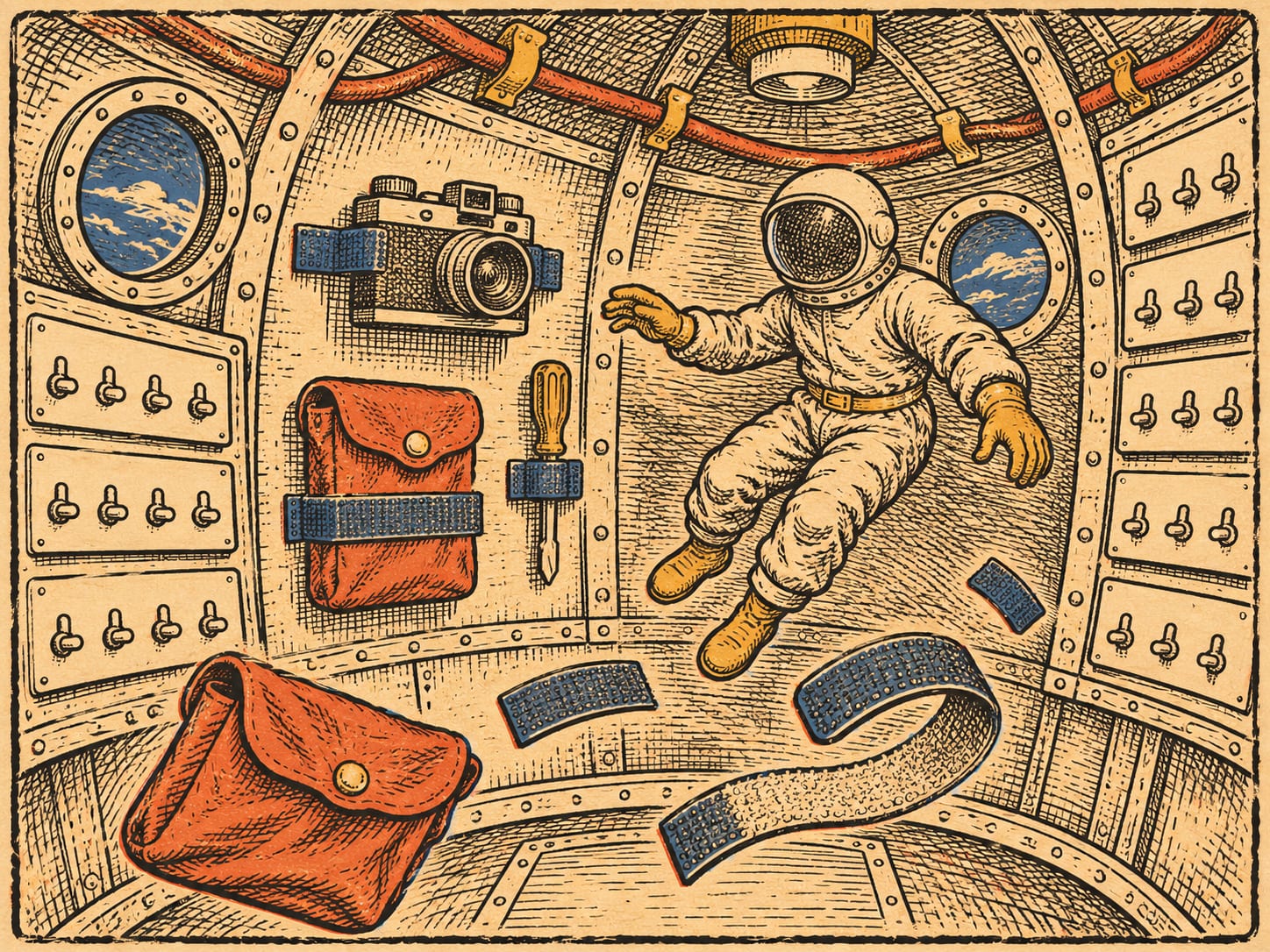
Did NASA invent Velcro?
It did not. NASA's own Spinoff FAQ says a Swiss engineer invented Velcro in the 1940s. The agency's role was heavy, visible use, especially on the Apollo missions.
Space made the fastener famous. It did not create it. The hooks, the loops and the name were all in place years before the Apollo 11 mission of 1969.
An early case of biomimicry
Velcro is often given as an early, familiar case of biomimicry, which is copying a design from nature to solve a human problem. The fastener copies how burdock burrs hold on to fur and cloth.
The Smithsonian describes de Mestral's look at the burr hooks as bio-inspired design. The National Inventors Hall of Fame defines the approach as applying designs, systems or processes from nature to human problems. The company calls its original hook-and-loop fastener a major example of biomimicry, and that is a brand's own wording.
After the patent ran out
By the 1960s the business had grown beyond Switzerland and North America. Velcro Companies and Velok merged during that decade to form Velcro Industries B.V.
The American Physical Society reports that the company came to sell more than 60 million yards of Velcro a year, and that de Mestral became a multimillionaire. Company and WIPO histories date the end of the original patent protection to 1978. The U.S. patent itself lists an expected expiry of 13 September 1972. Whichever date counts, competitors then entered the market, and the company moved toward industrial, automotive, aerospace and medical uses.
After that, protection rested on the VELCRO trademark and on later patents for improved products. The company asks people to say "VELCRO Brand hook and loop fastener." In a recent U.S. trademark case, NHDNC LLC v. Velcro BVBA and Velcro IP Holdings LLC, a challenger argued that VELCRO has become a generic word. A 2024 order of the Trademark Trial and Appeal Board recorded the challenge and split the case into stages. A company filing reported a consumer survey in which more than 50 percent of respondents called "Velcro" a brand name and about 44 percent called it a common name.
De Mestral in his own words
De Mestral died at his home in Commugny, Switzerland, on 8 February 1990. He had been inducted into the National Inventors Hall of Fame in 1999, nine years after his death.
His later remarks come through Swiss television. A report on a 1961 interview has him putting invention at 5 percent inspiration and 95 percent work. In a 1984 interview, speaking about the limits of his fortune after the patent expired, he is reported to have said, "J'ai gagné honnêtement ma vie," which means "I earned my living honestly."
Velcro, from the Jura Mountains to Apollo 11
- 19 June 1907
Georges de Mestral is born at Saint-Saphorin-sur-Morges
- 1941
De Mestral's own account places his hunting walk in the Jura Mountains
- 22 October 1951
Swiss patent application CH295638 is filed
- 1952
Velcro S.A. is formed in Switzerland
- 16 March 1954
The Swiss patent is granted
- 13 September 1955
U.S. Patent No. 2,717,437 is granted
- 1957
A U.S. facility opens in Manchester, New Hampshire
- 1959
Manufacturing begins in Spain
- 21 November 1961
U.S. Patent No. 3,009,235 is granted
- 1969
Velcro is used on Apollo 11 equipment and spacesuits
- 1978
The original patent protection ends, as company histories give it
- 8 February 1990
De Mestral dies at Commugny
Sources
- "Bio-inspired design" teaching resource, Smithsonian National Museum of Natural History
- U.S. Patent 2,717,437, "Velvet type fabric and method of producing same," and Swiss patent CH295638
- U.S. Patent 3,009,235, "Separable fastening device"
- George de Mestral inductee biography and "A walk in the woods" article, National Inventors Hall of Fame
- "George de Mestral," Historical Dictionary of Switzerland
- "Die wunderbare Geschichte des Klettverschlusses," Swiss Federal Institute of Intellectual Property
- "The Velcro IP story," World Intellectual Property Organization
- Velcro Companies, timeline of innovation and Spanish-language company history
- "Marchamos," issue 17, Spanish Patent and Trademark Office
- Physics history feature, American Physical Society, 2004
- Industrial Design, April 1959
- "Goods & Services: New Ideas," TIME, 8 September 1958; Medford Mail Tribune, 29 January 1959; "Self-Adhering Nylon Tapes," Journal of the American Medical Association, 1958
- Apollo 204 statement by James Webb and softgoods records, NASA; Spinoff FAQ, NASA
- NHDNC LLC v. Velcro BVBA and Velcro IP Holdings LLC, Trademark Trial and Appeal Board
- "Velcro: how space travel paved the way for a Swiss invention," SWI swissinfo.ch; "Swiss fact: VELCRO fasteners, popularised by NASA, were invented in Switzerland," Le News; Washington Post obituary, 1990
Watch the full story on the Flashback Fables YouTube channel, and send it to someone who would love it.