
The microwave oven exists because wartime radar needed a powerful tube, and a Raytheon engineer named Percy Spencer saw what that tube could do to food. He filed his patent on 8 October 1945, and it was granted on 24 January 1950.
The best-known start of the tale is a melted candy bar in Spencer's pocket, told in a Reader's Digest article by Don Murray in August 1958. The patent, the radar work and the machines that followed are better documented than that one scene.
Raytheon's commercial oven, the Radarange, stood about 6 feet tall and weighed about 750 pounds. A countertop oven followed in 1967 for $495.
A boy who left school at 12
Percy LeBaron Spencer was born on 9 July 1894 in Howland, Maine. His father died when Percy was 18 months old, and his mother left him with an aunt and uncle. His uncle died when he was seven.
At 12 he went to work in the mills to help support his widowed aunt. He had, in the words of the American National Biography, "only an elementary school education." Howland's own town history says he "never graduated from grammar school." He learned electrical work as a machinist's apprentice and kept teaching himself from textbooks and hands-on work.
He later served in the U.S. Navy as a radio operator. A later account attributed to Spencer has him describing those years this way: "I just got hold of a lot of textbooks and taught myself while I was standing watch at night." The same account sums up his method as "solving my own situation."
He joined the American Appliance Company, later Raytheon, in 1925. By the late 1930s he was a power-tube specialist at Raytheon Manufacturing Company. During the Second World War, Raytheon built radar equipment around cavity magnetrons, and Spencer improved the way those tubes were made. His methods helped Raytheon turn out thousands per day for Allied radar systems. The U.S. Navy gave him its Distinguished Public Service Award, the Navy's highest civilian honor.
He did not invent the magnetron. He worked out how to mass-produce it.
The tube behind the oven
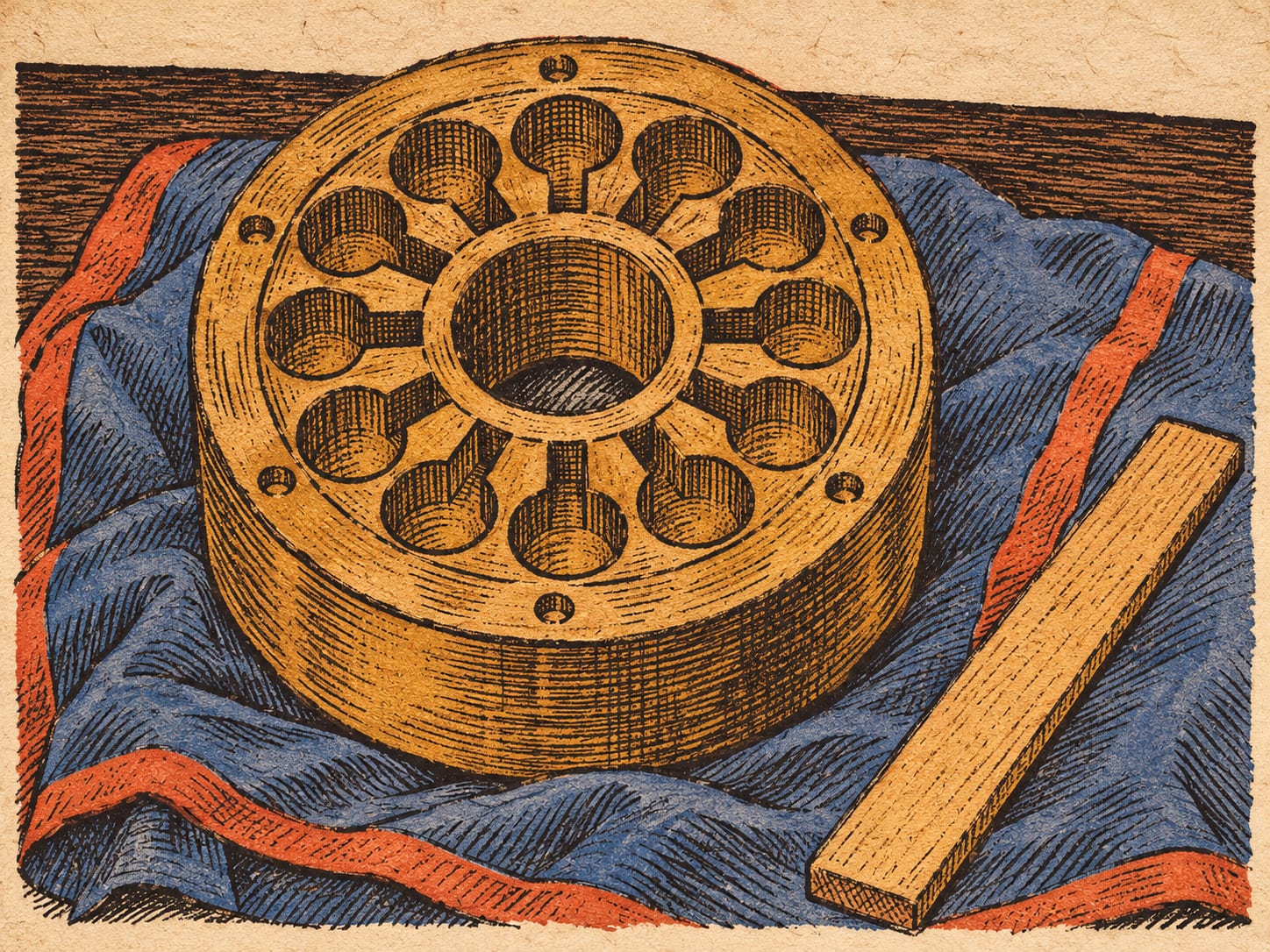
A cavity magnetron is a high-powered vacuum tube that makes microwave-frequency radio waves. Its metal resonant cavities let it produce much stronger, shorter-wavelength signals than earlier magnetrons.
John Turton Randall and Harry Boot built the practical cavity magnetron at the University of Birmingham in England, and a prototype was running there on 21 February 1940. James Sayers later joined the development team. The tube made compact airborne radar possible and became a major Allied technology. Magnetrons are still the part that makes the microwaves inside a microwave oven.
The candy bar in the pocket
Don Murray's Reader's Digest article, "Percy Spencer and His Itch to Know," described Spencer standing near an operating radar magnetron and noticing that a candy or peanut bar in his pocket had begun to cook or melt. The article treated that moment as the start of his investigation of microwave heating.
The snack itself is told several ways. Later retellings call it a chocolate bar. Spencer's grandson said it was more likely a peanut-cluster bar that Spencer carried to feed squirrels and chipmunks. The University of Maine names it as a Payday bar. Which bar it was is still open. Later accounts place the day in 1945.
So, the scene is a story told about Spencer, and the patent and later experiments are the part with paper behind it.
Popcorn and an egg
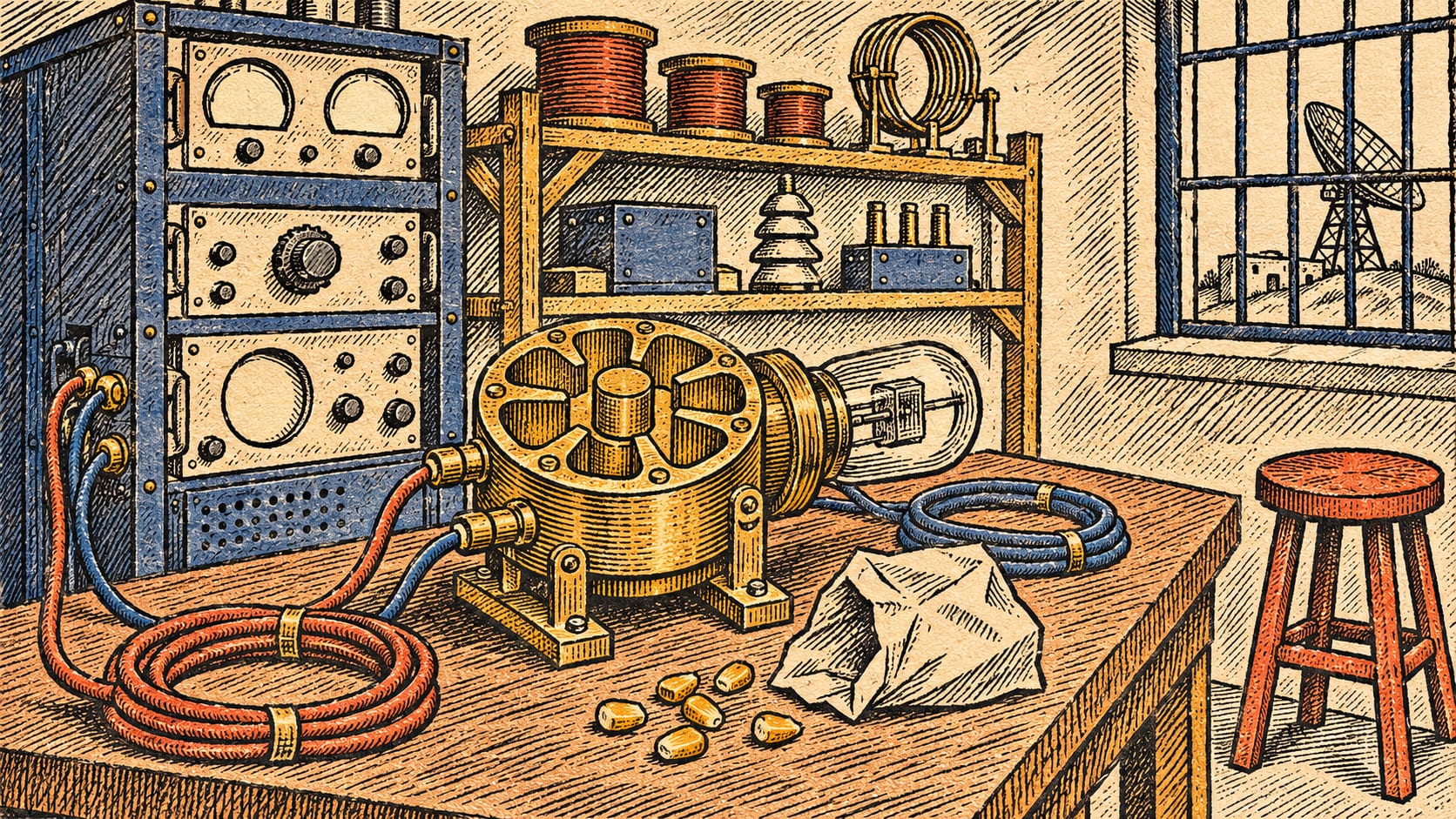
The commonly told sequence has three tests. A candy or peanut bar warmed or melted near a running magnetron. Corn kernels set near it popped. An egg exposed to it heated inside and burst.
Murray's 1958 article tells the popcorn and egg tests, and IEEE Spectrum and later institutional histories repeat them. Spencer's patent, granted in 1950, separately describes microwave cooking tests with an egg and a potato. It says an egg could be hard-boiled with substantially less energy than conventional cooking uses.
Later retellings add a colleague struck in the face by the exploding egg. That detail comes from the telling, not from the patent, and no one has put a name to the colleague.
What the patent described
U.S. Patent 2,495,429, "Method of Treating Foodstuffs," was filed by Spencer on 8 October 1945 and granted on 24 January 1950, with Raytheon Manufacturing Company as the assignee.
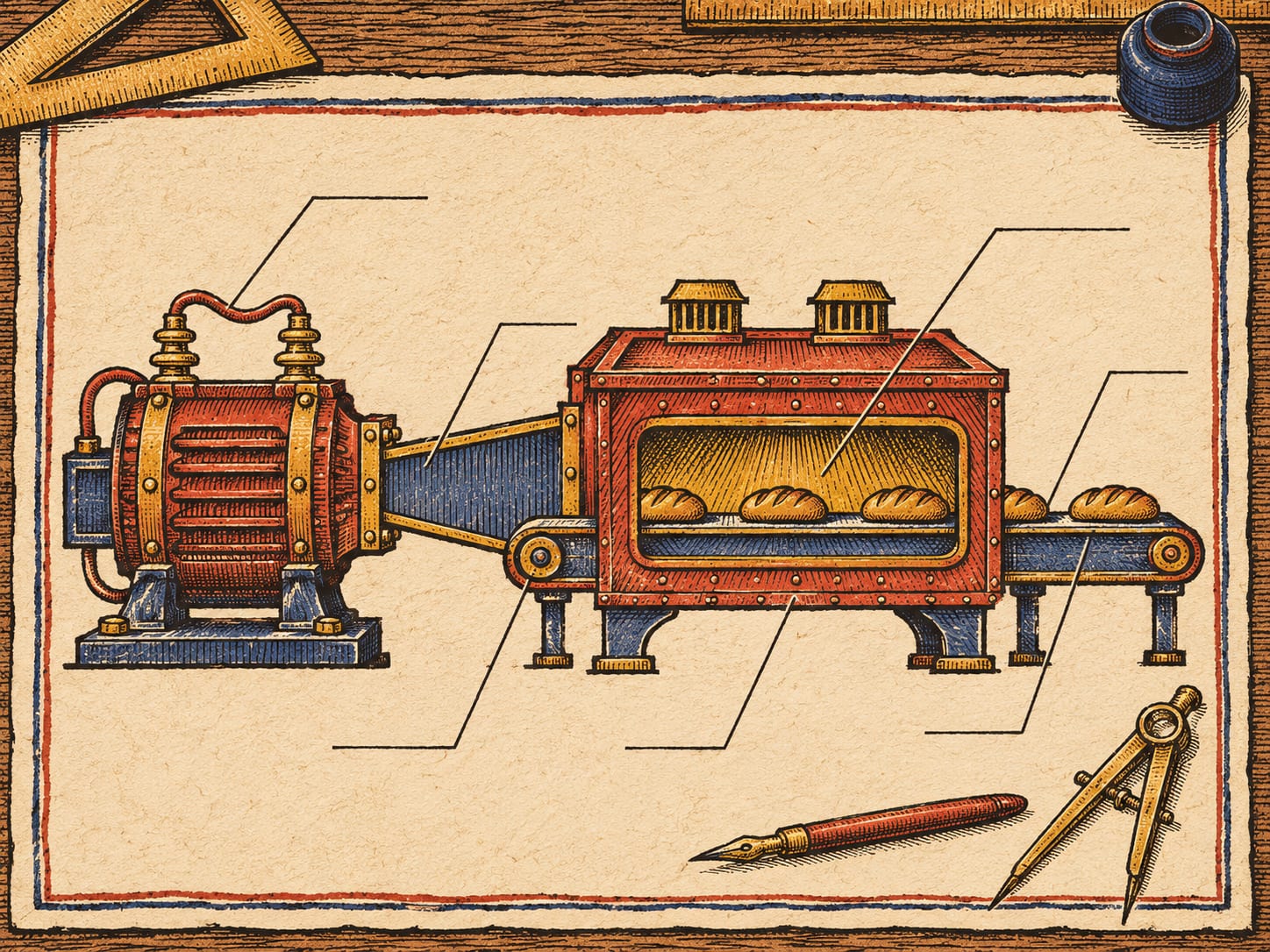
It described cooking food with electromagnetic energy in the microwave region, especially wavelengths of about 10 centimeters or less. Magnetron oscillators would make the energy, a waveguide would concentrate and guide it, and the food would sit in the resulting field.
The original design was not the compact countertop box of today. It included a conveyor that moved food through the microwave field at a controlled speed. The patent also described concentrating the waves in a small region so that food cooked efficiently and quickly.
Radio-wave cooking before Spencer
Heating with radio waves was not new in 1945. At the 1933 World's Fair in Chicago, Westinghouse demonstrated cooking with short radio waves. Its exhibit used a 10-kilowatt, 60-megahertz transmitter to cook sandwiches, steaks, potatoes and vegetables between metal plates.
Bell Labs research led to proposals in 1934 for heating materials with high-frequency electromagnetic waves, and Bell Telephone Laboratories filed a dielectric-heating patent in 1937.
Spencer's own contribution was to see the cooking potential of the high-power cavity magnetron, to develop a workable food-heating system, and to move the technology toward a commercial appliance.
Popular tellings describe one instant accident. John M. Osepchuk's historical review reports that Raytheon colleagues remembered a slower process, with earlier observations of warmth, popcorn experiments and deliberate engineering. The order of events remains disputed, while the patent and Raytheon's product work are documented.
The company behind the oven
Spencer's idea needed a company willing to bet on it, and that took people with other jobs.
Laurence K. Marshall was Raytheon's president and chief executive when the oven work began. He saw the commercial potential in Spencer's experiments, put engineers to work on a practical oven, and promoted the Radarange to restaurant-equipment dealers. By mid-1947 he had hired Charles Francis Adams Jr. as executive vice president. In early 1948 Marshall became board chairman and Adams became president.
Adams had been a partner at Paine, Webber, Jackson & Curtis and had sat on the Raytheon board since 1938. His role was financial and executive, not laboratory work. As president he protected the microwave program, ordered a redesign, and set up a food laboratory where a chef developed recipes.
Marvin Bock worked on the cooking tests for the original oven. His notebook put popcorn at 20 seconds and chicken fricassee at one minute. Steak kept its juices but did not brown.
Art Welch, Raytheon's sales promoter, carried those results into the showroom. At demonstrations for restaurant-equipment dealers he cooked popcorn, a six-pound roast in two minutes, a hamburger in 25 seconds and gingerbread batter in 29 seconds. He sold the oven as a way for restaurants to cook on demand, waste less food and wash fewer dishes.
The Radarange
Raytheon's commercial microwave oven was the Radarange, introduced for commercial use in 1947. The Smithsonian says a Cleveland restaurant bought one for $3,000, and it does not name the restaurant. Other historical accounts give about $5,000, and the large commercial oven is described elsewhere as costing more than $2,000 or about $2,600. The figures differ because they describe different models and dates.
The early Radarange stood about 6 feet tall and weighed about 750 pounds. Its magnetron was water-cooled. A 1953 production oven weighed about 670 pounds, stood 62 inches tall, ran on 220 volts and needed a water pipe to cool its magnetron. These ovens were meant mainly for restaurants, institutional kitchens, ships and aircraft, not for ordinary homes. Time called the oven "still too expensive for the home" in 1946.
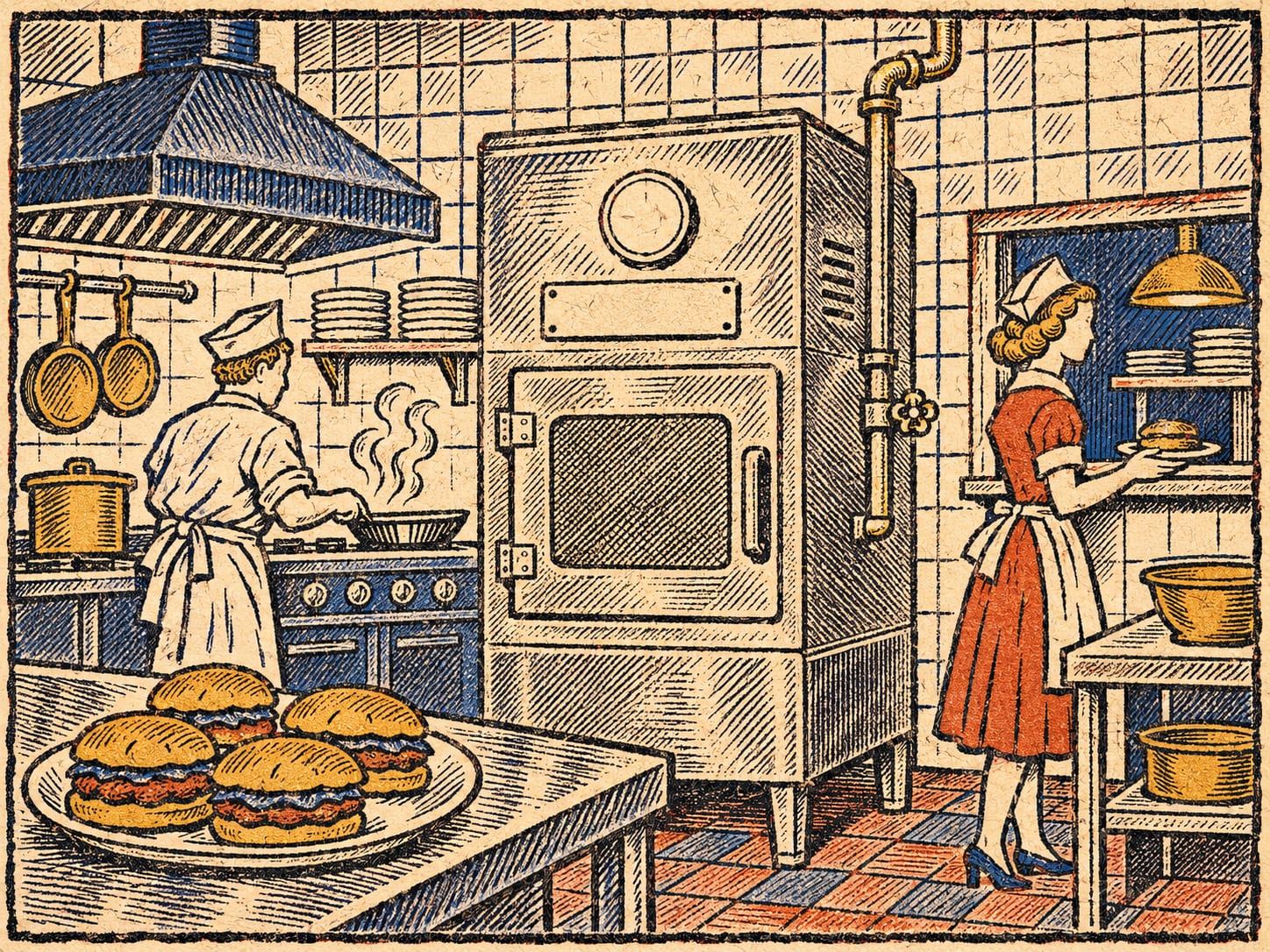
Raytheon expected airlines to be among its earliest buyers and counted quick-lunch restaurants as likely customers. In 1949 the Kodak Park cafeteria tested an oven. Cafeteria supervisor Evelyn Spaulding operated it, and Kodakery reported an egg cooked in five seconds, a hamburger in 22, beef stew in 45 and haddock in one minute.
By 1951 a Seafarers Log report said Radaranges had been installed on ocean-going ships and might become standard galley equipment. A 1952 Raytheon advertisement named the Pennsylvania Railroad and United States Lines among its users and offered ovens to hotels, restaurants and lunch counters. The nuclear-powered merchant ship NS Savannah later carried one in its galley, and a 1966 film shows a Radarange in the cafeteria of St. Paul Hospital in Dallas.
In 1955 Popular Electronics reported what the air-cooled models 1161 and 1170 could do: an 18-pound roast in 40 minutes, a chicken in nine minutes, an apple pie in six and steaks in one minute. What early cooks valued was speed, less food waste and meals made to order.
The Tappan RL-1
In 1955 the stove maker Tappan, which had licensed Raytheon's technology in 1952 or 1953, brought out the RL-1. The Smithsonian holds one and describes it as a microwave oven designed for home use.
It was not a compact box. It could be installed in a wall or used on a countertop, but it was large, heavy and expensive, and it needed a 220-volt connection. A recipe drawer held about 400 recipes. The price was $1,295, and buyers were unsure how to use the technology. Tappan made only 34 in 1955. Production continued until 1964, and the oven sold poorly.
Amana and the 1967 oven
Raytheon bought Amana Refrigeration in 1965, to pair its microwave technology with Amana's experience in making, distributing and marketing household appliances.
Amana's founder and president, George C. Foerstner, preferred refrigerators and did not want to enter the microwave business. Charles Adams later said the project "was really forced down his throat till it took hold." Once Foerstner accepted it, he set conditions. A 1967 Merchandising Week article reported that he insisted on service facilities, warranty support, Underwriters' Laboratories approval and consumer instruction before launch, and planned to hire home economists to teach buyers how to use the oven.
The oven itself came from Amana engineers and Raytheon staff, especially Foerstner's son Richard and the Raytheon engineer Richard Ironfield. Ironfield recalled that Raytheon engineers had seen the younger Foerstner as a privileged "goof-off," then admired his talent for simplifying parts. They redesigned brackets and other pieces so they could be stamped cheaply instead of welded from several parts. Ironfield had already patented a quarter-wave choke door seal in 1962, a major improvement in controlling leakage.
The result ran on standard 115-volt household current and sold for about $495. The Merchandising Week article had expected about $450. George Foerstner's forecast was 50,000 ovens a year. Raytheon had sold 10,000 Radaranges between 1953 and 1967, before the countertop model. A later engineering history reports 525,000 U.S. microwave sales in 1972 alone, with 885,000 ovens already installed.
The 1967 model mattered because it joined a lower price, countertop size, ordinary household voltage, simpler manufacturing and consumer instruction.
How ovens reached households
The countertop oven made microwave cooking practical at home. It encouraged quick reheating, fast defrosting, microwave-specific containers, frozen convenience foods and popcorn products. Price and public worry about microwave radiation held adoption back at the start.
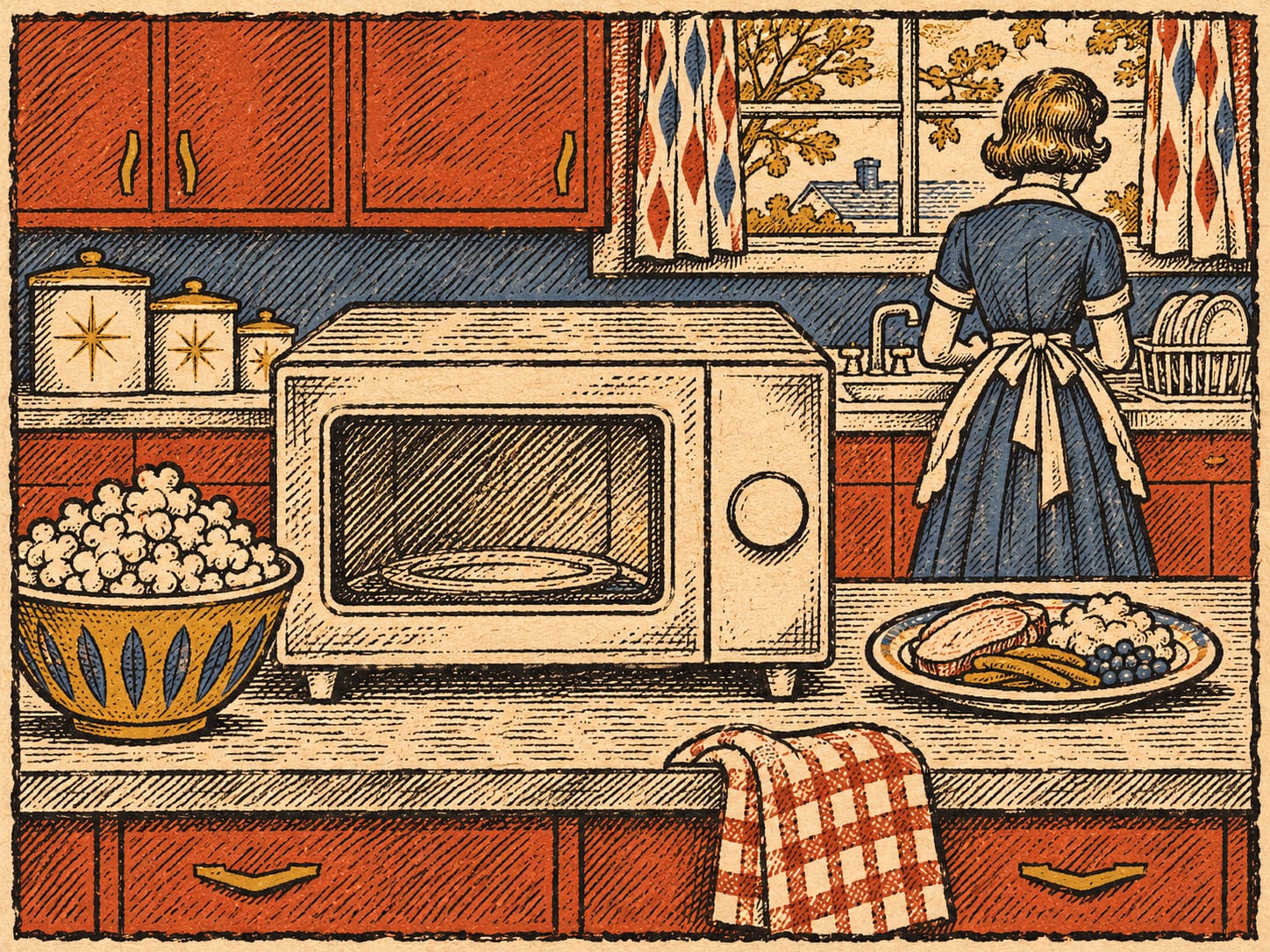
Ownership in U.S. households grew from under 1 percent in 1971 to 7.8 percent in 1978 and 14.2 percent in 1980. By 1982 it was 23.0 percent, and by 1984 it was 34.3 percent. The Statistical Abstract series gives 60.8 percent for 1987, and reporting at the time puts 1990 at roughly 75 to 80 percent. By 1997 to 2000, about 90 percent of households had one.
The numbers come from different surveys and series, so they do not form one continuous line. A separate Bureau of Labor Statistics series gives about 25 percent for 1986, for example. The pattern is still clear: from almost no homes in the early 1970s to a majority in the 1980s and about nine in ten by the end of the 1990s.
Rules for the new ovens
The worry about radiation was answered with law. The Radiation Control for Health and Safety Act of 1968 allowed federal performance standards for electronic products, microwave ovens among them. The Bureau of Radiological Health then issued the microwave-oven standard for ovens made after 6 October 1971.
It limited leakage to 5 milliwatts per square centimeter at about 5 centimeters from the oven surface. It required two independent door interlocks, a monitoring system that disabled the oven if an interlock failed, and controls that stopped operation with the door open.
The standard did not ban microwave cooking. It required makers to certify compliance and to design ovens so ordinary use would not leak hazardous radiation. The FDA says today that intense exposure can cause burns or cataracts but takes large amounts of radiation, and that most microwave-oven injuries are ordinary heat injuries from hot containers, overheated food or exploding liquids, including superheated water erupting from a cup.
From radio waves to the kitchen counter
- 1933
Westinghouse cooks food with short radio waves at the Chicago World's Fair
- 1934
Bell Labs research leads to proposals for heating materials with high-frequency waves
- 21 February 1940
A Randall and Boot cavity magnetron prototype runs at the University of Birmingham
- 8 October 1945
Spencer files the microwave cooking patent for Raytheon
- 1947
Raytheon introduces the Radarange for commercial use
- 24 January 1950
U.S. Patent 2,495,429 is granted
- 1955
Tappan introduces the RL-1 for the home at $1,295
- 1965
Raytheon acquires Amana
- 1967
Amana introduces a countertop microwave oven at $495
- 6 October 1971
The federal microwave-oven standard applies to ovens made after this date
Spencer after the oven
Spencer retired from Raytheon in 1964 and stayed on as a senior executive and consultant. The University of Maine's biography of him lists his post as "senior vice president, a director, and manager of microwave and power tube operations." It counts "over one hundred patents." Howland's town plan says 150. He held an award from the U.S. Army and three from the U.S. Navy.
He died in Newton, Massachusetts, on 7 September 1970, aged 76. His gravestone and some notices give 8 September. The New York Times obituary ran on 8 September under the headline "Percy Spencer, Inventor, Dead; Retired Raytheon Executive, 76."
What can be seen today
The Science Museum Group in London holds the original 1940 cavity magnetron of Randall and Boot, object 1946-107. The museum also holds an Amana Touchmatic Radarange from 1978 and a Speedarange from 1962, and has shown the Radarange in its Secret Life of the Home gallery.
The University of Birmingham's physics collection holds cavity-magnetron material tied to Randall, Boot and Sayers, including anode blocks made in its physics workshop between 1940 and 1945, and a replica made for the 50th anniversary. The Smithsonian's National Museum of American History holds a Tappan RL-1. Displays change, so it pays to check with each museum before a visit.
Sources
- "Tappan Model RL-1 Microwave Oven," Smithsonian Institution, National Museum of American History
- "Ride the Electromagnetic Wave with Percy Spencer," Library of Congress, Inside Adams blog
- U.S. Patent 2,495,429, "Method of Treating Foodstuffs"
- "A Brief History of the Microwave Oven," IEEE Spectrum
- Don Murray, "Percy Spencer and His Itch to Know," Reader's Digest, August 1958
- "From a Melting Bar to an Exploding Egg," Institute of Physics
- "Original Cavity Magnetron," Science Museum Group, and its Amana Radarange gallery account
- "Milestone Plaque for Microwave Pioneers," University of Birmingham, and the university's Physics Collection
- John M. Osepchuk, "The History of the Microwave Oven: A Critical Review"
- American Physical Society, APS News piece on the microwave patent, 2015
- Percy Spencer pages, Lemelson-MIT, Smithsonian Lemelson Center, Linda Hall Library and University of Maine; Howland comprehensive plan
- American National Biography, entry on Percy Spencer
- "The Greatest Discovery Since Fire," Invention & Technology, and the 1989 history of microwave-oven development
- Time, 1946 report on Raytheon's oven; Kodakery, 1949; Seafarers Log, 1951; Popular Electronics, March 1955; Merchandising Week, 30 January 1967
- Amana brand history
- U.S. Food and Drug Administration, microwave-oven safety page and history of the Radiation Control for Health and Safety Act; Federal Register, 15 October 1973, microwave standard
- U.S. Bureau of Labor Statistics, microwave oven quality adjustment; U.S. International Trade Commission, countertop microwave ovens from Japan
- U.S. Statistical Abstract appliance table, GovInfo; Washington Post, 1987
Watch the full story on the Flashback Fables YouTube channel, and send it to someone who would love it.