Quarantine comes from the Italian quaranta giorni, forty days, but the earliest surviving rule of its kind asked for thirty. On 27 July 1377, the Great Council of Ragusa, now Dubrovnik, ordered anyone arriving from a plague-infected region to spend a month in isolation before they could enter.
Venice later stretched the wait to forty days, and the name followed the number. The Italian word quarantena, from quaranta, "forty," is where English gets quarantine.
Today the word covers any separation of people who may have been exposed to an infectious disease, and the wait no longer has to be forty days. The disease and its incubation period set the length.
Plague reaches the ports, 1347 and 1348
After plague reached Mediterranean cities in 1347 and 1348, port authorities reached for a set of tools. They closed ports and banned travel. They demanded health certificates, inspected ships and cargo, set up isolation outside the city walls and ran sanitary cordons around infected places.
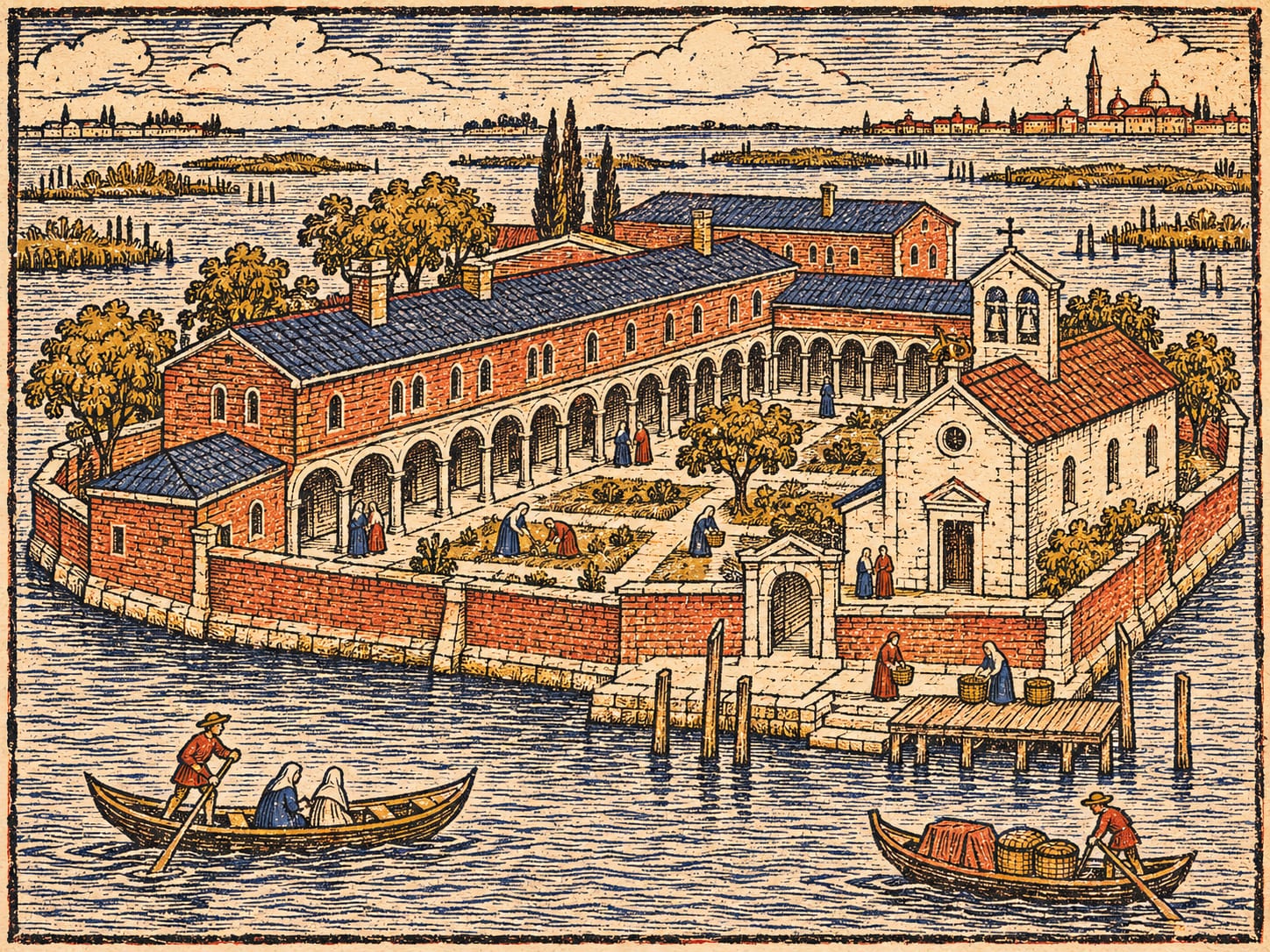
Venice appointed health officials during the Black Death and ordered ships from infected ports to stay at anchor before they landed. In 1423 the city set up a permanent plague hospital on the island of Santa Maria di Nazareth, later called Lazzaretto Vecchio.
The island housed infected people. It also kept suspected travellers, crews, goods and residents apart from the city.
Ragusa, 27 July 1377
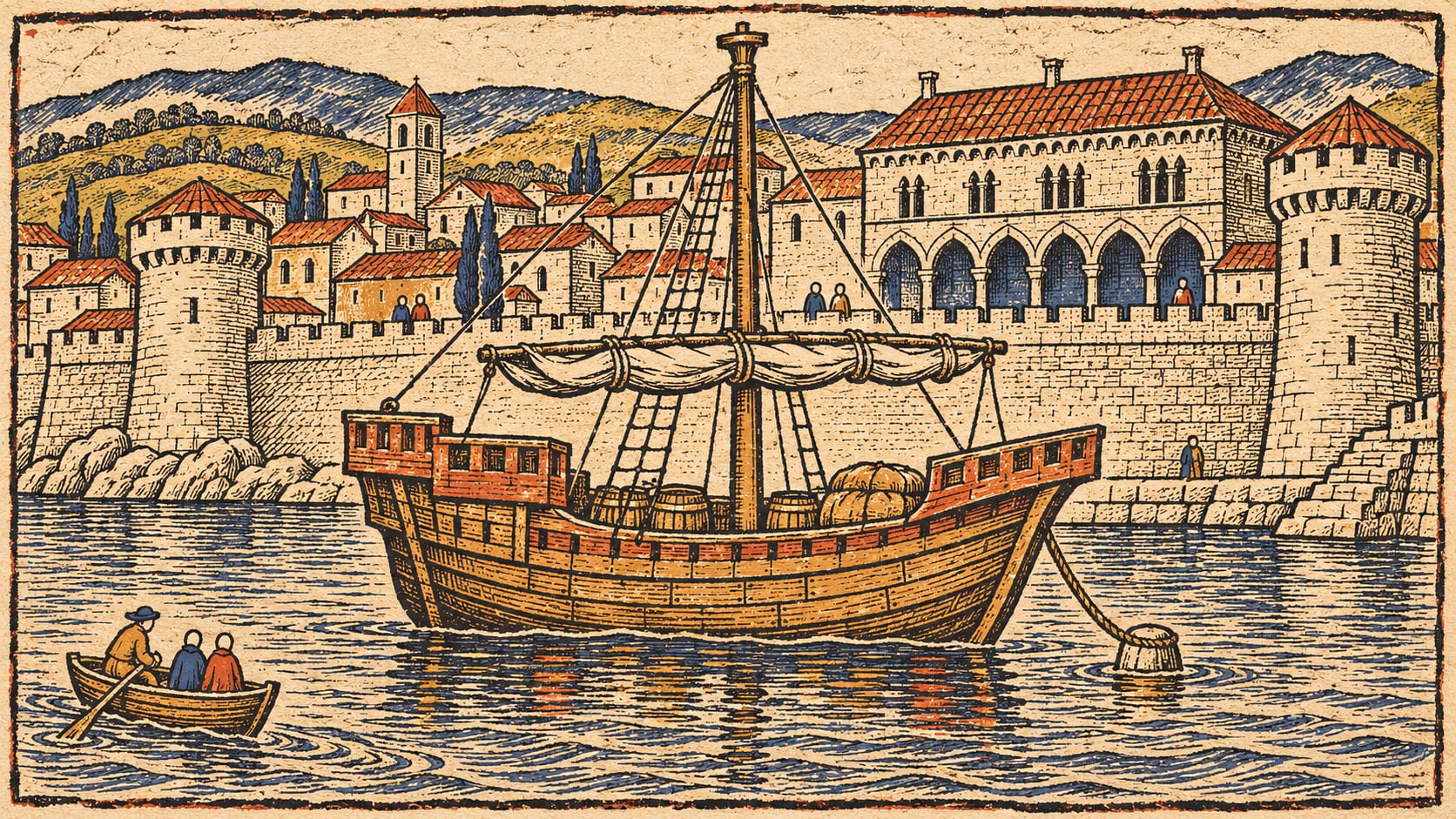
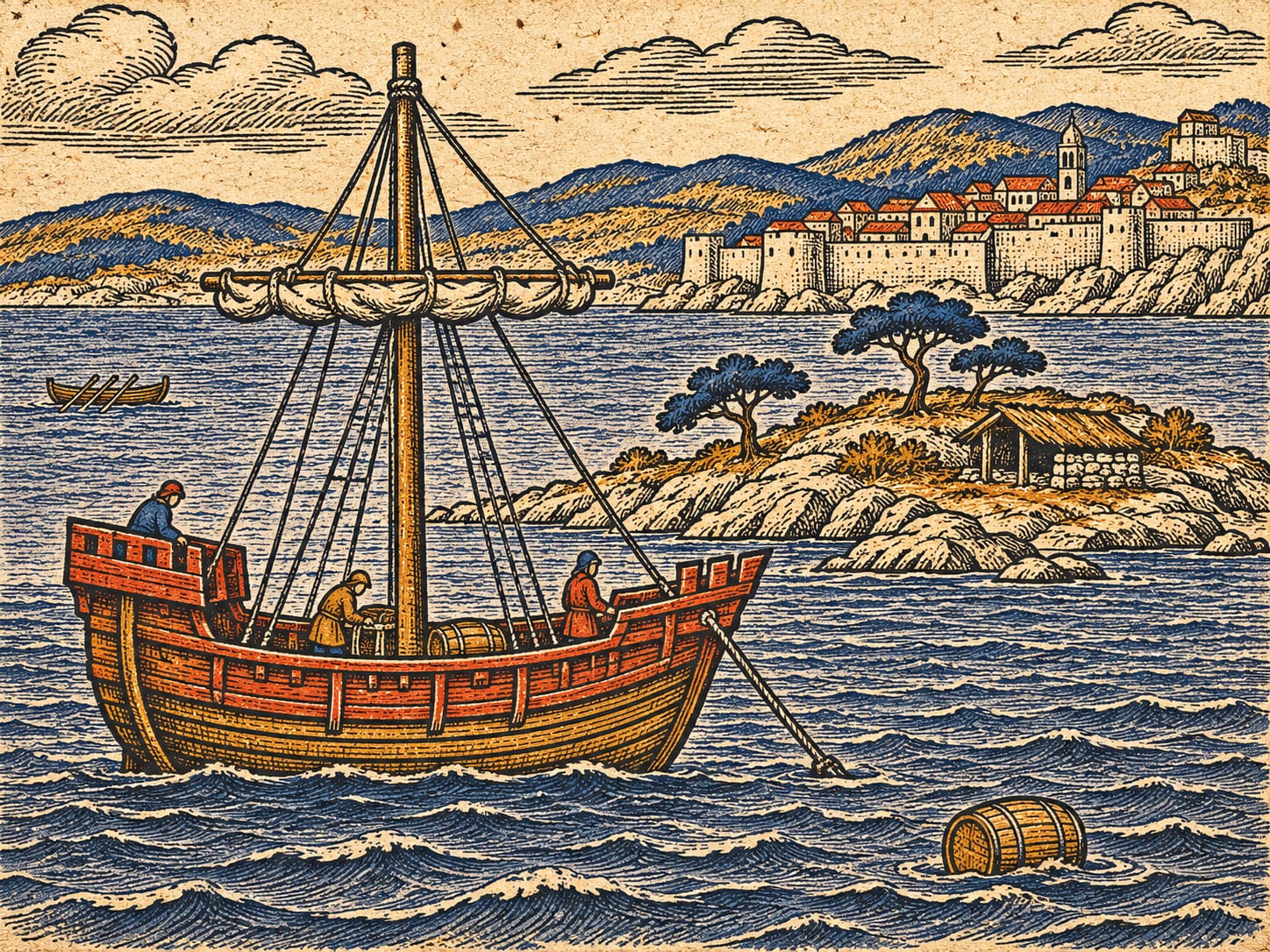
On 27 July 1377, the Great Council of Ragusa passed a rule for people coming from regions where plague had broken out. The entry in the council's Green Book carries the heading Veniens de locis pestiferis non intret Ragusium vel districtum, which means "Let no one coming from plague-stricken places enter Ragusa or its district."
Four provisions follow. Arrivals from infected regions could not enter Ragusa or its district until they had spent a month in isolation at Mrkan or Cavtat, and later accounts add the sites of Bobara and Supetar. No one from Ragusa could visit the people in isolation, and anyone who did had to stay with them. Only people appointed by the Great Council could bring food and other necessities. Anyone who broke the rule faced a fine and a month of isolation. The rule applied to citizens and outsiders alike.
The decree survives in the Liber Viridis, the Green Book of the Dubrovnik council, in chapter 49, and the Dubrovnik State Archives keep the original council record. The wait was thirty days, called a trentino or trentina. It was not forty. The decision belongs to the Great Council as a body. The chief physician Jacob of Padua is linked with the medical advice behind the policy.
Historian Gordan Ravančić names Dubrovnik's 1377 decree as the earliest documented thirty-day isolation rule.
Ragusa builds a system
One decree did not finish the work. In 1390, Ragusa set up a permanent health office. In 1397 the Great Council appointed three officials called kacamorti to enforce the rules, and the decree of that year confirmed the thirty days, named the place of confinement and set penalties.
The kacamorti watched the people held in isolation, kept unauthorised visitors away and acted against anyone who broke the rules. Penalties could include fines, prison or corporal punishment, and one account says they were applied to common people and not to the aristocracy. During an epidemic, bringing goods in from the countryside was forbidden.
The buildings changed too. By the fifteenth century, isolation shelters stood on Mrkan, Bobara and Supetar. The early shelters were wooden and could be burned if contamination was suspected. In 1429, a design for a permanent confinement building was carried out in Ragusan territory. Over decades, Ragusa moved from temporary isolation on islands and at Cavtat toward permanent lazaretto buildings and a health bureaucracy.
From thirty days to forty
Venice then stretched the wait. Ravančić separates Dubrovnik's earlier system from the larger Venetian one that followed, where the period grew to forty days and the city built a bigger network of lazarettos. The date usually given for the change is 1448, when the Venetian Senate extended the waiting period to forty days.
The Italian word for it was quarantena, from quaranta, "forty." That is where the English word quarantine comes from.
The change came gradually, and the Venetian measures show it. The decision of 1423 created the plague hospital on Lazzaretto Vecchio and gave the Signoria and the Collegio power to bar infected areas. It dealt with isolation and exclusion, and it did not lay out a general quarantine procedure. In 1468, a separate facility, Lazzaretto Nuovo, was set up for people, ships and cargo that were suspected but not necessarily sick, while Lazzaretto Vecchio stayed mainly a hospital for the infected.
Between those dates the Venetian authorities kept acting case by case:
- On 31 December 1430, the Collegio ordered the infected ship Delfina to stay outside Venice.
- On 14 May 1426, the Senate warned the Flanders galleys away from plague in England.
- On 27 December 1435, the Senate ordered the Romania galleys quarantined at Istria.
- On 8 October 1437, the Senate barred Venetians from the Treviso fair because of plague.
- On 9 June 1447, the Senate sent Pietro Valier and Francesco Foscarini to persuade sick people to enter the Lazaretto.
Later, the Provveditori alla Sanità received supreme authority from the Senate in 1486 and became a permanent body on 9 January 1490.
Ports used shorter or longer periods depending on the disease, where the ship had sailed from, what it carried and the local health rules. So, 1448 marks the date tied to Venice's formal extension. It does not mean every harbour moved to forty days overnight.
From plague ports to international rules
- 1347 to 1348
Plague reaches Mediterranean cities, and ports begin closing, inspecting ships and isolating arrivals
- 27 July 1377
The Great Council of Ragusa orders a one-month isolation for arrivals from plague-infected regions
- 1397
Ragusa appoints three kacamorti to enforce its quarantine
- 1423
Venice sets up a permanent plague hospital on Lazzaretto Vecchio
- 1448
Venice's Senate is usually credited with extending the wait to forty days
- 1468
Venice sets up Lazzaretto Nuovo for suspected, not sick, arrivals
- 1526
Marseille creates its lazaret on the island of Pomègues
- 1627
Building begins on the Lazareti at Dubrovnik
- 25 May 1720
The ship Grand-Saint-Antoine returns to Marseille from the Levant
- 23 July 1851
The Paris sanitary conference opens
- 1892
A formal international sanitary convention is drawn up at Venice
Why forty?
Why the number became forty has no single confirmed answer. Several explanations are offered, and each is a theory.
- Lent. Forty marked the fasting and purification before Easter, and medieval Christian culture tied it to Moses, Jesus, the Flood and the Israelites' years in the desert.
- The Bible. Some explanations link forty days of quarantine to biblical periods of testing, purification or separation. The number carried that weight, though no passage is tied to the Venetian rule.
- Hippocrates. One medical-history explanation connects forty days to ancient Greek ideas of "critical days," when the course of an illness might become clearer. Whether Venetian officials followed any Hippocratic rule is unknown.
- Watching for illness. Forty days gave a generous stretch to observe people, cargo and ships arriving from infected areas.
- Childbirth. Medieval and early modern societies often kept a forty-day lying-in period after a birth, which made forty a familiar span of recovery and separation. That is a parallel, not a proven origin.
Most likely, the practical value of a long wait and the weight of religious and cultural symbolism worked together.
How the word travelled
Venice used quarantena or quarantina, from quaranta giorni, in the quarantine sense by the fifteenth century or earlier. French had quarantaine for a group or period of forty, and later for sanitary detention. Spanish had cuarentena by about 1200, in the sense of religious fasting, and the sanitary sense came later, probably through Italian.
English had quarantine around 1600 for a quarantine building. Which use counts as the earliest depends on whether you mean the place, the period or the act of isolation.
Samuel Pepys caught the word in the middle of its change. On 26 November 1663, by the Old Style calendar then used in England, he wrote in his diary that plague was growing in Amsterdam and had reached Hamburg. The Navy Board, where Pepys was Clerk of the Acts, was about to make ships from those ports "perform their Quarantine" at Holehaven, a creek on the south coast of Essex, which he called "a thing never done by us before."
The order of the Council set the wait at thirty days. Pepys noted that this was "contrary to the import of the word," because in general use it now "signifies the thing, not the time spent in doing it." In other words, the English were already calling thirty days a quarantine.
Marseille, 1720
In 1720, plague killed tens of thousands in Marseille, and the quarantine system that was meant to stop it had a ship in its hands. Marseille ran a major system on the islands of Pomègues and Ratonneau, and its lazaret on Pomègues dates from 1526.
The ship was the Grand-Saint-Antoine, commanded by Captain Jean-Baptiste Chataud. It left Marseille for the Levant on 22 July 1719 and returned on 25 May 1720 after calls at Sidon, Tripoli, Cyprus and Livorno. Several crew members died on the voyage, including the ship's surgeon, and a medical certificate from Livorno described the deaths as a malignant pestilential fever. Jean-Baptiste Bertrand's account has seven men dying before or during the voyage, and the Musée d'Histoire de Marseille material describes eight.
Chataud presented a clean bill of health on 25 May. Marseille's health officials let the cargo go into the infirmaries instead of sending the ship and cargo to the quarantine station on Jarre. Jean-Baptiste Estelle, one of the city's four consuls, owned part of that cargo. A deposition survives from the same day, taken by Monsieur Tiran, the acting intendant of the city's health board.
Plague entered the city anyway. The regent, Philippe d'Orléans, ordered the ship burned on 28 July 1720, and the vessel and cargo were burned on 25 and 26 September. Chataud was imprisoned at the Château d'If.
Published death tolls differ. Inrap gives 30,000 to 40,000 deaths in Marseille between 1720 and 1722 and about 100,000 in Provence. A demographic study gives about 50,000 deaths in Marseille by December 1720, from a population of about 100,000. A study of the whole epidemic gives almost 120,000 deaths among about 400,000 people in 240 communities.
Ships, flags and lazarettos
Through the 1700s and 1800s, quarantine stayed mainly a system for ships. Vessels from infected or suspect ports anchored offshore or at a designated station. Officials checked the health certificate, the crew, the passengers, the cargo and the ports the ship had visited. People and goods could be held separately, aired, fumigated, washed or moved to a lazaretto. How long they stayed depended on the disease and the port.
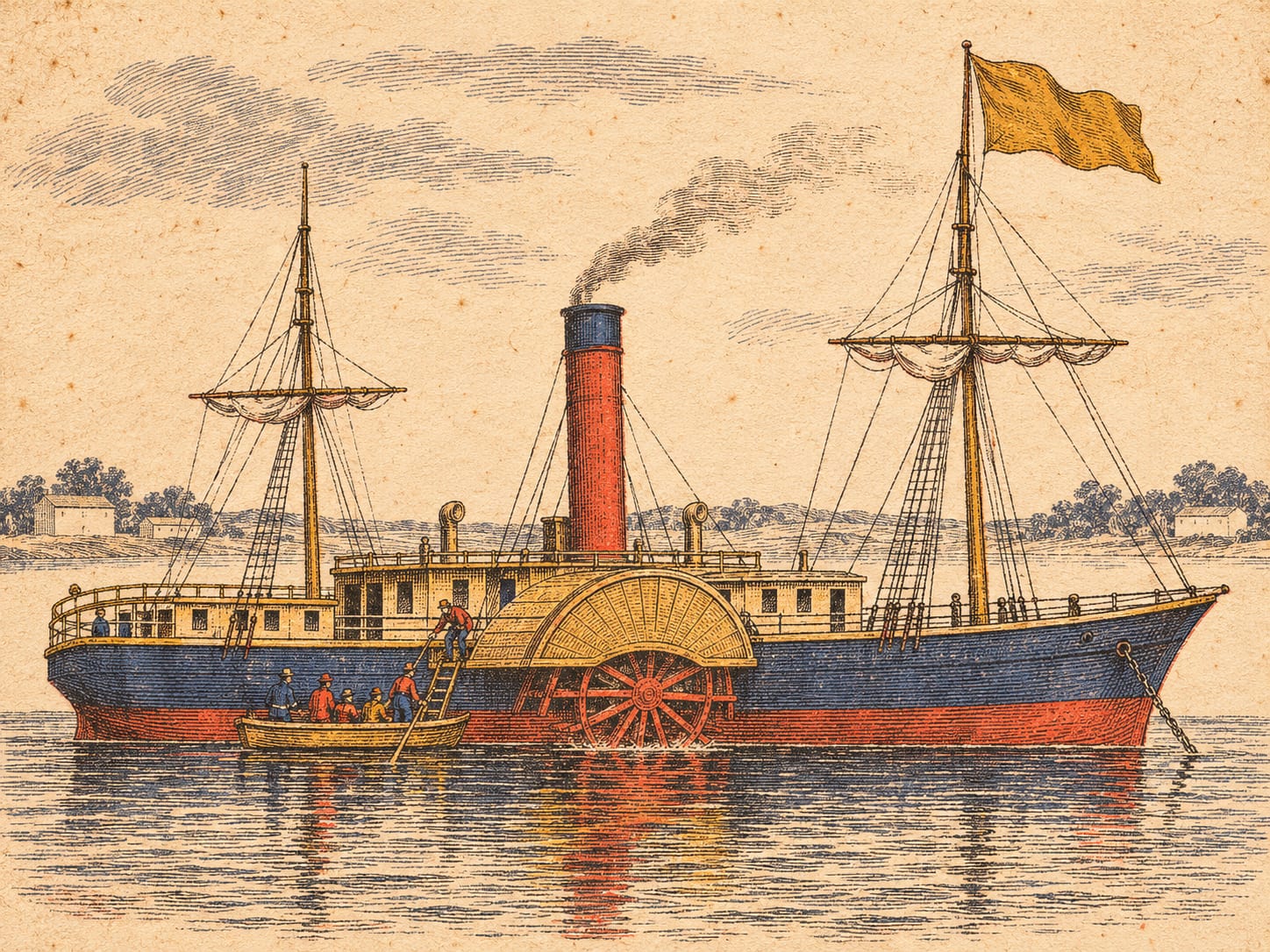
Yellow fever made quarantine matter in Atlantic and Mediterranean ports in the 1700s. Ships flew a yellow flag or another signal while they were held. Edward Montague, describing his ship's quarantine at Mahon in 1848 in a narrative of an expedition to the Dead Sea, wrote of "the abominable yellow flag" that marked it as "plague smitten": "Every boat steers off from us, afraid of contamination."
In the United States, repeated yellow-fever outbreaks helped bring federal quarantine legislation in 1878.
Spanish law shows the forty days still in use. A Spanish government notice of 1814 ordered a rigorous forty-day quarantine and cargo disinfection for ships from Gibraltar during a yellow-fever scare. A regulation of 1847 allowed ship quarantine of up to forty days after a death from a serious contagious epidemic.
New York's quarantine islands
Ellis Island's immigration station opened in 1892 with medical inspection and hospital buildings, and its own hospital for infectious disease opened in 1911. New York's system also used two nearby islands. Swinburne Island served mainly as a hospital for people showing symptoms, and Hoffman Island held people who had been exposed but had no symptoms yet.
A New York quarantine report for 1912 counts 6,304 people removed from inspected vessels for observation or detention. On Swinburne Island, 192 cases were treated and 14 people died. On Hoffman Island, 218 people were detained and seven died. Hoffman had 150 beds and Swinburne 100. In that year, inspectors boarded 4,175 steamships and 710 sailing ships, carrying 473,485 crew members and 1,034,967 passengers.
A United States Public Health Service report from another period records 11 ships held for cholera and 201 passengers sent to Hoffman Island for bacteriological examination. All of them tested negative. Ten ships were held for typhus, and 47 typhus cases were treated in hospital.
Ellis Island was not a medieval forty-day station. How long anyone was held depended on medical findings, the disease and the immigration rules. A child's school assignment about an Ellis Island detention survives, and it begins: "When we got to Ellis Island I didn't pass one of the inspections." The child was taken to a hospital and had to read English, and the writer resented that passengers in the top two cabin classes could leave the ship in Manhattan while steerage passengers went through Ellis Island. It describes Ellis Island, not detention on Hoffman or Swinburne.
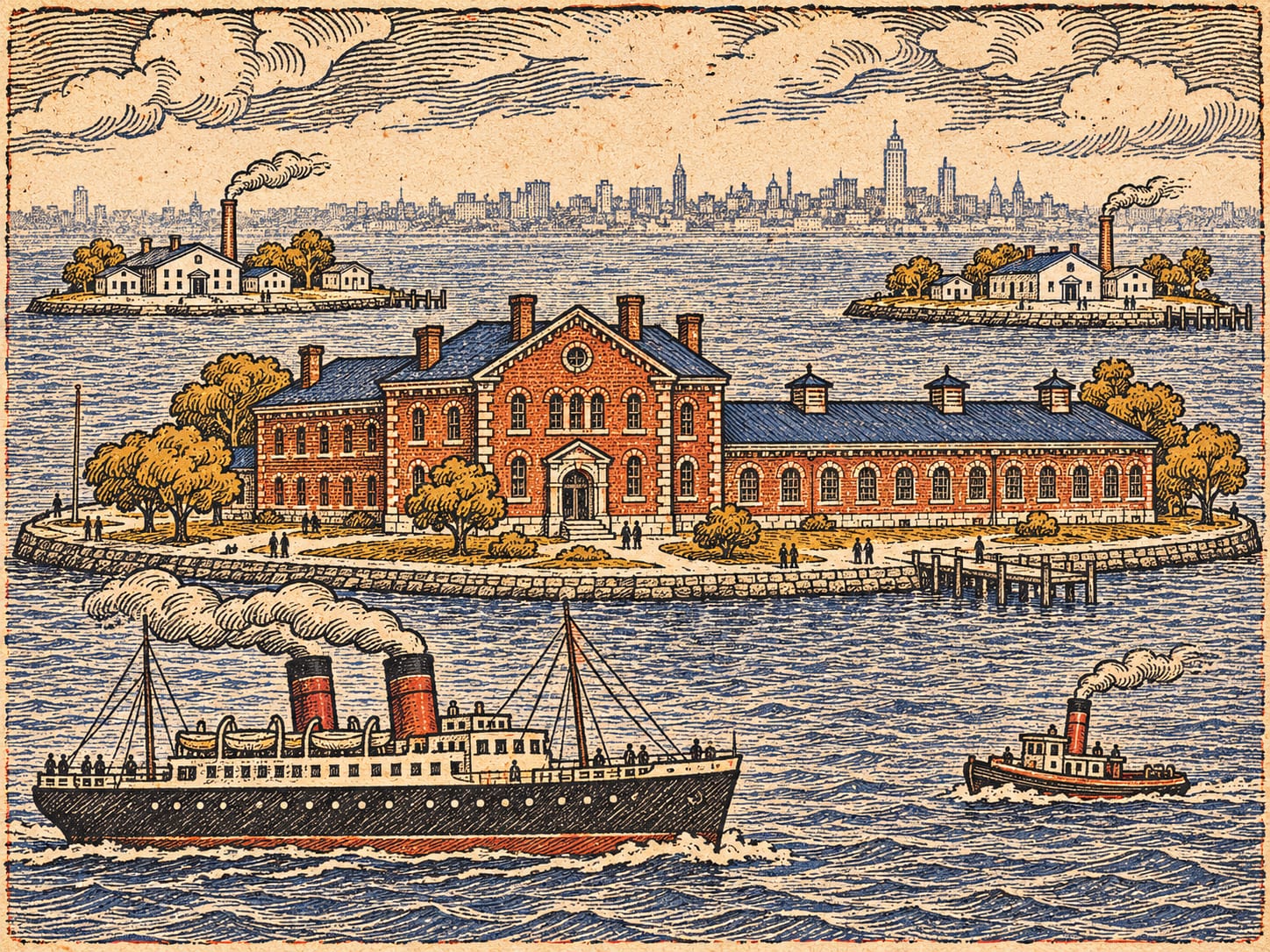
Hoffman and Swinburne are unpopulated parts of the Staten Island Unit of Gateway National Recreation Area, and the National Park Service keeps them closed to the public.
When countries began comparing rules
National quarantine rules varied from port to port and disrupted trade, while cholera, plague and other diseases moved through expanding Mediterranean shipping networks. The French government called a conference in Paris to draw up common sanitary rules for shipping. It opened on 23 July 1851 and ran until 19 January 1852.
Twelve states sent delegates: Austria, France, Great Britain, Greece, Portugal, Russia, Spain, the Ottoman Empire, Sardinia, Tuscany, the Papal States and the Kingdom of the Two Sicilies. Each sent a diplomat and a physician, 24 delegates in all, under a president, Count Lallemand.
The draft convention ran to 137 articles. It proposed ten full days of quarantine for people arriving from infected places and ten days for contaminated ships. A ship could be cut to five days if its voyage had lasted more than fifteen days with no sickness aboard. If cholera appeared among the people detained, the ten days started again. Some delegates argued for fifteen or seventeen days, and the room argued over whether cholera was contagious at all.
The convention did not take effect. Only four of the twelve states signed the final draft, and one historical account adds that only France and Sardinia ratified it. Diplomats and physicians voted separately, so a country's two votes could cancel each other. Britain opposed quarantine as an obstruction to commerce and preferred sanitary regulation.
French official history states that the convention produced no uniform European rules. It still trimmed some exaggerated quarantine practices and set terms and principles that later conferences used.
More conferences followed: Paris in 1859, Constantinople in 1866, Vienna in 1874, Washington in 1881 and Rome in 1885. In 1892 a formal international sanitary convention was drawn up at Venice, aimed at keeping cholera from entering Europe by the Suez route.
What stands in Dubrovnik today
The Lazareti that survive at Ploče, beside the eastern entrance to the city, were authorized by the Senate of the Republic of Dubrovnik in 1590 and built in stages from 1627. Sources give completion dates of 1642, 1647 and 1648. The government of the Republic built them near the main land and sea routes from plague-affected regions. The complex has ten halls arranged around five courtyards.
They were declared part of Dubrovnik's fortifications in 1724, and their quarantine work continued into the nineteenth century. One Croatian planning document gives 1872 as the end of their original role as a health institution.
The Dubrovnik tourist board describes the site as the only fully preserved quarantine complex on the European side of the Mediterranean. It is no longer a working station. It is open as a cultural complex with exhibitions, concerts, workshops and lectures, and it houses groups such as the Linđo Folk Music Ensemble and Art Workshop Lazareti.
Cuarentena today
In Spanish, cuarentena has two main meanings: a period of forty days, and the preventive isolation of people, animals or goods that may have been exposed to an infectious disease. Modern health usage does not require exactly forty days.
Older Spanish also used cuarentena for the forty days after childbirth, and a Spanish legal-history article documents that use in early modern Inquisition procedure. Mexico's General Health Law, in Article 406, now defines cuarentena as restricting the movement of healthy people who have been exposed to a transmissible disease, for the time strictly necessary to control contagion. It sets no forty-day requirement.
Quarantine and isolation are different. Quarantine is for people who were exposed but are not known to be infected. Isolation is for people who are already infected or ill.
Ragusa asked for thirty days in 1377. Venice made it forty, and the number stayed in the word long after the rule let it go.
Sources
- Gordan Ravančić, "Dubrovnik's Invention of the Quarantine," peer-reviewed historical article
- "The Old Port of Dubrovnik," Emerging Infectious Diseases, Centers for Disease Control and Prevention
- "History of Port Health," Centers for Disease Control and Prevention
- Historical medical guide to old Dubrovnik with English translation of the 1377 regulation, University of Zagreb
- "Learning from the past in the COVID-19 era," Postgraduate Medical Journal, Oxford Academic
- J. Henderson, Plague Control in Venice 1348-1600, University of Kent; "The quarantine," 1600 Venezia; "Venetia 1600," exhibition, Palazzo Ducale
- "Quarantine: an early modern approach," History & Policy
- Etymonline, Wordorigins and Columbia Journalism Review entries on the history of "quarantine"
- Diary of Samuel Pepys, 26 November 1663; Edward Montague, Narrative of the Late Expedition to the Dead Sea
- "Cuarentena," Dicciomed, Universidad de Salamanca; Ley General de Salud, Article 406, Mexico; Gaceta de Madrid, 1 September 1814
- Musée d'Histoire de Marseille; Archives départementales des Bouches-du-Rhône; Inrap; "Two thousand years of epidemics in Marseille"; David Barnes, "Cargo, 'infection,' and the logic of quarantine in the nineteenth century"
- Quarantine Islands, National Park Service; United States Public Health Service report; Library of Congress photograph of the Ellis Island quarantine buildings
- Proceedings of the International Sanitary Conference, Paris, 1851; French Ministry of Health sanitary-history volume; World Health Organization official records and United Nations Archives, "Early International Health Efforts"
- "The Lazarettos," Dubrovnik Tourist Board
Watch the full story on the Flashback Fables YouTube channel, and send it to someone who would love it.