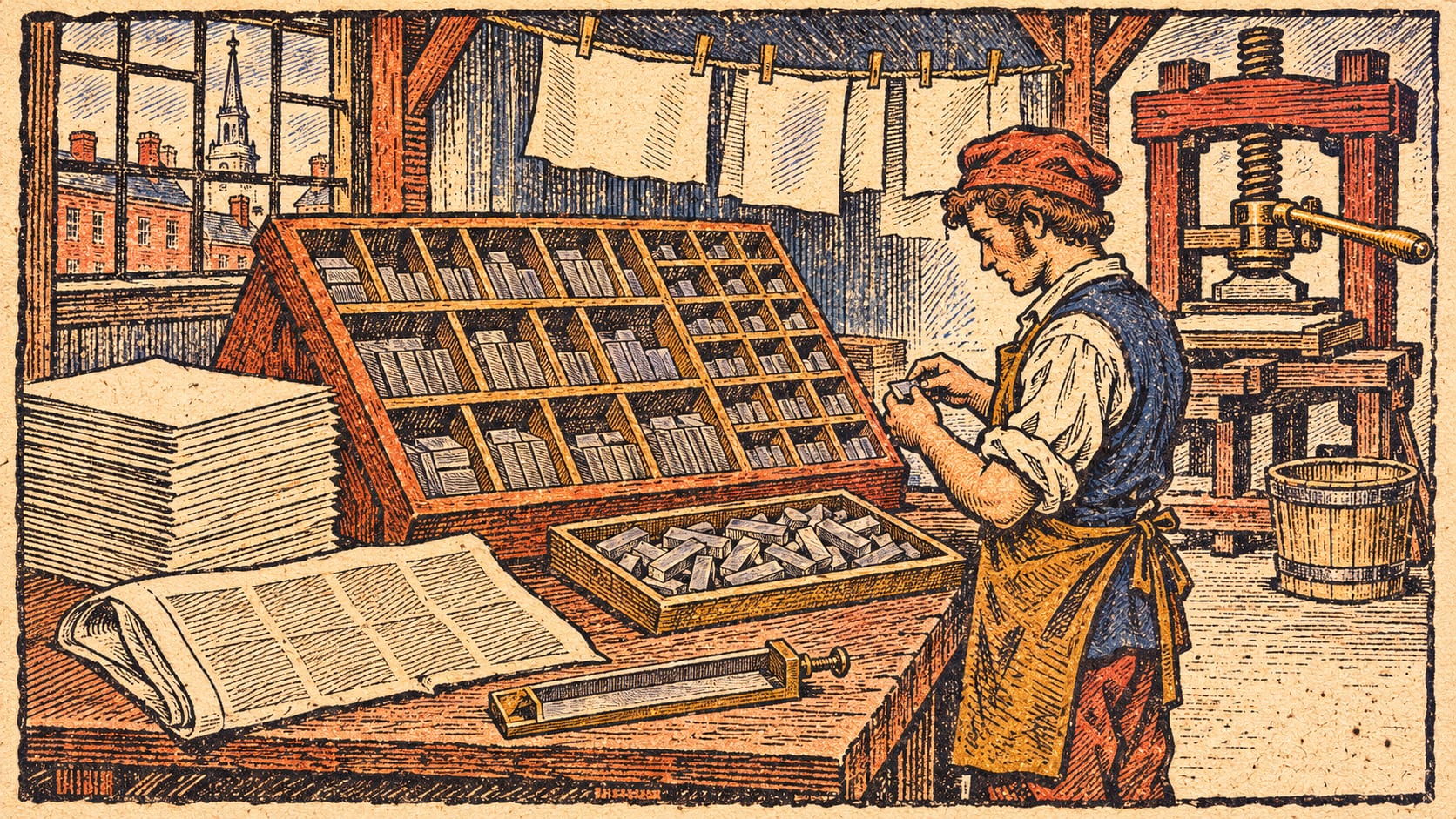
The earliest known printed O.K. ran in the Boston Morning Post on 23 March 1839. Editor Charles Gordon Greene meant it as a joke: a shortened, deliberately misspelled "oll korrect," for "all correct."
In the late 1830s, Boston newspapers were full of comic abbreviations, and O.K. was one of dozens. A presidential campaign helped it survive in 1840, and the telegraph gave it a job from 1844.
From there it travelled through newspapers, trade and American popular culture into languages around the world, Spanish among them.
The Boston Morning Post, 23 March 1839
The line sits in a squabble with a rival paper. The Providence Journal had printed a report about a Boston deputation travelling to New York, and the Post thought the Journal's editor was "a little too quick on the trigger." The Post had said nothing about the deputation passing through Providence, and said so.
Then came the jab. If the "Chairman of the Committee on Charity Lecture Bells," a member of the deputation, came back to Boston by way of Providence, the editor of the Journal and his train-band would have their "contribution box," et ceteras, "o.k." meaning "all correct," and would "cause the corks to fly, like sparks, upward."
Three days later, on 26 March 1839, the Post used it again. Of some visitors being sent off toward New York, the paper wrote that many members of O.F.M. had shaken their hands and wished them a speedy passage, and "They were o.k."
Allen Walker Read showed in 1963 and 1964 that the 23 March item was the earliest documented printed use of O.K. with its modern meaning. Spoken use may have come earlier. Greene's printed line is the origin of the abbreviation that can be pointed to on a page.
Charles Gordon Greene, the editor
Greene was born on 1 July 1804 in Boscawen, New Hampshire. On 9 November 1831 he founded the Boston Morning Post in Boston with William Beals, and he edited it, later conducting the Boston Post until he sold it in 1875. He also sat in the Massachusetts legislature and served two terms as naval officer of the Port of Boston. He died in Boston on 27 September 1886.
Readers of his day knew him as a Democratic editor with a taste for vigorous politics and humour. The 1881 King's Handbook of Boston credited his editorship with making the Post "the leading Democratic daily in the country," and the paper ran a humorous column called "All-Sorts."
The 1839 item is not signed. Read named Greene as its probable author, and the case is strong: it was an editorial jab at the Providence Journal, and Greene was the editor. "Probably Greene" is as far as the evidence goes. No statement by Greene survives saying he invented O.K.
Later writers gave him the credit anyway. In 1949 The New Yorker ran a piece on the life and times of O.K. that followed H. L. Mencken's account, which put the start of O.K. in the 1840 campaign. Read's newspaper work then moved the earliest known printing back a year, to Boston.
Allen Walker Read and six articles
Read, a linguist, published six articles on O.K. in the journal American Speech between February 1963 and December 1964. The opening article, "The First Stage in the History of 'O.K.'," set out the 1839 Post passage. The second followed the 1840 political use. The third, "Could Andrew Jackson Spell," took on the Jackson spelling story. The 1964 articles traced the folklore, the telegraph, dictionary explanations and the rival theories.
Later scholars added to his account rather than replacing it. Allan Metcalf argued that O.K. survived because the 1840 campaign handed an existing expression a national stage, and that the telegraph then supplied a use for a short acknowledgment. Frederic Cassidy discussed a possible African origin in 1981, and the theory did not displace the Boston evidence. The Oxford English Dictionary and Jonathon Green's historical slang dictionary both keep the 1839 Boston printing and note the competing explanations.
O.K. shows up in more papers in 1839
The Post was not the only paper to print it that year. By December 1839 the abbreviation had turned up in several cities:
- Baltimore Sun, 15 April 1839: a "grape brand" pronounced "O.K." and "all correct"
- New York Evening Tattler, 2 September 1839: "O.K.! all correct!"
- Boston Evening Transcript, 11 October 1839: "It is O.K. (all correct) in this quarter."
- New York New Era, 12 December 1839: a Third Ward meeting to approve the nomination of Harrison, which, "in the Butt Ender's phrase, is O.K., that is, 'oll korrect.'"
- Boston Morning Post, 18 December 1839: a reply to a correspondent, "Confucious [sic] Roundhead's communications are all 'O.K.,' and will appear in short time."
So, by the end of 1839 O.K. was already circulating in Boston, New York and Baltimore, a full year before the presidential campaign that usually gets the credit.
Boston's craze for comic abbreviations
O.K. did not appear alone. In the late 1830s, Boston newspapers used comic abbreviations and deliberate misspellings as a literary fad. Readers were expected to enjoy decoding them.
A few of the abbreviations that ran in the papers:
- O.W., for "oll wright," meaning "all right"
- N.G., for "no go" or "no good"
- K.Y., for "know yuse," meaning "no use"
- K.G., for "know go," meaning "no go"
- S.P., for "small potatoes"
There was a long one too: O.K.K.B.W.P., for "one kind kiss before we part." And O.F.M., the club in the Post's 26 March item, stood for "our first men."
O.K. combined both halves of the fashion: initials and misspelled words. "Oll korrect" became O.K.
Old Kinderhook and the 1840 campaign
Martin Van Buren was born in Kinderhook, New York, and was nicknamed "Old Kinderhook." In his unsuccessful 1840 campaign for reelection, his supporters formed Democratic O.K. Clubs and used "O.K." as a slogan and a mark of belonging.
An advertisement for the Democratic O.K. Club ran in the New York New Era on 23 March 1840, the earliest documented campaign use. The club met at the home of a member named Colvin, at 245 Grand Street, on Tuesday evening, 24 March 1840.
Three days after that, on 27 March, O.K. men broke up a Whig meeting at Masonic Hall. The New York Herald described the scene: "About 500 stout, strapping men, marched three and three, noiselessly and orderly. The word O.K. was passed from mouth to mouth, a cheer was given, and they rushed into the hall upstairs, like a torrent." Another account of the same season gave the chant as "Down with the whigs, boys, O.K."
The campaign gave an existing abbreviation a second meaning. Campaigners could use O.K. at once for "Old Kinderhook" and for "all correct," and Read summed the doubled slogan up as "Old Kinderhook is all correct." The slogan appeared in campaign material and in political cartoons.
Whigs read the letters their own way
Van Buren's opponents turned the letters against him. One Whig reading was "Kicked Out," a prediction of his defeat. Others were "Out of Kash," "Out of Karacter," "Orful Kalamity," "Orfully Confused" and "All Kwarrelling." These were campaign wordplay, jabs at a rival, and nobody offered them as the history of the letters.
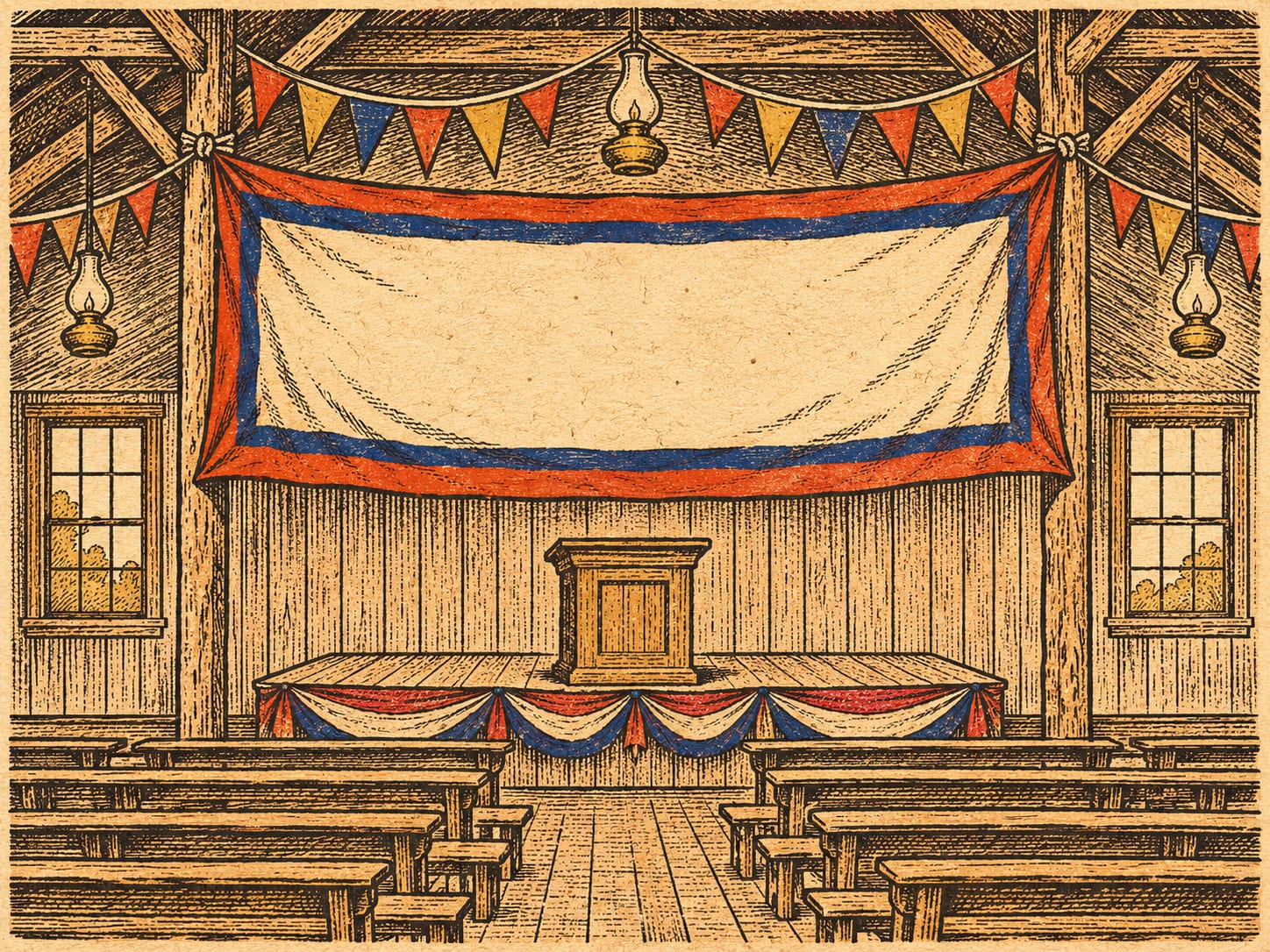
Whig campaigners also borrowed the bad-spelling joke. At a Harrison convention in Urbana, Ohio, in September 1840, a banner read "THE PEOPLE IS OLL KORRECT," a wording described by the historian J. Warren Keifer. Van Buren's Democratic papers used it to paint Harrison's supporters as ignorant.
Van Buren lost the election to William Henry Harrison. O.K. survived the campaign anyway. The Oxford Companion to the English Language describes the Old Kinderhook use as the event that helped the abbreviation survive and spread.
The Andrew Jackson story
The claim that Andrew Jackson invented O.K. by misspelling "all correct," or used it as a mark of approval, is a legend. It circulated during the 1840 campaign, when Jackson's reputation for poor spelling was a political joke.
The earliest known printed version ran in the New York Morning Herald on 30 March 1840, written by its editor, James Gordon Bennett. It put these words in the story: "By the eternal, Amos is Ole Kurrek (all correct) and no mistake." It went on to say that Jackson ordered papers marked "O.K." to show they were approved, because he supposedly thought "ole kurrek" was the right spelling.
Read called the anecdote a campaign-era hoax aimed at Jackson and the Democrats. It appeared a full year after the Post printing, so it cannot explain where O.K. came from. It mattered anyway, because it steered later explanations toward Jackson's spelling and away from the 1839 newspaper joke.
The telegraph gives it a job
Regular telegraph transmissions began in 1844. By then O.K. was already five years old in print, and the telegraph gave it a practical setting beyond newspaper jokes.
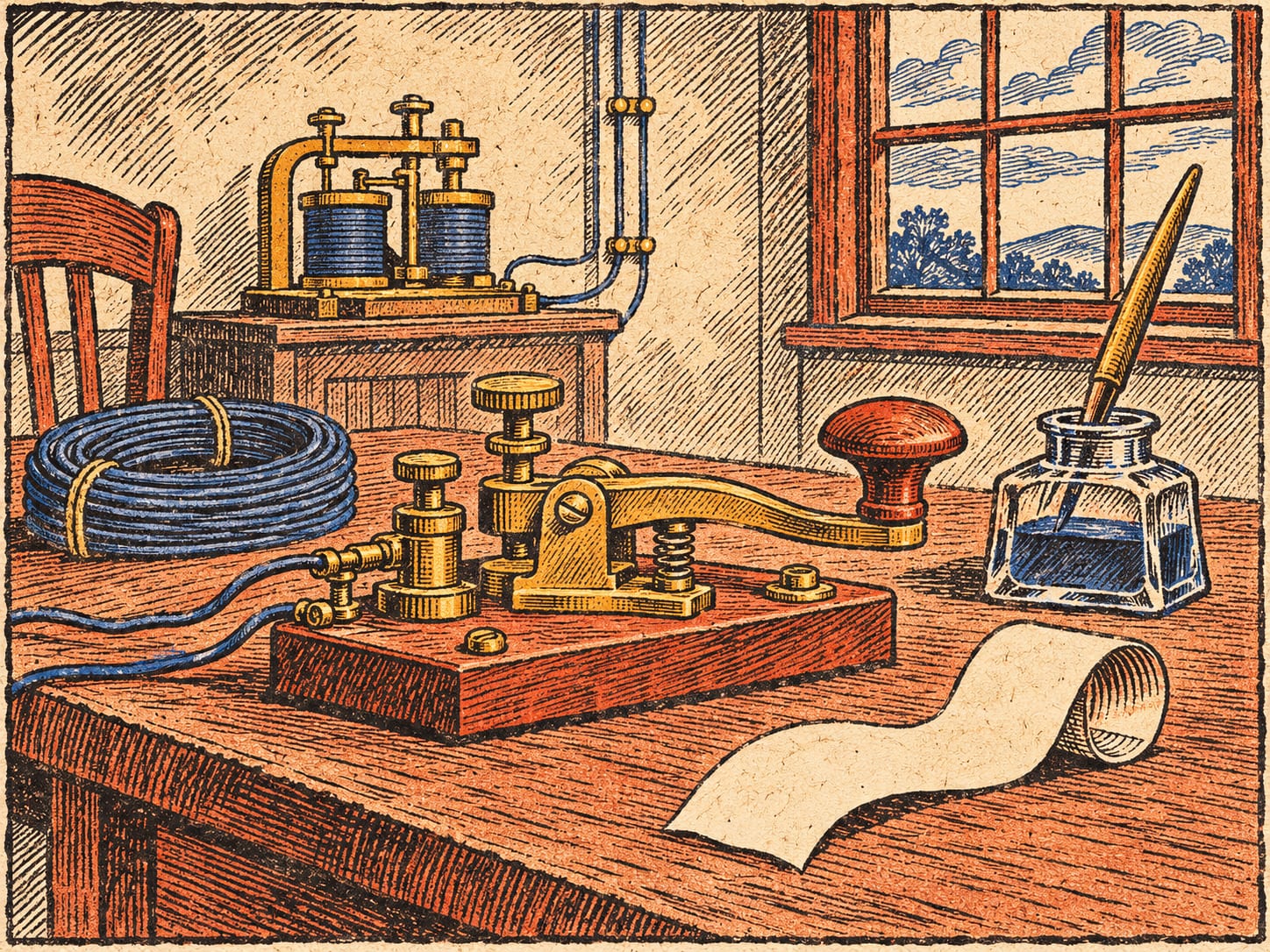
Telegraph operators used it as a short acknowledgment that a message had been received, or that an instruction was acceptable. A dated report shows it at work in 1866. On 27 July 1866 a telegram arrived at the cable station at Valentia, Ireland, from R. A. Glass, managing director of the Telegraph Construction and Maintenance Company. It read: "O.K.," (all correct). The report ran in Saunders's News Letter the next day.
The ninth edition of the Encyclopaedia Britannica, published in the 1870s, described the same habit inside the telegraph office. A receiving operator adjusts the instrument, then "signals back 'O.K.' ('All correct!') and is ready to receive the message." By the 1870s O.K. was established as a standard telegraphic acknowledgment.
A slang dictionary calls it an Americanism
John Camden Hotten's The Slang Dictionary, published in London by Chatto and Windus in 1874, gave O.K. an entry. It spelled out "OLL KORRECT, i.e. all correct," said a matter had to be "on the 'square,' and perfectly in order," and called the term "an Americanism."
Hotten also passed along a different story: that the letters were "marked on a document by an official to signify that all was right and proper." That was a nineteenth-century explanation, and it is not the one the Boston newspapers support. His shorter entry in the 1864 edition had already carried "oll korrect" and the sense of things "done in order."
The word kept moving through newspapers, political communication, British popular culture, international commerce, telegraph networks and the growing reach of American English. By the twentieth century, O.K. had entered many languages.
Wilson, Twain and the word at large
In 1919 President Woodrow Wilson wrote the word as "okeh." Accounts of his usage say he took the spelling from the Choctaw theory, because the Century Dictionary linked it to a Choctaw affirmative. His spelling shows how long the Choctaw idea lasted; it does not show that the idea was right.
Mark Twain used O.K. in ordinary writing and correspondence in the later nineteenth century, and a Twain bibliography records an editorial mark in which he approved material with a plain "O.K." He left no statement on where it came from.
O.K., from a Boston joke to a world word
- Late 1830s
Boston newspapers run comic abbreviations such as O.W. and N.G.
- 23 March 1839, Boston
The Boston Morning Post prints "o.k." for "all correct"
- 15 April to 18 December 1839
O.K. turns up in Baltimore, New York and Boston papers
- 23 to 27 March 1840
The Democratic O.K. Club advertises, meets, and breaks up a Whig meeting
- 30 March 1840
The New York Morning Herald prints the Andrew Jackson spelling story
- 1844
Regular telegraph transmissions begin, and operators use O.K. as an acknowledgment
- 27 July 1866
A cable telegram from Valentia, Ireland, reads "O.K." (all correct)
- 1874
Hotten's Slang Dictionary calls O.K. an Americanism
- 1963 and 1964
Allen Walker Read's six articles establish the 1839 printing as the earliest documented use
Other origin stories
Many other explanations have been offered for O.K. Each lacks a documented chain linking the proposed word to the English uses of 1839.
Other proposals include the Mandingo or Mande o-ke, said to mean "certainly" or "all right"; Scots och aye, for "oh yes"; French au quai or the Haitian port Aux Cayes; and German alles korrekt and a Latin-style omnes korrecta. Each is disputed or told as legend, and none has a documented path to the Boston newspaper.
O.K. in Spanish and other languages
In Spanish, "OK" is widely used beside the adapted forms okey and, in parts of Spanish America, oká. It means de acuerdo, está bien or bien.
In Mexico, the Diccionario del español de México gives okey as a popular adverb meaning de acuerdo, está bien or bueno. It also gives the noun meaning approval or authorization, abbreviated ok.
The Real Academia Española and the Association of Academies of the Spanish Language recognize okey as the Spanish reading of the English initials O.K. They also recognize oká in some American countries. Spanish alternatives include bien, de acuerdo and vale. In Spain, OK is widely understood and vale is a common local equivalent. In the Antilles, okey? is a colloquial tag added to a question.
Comparative evidence places Spanish okay and okey in the 1930s. O.K. appears in many other languages too, often as an unadapted borrowing with local spellings and pronunciations. Its spread followed international English, telegraphy, American popular culture, broadcasting, commerce, and later film and digital communication.
Sources
- "How Boston Created 'The American Philosophy In 2 Letters,'" GBH
- "Happy birthday OK," Oxford University Press
- "It's All OK," Cambridge Dictionary blog
- The Oxford Companion to the English Language
- "Allen Walker Read, 96," Los Angeles Times
- "1840: Presidential Campaigns," Indiana University collections
- "THIS AND THAT: Where did the expression 'OK' come from?"
- "OKAY across Languages," academic study
- "OK," The LINGUIST List
- "okey," Diccionario del español de México, El Colegio de México
- "okey," FundéuRAE, and the Nueva gramática, Association of Academies of the Spanish Language
- Study of European Anglicisms, Universidad de La Laguna
- King's Handbook of Boston, 1881
- "The Life and Times of O.K.," The New Yorker, 1 October 1949
- American Speech articles by Allen Walker Read, 1963 and 1964
- The Slang Dictionary, John Camden Hotten, Chatto and Windus, 1874
- Encyclopaedia Britannica, ninth edition, "Telegraph"
- "Log-Cabin Canvass, Hoosier Style," Indiana Magazine of History
- "The Birth of OK, 175 Years Ago," History.com
Watch the full story on the Flashback Fables YouTube channel, and send it to someone who would love it.