
Pilots say Mayday because it sounds like the French m'aider, which means "help me", and in 1923 a radio officer at London's Croydon Airport is credited with choosing it.
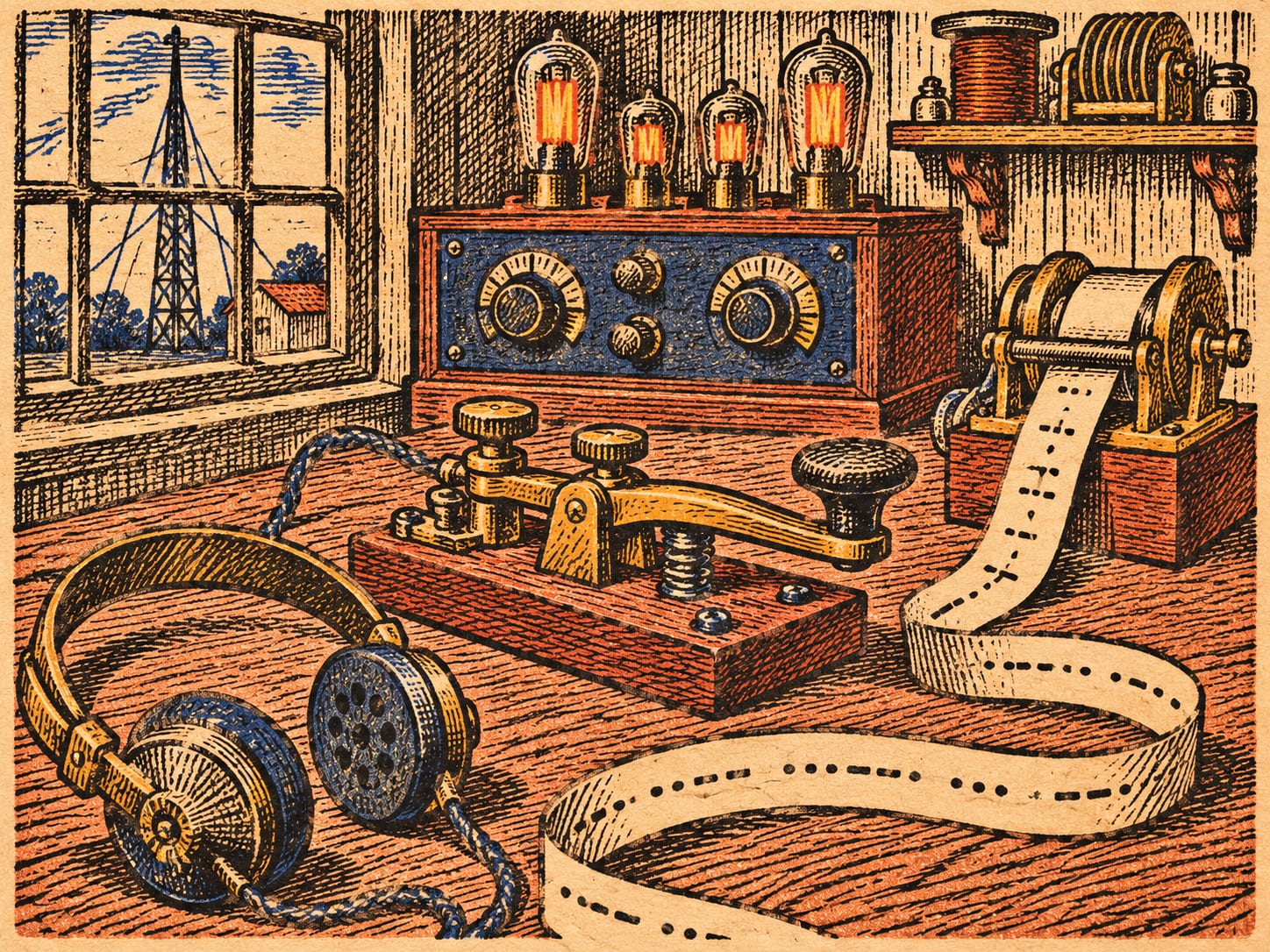
SOS was built for Morse code, three dots, three dashes and three dots tapped on a key. Spoken over the early radio telephone, the letter S was hard to make out, and pilots needed a short word that could not be mistaken for anything else.
Britain approved the procedure in 1924. In 1927 an international convention in Washington made Mayday the spoken distress call, and the FAA still tells pilots in grave danger to begin with it, preferably three times.
Why SOS did not work on a radio telephone
The International Telecommunication Union adopted SOS as an international standard in 1906. It was a signal for radiotelegraphy, sent by key, and it suited the job.
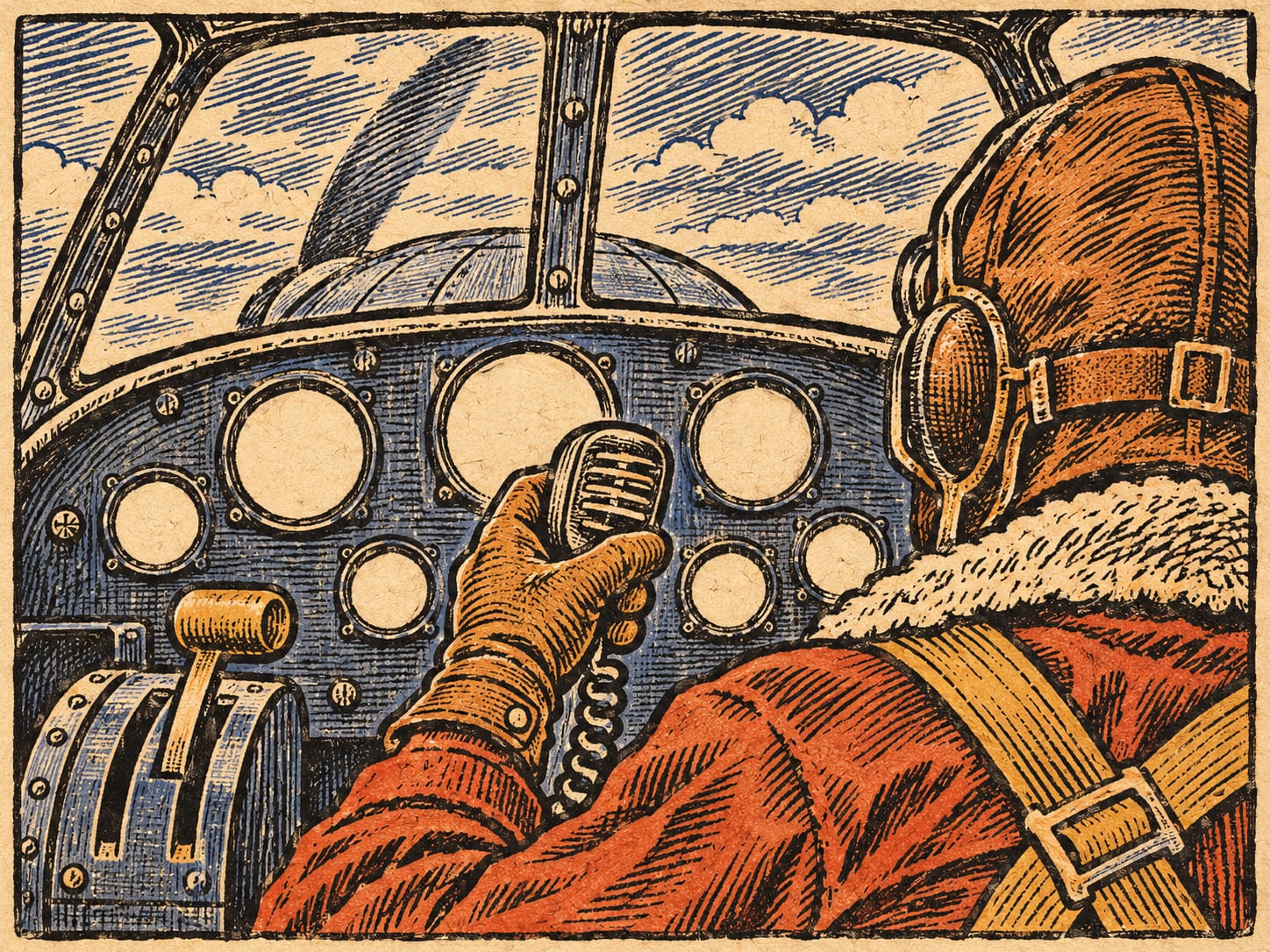
Early radio telephony was different. The letter S was difficult to tell apart, and spoken transmissions could be unclear and open to misunderstanding. Aviators needed a short, unmistakable spoken signal that did the work of Morse SOS.
A 1923 report in The Times said that SOS would give way, in telephone communication, to "May-day" because the letter S was hard to distinguish by telephone. The history of Croydon Airport names the same shift, from Morse telegraphy to radio telephony, as the reason for a new spoken signal.
Croydon Airport, 1920 to 1922
Croydon became London's international airport on 29 March 1920. The Air Ministry ran it. It handled international passengers, mail and cargo, including routes to northern France, and it used radio officers, radio telephony, Morse equipment and early air-traffic-control procedures.
On 3 June 1920, Air Ministry Notice to Airmen No. 61 made Croydon Britain's air traffic control centre: "The wireless control of all the British stations, including stations licensed on private aerodromes, will be carried out by Croydon." Telephony reported aircraft positions and route weather. By 1922, civil air traffic officers and radio officers were plotting positions by hand, usually to about two miles, with each estimate taking about two minutes.
The best-documented controller is George J. H. "Jimmy" Jeffs. His Air Traffic Control Licence No. 1 is dated 22 February 1922, although it was issued afterward. He developed Croydon's operating procedures and later helped set up more than twenty-five British air traffic control units.
On 7 April 1922, a French Farman Goliath flying from Paris Le Bourget to Croydon collided north of Paris with a British de Havilland DH-18 flying the other way. All seven people aboard both aircraft died. Until then, aircraft had followed similar but loosely defined routes and relied on seeing and being seen.
A meeting at Croydon after the crash set out firmer rules. Routes between Britain, France, Belgium and the Netherlands were defined. Aircraft had to keep to the right side of designated routes, carry radio equipment and stay in contact with ground stations.
Stanley Mockford
Frederick Stanley Mockford, known as Stanley, was Croydon's Senior Radio Officer and a civil servant of the Air Ministry. In 1923 he put forward the distress phrase "Mayday" as the spoken equivalent of SOS.
Historic Croydon Airport says he chose a word that would be clear to both English and French pilots. The airport's traffic included flights between Croydon and Le Bourget, near Paris.
A later memorial and family-history account gives his birth as 8 December 1897, and a 1962 obituary gives only the year. Before the First World War he worked as a telegraphist for the London, Brighton and South Coast Railway. In 1915 he joined the Royal Flying Corps as a wireless operator, and later accounts place him in Britain and France training aircrew and helping install aircraft wireless sets.
After the war he became an Air Ministry official working on wireless services for civil aviation. He was the first examiner of candidates for the air operator's radio licence, and by 1923 he was senior radio officer at Croydon.
In 1930 he joined the Marconi Wireless Telegraph Company. He became assistant sales manager in 1933 and in August 1935 manager of Marconi's Aircraft Department, later assistant general manager and deputy general manager. He died on 1 March 1962, aged 64.
The Times of 2 February 1923
The Times of London carried a report headed "New Air Distress Signal" on 2 February 1923, on page 7, column 4. It reads: "New arrangements for the salving [sic] of aeroplanes that may be forced to alight in the Channel will be in operation during the forthcoming night flights between London and Paris. Owing to the difficulty of distinguishing the letter 'S' by telephone, the international distress signal 'S.O.S.' will give place to the words 'May-day,' the phonetic equivalent of 'M'aidez,' the French for 'Help me.'"
Then it describes a test. "During a recent test a R.A.F. flying-boat, descending in the Channel, gave the international distress signal three times by wireless telephony and reported that her engines had failed. The message was picked up at Croydon and Lympne." The Civil Aviation Traffic Officer at Lympne telephoned the Dock Master at Dover, and within twenty minutes of the call a tug from Dover was alongside, having steamed about three miles. Dover had been given no warning.
The new arrangement covered the coming night flights between London and Paris, not all flying everywhere. The article does not name Mockford. The Wireless Age, in June 1923, described "May Day" as an airplane SOS and linked it to the French m'aidez.
From French m'aider to English Mayday
The usual account is that Mayday is an English spelling of the sound of the French m'aider, "help me". Some versions use the longer venez m'aider, "come help me".
The French in the popular story is slightly off. M'aider means "to help me", while m'aidez means "you help me" or, politely, "help me". Venez m'aider means "come help me". The international regulations themselves use m'aider, so that is the form the official wording backs.
Did Mockford coin it?
Croydon airport histories and Historic England name Mockford. The Historic Croydon Airport Society credits him with creating "Mayday, Mayday, Mayday". The 1923 newspaper and magazine reports explain the word without naming him, and no document written or signed by Mockford has been shown.
So, the careful way to say it is that Mockford is credited with the word. The credit comes from the airport's own history and later accounts, and it is the version Spanish and English retellings repeat today.
From British rule to world rule
Historic Croydon Airport says the United Kingdom approved the procedure in 1924 through The Air Pilot: Great Britain, three years before it went international. His Majesty's Stationery Office published the first edition of that handbook in 1924, by order of the Air Council, at 162 pages with maps and charts. A copy sits in the Royal Museums Greenwich library.
A British magazine had put the rule in plain words by October 1925. Wireless Magazine wrote: "To avoid confusion with ships' signals, the words 'May Day,' derived from the French m'aidez, are used instead of S O S."
The International Radiotelegraph Conference met in Washington from 4 October to 25 November 1927, and the convention was signed on 25 November. Herbert Hoover was among the United States delegates, L. Boulanger sat for France, and Air Commodore Lyster F. Blandy was among Great Britain's seven delegates.
Article 19, section 2, says: "The same rules apply to the radiotelephone distress call which consists of the spoken expression MAYDAY (corresponding to the French pronunciation of the expression 'm'aider')." The call was to be sent three times, and it had absolute priority over every other transmission. A distress message was to give the name of the ship, aircraft or vehicle, its position, the nature of the distress and the help wanted.
The convention text does not say who proposed the word, and it records no separate vote on it. Mockford's part in 1923 rests on the Croydon histories.
The same 1927 rules kept the Morse distress procedure in place. The two signals served two technologies: SOS by key, MAYDAY by voice.
Mayday, from Morse to the microphone
- 1906
The International Telecommunication Union adopts SOS as a Morse distress standard
- 29 March 1920
Croydon becomes London's international airport
- 3 June 1920
Notice to Airmen No. 61 gives Croydon wireless control of British air stations
- 7 April 1922
A French and a British aircraft collide north of Paris, and all seven aboard die
- 2 February 1923
The Times prints "New Air Distress Signal" and explains "May-day"
- June 1923
The Wireless Age calls "May Day" an airplane SOS
- 1924
The United Kingdom approves the procedure in The Air Pilot: Great Britain
- 25 November 1927
The Washington Convention, signed after a conference that began on 4 October, adopts MAYDAY as the spoken radiotelephone distress call
- 30 May 1949
The ICAO Council adopts Annex 10 on aeronautical telecommunications
- 1 February 1999
The Global Maritime Distress and Safety System becomes fully implemented
What a pilot says today
The International Civil Aviation Organization's Council adopted its standards for aeronautical telecommunications on 30 May 1949 as Annex 10, effective 1 March 1950. A later consolidated Annex 10, Volume II, says: "The radiotelephony distress signal MAYDAY and the radiotelephony urgency signal PAN PAN shall be used at the commencement of the first distress and urgency communication respectively." A distress message is to begin with MAYDAY, preferably spoken three times, and give the station called, the aircraft, the trouble, the pilot's intention, position, level and heading.
The FAA's Aeronautical Information Manual says a distress call should begin "MAYDAY, MAYDAY, MAYDAY", preferably repeated three times. Mayday means grave and imminent danger that needs help at once. It has absolute priority, and it commands radio silence on the frequency.
The FAA's distress and urgency rules rest on ICAO procedures. Repeating the word also helps a call get through when radio interference breaks up part of it.
Two other signals sit beside it.
The 1927 rules connect PAN with the French panne, a breakdown or failure.
Three Mayday calls in accident reports
On 15 January 2009, the captain of US Airways Flight 1549, Chesley B. "Sully" Sullenberger, transmitted at 15:27:32.9: "mayday mayday mayday. uh this is uh Cactus fifteen thirty nine hit birds, we've lost thrust (in/on) both engines we're turning back towards LaGuardia." The cockpit voice recorder caught it, but the controller did not hear the Mayday portion because another pilot was transmitting. The aircraft landed on the Hudson River. All 155 occupants evacuated, and one flight attendant and four passengers were seriously injured.
In 2005 a British pilot lost an engine over the Solent. His call, as the Air Accidents Investigation Branch recorded it, was: "MAYDAY, MAYDAY, MAYDAY, G-BZJC, ENGINE FAILURE, 2,000 FT OVER THE SOLENT HEADING FOR GOSPORT, TWO PERSONS ON BOARD." He turned toward Gosport and landed safely.
A third call ended differently. The pilot of a Piper PA-31T1 reported smoke in the cockpit and then transmitted "mayday mayday mayday mayday mayday" and a part that cannot be made out. The airplane crashed about a quarter mile short of the airport and burned, and the pilot died.
Mayday, SOS and the sea
SOS is still the Morse distress signal, and Mayday is still the spoken one. The big change at sea came with the Global Maritime Distress and Safety System. The International Maritime Organization says it was fully implemented on 1 February 1999, using satellites and land-based systems to send distress alerts.
That moved ships away from compulsory Morse distress watchkeeping. It did not retire the spoken word. Maritime authorities still use MAYDAY for voice distress calls, including on VHF Channel 16.
Mayday, May Day and the rule of three
Mayday has nothing to do with May Day or 1 May. The explanation runs through French m'aider, not the calendar.
The rule of three comes from the international distress procedure, and it is still in use. The 1927 convention set three transmissions, and the FAA still says "preferably repeated three times".
Mayday in Spanish and other languages
Mayday is the same word in English, Spanish, French and other languages on aviation and maritime radio. Spanish speakers say it roughly as "méidei" instead of translating it as auxilio.
Spanish emergency and rescue training often explains Mayday as an adaptation of French m'aider and gives the meaning as "ayúdenme". A Chilean fire-rescue training guide uses "MAYDAY, MAYDAY, MAYDAY" for an immediately life-threatening situation.
The Spanish newspaper Heraldo tells the Croydon and Mockford story and separates Mayday from PAN-PAN, which it explains is for less urgent problems. The main differences between languages are translation and pronunciation, not a different origin.
Airport House today
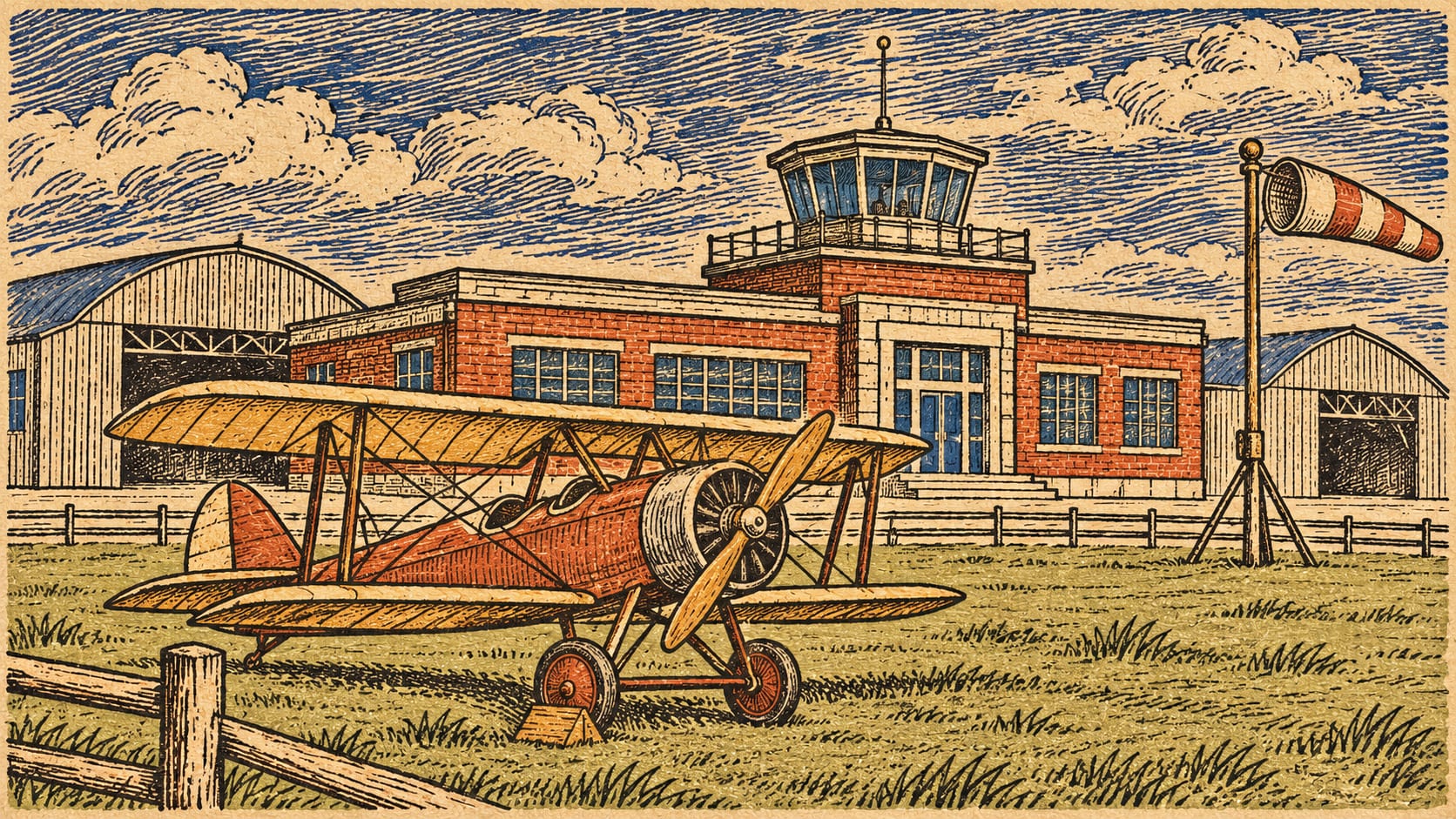
Airport House on Purley Way in Croydon was built between 1926 and 1928 by the Air Ministry's Department of Buildings and Works. It joined the terminal and the control tower in one building and was once called the Administration Building. Historic England listed it Grade II* on 1 August 1978 as a rare survivor of the early purpose-built airport terminals, and as an early integrated control tower in the story of air traffic control and ground-to-air radio.
Heathrow replaced Croydon as London's main airport in 1946. Croydon's grass runways and tight site could not handle larger post-war aircraft. The airport closed to general flying on 1 May 1959, with limited exceptions for established commercial operators, and everything stopped by 30 September 1959, when Ministry services were withdrawn. The last scheduled commercial service from Croydon was a Morton Air Services de Havilland Heron flight to Rotterdam.
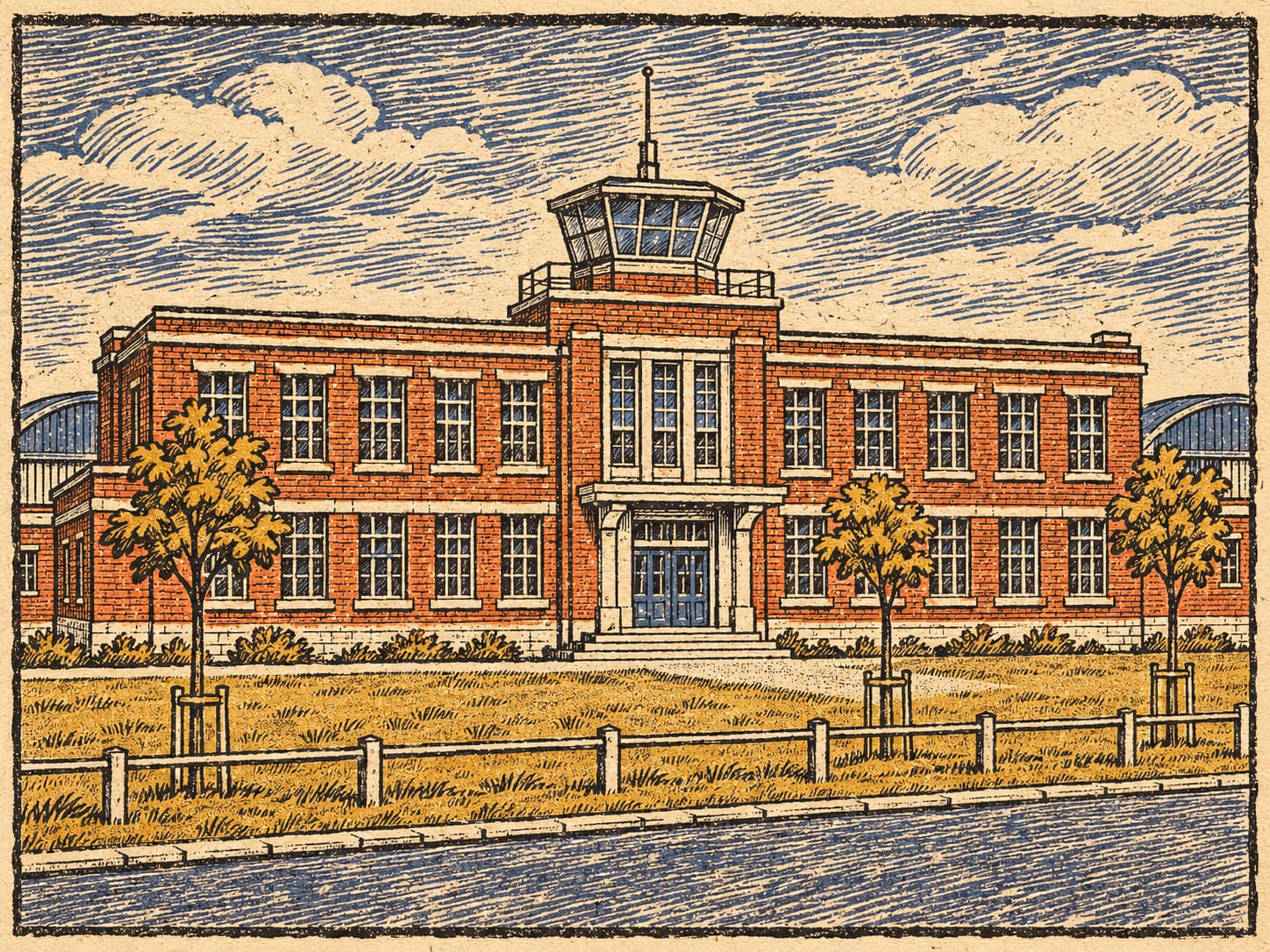
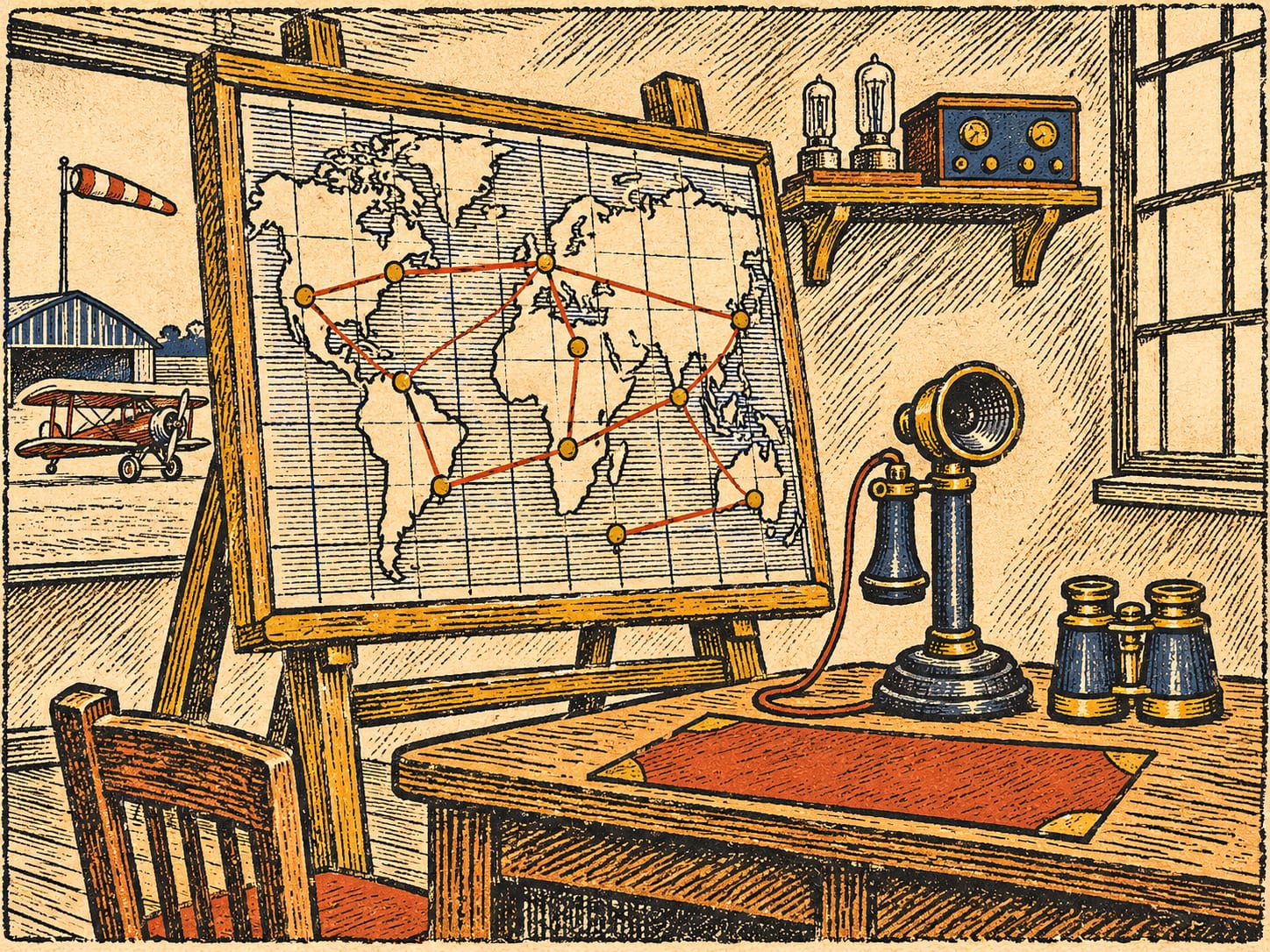
The Croydon Airport Visitor Centre opened in Airport House in 2000. It is a volunteer-led museum, and guided tours include the control tower. Its former radio room is shown as the hub of the control system, with a big mapping board for plotting aircraft, a tall telephone, binoculars and radio equipment, and a photograph of the early radio room.
Sources
- "New Air Distress Signal," The Times, 2 February 1923, as cited by the American Dialect Society
- The Wireless Age, June 1923; Wireless Magazine, October 1925
- "Genesis of Air Traffic Control," Historic Croydon Airport; "Start of civil operations" and "Twilight years, 1946 to 1959," Historic Croydon Airport
- "Airport House," Historic England
- Croydon Airport Visitor Centre teachers' pack, Croydon Airport Society
- Obituary of F. S. Mockford, Wireless World, April 1962; Selmeston local history and Royal Air Forces Association branch newsletter
- Air Ministry procedures for air traffic control, Civil Air Navigation and Air Traffic Services journal
- The Air Pilot: Great Britain, 1924, Royal Museums Greenwich library catalogue
- International Radiotelegraph Convention of Washington, 1927, Article 19, International Telecommunication Union
- Annex 10, Aeronautical Telecommunications, International Civil Aviation Organization
- Aeronautical Information Manual, Distress and Urgency Procedures, Federal Aviation Administration
- Accident report on US Airways Flight 1549, National Transportation Safety Board; Bulletin 8/2006, Air Accidents Investigation Branch; report ERA15FA181, National Transportation Safety Board
- "Radiocommunications and Search and Rescue," International Maritime Organization
- GMDSS VHF procedures for small boat users, UK Maritime and Coastguard Agency
- "Origin of Mayday," Word Histories
- "¿Por qué se usa 'mayday' como llamada de socorro?," Heraldo, 2017
- Chilean National Fire Academy rescue training guide
- Written answers on Croydon Airport closure, House of Commons, 2 March 1959
Watch the full story on the Flashback Fables YouTube channel, and send it to someone who would love it.