
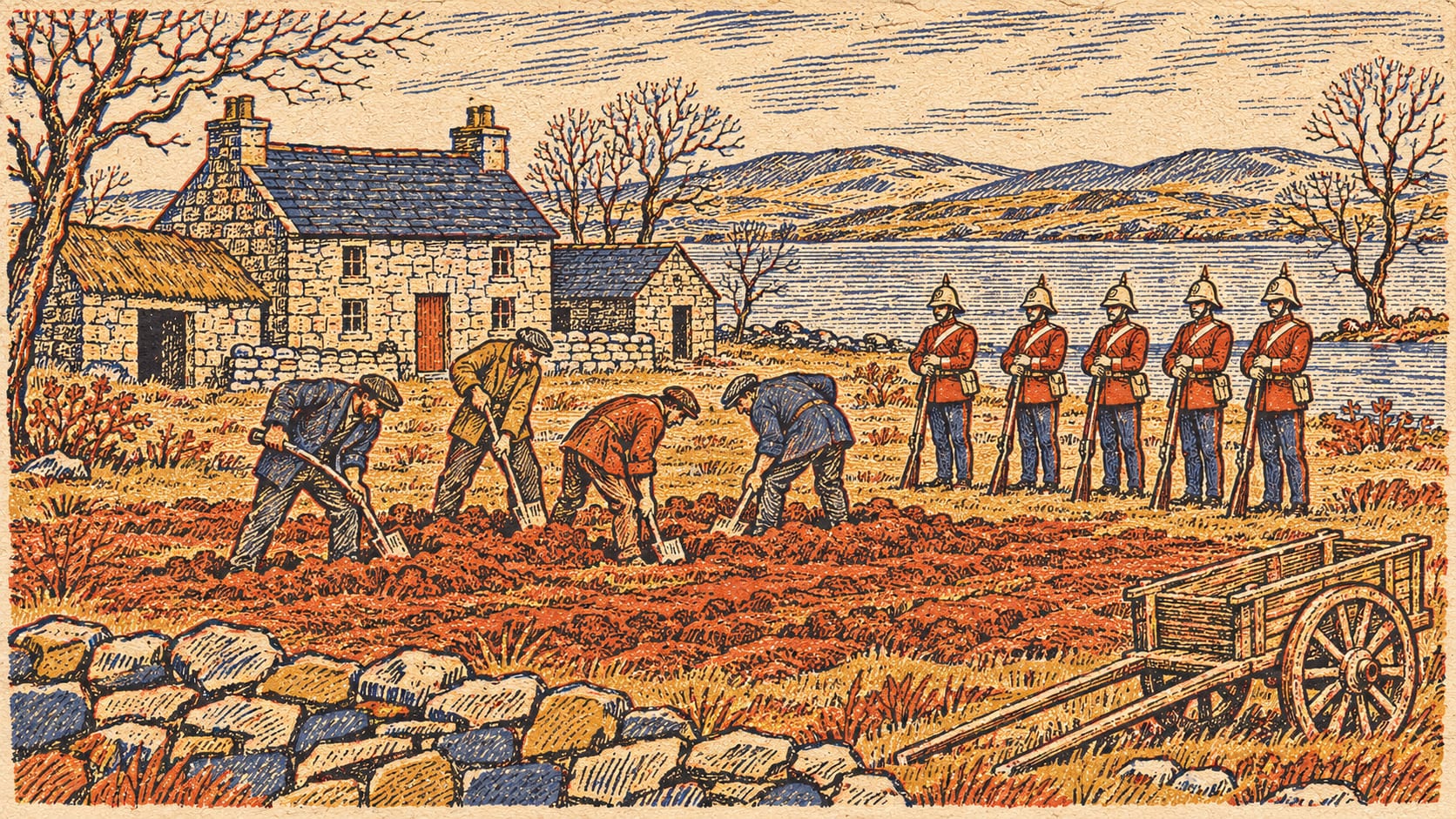
The word boycott comes from a man's name. In autumn 1880, neighbours, servants, labourers and shopkeepers around Lough Mask in County Mayo, Ireland, cut off Captain Charles Boycott, a land agent, and within weeks newspapers were using his surname as a verb.
It began on 22 September 1880, when Boycott tried to serve eviction processes, the legal papers that start an eviction, on eleven tenants. It ended in November with almost 1,000 troops guarding a crew of outside labourers while they gathered his crops, at a cost of about £10,000.
The man behind the word
Charles Cunningham Boycott was born on 12 March 1832 in Burgh St Peter, Norfolk, England. He served briefly in the 39th Foot, reached the rank of captain and sold his commission in 1852. After the army he made his living in Ireland as a land agent and farmer.
In 1873 he moved to Lough Mask House near Ballinrobe, County Mayo. He leased about 300 acres of his own there. He also became agent for Lord Erne's nearby estate of 1,500 acres, where thirty-eight tenant farmers paid £500 a year in rent between them. Boycott took 10 percent of that rent as his commission.
So, was he a captain, a landlord or an agent? Three labels get attached to him, and each names something different. Captain was his army rank. Farmer was his own work on his own leased land. Agent was his paid job for Lord Erne, which meant managing the estate, collecting the rents and carrying out the landlord's decisions, evictions included. Boycott was also a magistrate.
What the tenants were asking for
The Irish National Land League was founded in October 1879 by Charles Stewart Parnell, Michael Davitt and James Daly. Parnell became its president and Davitt one of its secretaries. It grew out of the Land League of Mayo, founded on 16 August 1879.
The League spoke for tenant farmers who rented their land, many of them from absentee landlords. Its immediate program was known as the Three Fs: fair rent, fixity of tenure and free sale. Fair rent meant rents judged reasonable, not set by the landlord alone. Fixity of tenure meant a tenant paying a fair rent should not be evicted. Free sale meant a tenant could sell an interest in a farm, including the value of the improvements made to it.
Its methods were collective. Tenants could withhold rent during a dispute, and they could isolate anyone who took a farm from which another tenant had been evicted. Over the longer term, the League aimed at tenant ownership of the land.
Ennis, 19 September 1880
Three days before Boycott's eviction papers, Parnell spoke at Ennis, County Clare. He was talking about a man who took a farm from which another tenant had been evicted, and what his neighbours should do about him. He did not ask for violence. He asked for isolation.
Such a man, Parnell said, should be isolated on the road, in the streets, at shop counters, at fairs and markets, and even in the place of worship. He should be left "severely alone," put into "a sort of moral Coventry."
Parnell described a method that day. The word for it came out of what happened next.
22 September 1880: eleven eviction processes
The eleven tenants had turned down an offered rent cut of 10 percent and asked for 25 percent. Lord Erne refused. On 22 September 1880, Boycott tried to serve eviction processes on the eleven, who had not paid the rent the estate demanded.
The process server, David Sears, had an escort of seventeen Royal Irish Constabulary men. He managed to serve three notices. At the fourth house, Mrs Fitzmorris refused her notice and called out to her neighbours. Women threw stones, mud and manure, and Sears and the police retreated to Lough Mask House with a crowd behind them.
The refusal spread outward from there. Boycott's own workers had already struck in August for higher wages, and the Land League had encouraged them to resist his management. Now his servants left. Local labourers would not work for him, and local traders would not supply him.
Crowds jeered and harassed him. Walls and fences were damaged, and he needed police protection. The campaign turned to demanding that he be removed as agent. As the autumn harvest came closer, Boycott could not find enough local labour to gather his crops.
A name for it
Father John O'Malley, a parish priest and Land League organizer in County Mayo, is credited with the word. The credit rests on the later telling of James Redpath, a journalist for the New York Tribune. The account printed in 1881 describes a dinner at which Redpath said he was "bothered for a word." The Dictionary of Irish Biography dates the dinner to 25 September 1880.
O'Malley's answer, as told, passed over Athenian ostracism: "'Ostracism,' said Father O'Malley, 'will not do; the people would not understand it. How would it do to call it "Boycotting?"'" Redpath was delighted with the suggestion and adopted it.
Redpath used the term in print in an article about Lough Mask House in the Chicago Inter-Ocean on 12 October 1880. British newspapers had it the same year. On 20 November 1880 The Times wrote: "The people of New Pallas have resolved to 'Boycott' them and refused to supply them with food or drink." The Daily News used "Boycotted" on 13 December 1880.
The Oxford English Dictionary took the word into its historical dictionary in 1888.
Did Parnell invent it? He gave the method at Ennis. A priest in County Mayo is credited with the word, and a journalist carried it into print within weeks.
Boycott's own account
Boycott wrote to The Times, and his letter ran on 18 October 1880. It does not use the word as a noun or a verb. It asks for protection and for readers to understand "the power of the Land League."
He describes 22 September as a process server "escorted by a police force of seventeen men" who "retreated to my house for protection, followed by a howling mob of people, who yelled and hooted at the members of my family." The next day, he writes, some hundred people came up to his house and ordered off all his farm labourers, workmen and stablemen, "commanding them never to work for me again."
The details run on. His herd was frightened into giving up his job. His blacksmith received a letter threatening murder if he did any more work for Boycott. His laundress was ordered to give up his washing. A boy of twelve who carried his postbag to and from Ballinrobe was struck and threatened on 27 September, so Boycott sent his young nephew instead, and on 2 October the nephew was stopped on the road and threatened too. Shopkeepers were warned to stop supplies, and the postmistress said the telegraph messenger had been stopped on the road.
"My farm is public property; the people wander over it with impunity," Boycott wrote. "I can get no workmen to do anything, and my ruin is openly avowed as the object of the Land League unless I throw up everything and leave the country."
This is Boycott's own telling. The letter does not ask for a military harvest. That idea came later, from supporters in the unionist press, and the government took it up.
The Boycott Relief Expedition
The Belfast News-Letter and other unionist newspapers raised support for Boycott. An Ulster supporter offered to march south with volunteers if £500 could be raised. Nearly £800 came in, and offers arrived from hundreds of men. The organisers cut the party to 100. The government opposed a large armed party, and Boycott said fifty men would be enough. On 8 November the government announced it would protect outside labourers who came to bring in his crops.
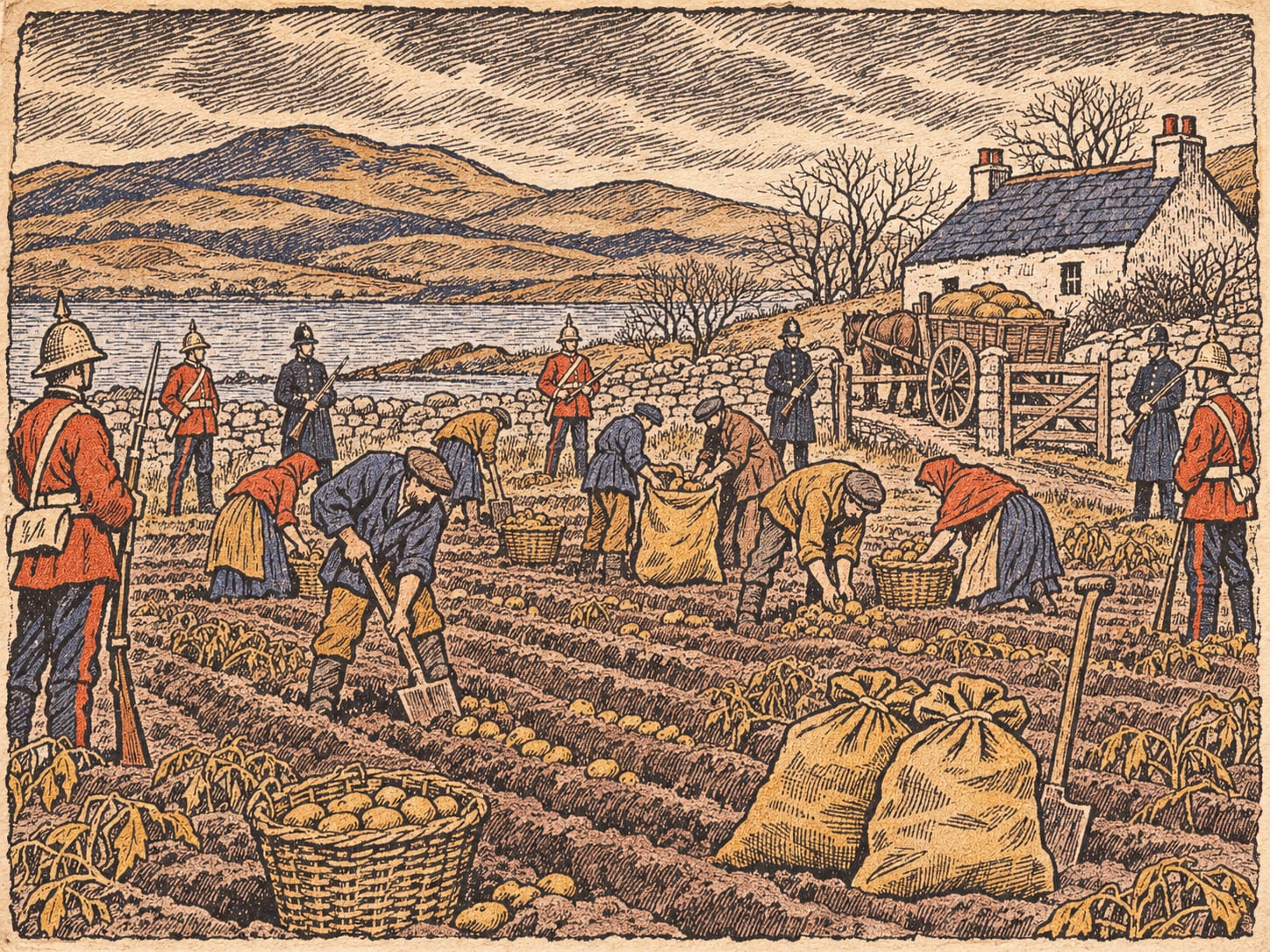
The volunteers came chiefly from Cavan and Monaghan. They gathered at Mullingar and went by train to Claremorris, where local carters would not carry them. They had to march the rest. A report reproduced in the Tipperary News described "fifty volunteer Orange laborers from Ulster" under an escort of two thousand troops, with a "tramp to Lough Mask House, over a distance of fifteen miles."
The Land League had given its instructions for the day. The same report quotes them: "They were not to be hooted or molested or supplied with anything. Cars were not to be let or lent for their use, nor food of any kind to be given or sold to them. They were to be looked at and laughed at; that was all. This advice was implicitly obeyed."
The Annual Register describes jeers, mud-throwing and a refusal of transport at Claremorris, then an unmolested march. It says the local people offered "no serious violence." The labourers reached Lough Mask "drenched to the skin" and camped in tents on Boycott's grounds. One report claimed that soldiers foraged among the estate's poultry and livestock and that the military camp damaged the lawns.
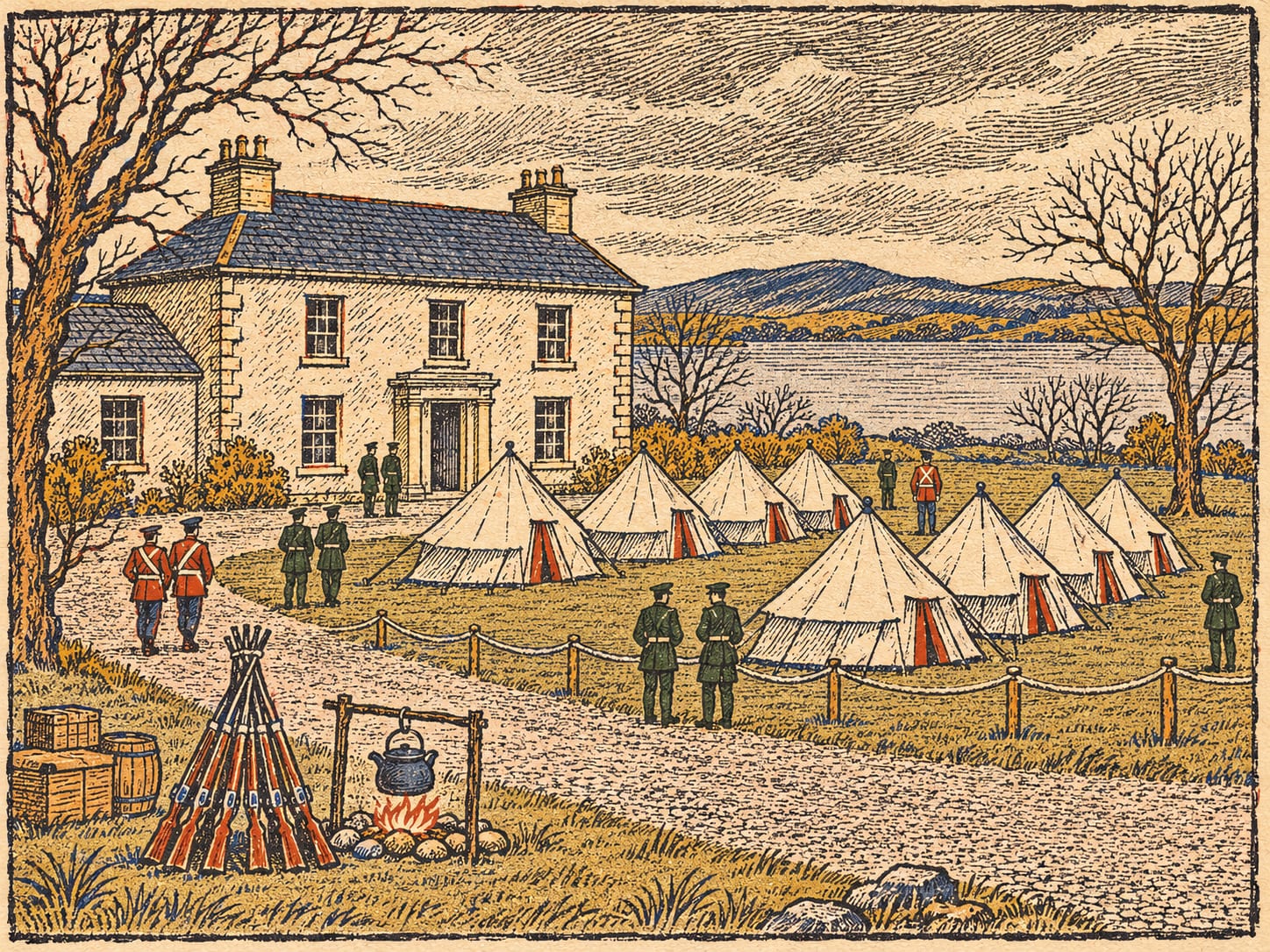
On 12 November the Boycott Relief Expedition was in place at Lough Mask. The National Library of Ireland catalogues it as running from 12 to 26 November. The force included a troop of the King's Dragoon Guards, four companies of infantry, a troop of the 19th Hussars, mounted police on the road from Claremorris to Ballinrobe, two field pieces and 150 Royal Irish Constabulary officers and men. About 900 soldiers were stationed at Ballinrobe, and Colonel Bedingfield commanded the military force in the area.
The counts of the labourers differ. The Dictionary of Irish Biography gives fifty-seven loyalists from Cavan and Monaghan. National Library of Ireland records commonly describe fifty "Orange Labourers." The escort is counted as about 900 soldiers, almost 1,000 troops, or two thousand troops as far as Claremorris, and those figures describe different parts of the operation. Parliament was told the troops were sent mainly to protect the labourers at work.
In Ballinrobe, the Tipperary News report says Father O'Malley told people to stay indoors and close their shops as the column passed, and that they did. The labourers gathered the crops and left on 25 or 26 November, returning north by train. Nothing in the accounts has them attacked on the way home.
The whole operation cost about £10,000, roughly thirty times the value of the crops, in the Dictionary of Irish Biography's count. One report at the time put the crops at about £350 and the cost to the state and the expedition's backers at about £3,500. Isolating one man's farm had brought almost 1,000 troops to Mayo.
What boycotting meant in 1880
In Ireland in 1880, boycotting meant more than declining to buy something. It combined refusing labour, refusing trade, refusing services and refusing ordinary social contact. A person under it could find no one to work for him, no shop to supply him and no neighbour willing to speak.
Today the word names organized action against a person or a business, meant to block its social or commercial activity. It carries the name of the man who farmed and managed land at Lough Mask.
Who was boycotted next
In December 1880 William Bence-Jones of Lisselan, near Clonakilty in County Cork, refused to accept Griffith's Valuation in place of the rent in his contracts. His tenants and neighbours boycotted his farm produce and livestock, and his labourers left. On 3 December 1880 a symbolic grave was dug outside his front door. He brought in twenty-two loyal workers from Bandon and Cavan under police protection.
The dispute ran until the Cork land courts in April 1882, when the tenants broadly won and the leases were overturned. Bence-Jones had moved to London in late 1881, and he died there on 22 June 1882. Colonel O'Callaghan in County Clare was also boycotted in 1880.
The method spread to merchants, shopkeepers, tenants who paid rent, land agents and people who took evicted farms. At Mountmellick, County Laois, Michael Davitt looked into a boycott that rested on a false rumour and had it lifted.
Davitt later called boycotting a defensive weapon of the League, and he admitted that League leaders stepped in when it was used for personal revenge. In 1890 the Special Commission concluded that boycotting had become "a system of intimidation of a most severe and cruel character" and that the combination using it was illegal in its objects and means. That was the Commissioners' judgment, and not every participant accepted it.
The Land Act of 1881
The Land Law (Ireland) Act 1881 brought in the Three Fs for qualifying tenants. A tenant, a landlord or both could ask a court to fix a fair rent. A court-fixed rent gave a statutory term of fifteen years, under the Act's conditions, and that was fixity of tenure. Free sale let a tenant transfer his interest under statutory rules. The Act also set up the Land Commission and land courts that could set judicial rents, and the rent a court fixed became the rent the tenant owed.
For tenants like those on Lord Erne's estate, this moved rent disputes from private bargaining and landlord-controlled eviction toward a court process supervised by the state. It did not give every tenant ownership, wipe out arrears or stop every eviction.
The League decided to test the Act through selected cases. Then the government arrested Parnell and other leaders and suppressed the League. Its No-Rent Manifesto of 18 October 1881 called the Act "as yet untested" and advised tenants to pay no rent until political conditions changed.
How the word travelled
The word spread through newspapers and political reporting after the 1880 land dispute. Several European languages took it in, often changing the spelling and the sound.
French took the English verb and made it boycotter. Spanish adapted it to boicot, and the Spanish language academies treat it that way. A scholarly study of Russian loanwords gives Russian bojkót and bojkotírovat', with French and German as possible go-betweens.
Every one of these starts from the surname of a land agent in County Mayo. The French Academy names Charles C. Boycott as the source of the English verb that French borrowed.
Where Boycott went
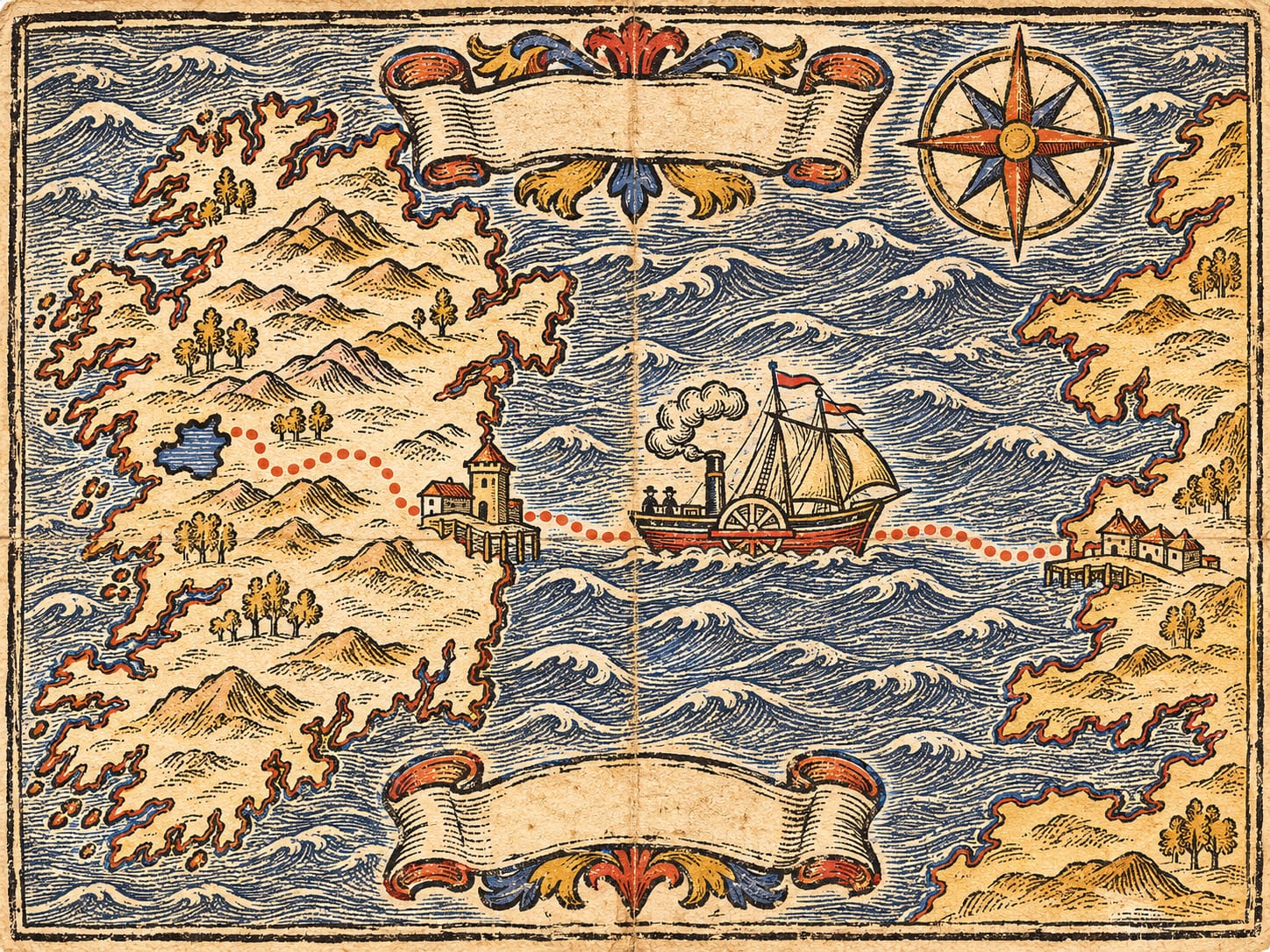
Boycott and his wife left Lough Mask on 27 November 1880 and went to the Hammam Hotel in Dublin. After death threats, he travelled to London on 1 December 1880. He visited the United States from March to May 1881.
He returned to Lough Mask on 19 September 1881 and stayed on as Lord Erne's agent until February 1886. He then became land agent for Sir Hugh Adair's Flixton estate in Suffolk, England.
Boycott died at Flixton on 19 June 1897, aged sixty-five, after several years of ill health. He was buried at Burgh St Peter, Norfolk, the village where he was born.
What survives
Lough Mask House still stands beside Lough Mask Castle, a substantial house the University of Galway dates to the early 1840s. Bernard Daly bought Boycott's lease of the house and farm by the mid-1880s, and Daly's descendants continued to live there. It is a private home, not a museum.
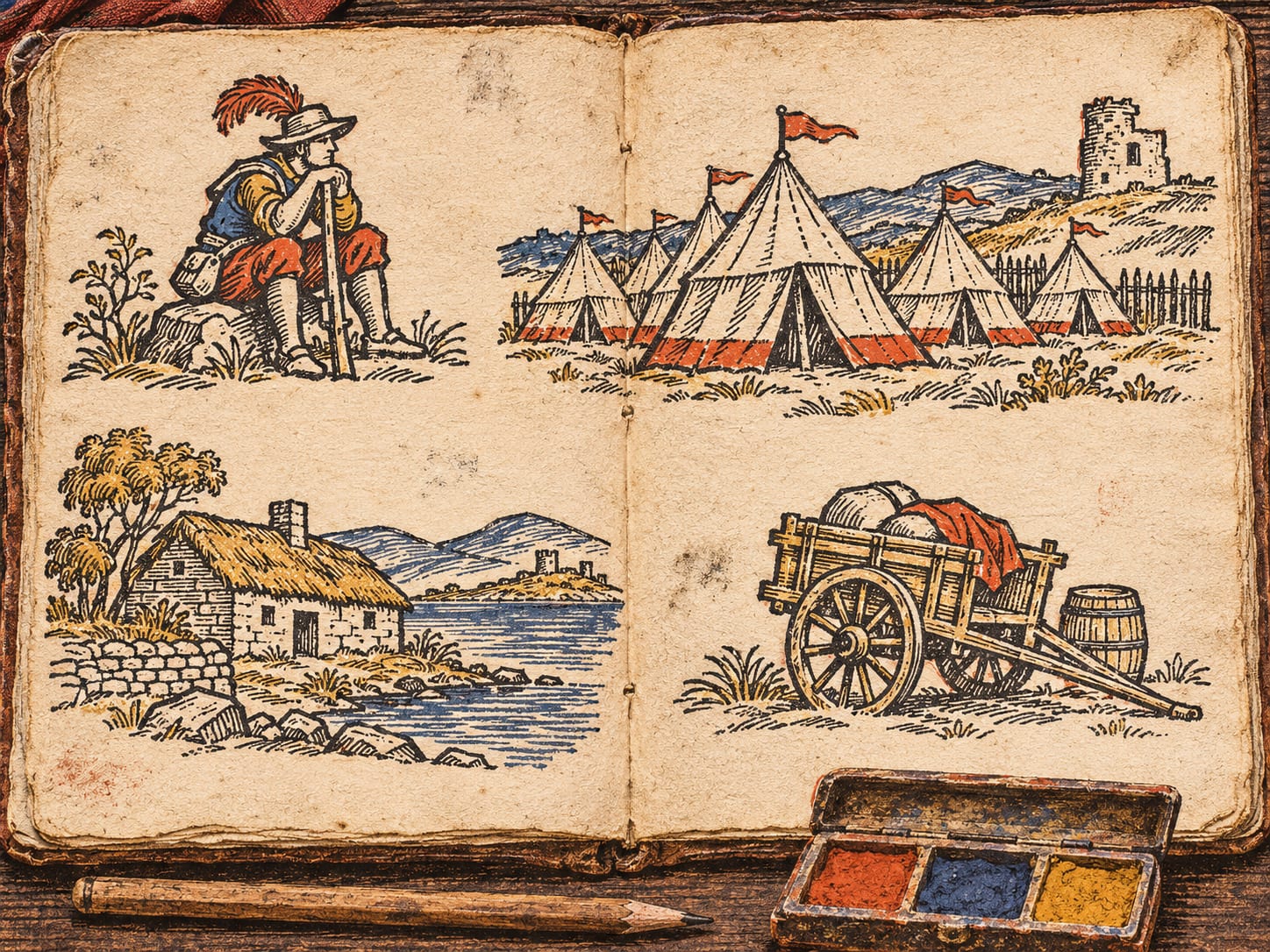
The National Library of Ireland holds drawings by the artist C. W. Cole made during the November 1880 expedition. They show Lough Mask House, the military camp, the Orange labourers and the route to Lough Mask, under titles such as "Capt. Boycott's house, Ballinrobe," "Notes at Boycotts," "On the way to Lough Mask" and "The crops in Breaking up." The Graphic printed "Captain Boycott and his Escort" and "Constabulary and line encampment in the grounds of Lough Mask House" on 20 November 1880, and "Come in & make yourself at home" and "Going to Ballinrobe market day" on 4 December 1880. The library owns the reproduction rights, and the originals sit in its Prints and Drawings collection.
At Burgh St Peter in Norfolk, St Mary's Church still stands, with its oldest parts from about 1200 and an unusual late eighteenth-century tower built by the Boycott rectors. Charles Cunningham Boycott's grave is in the churchyard beside the east window. The church is listed as open to visitors, and it is worth confirming access before travelling.
Boycott and the word
- 12 March 1832
Charles Boycott is born in Burgh St Peter, Norfolk
- 16 August 1879
The Land League of Mayo is founded
- October 1879
The Irish National Land League is founded
- 19 September 1880
Parnell speaks at Ennis about isolating a man who takes an evicted tenant's farm
- 22 September 1880
Boycott tries to serve eviction processes on eleven tenants and takes refuge at Lough Mask House
- 25 September 1880
The dinner at which Redpath and Father O'Malley are said to have settled on the word
- 12 October 1880
James Redpath uses the word in print in the Chicago Inter-Ocean
- 18 October 1880
The Times prints Boycott's letter
- 12 November 1880
The Boycott Relief Expedition is in place at Lough Mask
- 20 November 1880
The Times prints "Boycott" as a verb
- 27 November 1880
Boycott and his wife leave Lough Mask for Dublin
- 3 December 1880
A symbolic grave is dug outside William Bence-Jones's door in County Cork
- 18 October 1881
The Land League issues its No-Rent Manifesto
- 19 June 1897
Boycott dies at Flixton, Suffolk
Sources
- Dictionary of Irish Biography, Royal Irish Academy, entries on Charles Cunningham Boycott, Charles Stewart Parnell, John O'Malley, James Redpath and William Bence-Jones
- Landed Estates Database, University of Galway, entries on Boycott and on Lough Mask House
- The Land League, "History"
- Captain Boycott's letter to The Times, 18 October 1880, as reproduced in The Complete Shorter Works of James Connolly
- The Land League: A Narrative of Four Years of Irish Agitation, State Library of New South Wales copy, including James Redpath's account
- "The Lough Mask Expedition," Tipperary News
- National Library of Ireland catalogue records, including "Captain Boycott and his Escort" and "Constabulary and line encampment in the grounds of Lough Mask House"
- The Annual Register, 1880
- Hansard, House of Commons, 12 January 1881 and 3 March 1890
- Land Law (Ireland) Act 1881, Irish Statute Book; Irish National Land League, No-Rent Manifesto, 18 October 1881
- "Captain Boycott and the Lord Erne evictions of 1880," Tourmakeady local-history paper
- "As it was said," extracts from Parnellite speeches and writings, 1878 to 1886
- World English Historical Dictionary, entry "Boycott", reproducing early Oxford English Dictionary citations
- Académie française, entry "boycotter", and FundéuRAE on "boicot" and "boicoteo"
- Morton Benson, "English Loanwords in Russian," and Vasmer's Etymological Dictionary of the Russian Language
- The Keep Military Museum, article on Captain Boycott's story
- St Mary's Church, Burgh St Peter, A Church Near You listing
- El País, 28 September 2024, on the origin of the word boicot
Watch the full story on the Flashback Fables YouTube channel, and send it to someone who would love it.